Between 2019 and 2025, Singapore has undergone a marked transformation in its innovation posture, shifting from a high volume patent filing jurisdiction to a deliberately curated hub of strategic, high value IP.
A defining milestone in this evolution was the unveiling of the Singapore IP Strategy 2030 (SIPS 2030) by Intellectual Property Office of Singapore (IPOS), a government initiative that aims to cement Singapore’s status as a prominent global hub for intangible assets and IP.
The momentum has also been visible at the ecosystem level. During IP Week @ SG 2025, Singapore’s marquee IP gathering, over 5,000 delegates from 40+ countries convened under the theme “Ideas to Assets: Innovating in Times of Change”, underscoring the region’s growing commitment to turning ideas into protected, monetisable value.
Against this backdrop of policy overhaul, ecosystem engagement and global positioning, this report offers a comprehensive, data backed exploration of Singapore’s patent filing trends from 2019–2025.
How has the Patent Filing Trend in Singapore Changed Over the Years?
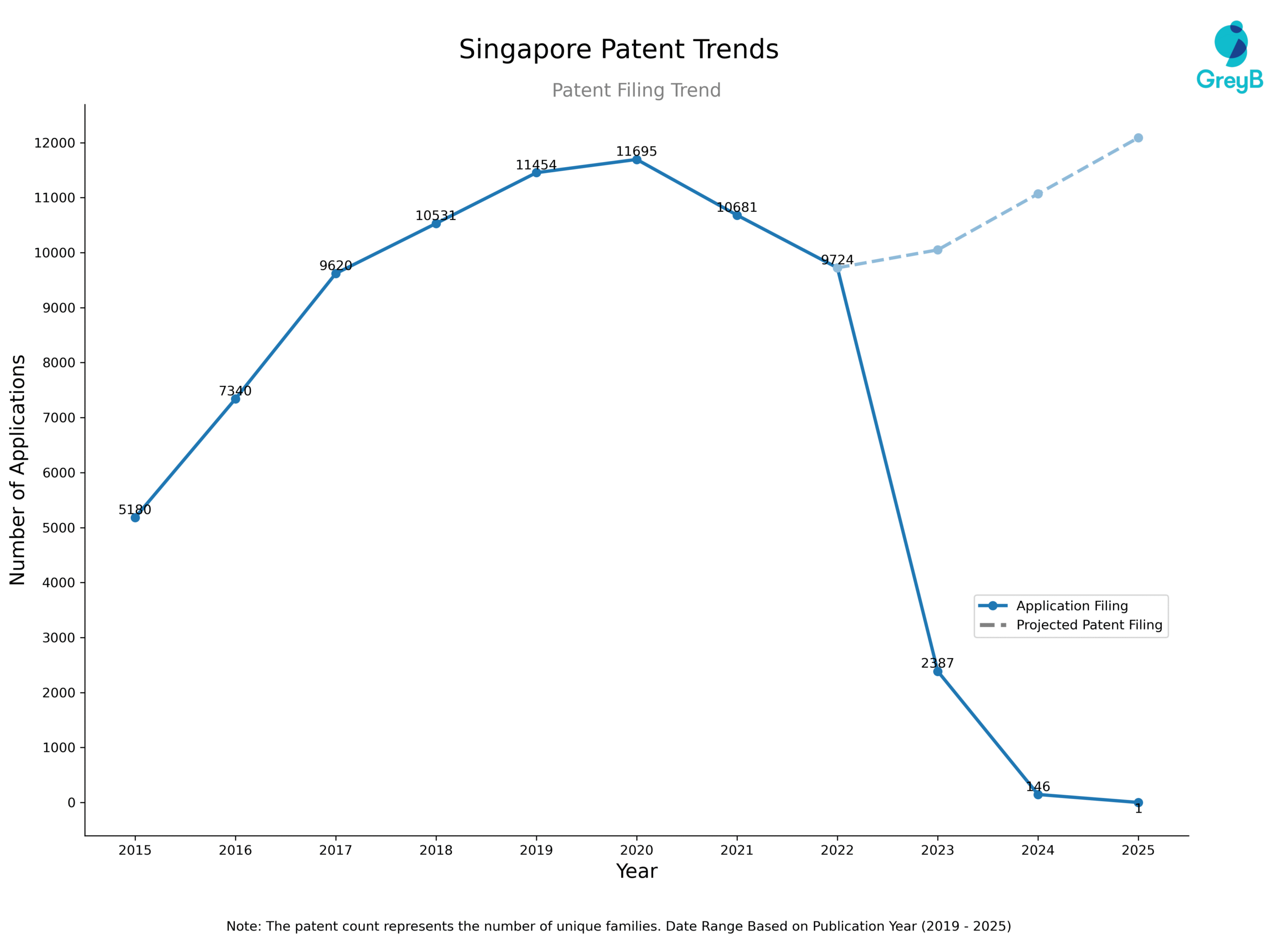
Singapore’s patent journey has two acts: the climb to 2019 and the subsequent descent. The early rise signalled its emergence as a regional IP filing hub. But from 2020 onwards, a shift took place, not a collapse of innovation but a recalibration.
Patent publication years, especially for recent filings (2023–2025), may reflect incomplete datasets due to the 18-month publication window. This means the apparent dip post-2022 might be partially due to publication delays and not a literal collapse in innovation.
Who Are the Top Companies in Singapore Patent Landscape?
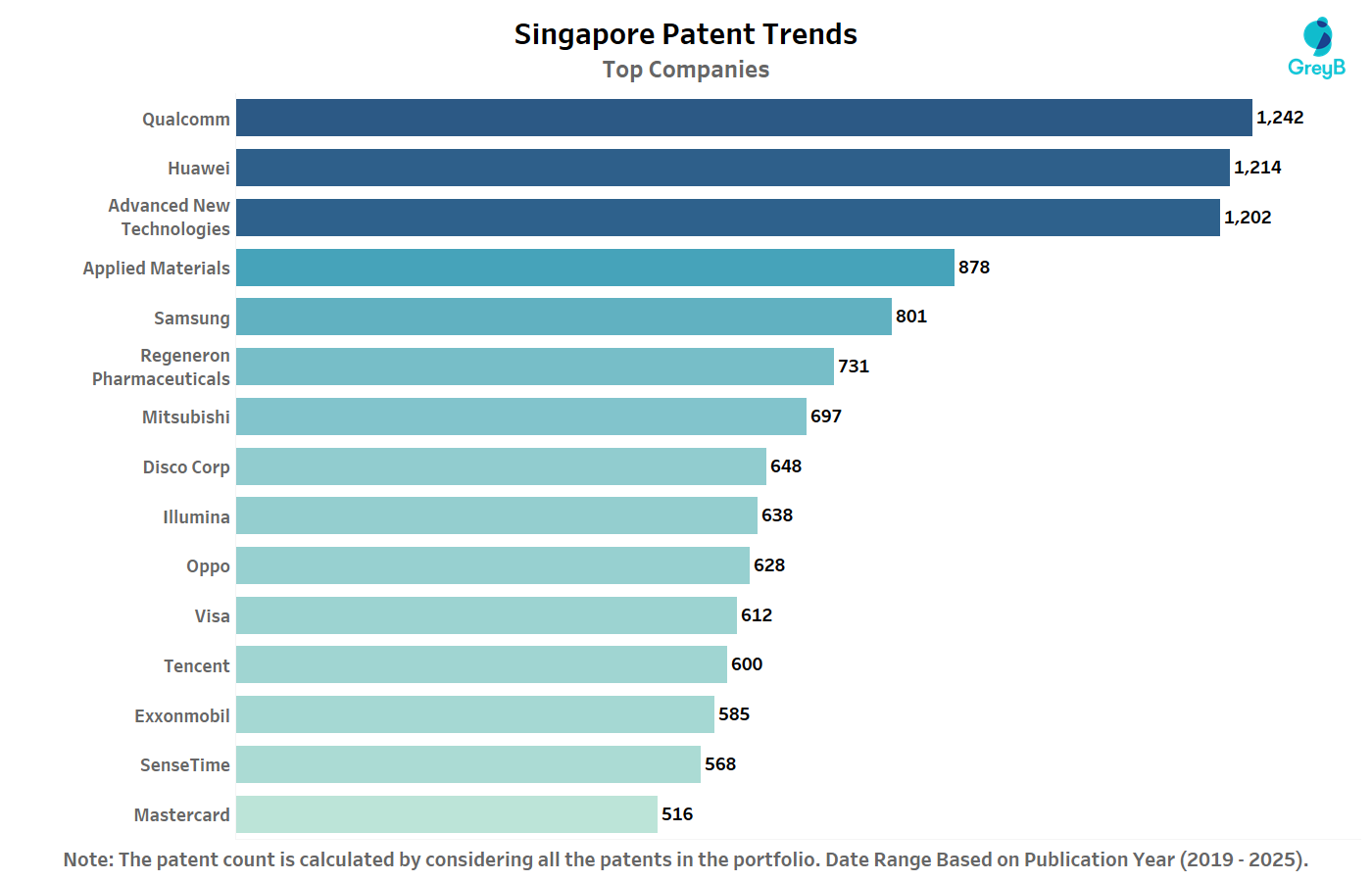
This ranking highlights how Singapore is being used as a strategic filing hub rather than a purely domestic innovation base. Most top filers including companies like Qualcomm, Huawei, Samsung, Mitsubishi, OPPO, Visa, Tencent, ExxonMobil and others are headquartered outside Singapore, indicating that global players rely on Singapore for broader Asia-Pacific coverage.
The filings span semiconductors, electronics, pharmaceuticals, and consumer tech, which shows strong participation from both US and Asian multinational firms. As Singapore continues strengthening its IP systems and regional connectivity, the quality, commercial value, and monetisation potential of filings made here is likely to rise further.
Who Are the Top Universities & Institutions in Singapore Patent Landscape?
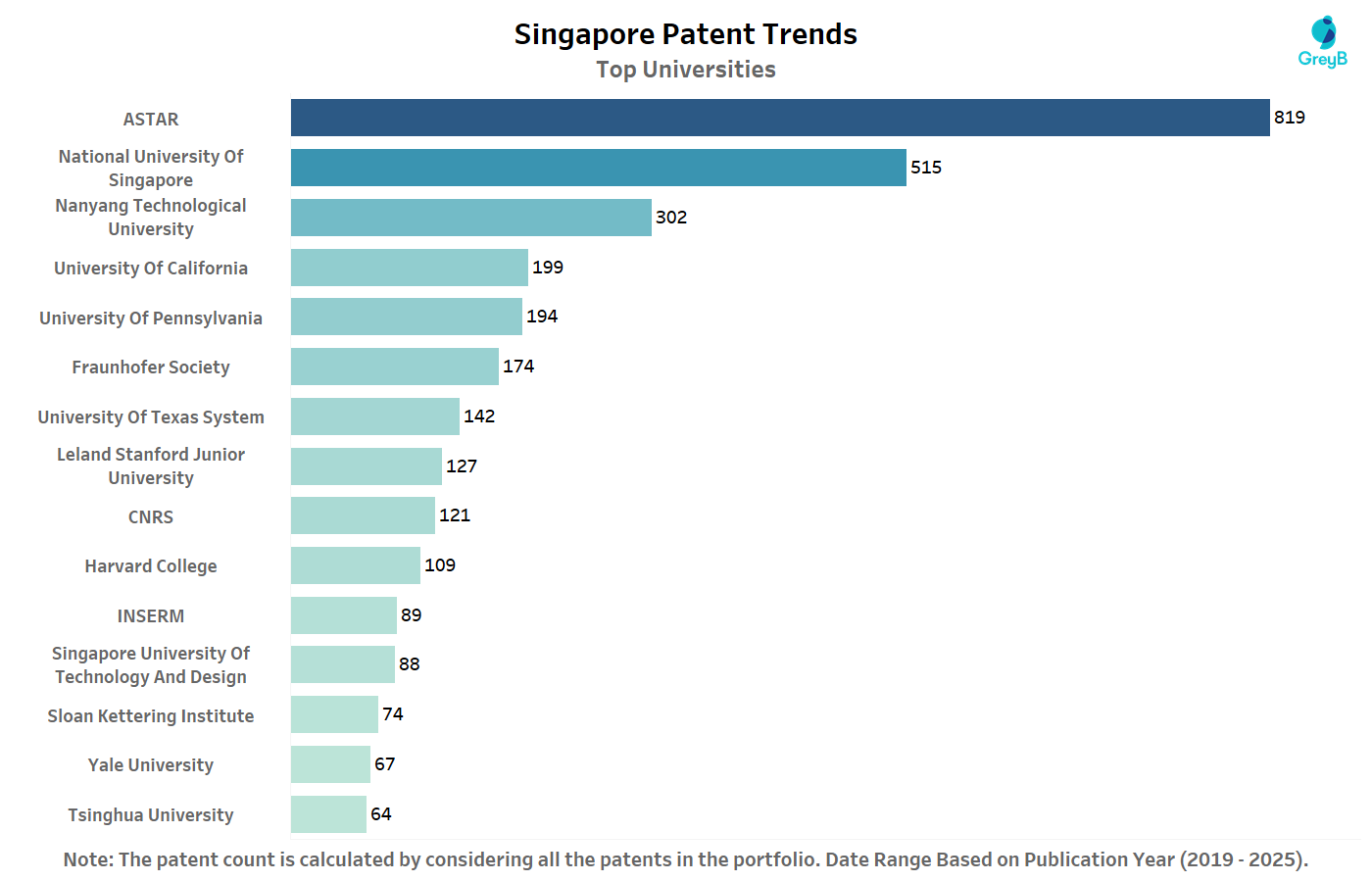
Singapore’s innovation backbone is further reinforced by academic IP. This chart spotlights the research institutions shaping Singapore’s R&D landscape, and it implies the local leadership, global collaboration and increasingly translational science.
Leading the chart is the Agency for Science, Technology and Research (ASTAR) with 819 patents. ASTAR’s partnerships with global players like Rolls-Royce and SAESL through its Smart Manufacturing Joint Lab Phase Two, launched in 2023, reflect its drive to anchor advanced manufacturing capabilities in Singapore’s industrial ecosystem.
Interestingly, global universities such as the University of California, University of Pennsylvania, Stanford and Harvard also appear in the top 15. Their filings are often part of broader APAC commercialization strategies, signaling that global academic IP portfolios increasingly include Singapore as a key node.
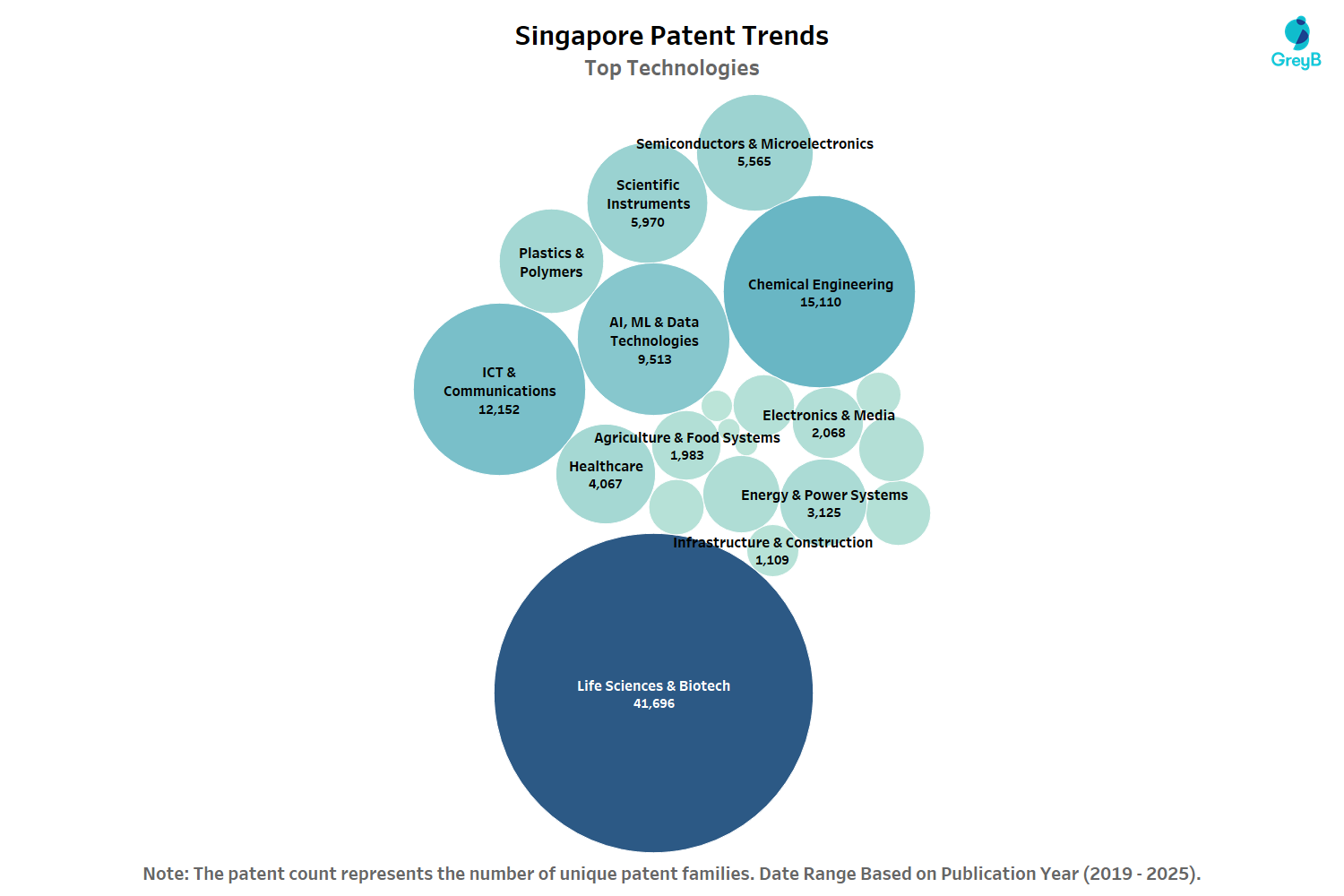
Which Key Technology Areas Dominate the Patent Landscape in Singapore?
Singapore’s patent landscape is telling a clear story: innovation gravitating toward life sciences and digital technology, not just in isolated pockets but in full stride.
Life Sciences claims the largest share of filings by far. This aligns with Singapore’s deliberate positioning as a biotech and med‑tech innovation hub. Global pharmaceutical player Eli Lilly and Company launched a S$42 million Digital Health Innovation Hub in Singapore in 2024 to develop wearable sensor tech and AI‑driven health platforms. This signals that life sciences patents here are not just domestic efforts, they form part of multinational R&D anchoring in Singapore.
How Singapore’s Consumers Are Shaping Patentable Innovation?
Ultra connected environment
In early 2025, Singapore had internet penetration of 95.8 % and mobile connections amounting to 179 % of its population.
Consumer tech innovations – in digital platforms, communication systems and imaging tools – are supported by a pervasive digital backbone.
Digital first shopping behaviour
Over 65 % of Singaporean shoppers used their smartphone in their latest purchase, according to a July 2025 review.
Innovations in digital tech – e‑commerce, mobile payment, data analytics – are directly targeted at a market where digital usage translates into real purchasing behaviour.
Rising health tech and home care adoption
A Singapore based start up, Speedoc, has been using AI and connected devices to deliver home based care, signalling consumer openness to non hospital health tech.
Patent filings in life sciences and remote health systems may map to growing consumer demand for healthcare at home and wearable/connected devices.
Sustainability as purchasing filter
A survey found 7 in 10 Singapore consumers believe sustainability is important, though only ~3 in 10 are actively contributing.
Innovations in chemical manufacturing, eco materials and sustainable processes matter not just to industry, but to end users choosing products with green credentials.
Premium, experience led and localisation driven retailing
Singapore is increasingly used by luxury brands as a testbed for immersive retail experiences and regional launches.
Patent activity in imaging systems, navigation/transportation systems or digital services may tie into physical plus digital experiences that Singapore consumers value.
Cautious spending, yet demand for value and novelty
The UOB Group ASEAN Consumer Sentiment Study Consumer Sentiment Study (Singapore Edition, 2025) shows the majority of consumers are prudent in spending, even as digital and lifestyle demands evolve.
While innovation is welcome, patents and licensing strategies should recognise that consumers will pay for clear value differentiation or convenience — not just technology for technology’s sake.
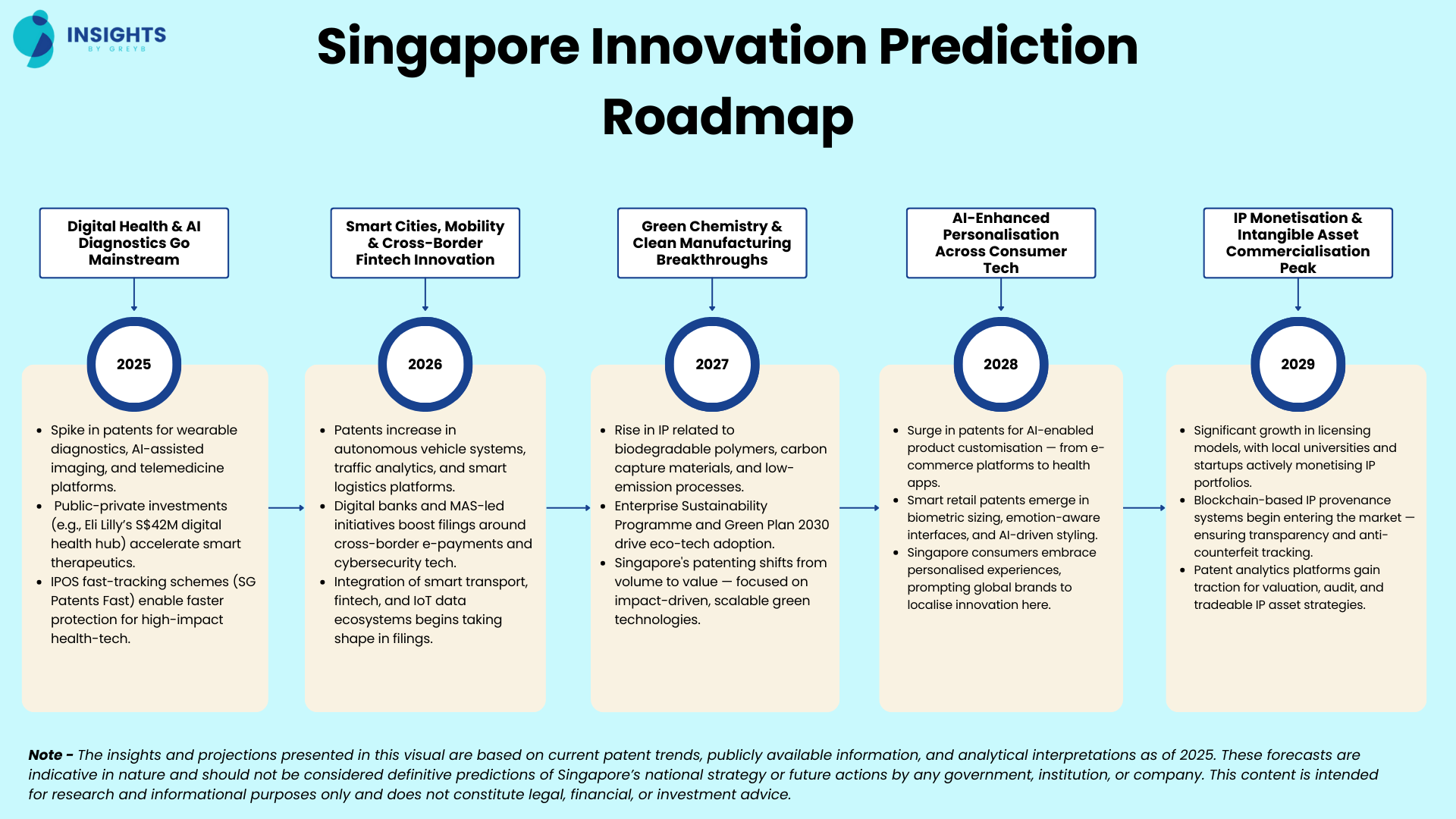
Singapore Innovation Prediction Roadmap
What is in the report?
Top Domestic & Foreign Companies Shaping Innovation in Singapore
Evolution of Patent Filing Activity of Top Companies in Singapore
Key Inventors Filing Patents in Singapore
Evolution of Patent Filing Activity of Top Inventors in Singapore
Top Research Centers for Singapore Patents
Fill the form to get the details:
Fill the form to get the details:
Our comprehensive report provides an in-depth look into the patent portfolio. The report includes a breakdown of the patent portfolio across various technologies, listing the patent along with brief summaries of each patent's technology.