Exploring the Next Steps in Wi-Fi Technology
While Wi-Fi 6 has brought us faster speeds, better efficiency, and enhanced performance, it’s not without its limitations. As we look to the future, we realize that we need even more robust Wi-Fi to support the next generation of technologies. In this blog, we’ll uncover the challenges of Wi-Fi 6 and see how the latest advancements in Wi-Fi 7 are stepping up to meet these needs. Whether you’re a tech enthusiast or just want a more reliable internet connection, join us as we explore how to stay ahead in the evolving world of wireless technology.
Curious how WiFi 7 is set to transform the wireless world? While WiFi 6 laid the groundwork, WiFi 7 is pushing the limits of innovation. Discover the patent trends and key technology areas that are shaping the next generation of connectivity in our in-depth analysis of WiFi 7!
Next steps in Wi-Fi Technology

In the future, we’ll face big challenges like handling the growth of smart devices (IoT), dealing with crowded airwaves, fixing security issues, and smoothly connecting with new technologies like 5G and 6G. It’s important to understand these challenges to keep our wireless networks running smoothly and ready for the future.
| Challenges in WiFi 6 | Challenge | Implication |
| Crowded Spaces, Big Headaches | Setting up Wi-Fi 6 in crowded places is tricky. You need to carefully plan channels and manage interference. | If you don’t plan perfectly, interference can mess up the network, making your Wi-Fi 6 less awesome. |
| Pricey Upgrades and Compatibility Drama | Not all gadgets play nice with Wi-Fi 6, causing compatibility headaches. | Upgrading can be pricey and compatibility issues can slow things down, leaving many stuck on outdated, slower Wi-Fi. |
| Battery Drainer | Even though it’s better at data transmission, Wi-Fi 6 can still be a power hog, especially with many devices connected. | High power use drains batteries faster, which is bad news for gadgets that need to last all day. |
| IoT Overload | The explosion of IoT devices means Wi-Fi 6 needs to handle a ton of connections smoothly. | Making sure Wi-Fi 6 can keep up with all these devices without slowing down is crucial, especially to avoid lag and congestion. |
| Security Woes | More devices mean more potential security risks, despite new security features in Wi-Fi 6. | Keeping up with security updates is vital to protect against the latest cyber threats and keep your network safe. |
| Tech Integration Challenges | Wi-Fi 6 needs to seamlessly work with new tech like 5G and edge computing. | Ensuring everything works together smoothly is key to building robust, future-proof networks, requiring industry-wide collaboration. |
Wi-Fi 7’s Solutions to Wi-Fi 6 Challenges
As Wi-Fi 6 handles today’s connectivity needs, Wi-Fi 7 is stepping up as the next big thing in wireless technology. It’s designed to fix the issues we see with Wi-Fi 6 and meet the needs of future applications. With super-fast speeds, improved efficiency, and ultra-low lag, Wi-Fi 7 is set to fix the issues of the past and power the future of connectivity.
Multi-Link Operation (MLO) in Action
Imagine you’re in a bustling hospital, where seamless and reliable connectivity is crucial for saving lives. A smart healthcare system here uses various IoT devices for real-time patient monitoring, diagnostics, and emergency response. Now, let’s see how Wi-Fi 7’s Multi-Link Operation (MLO) comes into play.
Smart Healthcare System
In this hospital, wearable health sensors continuously monitor patients’ vital signs like heart rate and blood pressure. These sensors need to transmit data to doctors and nurses in real-time, ensuring quick response to any critical changes.
Wi-Fi 7 with MLO: MLO allows these sensors to use multiple frequency bands—2.4 GHz, 5 GHz, and 6 GHz—simultaneously. This means if one band gets crowded, the data can automatically switch to another band without any delay. This ensures continuous and reliable data transmission, which is vital for real-time health monitoring.
How MLO Enhances Performance:
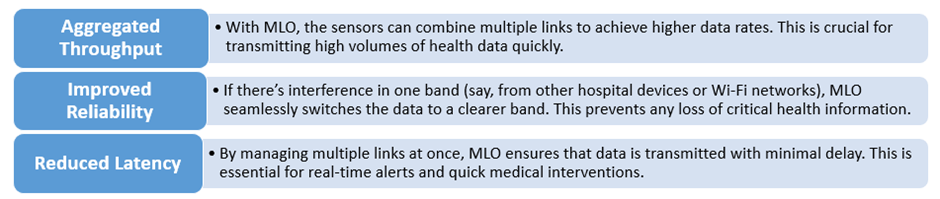
Wi-Fi 6 Limitations: Wi-Fi 6 introduced some improvements, but it still relies on single-band operation. This means if there’s interference or congestion in that band, it can lead to delays or dropped connections. MLO in Wi-Fi 7 overcomes this by dynamically switching between multiple bands, ensuring smoother and more reliable connectivity.
In summary, MLO in Wi-Fi 7 transforms how data is transmitted in critical environments like hospitals, ensuring continuous, reliable, and fast connectivity that can make a difference between life and death.
Scalability with IoT Expansion in Wi-Fi 7
As our world becomes more connected, the number of IoT devices is skyrocketing. From smart homes to industrial automation, we need networks that can handle this explosion of devices without compromising performance. This is where Wi-Fi 7’s scalability shines.
Smart Manufacturing
Picture a smart factory where hundreds of machines and sensors communicate with each other to streamline production. These devices need a network that can handle high data traffic efficiently and reliably.
Wi-Fi 7 Scalability: Wi-Fi 7 supports wider channel bandwidths (up to 320 MHz) and higher modulation schemes (4K QAM), significantly increasing the network’s capacity to handle more devices and higher data rates.
How Scalability Enhances Performance:
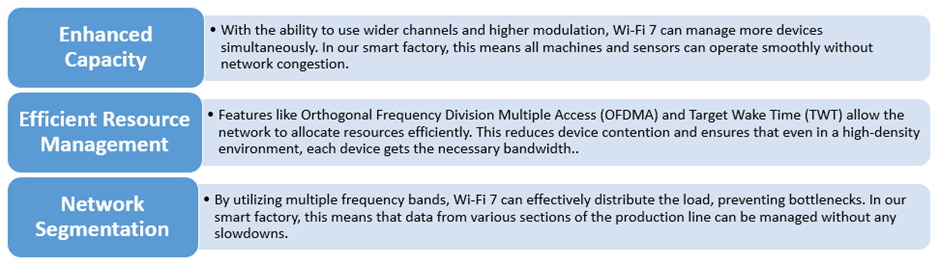
Wi-Fi 6 Limitations: While Wi-Fi 6 introduced features like OFDMA, it still faces challenges in extremely high-density environments. Wi-Fi 7 builds on these improvements by offering even greater capacity and more efficient resource management, ensuring that the network remains robust even as the number of connected devices continues to grow.
Gaming Security in Wi-Fi 7: A New Level of Protection
Picture this: you’re diving into an immersive metaverse gaming experience, where the line between the virtual and real worlds blurs. Here, players from all over the globe interact in a fully realized digital universe. In this high-stakes environment, security isn’t just a feature—it’s a necessity. That’s where Wi-Fi 7’s advanced security features come into play.
The Future of Metaverse Gaming
In the metaverse, players wear advanced VR headsets with motion sensors and haptic feedback devices, creating a fully immersive experience. These devices need to transfer a lot of data in real-time for smooth gameplay. However, this also means there’s a risk of cyber-attacks and data breaches.
Enhanced Encryption and Security Protocols
Wi-Fi 7 comes with stronger encryption and better security protocols. This ensures that all the data sent between your VR headset and the gaming servers is highly secure, making it extremely difficult for hackers to access or alter your information.
How Wi-Fi 7 Keeps You Safe
Imagine you’re in the middle of an epic boss battle in a futuristic cityscape. With Wi-Fi 7’s robust security features, you don’t have to worry about hackers stealing your personal information or game data. The network automatically identifies and blocks suspicious activities, keeping your gaming experience smooth and secure.
Final Showdown
Wi-Fi 7’s advanced features, like Multi-Link Operation (MLO) and enhanced scalability, bring big improvements over older standards, making networks better at handling the growing number of IoT devices and the need for faster, more reliable connections. In your smart home, it means your thermostat, security cameras, and even Alexa can chat away without dropping a beat. In smart cities, MLO helps traffic cameras and emergency services stay connected, keeping things running smoothly. Retail stores can keep track of inventory in real-time and give customers a slick experience with smart fitting rooms. And in schools, smartboards and tablets can work together without a hitch, keeping the learning flowing. Wi-Fi 7’s advanced security measures ensure that your adventures remain private and protected. Whether you’re exploring new worlds or competing in high-stakes tournaments, Wi-Fi 7 makes sure your experience is safe from start to finish.
GreyB’s is about to launch a full SEP report in Wi-Fi 7 that can give a competitive edge to these personas.
Need to know anything else? We’ve got you covered!