
Remember when Photoshop was the “scary tech” because someone could swap your head onto Brad Pitt’s body? That was child’s play compared to today’s AI-generated deepfakes.
Now, we’ve got synthetic media so realistic your grandma could FaceTime with a scammer and wire him her retirement money.
The race is on: AI that fakes it vs. AI that spots the fakes. Let’s talk about the second group-the deepfake detectors.
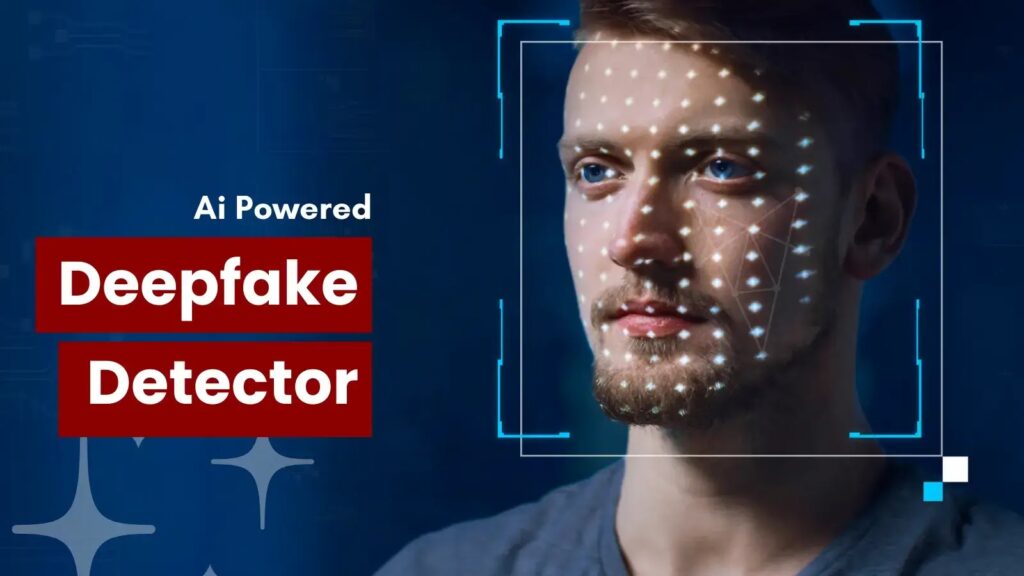
What is a Deepfake Detector?
A deepfake detector is a software or AI system designed to determine whether digital media is authentic or artificially generated. Detectors analyze content at multiple levels:
1. Visual clues (e.g., lighting, face boundaries, eye movements)
2. Audio inconsistencies (lip-sync mismatches, robotic voice patterns)
3. Biological signals (heartbeat/pulse from facial videos – still an emerging and fragile method)
4. Model-based classifiers (machine learning trained on real vs. fake data)
5. Metadata checks (file origin, compression signatures)
These methods are often combined in ensembles, improving reliability across different manipulation techniques.
How It Works
Deepfake detection begins with the ingestion of media – whether photo, video, or audio – which is then preprocessed to reduce noise, extract frames, or isolate voice tracks. The system next identifies key features such as facial movements, vocal tones, lip-sync alignment, and metadata signatures.
These signals are analyzed using advanced AI models including CNNs, CLIP-based architectures, and ensemble classifiers that have been hardened through adversarial training. The outputs from these models are aggregated through a decision layer, where results are compared, weighted, and scored. Finally, the system delivers a clear verdict, flagging the media as authentic or artificially generated, while continuously adapting to the evolving sophistication of deepfake techniques.
Patents behind the Technology
| Patent Number | Company / Institution | Problem | Patented Innovative Solution | Impact of the Patents |
| US20240312249A1 | McAfee | Accuracy Limits Of Single-Model Systems | Multi-Model Ensemble Using Binary, Filter & Image Quality Models | Reduces False Positives And Improves Decision Confidence Across Diverse Media Types |
| WO2025122163A1 | Lack Of Model Traceability | Embedding-Based AI Comparison Across Generative Categories | Enables Origin Tracing Of Manipulated Content And Strengthens Explain ability For AI Audit Trails | |
| IN202411085341A | Ajay Kumar Garg Eng. College | Difficulty Detecting Video Audio Deepfakes | CNN + RNN Hybrid Analyzing Facial Cues, Speech, And Metadata | Provides Real-Time Detection And Integrates With Social Platforms For Immediate Content Filtering |
| US11727721B2 | JPMorgan | Generalized Media Manipulation Risk | Scoring Analyzer Integrating Multiple Detection Outputs | Offers Scalable, Probabilistic Detection Suitable For Finance, Media, And Regulatory Enforcement |
Each of these patents demonstrates layered AI approaches, integrating different classifiers and quality checks to improve robustness.
Curious About How the Latest Patents Are Tackling Deepfake Detection Challenges? Get your hands on a complete list of these innovative patents, the problems they target, and the solutions they offer.
Deepfake in Real Life: Maryland Deepfake Audio Smear (2025)
In spring 2025, a high school athletic director in Maryland created and circulated an AI-generated audio clip that falsely portrayed the school principal making racist and anti-Semitic remarks. The fabricated clip spread rapidly through social media and local networks, sparking outrage, protests, and threats directed at the principal.
Detection & Outcome: Investigators and forensic experts analyzed the recording and determined it was synthetic, exposing it as a deepfake. The athletic director ultimately entered an Alford plea – acknowledging the strength of the evidence without admitting guilt – and was sentenced to four months in jail.
Where It’s Being Used
Today, deepfake detectors are being tested or deployed in:
1. Social media platforms (e.g., Meta, TikTok) for content moderation
2. Banking and financial institutions for KYC and fraud detection
3. Newsrooms and fact-checking platforms
4. Government and defense agencies for national security verification
Regulation & Industry Standards
Organizations like NIST in the U.S. are working on standards for media authenticity, while the EU AI Act includes transparency clauses that will require labeling of synthetic content.
Startups and large tech firms alike are now developing APIs and real-time SDKs for deepfake detection integration.
Performance Benchmarks & Detection Accuracy
Deepfake detectors are tested against datasets like FaceForensics++ and DFDC. Leading models such as Xception and CLIP-based ensembles report accuracies of 89–94% in controlled environments.
Importantly, improvements in handling short, low-res videos are reducing false positives essential step for real-world deployment.
Conclusion
Deepfakes are no longer just clever internet tricks-they’re a global trust crisis. From fraud to political sabotage, the stakes are immense. But innovation is catching up.
Patents from Google, McAfee, JPMorgan, and others showcase robust, multi-model detection systems designed to outsmart even the most sophisticated fakes. As tools mature, deepfake detection will become as indispensable as antivirus software or email spam filters.
In this battle for truth, deepfake detectors are our digital frontline.
Stay Ahead of the Curve in Deepfake Detection Technology. Discover the Latest Trends and Tools in Identifying Deepfakes Today. Want to know more? Then Fill out the form