
In July 2025, JPMorgan’s blockchain wing, Kinexys, quietly unleashed a pilot that could rewire carbon markets. In partnership with S&P Global, they began minting carbon credits as digital tokens, credits that can be traded, traced and retired on blockchain rails.
This move sent ripples through climate-tech and finance circles alike. For years, carbon credits have lived as registry entries, spreadsheets and certificates: intangible promises with unverifiable trails.
Today, we see those promises transforming into discrete digital assets. A farmer in Brazil or a wind farm in Spain could now have each ton of avoided carbon wrapped in a token or NFT, with metadata tracing its origin, verification status and ownership history, all visible at a glance.
Take ecoBridge’s NFT Impact Certificate on the Solana network. It retired carbon credits completely on-chain, cross‑chain verified via the Regen Network, a real example where the technology is not theory, but action. Or consider MintCarbon, which lets projects mint carbon credit NFTs on Polygon, thus combining ecological purpose with Web3 mechanics.
These innovations are more than buzz. They represent a structural pivot: from opaque markets to programmable trust, from fractured registries to unified digital ledger systems, from slow audits to near‑instant verification.
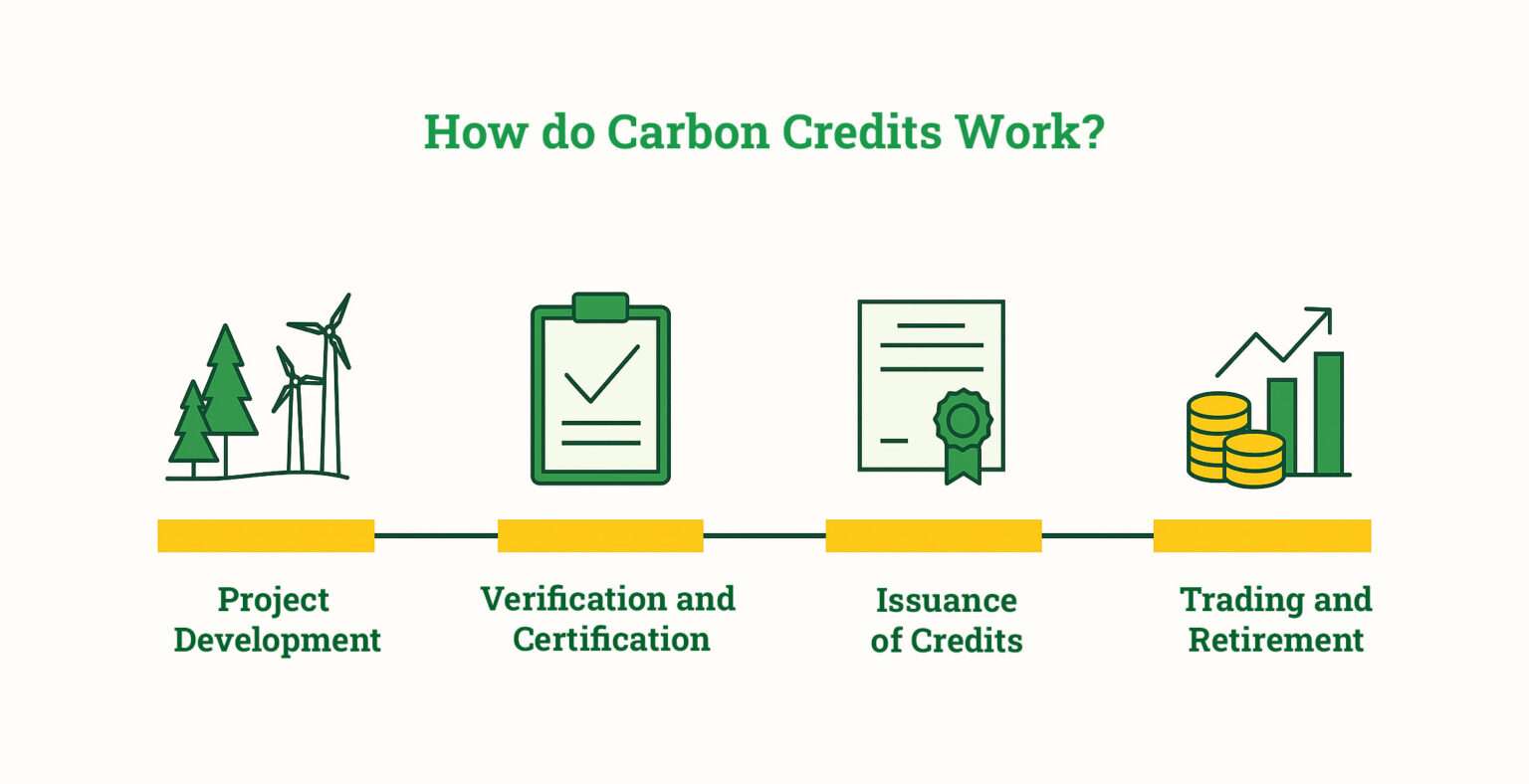
In this article, we’ll trace the key patents shaping this frontier. Whether you’re navigating this space as an IP strategist, an R&D decision-maker or a tech-forward sustainability leader, this is a window into how innovation, trust and climate impact will soon be traded.
Check out Carbon Credit Trading patents filed in 2025:
Recent Patents behind Carbon Credit NFTs
| Patent Number | Publication Year | Patent Holder | Token Type | Problem Addressed | Proposed Solution |
| JP2025090920A | 2025 | Nomura Research Institute | Credit reservation tokens & credit tokens | Delayed monetization for small-scale forest projects (1-year certification delay) | Immediate liquidity through reservation tokens issued before certification, convertible to actual credits once authenticated |
| JP2025090921A | 2025 | Nomura Research Institute | Credit tokens, credit reservation tokens & aggregated tokens | Bilateral trading inefficiencies, lengthy certification, profit distribution difficulties | Token aggregation and pooling with transparent revenue distribution mechanisms |
| IN202541026795A | 2025 | Saveetha Institute | Blockchain-based credits | Lack of transparency and standardization in biomedical industry | Sector-specific decentralized marketplace with validation tools and real-time analytics |
| IN202511017157A | 2025 | GL Bajaj Institute | Tokenized green credits | Administrative delays, high costs, fraud susceptibility, manual verification | Comprehensive blockchain system with environmental sensors and automated compliance |
| US2024119464A1 | 2024 | ZeroSix, Llc | Hybrid tokens (fungible & non-fungible aspects) | Lack of transparency and audibility in carbon credit markets | “Proof of Protocol” and “Proof of Permanence” mechanisms with blockchain-anchored records and IoT monitoring |
| US2024249355A1 | 2024 | Carbon2o2 Llc | NFTs (ERC-721 protocol) | Market accessibility and fraud prevention | Three-step verification process with AI analysis and sensor integration for real-time monitoring |
| KR20240032756A | 2024 | Winkle Co, Ltd | Credit NFTs & mini credit NFTs | Limited participation by small-scale entities in carbon markets | Blockchain marketplace with incentive mechanisms and time-limited NFTs to prevent speculation |
| US2024320690A1 | 2024 | California Bountiful Foundation | Cryptographic tokens on blockchain | Agricultural carbon sequestration not recognized as tradable asset | Quantification methodology with permanency through biochar/lumber conversion |
| IN202411015568A | 2024 | Chandigarh University | Carbon credits with distinct identifiers | Lack of transparency, complex tracking, double counting risks | Autonomous blockchain system with AI-based smart contracts and public registry |
| KR20230133674A | 2023 | K-Power Energy Co, Ltd | Real asset carbon credit NFTs | Information imbalances and inefficient carbon credit management | Direct credit trading with edge computing and automated accumulation on blockchain |
Get the list of Cabon Credit Trading patents. Discover the problems they solve and the solutions they offer. Fill out the form to access it now!
While these patents represent significant advancements in the tokenization of carbon credits, there are still hurdles that need to be addressed before these technologies can achieve widespread adoption. From regulatory fragmentation to data integrity issues, let’s explore the key challenges that are still being researched and worked on in this space.
Key Challenges and Ongoing Research in Carbon Credit Tokenization
While tokenizing carbon credits with NFTs brings faster trading and increased transparency, several hurdles still stand in the way of widespread adoption. These challenges aren’t just technical, they’re governance, regulatory, and scalability issues that the industry is actively working to solve. The patents and research driving this innovation underscore these gaps, but they also highlight the opportunities for forward-thinking companies to lead the way. Here’s a breakdown of the key challenges we’re facing:
- Data Accuracy & On-Chain Verifiability
Tokenized carbon credits rely on IoT devices and edge nodes to provide emissions and sequestration data directly to blockchains. However, ensuring that this data is consistently calibrated, tamper-proof, and universally accepted remains an unresolved challenge. Additionally, while location-indexed tokens improve traceability, the need for standardized spatial schemas across carbon registries still persists. Progress here could significantly enhance the reliability of carbon credit tracking. - Double-Counting & Provenance Control
Preventing double-counting of carbon credits across blockchains is critical. While unique asset identifiers (like CUSIP-style IDs) and registry services are in play, there’s no universal standard for token identifiers or a global consensus on cross-platform synchronization. Likewise, while blockchain records transaction history, guaranteeing that each carbon credit is retired once even when interacting across multiple chains is still being refined. This is a critical area where collaboration is needed to ensure integrity in the marketplace. - Regulatory Compliance, KYC & Auditability
Blockchain solutions are beginning to incorporate multi-signature smart contracts that could streamline legal and compliance workflows. But creating scalable governance models that can be adapted across jurisdictions is still a work in progress. Additionally, the identity-linked wallets designed to enhance AML/KYC compliance raise concerns over privacy, with varying levels of regulatory acceptance around the globe. This tension between privacy and transparency remains a key point of discussion. - Interoperability Between Blockchains & Traditional Markets
For carbon tokens to flow freely, blockchain interoperability is essential. Bridging permissioned and public chains allows for the seamless transfer of tokens while maintaining custody controls. But challenges around security, latency, and standardized API specifications persist. Developing these cross-chain solutions will be crucial for enabling wider market integration between traditional carbon markets and blockchain ecosystems. - Market Liquidity, Price Stability & Fractionalization
To make carbon credits more liquid and accessible, there’s a growing interest in fractional NFTs, allowing micro-units of carbon credits to be traded. While this could democratize the market, standards for fractional ownership and retirement accounting are still being developed. Furthermore, challenges in maintaining price stability and avoiding volatility remain, particularly when pegging token prices to fiat currencies.
While the challenges in tokenizing carbon credits are significant, they also present a unique opportunity for those in IP, R&D and sustainability sectors to shape the future of climate finance. As ongoing research and patents continue to address these hurdles, the potential for blockchain and NFTs to revolutionize carbon markets remains enormous. Let’s now look ahead at the strategic implications for IP professionals, R&D leaders and innovators who are ready to drive this change.
Strategic Opportunities in Carbon Credit Tokenization
| Current Challenges | Opportunities | Actionable Insights |
| Data Accuracy & On-Chain Verifiability | Building trust through verifiable data | Focus on securing patents related to sensor calibration, IoT data integrity, and blockchain verification protocols. |
| Double-Counting & Provenance Control | Ensuring unique, verifiable carbon credits | Work on cross-chain synchronization and unique asset identifiers for global token standards. |
| Regulatory Compliance & KYC | Scalable legal frameworks for tokenized markets | Track emerging regulations, engage in standardization efforts, and design compliant ecosystems across jurisdictions. |
| Interoperability Between Blockchains & Traditional Markets | Seamless integration of traditional and blockchain markets | Develop cross-platform solutions that bridge the gap between permissioned and public blockchains. |
| Market Liquidity, Price Stability & Fractionalization | Wider market participation with fractional ownership | Innovate with fractional NFTs and explore algorithmic price stability mechanisms for more accessible and stable markets. |
As we look ahead, the tokenization of carbon credits and the rise of NFTs are set to redefine the landscape of sustainability finance. These innovations present a powerful opportunity to create more transparent, efficient, and scalable systems for tracking and trading carbon offsets but they also come with challenges that must be addressed in order to unlock their full potential.
The road ahead is rich with possibilities. Blockchain and NFTs can provide solutions to long-standing issues in carbon markets, including data integrity, market liquidity, and price stability. As these technologies mature, they have the potential to democratize access to carbon trading, allowing smaller players to participate in a market that was once reserved for large corporations.
As the landscape evolves, there’s a tremendous opportunity for innovation to drive change. The solutions that emerge will not only shape the future of carbon credit markets but also have a significant impact on the broader global transition to sustainability. By addressing the challenges and embracing the opportunities presented by tokenization, the potential for more inclusive, efficient, and trustworthy environmental finance systems is well within reach.
The future of carbon markets is being shaped today. For those ready to lead, the path is clear: leverage the innovations at the intersection of blockchain and NFTs, collaborate across industries, and build the technologies and frameworks that will define the next generation of sustainable finance.
Interested in a deeper Carbon Credit Trading patent analysis?
Request a tailored report or claim-to-product mapping to explore competitor strategies.