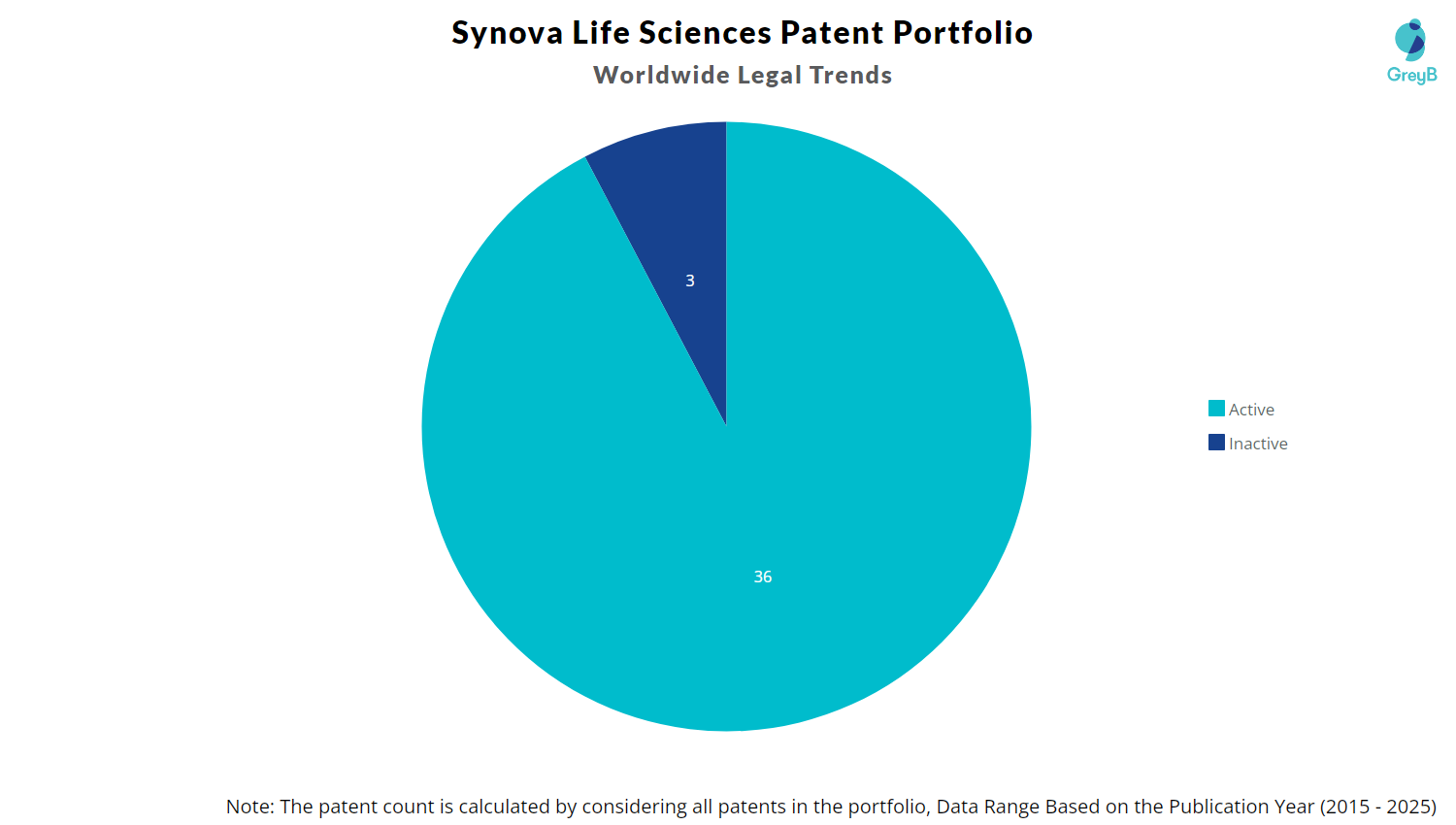
Synova Life Sciences has a total of 39 patents globally, out of which 29 have been granted. Of these 39 patents, 92% patents are active. The United States of America is where Synova Life Sciences has filed the maximum number of patents. Parallelly, United States of America seems to be the main focused R&D centre and also is the origin country of Synova Life Sciences.
Synova Life Sciences was founded in 2013. The company makes a device that collects and processes a person’s own fat tissue to extract stem cells. These stem cells keep their natural healing properties and can be used by doctors to treat injuries, degenerative diseases, and support tissue repair.
Do read about some of the most popular patents of Synova Life Sciences which have been covered by us in this article and also you can find Synova Life Sciences patents information, the worldwide patent filing activity and its patent filing trend over the years, and many other stats over Synova Life Sciences patent portfolio.
How many patents does Synova Life Sciences have?
Synova Life Sciences has a total of 39 patents globally. These patents belong to 2 unique patent families. Out of 39 patents, 36 patents are active.
How Many Patents did Synova Life Sciences File Every Year?
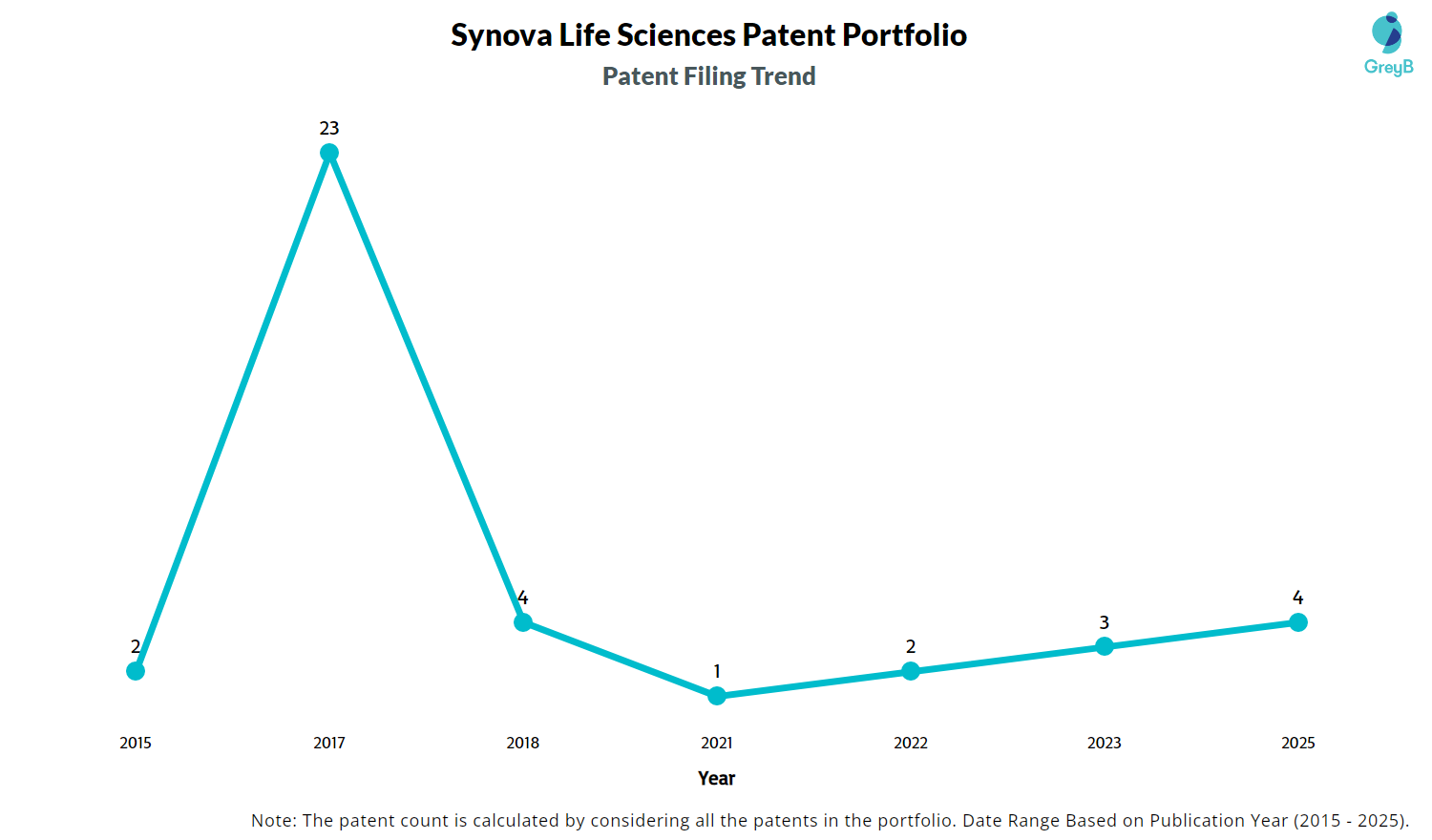
Are you wondering why there is a drop in patent filing for the last two years? It is because a patent application can take up to 18 months to get published. Certainly, it doesn’t suggest a decrease in the patent filing.
| Year of Patents Filing or Grant | Synova Life Sciences Applications Filed | Synova Life Sciences Patents Granted |
| 2025 | 4 | 5 |
| 2024 | – | 5 |
| 2023 | 3 | 4 |
| 2022 | 2 | 5 |
| 2021 | 1 | 8 |
| 2019 | – | 2 |
| 2018 | 4 | – |
| 2017 | 23 | – |
| 2015 | 2 | – |
How many Synova Life Sciences patents are Alive/Dead?
Worldwide Patents
How Many Patents did Synova Life Sciences File in Different Countries?
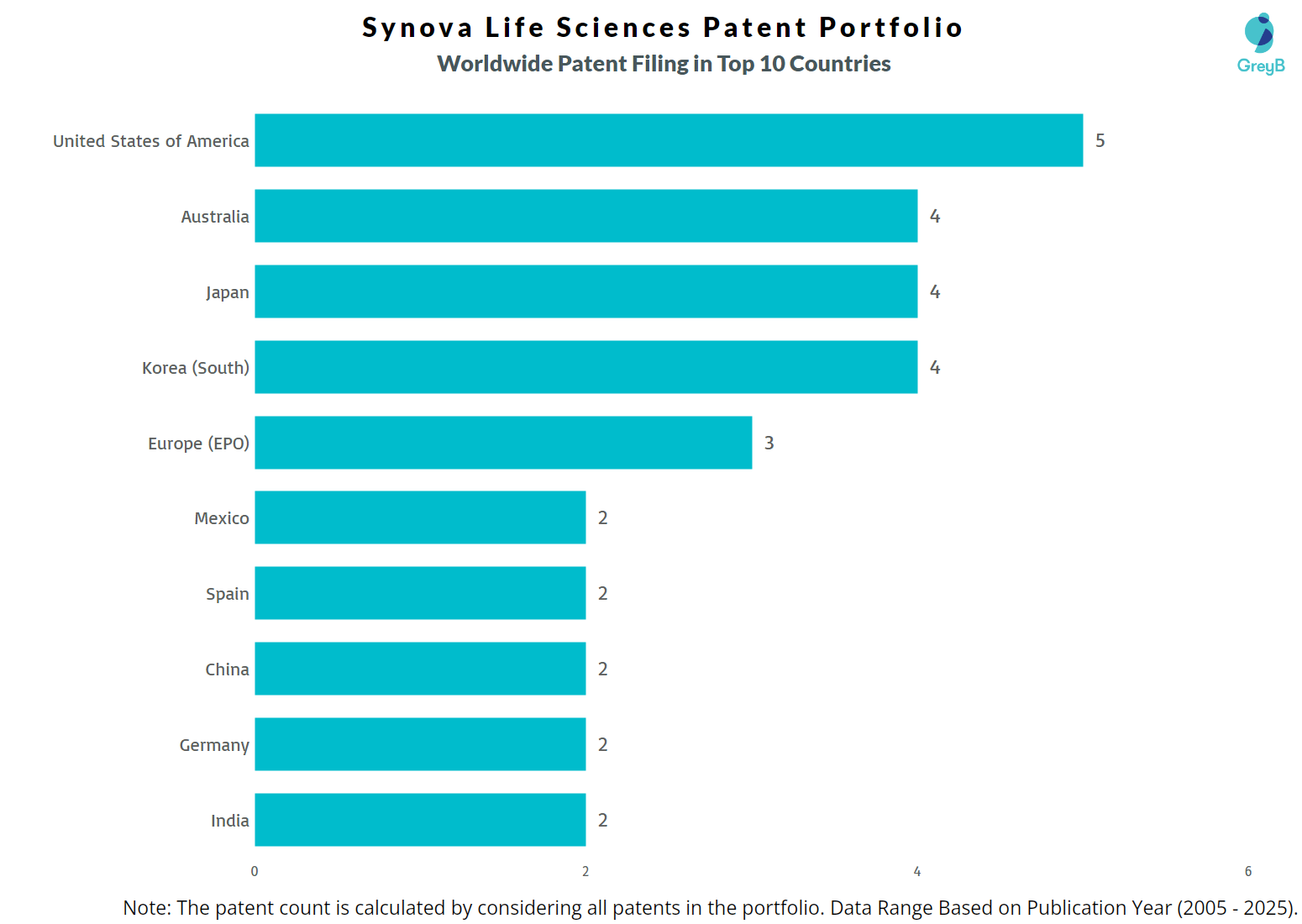
Countries in which Synova Life Sciences Filed Patents
| Country | Patents |
| United States of America | 5 |
| Australia | 4 |
| Japan | 4 |
| Korea (South) | 4 |
| Europe (EPO) | 3 |
| Mexico | 2 |
| Spain | 2 |
| China | 2 |
| Germany | 2 |
| India | 2 |
| Norway | 2 |
| Brazil | 1 |
| Denmark | 1 |
| Austria | 1 |
| Colombia | 1 |
| Canada | 1 |
Where are Research Centers of Synova Life Sciences Patents Located?
The Research Centers of Synova Life Sciences Patents is the United States of America.
What Percentage of Synova Life Sciences US Patent Applications were Granted?
Synova Life Sciences (Excluding its subsidiaries) has filed 3 patent applications at USPTO so far (Excluding Design and PCT applications). Out of these 2 have been granted leading to a grant rate of 100%.
Below are the key stats of Synova Life Sciences patent prosecution at the USPTO.

Which Law Firms are managing US Patents for Synova Life Sciences?
| Law Firm | Total Applications | Success Rate |
| Sheridan Ross Pc | 2 | 100.00% |
| Faegre Drinker Biddle & Reath Llp | 1 | 100% |
List of Synova Life Sciences patents
| Synova Life Sciences Patents | Title |
| US12281331B2 | Separation, Dissociation And/Or Disaggregation Of Cells Using Shockwaves Or Mechanical Impacts |
| MX422863B | Separation, Dissociation And/Or Disintegration Of Cells Using Shock Waves Or Mechanical Impacts |
| MX383501B | Separation, Dissociation And/Or Disaggregation Of Cells Using Shockwaves Or Mechanical Impacts |
| AU2023226696B2 | Separation, Dissociation And/Or Disaggregation Of Cells Using Shockwaves Or Mechanical Impacts |
| JP7631423B2 | Separation, Dissociation, And/Or Disaggregation Of Cells Using Shock Waves Or Mechanical Impact |
| US20250207100A1 | Separation, Dissociation And/Or Disaggregation Of Cells Using Shockwaves Or Mechanical Impacts |
| US20250207099A1 | Separation, Dissociation And/Or Disaggregation Of Cells Using Shockwaves Or Mechanical Impacts |
| AU2025203930A1 | Separation, Dissociation And/Or Disaggregation Of Cells Using Shockwaves Or Mechanical Impacts |
| JP2025076452A | Separation, Dissociation And/Or Disaggregation Of Cells Using Shockwaves Or Mechanical Impacts |
| US11866732B2 | Separation, Dissociation And/Or Disaggregation Of Cells Using Shockwaves Or Mechanical Impacts |
| CN115011555B | Methods For Separating, Dissociating And/Or Lysing Cells Using Shock Waves Or Mechanical Impact |
| ES2964374T3 | Isolation Of Stem Cells From Adipose Tissue |
| KR102676009B1 | Separation, Dissociation And/Or Disaggregation Of Cells Using Shockwaves Or Mechanical Impacts |
| KR102625925B1 | Separation, Dissociation And/Or Disaggregation Of Cells Using Shockwaves Or Mechanical Impacts |
| EP4324915A3 | Separation, Dissociation And/Or Disaggregation Of Cells Using Shockwaves Or Mechanical Impacts |
| EP3872164B1 | Isolating Stem Cells From Adipose Tissue |
| DE602017075105T2 | Isolation Of Stem Cells From Fatty Tissue |
| AU2022201872B2 | Separation, Dissociation And/Or Disaggregation Of Cells Using Shockwaves Or Mechanical Impacts |
| JP7300486B2 | Separation, Dissociation, And/Or Disaggregation Of Cells Using Shock Waves Or Mechanical Impact |
| IN202228045492A | Separation, Dissociation And/Or Disaggregation Of Cells Using Shockwaves Or Mechanical Impacts |
| CN109415675B | Methods Of Isolating, Dissociating And/Or Lysing Cells Using Shock Waves Or Mechanical Shock |
| BR112018068820B1 | Method For Isolating Stem Cells From Adipose Tissue And Device For Performing Said Method |
| IN405099B | Separation Dissociation And/Or Disaggregation Of Cells Using Shockwaves Or Mechanical Impacts |
| JP7037510B2 | Separation, Dissociation And/Or Disaggregation Of Cells Using Shock Waves Or Mechanical Impact |
| KR102419230B1 | Separation, Dissociation And/Or Disaggregation Of Cells Using Shockwaves Or Mechanical Impacts |
| EP3430122B1 | Separation, Dissociation And/Or Disaggregation Of Cells Using Mechanical Impacts |
| ES2884348T3 | Separation, Dissociation And/Or Disaggregation Of Cells Using Mechanical Impacts |
| NO3872164B1 | Isolating Stem Cells From Adipose Tissue |
| DK3430122T3 | Separation, Separation And/Or Division Of Cells Using Mechanical Shocks |
| DE602017039220T2 | Separation, Dissociation And/Or Decay Of Cells Via Mechanical Impact |
| AT1396249T | Separation, Dissociation And/Or Disintegration Of Cells By Means Of Mechanical Impact |
| AU2017235653B2 | Separation, Dissociation And/Or Disaggregation Of Cells Using Shockwaves Or Mechanical Impacts |
| KR102313628B1 | Separation, Dissociation And/Or Deaggregation Of Cells Using Shock Waves Or Mechanical Shock |
| US10329533B2 | Regenerative Cell And Adipose-Derived Stem Cell Processing System And Method |
| NO3430122B1 | Separation, Dissociation And/Or Disaggregation Of Cells Using Mechanical Impacts |
| CO20180011074A2 | Separation, Dissociation And/Or Disintegration Of Cells Using Shock Waves Or Mechanical Impacts |
| WO2017161343A1 | Separation, Dissociation And/Or Disaggregation Of Cells Using Shockwaves Or Mechanical Impacts |
| CA3056209A1 | Separation, Dissociation And/Or Disaggregation Of Cells Using Shockwaves Or Mechanical Impacts |
| WO2015127126A1 | Regenerative Cell And Adipose-Derived Stem Cell Processing System And Method |
What are Synova Life Sciences key innovation segments?
What Technologies are Covered by Synova Life Sciences?
The chart below distributes patents filed by Synova Life Sciences in different countries on the basis of the technology protected in patents. It also represents the markets where Synova Life Sciences thinks it’s important to protect particular technological inventions.
R&D Focus: How has Synova Life Sciences search focus changed over the years?
EXCLUSIVE INSIGHTS COMING SOON!
Interested in knowing about the areas of innovation that are being protected by Synova Life Sciences?