As the demand for faster and more reliable wireless connectivity continues to surge, Wi-Fi 8 (also known as IEEE 802.11bn) is set to address these evolving needs. Building on its predecessors, Wi-Fi 8 aims to deliver significant improvements in speed, capacity, and latency, offering key support for emerging technologies like augmented reality (AR), automation, and industrial IoT.
By 2027, Wi-Fi 8 is expected to revolutionize how businesses manage communication, data transfer, and device interoperability, bringing network efficiency to the next level. With the final approval of the IEEE 802.11bn (Wi-Fi 8) standard expected by September 2028, businesses can anticipate Wi-Fi 8 products to hit the market by late 2027, aligning with the typical 4-year cadence seen in previous Wi-Fi generations.
As a leading consulting firm, GreyB’s strategic insights will help you navigate this transformation, positioning your business to leverage Wi-Fi 8’s next-level performance and capabilities.
What new features does Wi-Fi 8 introduce compared to earlier versions?
| Feature | Wi-Fi 4 | Wi-Fi 5 | Wi-Fi 6 | Wi-Fi 7 | Wi-Fi 8 |
| Maximum Channel Bandwidth (MHz) | 40 | 160 | 160 | 320 | 320 |
| Frequency Bands (GHz) | 2.4 and 5 | 5 | 2.4, 5 and 6 | 2.4, 5 and 6 | 2.4, 5 and 6 |
| Max PHY Rate | 150 Mbps * to 4600 Mbps | 433 Mbps * 8 to 4.3 Gbps | 1200 Mbps * 8 to 9.6 Gbps | 2880 Mbps * 8 to 23 Gbps | 2880 Mbps * 8 to 23 Gbps |
| Modulation | 64 QAM | 256 QAM | 1024 QAM | 4096 QAM | 4096 QAM |
| Spatial Streams | 4 | 4 | 8 | 8 | 8 |
| MU-MIMO | — | DL only | UL & DL | UL & DL | UL & DL |
| Target Wait Time | — | — | Individual, broadcast | Restricted | Coordinated |
| OFDMA (# RU per STA) | — | — | Yes (single) | Yes (multiple) | Yes (multiple) |
| Multi-Link Operation | — | — | — | Yes | Yes |
| Multi-AP Coordination | — | — | — | Yes | Yes |
| DSO/NPCA | — | — | — | — | Yes |
| DRU | — | — | — | — | Yes |
| IEEE Standard | 802.11n | 802.11ac | 802.11ax | 802.11be | 802.11bn |
The table highlights the evolution of key features across Wi-Fi generations, emphasizing how Wi-Fi 8 builds upon its predecessors. Wi-Fi 8 retains the wide 320 MHz bandwidth and high PHY rates introduced in Wi-Fi 7 but brings in more advanced capabilities such as coordinated Target Wake Time, support for Distributed RU (dRU), Dynamic Spectrum Optimization (DSO), and enhanced multi-link operation. These improvements reflect ongoing IEEE efforts to boost efficiency, reduce latency, and enable better performance in dense environments. As the 802.11bn standard takes shape, Wi-Fi 8 stands out with a clear shift toward coordination and adaptability across networks.
These advancements make Wi-Fi 8 particularly suitable for business environments with dense networks, low-latency applications, and the next wave of smart devices.source
Key Contributors to Wi-Fi 8
The IEEE working group leading the development of Wi-Fi 8 (802.11bn) has already received a large number of submissions from major companies. These contributions help shape the direction of the standard and give insight into which organizations are most involved. By tracking these inputs, we can follow the progress of Wi-Fi 8 and see who is influencing its core features.
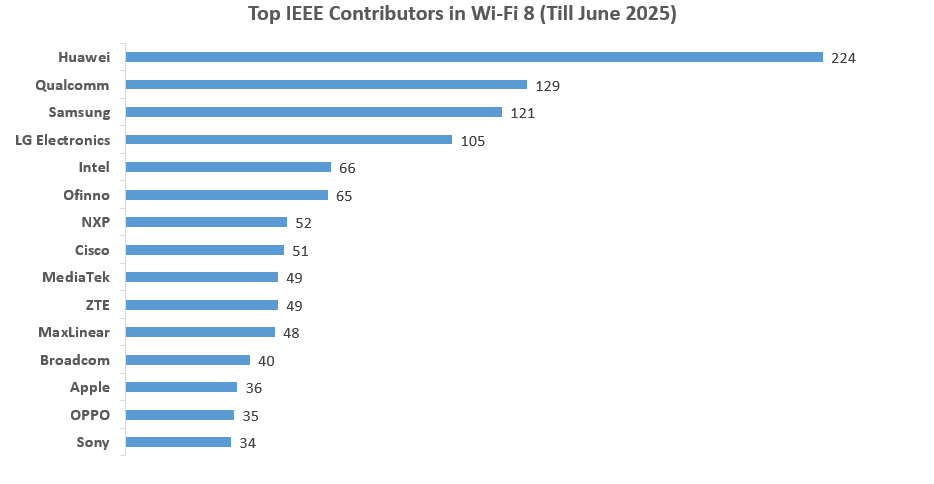
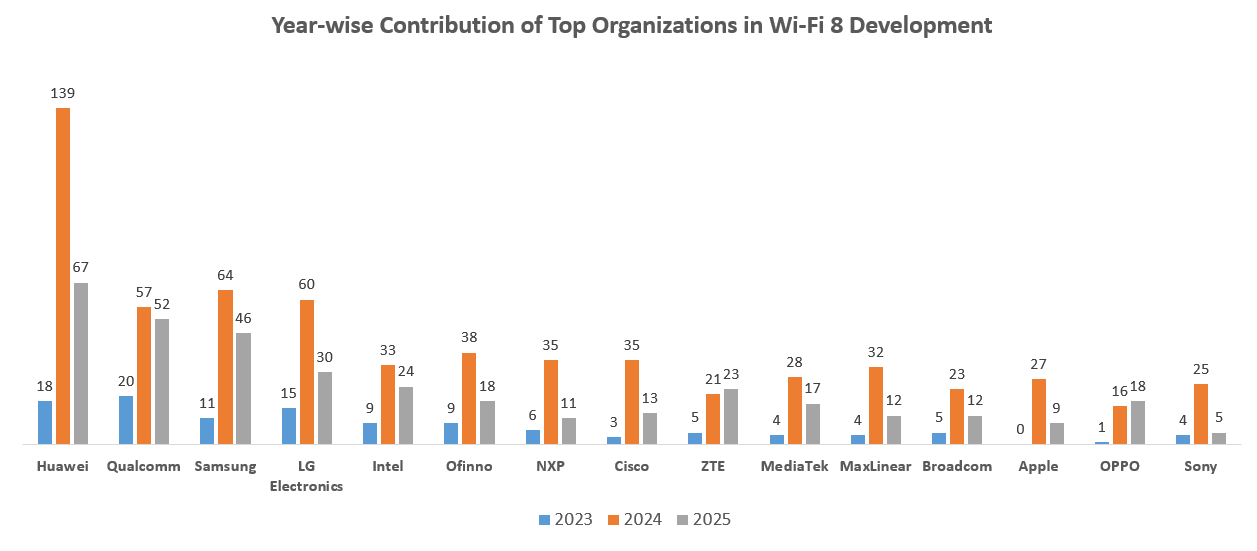
**Note: The above chart shows the top 10 contributors in Wi-Fi 8 till June 2025. Documents such as the agenda and minutes of the meeting have been removed while taking the count. All data has been sourced from the IEEE website.**
Company Contributions to Key Wireless Standard Features
The chart shows the participation of various companies in key technical features and proposals related to wireless communication standards, highlighting which companies have contributed to specific areas such as modulation, multi-link operation, coordination, power saving, and others. Each green check mark indicates active involvement or contribution in that feature.
| Company | Modulation | Target Wait Time | Multi-Link Operation | Multi-AP Coordination | DSO | NPCA | DRU | CO-BF | CO-SR | In-Device Coexistence (IDC) | TXOP Preemption | HIP EDCA | Power Saving | |
| Huawei | Yes | Yes | Yes | Yes | Yes | Yes | Yes | Yes | Yes | Yes | Yes | Yes | ||
| Qualcomm | Yes | Yes | Yes | Yes | Yes | Yes | Yes | Yes | Yes | Yes | Yes | |||
| Samsung | Yes | Yes | Yes | Yes | Yes | Yes | Yes | Yes | Yes | Yes | Yes | Yes | Yes | |
| LG | Yes | Yes | Yes | Yes | Yes | Yes | Yes | Yes | Yes | |||||
| Intel | Yes | Yes | Yes | Yes | Yes | Yes | Yes | Yes | Yes | |||||
| Ofinno | Yes | Yes | Yes | Yes | Yes | Yes | Yes | Yes | Yes | Yes | ||||
| NXP | Yes | Yes | Yes | Yes | Yes | Yes | Yes | |||||||
| Cisco | Yes | Yes | Yes | Yes | Yes | Yes | ||||||||
| ZTE | Yes | Yes | Yes | Yes | Yes | Yes | Yes | |||||||
| MediaTek | Yes | Yes | Yes | Yes | Yes | |||||||||
| MaxLinear | Yes | Yes | Yes | |||||||||||
| Broadcom | Yes | Yes | Yes | Yes | Yes | Yes | Yes | Yes | ||||||
| Apple | Yes | Yes | Yes | Yes | Yes | |||||||||
| OPPO | Yes | Yes | Yes | Yes | Yes | Yes | Yes | Yes | Yes |
**Note: The above table is prepared by analysing only the title of the contributions.
The actual results may change after a full manual review.**
Key Insights:
NPCA, DRU, and Co-BF appear among the most frequently mentioned technologies across contributions, and technologies like NPCA and DRU are also considered to be the key technologies in wifi 8. This suggests a strong industry focus on improving scheduling flexibility and resource allocation in Wi-Fi 8.
- Huawei, Qualcomm, and Samsung are the leading contributors to Wi-Fi 8. These companies are involved in nearly all the features, signifying their central role in shaping the technology.
- Samsung stands out for contributing to almost every feature, highlighting its deep commitment to developing Wi-Fi 8 across multiple aspects.
- Power saving is a prominent focus, with many top companies contributing significantly to this area. This suggests that reducing power consumption for mobile and IoT devices is a key goal of Wi-Fi 8 development.
- MediaTek, Maxlinear, and Apple, compared to the other major players, are more focused on a smaller set of technologies, particularly Multi-Link Operation, CO-BF, and Power Saving.
Companies have already started filing patents for emerging Wi-Fi 8 technologies.
Companies like Intel, Huawei, and LG Electronics have already started filing patents related to key technologies of WiFi 8, such as NPCA. A few examples are:
- Intel has filed patents to improve how secondary channels are used when primary channels are busy, focusing on making non-primary channel access (NPCA) more efficient.
- Huawei is working on methods to switch between primary and non-primary channels for better communication efficiency.
- LG Electronics is creating a way to prevent unnecessary use of NPCA by transferring NPCA modes through management frames, helping coordinate channel access better.
Who are the top contributors in WiFi 8?
| Authors | Associated Company | Number of Contributions |
| Alfred Asterjadhi | Qualcomm | 45 |
| Liwen Chu | NXP | 34 |
| Ross Jian Yu | Huawei | 26 |
| Eunsung Park | LG Electronics | 25 |
| Dongguk Lim | LG Electronics | 24 |
| Mengshi Hu | Huawei | 23 |
| Sigurd Schelstraete | MaxLinear | 23 |
| Yusuke Asai | NTT | 23 |
| Binita Gupta | Cisco Systems | 22 |
| Jay Yang | ZTE | 22 |
| Brian Hart | Cisco Systems | 21 |
| Alice Chen | Qualcomm | 20 |
| Jason Yuchen Guo | Huawei | 19 |
| Juan Fang | Intel | 19 |
| Guogang Huang | Huawei | 17 |
Alfred Asterjadhi, working in Huawei as a Principal Engineer, and Liwen Chu, working in Nexperia as a Technical Director, are leading the contributions for WiFi 8.
We recently published a report titled “WiFi 7 Patents: Next Generation of Wireless Connectivity”. Interestingly, many of the top inventors driving Wi-Fi 7 innovations – such as Alfred Asterjadhi, Dongguk Lim, Eunsung Park, and Jason Yuchen Guo are also the current leading contributors to Wi-Fi 8. Their continued involvement highlights a strong link between the development of both generations. Below are the key technologies they focused in in their recent contributions for Wifi 8:
- Alfred Asterjadhi (Qualcomm Inc.):
- Enhancing control and acknowledgment mechanisms, such as secure and flexible control frames.
- Exploring power-saving techniques, including AP power save and dynamic power save methods.
- Working on coexistence protocols for ultra-high reliability (UHR) scenarios.
- Contributing to MAC-level changes, including proposals like ELR MAC and ICF/ICR modes.
- Enhancing control and acknowledgment mechanisms, such as secure and flexible control frames.
- Dongguk Lim (LG Electronics):
- Focuses on Enhanced Link Reliability (ELR) and PHY Signaling:
- Work on ELR transmission to improve signal reliability, especially in high-density environments.
- Contributions related to signaling for MCS and UEQM in 11bn for more efficient communication.
- Focused on ELR PPDU format, ensuring optimized PHY signaling for DRU.
- Involved in designing Relay Communication protocols and signaling to improve the overall network efficiency.
- Work on ELR transmission to improve signal reliability, especially in high-density environments.
- Focuses on Enhanced Link Reliability (ELR) and PHY Signaling:
- Eunsung Park (LG Electronics):
- Focuses on DRU and UHR-STF:
- Extensive work on DRU tone plans and bandwidth management strategies, including 60 MHz and 20 MHz tone plans.
- Developed key proposals for Hybrid PPDUs and distribution bandwidth for DRU, optimizing the use of available spectrum.
- Contributions to signaling for DRU in trigger frames to ensure smoother transitions and enhanced resource allocation.
- Focused on Cyclic Shift Design (CSD) and UHR-STF for DRU transmission, enhancing the efficiency of transmission in the network.
- Extensive work on DRU tone plans and bandwidth management strategies, including 60 MHz and 20 MHz tone plans.
- Focuses on DRU and UHR-STF:
- Jason Yuchen Guo (Huawei):
- Coordinated Spatial Reuse (CSR): Jason is actively working on CSR protocols, frame sequencing, and performance simulations to improve spectrum reuse and reduce interference in dense environments.
- Coordinated Beamforming (CBF): He has contributed to MAC-level protocols that support coordinated beamforming across multiple devices for better signal direction and network efficiency.
- Power Saving and Multi-Link Operation: His work includes proposals for power-saving modes in multi-link systems, aiming to reduce energy usage in client devices during simultaneous link operations.
- Non-Primary Channel Access (NPCA): Jason has addressed NPCA challenges like asymmetric switching and session setup to improve flexibility and reliability in accessing secondary channels.
- Multi-AP Coordination: He has also explored mechanisms for intention signaling and feedback exchange between access points, helping coordinate activity across devices in complex network setups.
- Coordinated Spatial Reuse (CSR): Jason is actively working on CSR protocols, frame sequencing, and performance simulations to improve spectrum reuse and reduce interference in dense environments.
Conclusion:
Wi-Fi 8, built on the IEEE 802.11bn standard, is on track to reshape wireless connectivity. It focuses on improving network efficiency, reducing delays, and handling dense environments better than previous generations. Companies like Huawei, Qualcomm, and Samsung are leading this shift by contributing to a wide range of core features, including power saving, resource coordination, and multi-link operation.
The standard is expected to be finalized by 2028, with commercial products likely to appear by late 2027. This gives businesses time to prepare for adoption and integration. Tracking the technical contributions now can help companies plan ahead and stay competitive.
GreyB continues to monitor these developments closely. Our research highlights who is shaping Wi-Fi 8 and what they’re working on, giving you the clarity to make informed decisions as the next phase of wireless technology unfolds.