
Ultra-wideband (UWB) technology has steadily moved beyond location tracking and device discovery to become a foundational layer for next-generation consumer electronics. While smartphones and smart tags have been the primary beneficiaries so far, Samsung’s recent patents suggest that true wireless earbuds may be the next major frontier for UWB adoption.
Through a series of patent filings, Samsung outlines a new wireless earbud architecture that combines Bluetooth and UWB to improve audio delivery, synchronization, and contextual user interaction. These inventions point toward a future where earbuds are no longer passive audio accessories, but active, spatially aware computing nodes within Samsung’s ecosystem.
The Limitations of Today’s True Wireless Earbuds
Despite rapid innovation, most true wireless stereo (TWS) earbuds still rely on relatively conventional architectures. Common challenges include:
- Latency and synchronization issues, especially when streaming high-quality audio or video
- Master–slave dependency, where one earbud relays audio to the other, creating single points of failure
- Interference in crowded RF environments, such as public transport or offices
- Limited contextual awareness, restricting earbuds to basic input–output roles
Bluetooth, while power-efficient and widely compatible, struggles to deliver precise timing, spatial awareness, and parallel data transmission at scale. Samsung’s patents indicate that UWB could address many of these constraints.
Why UWB Changes the Game for Audio Streaming
UWB brings several advantages that directly address long-standing TWS pain points:
- Parallel audio transmission
Each earbud receives synchronized audio streams independently, reducing delay and desynchronization. - Lower latency
UWB’s high data rate and precise timing enable smoother audio–video alignment, particularly for gaming and video playback. - Improved reliability
Eliminating inter-earbud relaying reduces dropouts caused by obstruction or signal degradation. - Better performance in dense environments
UWB’s short-range, low-interference characteristics improve stability in crowded wireless spaces.
Together, these benefits suggest a move away from incremental Bluetooth optimization toward a fundamentally new earbud communication model.
Samsung’s Hybrid Bluetooth–UWB Earbud Patents
At the core of Samsung’s approach is a dual-connectivity model that assigns different roles to Bluetooth and UWB.
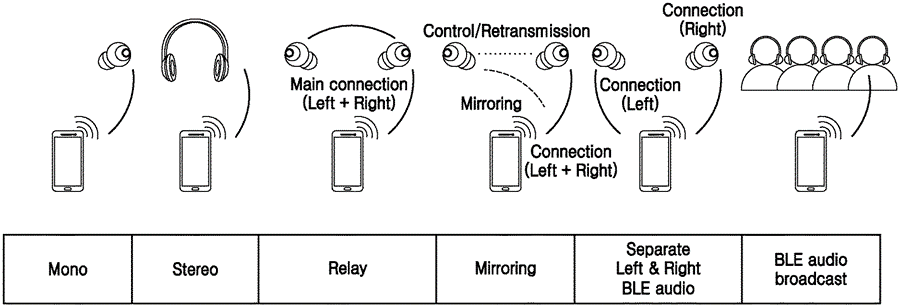
According to patent US2025039604A1, a source device such as a smartphone first establishes a traditional Bluetooth (BT) connection with one earbud for control and coordination. If the source device supports UWB, the system then establishes:
- A first UWB connection between the source device and the first earbud
- A second, independent UWB connection between the source device and the second earbud
Instead of routing audio through a single “master” earbud, each earbud receives audio data directly from the source device via UWB.
The same architecture is reinforced in CN117041792A, highlighting Samsung’s intent to protect this concept across major jurisdictions and signaling its strategic importance.
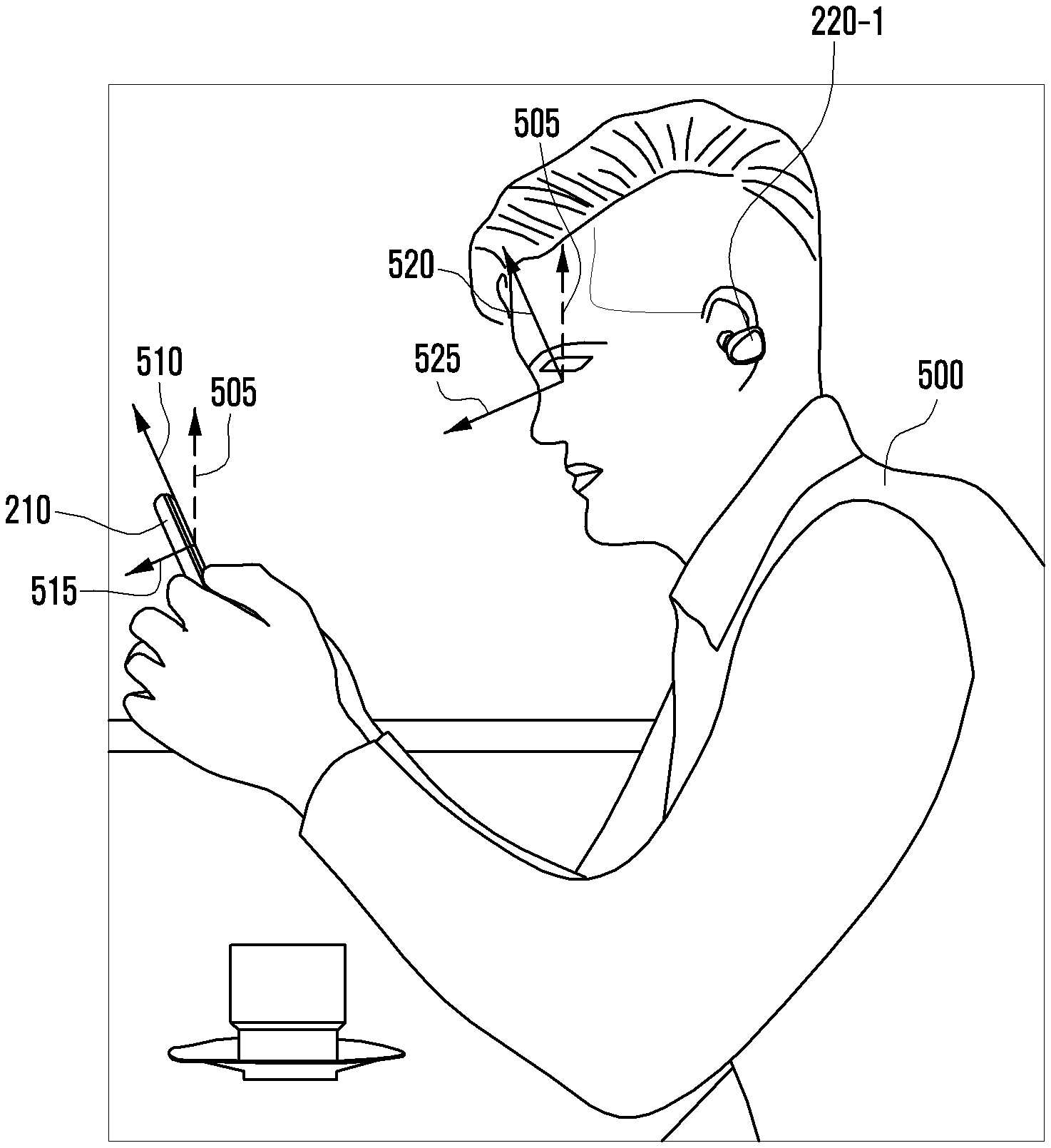
Samsung’s vision for UWB earbuds extends beyond audio delivery. Patent US11928256B2 reveals how wireless earbuds can participate in context-aware user interaction.
In this invention, sensors embedded in the earbuds work in tandem with sensors in a connected electronic device to:
- Estimate the field of view (FOV) of the user
- Estimate the FOV of the electronic device, such as a smartphone or tablet
- Determine whether the user is gazing at the device’s screen
- Trigger specific actions based on gaze recognition
This approach effectively turns earbuds into perceptual extensions of the user, capable of understanding attention and intent without explicit touch input.
What This Signals About Samsung’s Long-Term Strategy
Taken together, these patents suggest that Samsung views UWB earbuds not merely as an audio upgrade, but as a platform-level innovation. The focus on direct UWB streaming, independent earbud connectivity, and contextual sensing indicates preparation for future use cases that demand:
- Ultra-low latency
- Precise spatial awareness
- Multi-device coordination
As immersive media, wearable computing, and smart environments continue to evolve, earbuds equipped with UWB could play a central role in how users interact with digital content.
Curious which other companies are innovating in UWB technology? Request a full patent landscape report by filling out the form below.