When most people think of quantum computing, they picture laboratory machines cooled to near absolute zero, researchers in white coats, and headlines about computers that could break all known encryption. What they rarely picture is a patent office.
But behind every quantum computing breakthrough – every new qubit design, every error-correction method, and every quantum algorithm – there is a patent filing. Patents are not just legal paperwork. They are the real scoreboard of innovation. They tell you who is actually building something new, which countries are investing seriously, and where the global technology race is truly headed.
This analysis covers quantum computing patents filed worldwide between 2015 and 2026. We have broken the data into four key sections: the year-wise filing trend, R&D centre distribution by country of origin, the geographical distribution of patent filings, and the top companies leading the charge. The story the numbers tell is compelling – and in several places, quite surprising.
How the patent filing activity has changed over the year in Quantum Computing Industry?
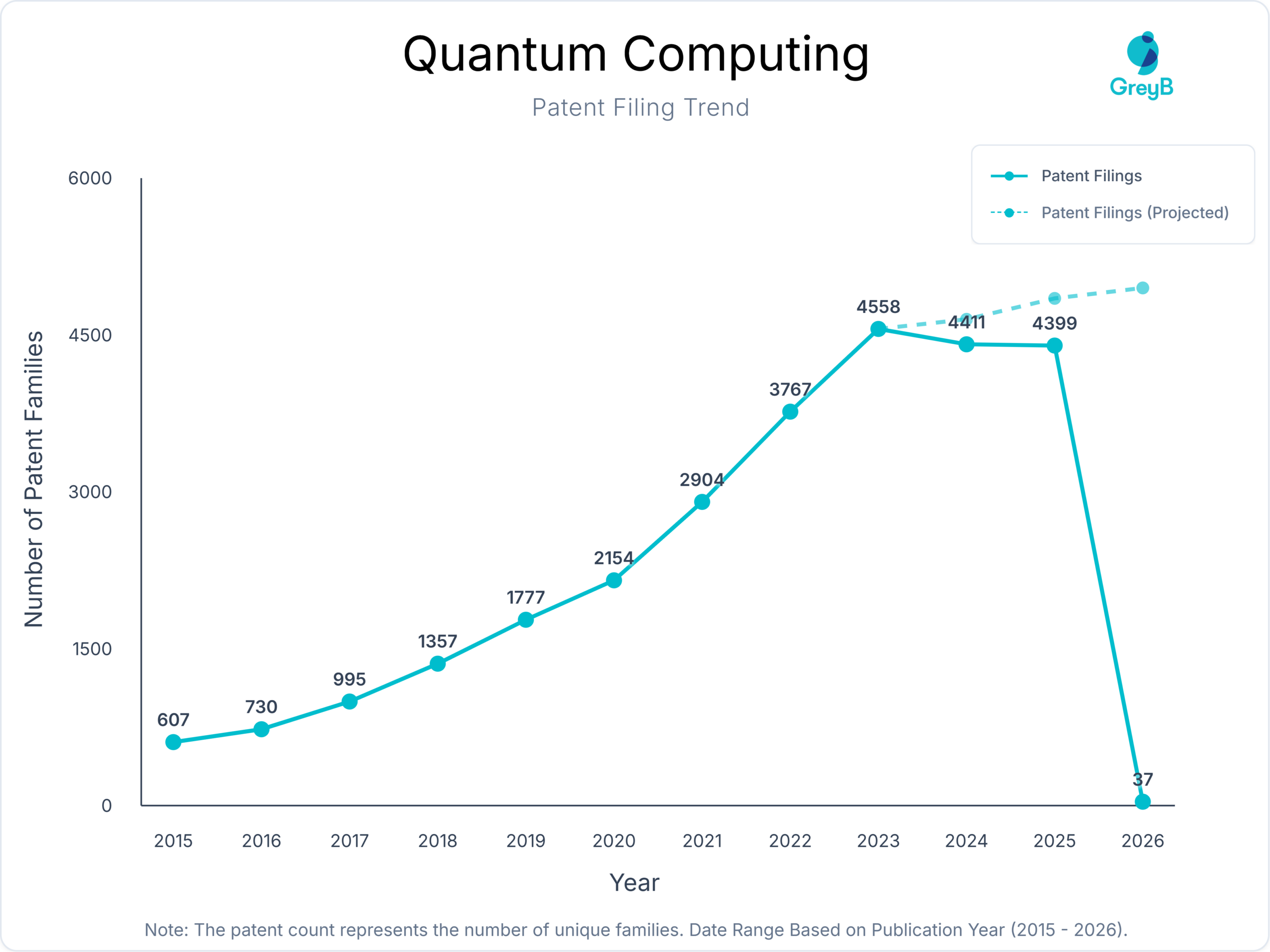
In 2015, just 607 quantum computing patents were filed worldwide. By 2023, this number grew impressively to 4,558 – a sevenfold increase in only eight years. This remarkable growth shows that quantum computing is a highly promising and fast-moving field.
Are you wondering why there is a slight dip in filings in 2024 (4,411) and 2025 (4,399)? The reason is simple – patent applications take time to get published, often up to 18 months. So the recent dip doesn’t mean innovation has slowed down – it just means many filings are still waiting to appear in the records.
Who is leading the innovation race in Quantum Computing Industry?
The quantum computing race is no longer just about science – it’s about strategy, and the competition is global.
Market Leader in Quantum Computing Patent Filing
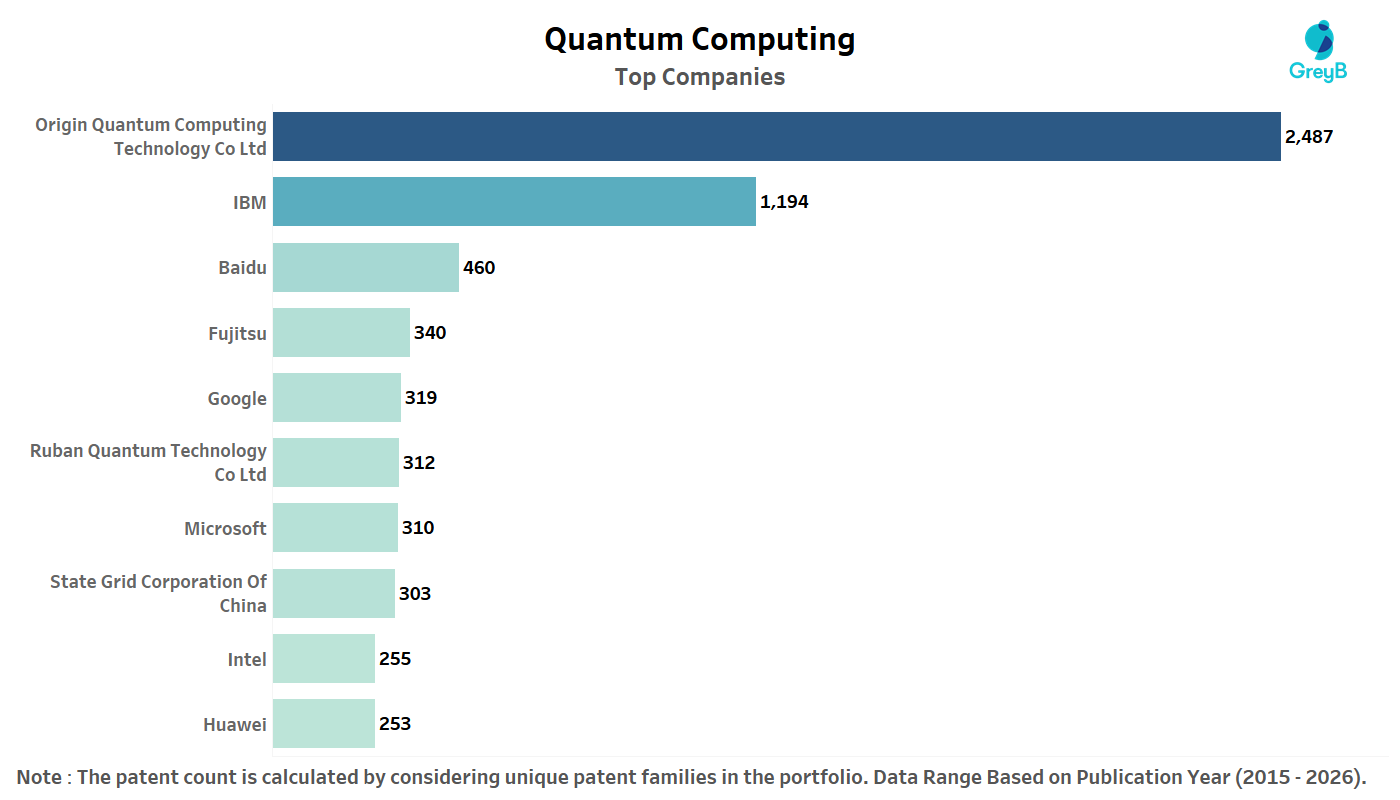
Origin Quantum tops the chart as China’s homegrown quantum champion with over 2,487 patent families, the highest of any single organization globally. Its position reflects how seriously China is investing at a national level. Notably, Chinese organizations – including Baidu (460), Huawei (253), Ruban Quantum (312), and State Grid Corporation (303) -hold a dominant presence, backed by strong government funding and a clear national agenda.
On the global stage, IBM remains the most trusted name with 1,194 filings, consistently ranking as the world’s leading Western patent holder in quantum computing. Google (Alphabet) follows with 319 filings, with a remarkable 95.6% of its quantum patents contributed directly by Google LLC – signaling just how focused and deliberate its quantum strategy is. Microsoft (310) is quietly playing a longer game with a bold hardware approach that could leapfrog the competition.
Which Country are leading the innovation race in Quantum Computing Industry?
When it comes to quantum computing, two countries are clearly pulling ahead of the rest – and the gap is significant.
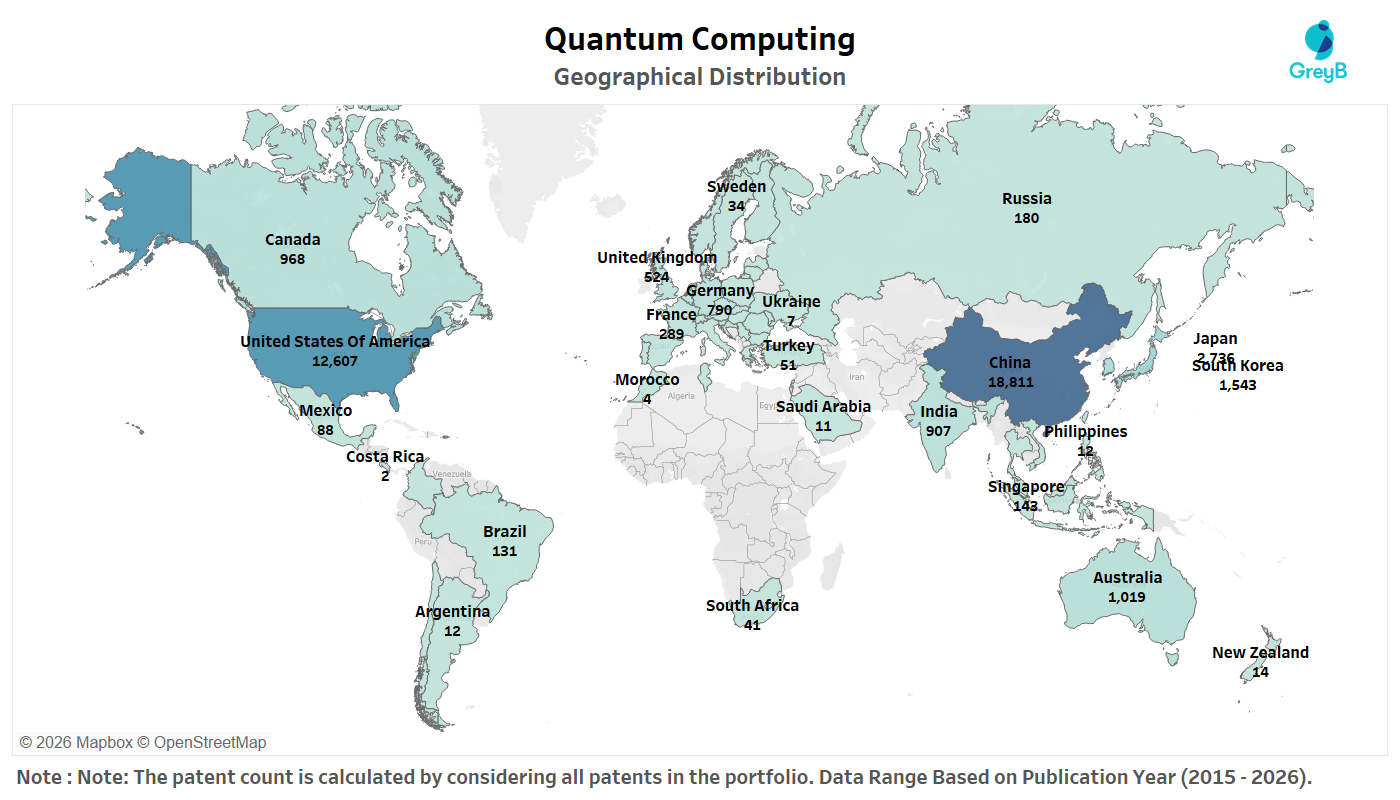
China leads by a wide margin with 18,811 filings, reflecting years of sustained government investment and a national mission to become the world’s quantum superpower. The United States follows as a strong second with 12,607 filings, driven largely by its thriving private sector – from tech giants to well-funded startups. Together, these two nations account for the overwhelming majority of global quantum patent activity.
Europe (3,994), Japan (2,736), and Korea (1,543) hold their ground as established innovation hubs, with strong academic research and growing corporate interest backing their filings. Australia (1,019) and Canada (968) punch above their weight given their relatively smaller populations, reflecting focused government funding and world-class research institutions.
India’s presence at 907 filings is noteworthy and growing. With a strong push from government initiatives like the National Quantum Mission and top-tier research institutions entering the space, India is steadily building its position as an emerging quantum nation to watch.
Beyond IBM & Google: What’s Happening Across the Quantum Technologies?
While the patent activity of leading players like IBM, Google, and Origin Quantum highlights their innovation strategies, they represent only one part of the broader Quantum Computing landscape.
The real competitive edge lies in understanding:
- Global filing trends and technology shifts across quantum hardware and software
- Competitive benchmarking of major quantum players across countries
- Emerging innovators and silent patent builders quietly building their portfolios
- Technology heatmaps across qubits, error correction, quantum cryptography, and algorithms
- High-impact patents shaping the next generation of quantum systems
Reach to us for full report for complete Quantum Technologies
Where are Research Centers of Quantum Computing Patents Located?
Behind every quantum computing breakthrough is a research and development centre quietly doing the hard work – and the data on where these centres are located reveals a clear and compelling story.
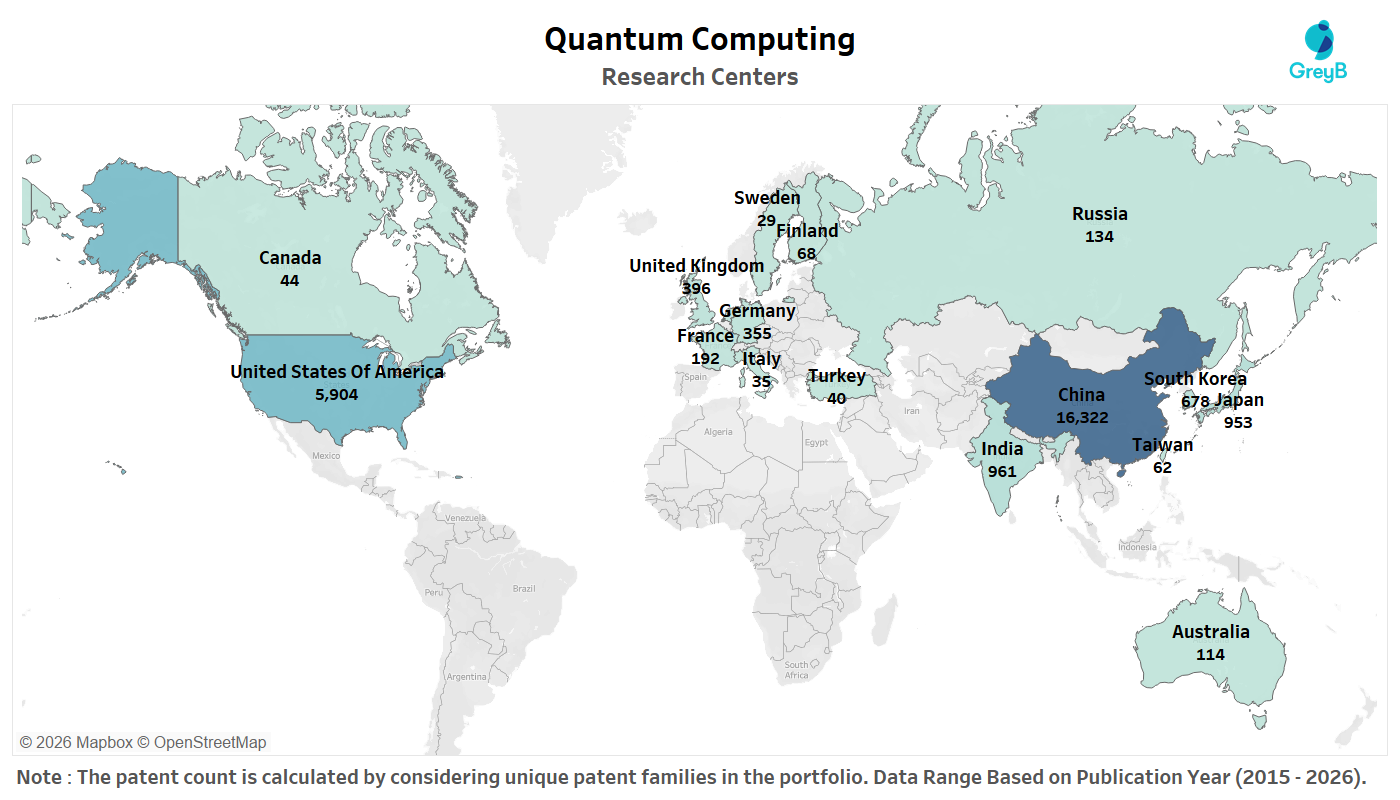
China dominates R&D activity by a remarkable margin with 16,322 centres, nearly three times the presence of the United States. This reflects China’s strategy of not just filing patents but deeply investing in fundamental research – building the scientific foundation for long-term quantum leadership.
The United States follows with 5,904 centres, powered by a combination of world-class universities, national laboratories, and corporate R&D arms from companies like Google, IBM, and Microsoft.
What stands out most in this list is India’s rise to third place with 961 centres – ahead of Japan (953), Europe (844), and Korea (678). This is a significant signal. India’s growing network of quantum research institutions, combined with its National Quantum Mission, is clearly translating into real research output on the global stage.
Best patents in Quantum Computing –
| Patents | Citation | Company | Technology |
| US20140032259A1 | 421 | Anonos Inc | Adtech |
| US20170214701A1 | 441 | Hasan Syed Kamran | Cybersecurity |
| CN110073301A | 594 | Strong Force Iot Portfolio 2016 Llc | IOT |
| US20190339688A1 | 440 | Strong Force Iot Portfolio 2016 Llc | IOT |
| US20200225655A1 | 424 | Strong Force Iot Portfolio 2016 Llc | IOT |
| US20200348662A1 | 582 | Strong Force Iot Portfolio 2016 Llc | IOT |
| US20210157312A1 | 526 | Strong Force Iot Portfolio 2016 Llc | IOT |
| US20160164571A1 | 583 | At&T Intellectual Property I L P | Telecommunications |
| US9461706B1 | 554 | At&T Intellectual Property I L P | Telecommunications |
| WO2016081125A1 | 379 | At&T Intellectual Property I L P | Telecommunications |
Quantum computing is reshaping competitive boundaries – but where will it create advantage, and where could it disrupt?
Uncover industry-specific impact, emerging whitespace, competitive blind spots, and future technology trajectories before the market matures.
Request a customized strategic patent intelligence deep dive.