The skincare industry is no longer just about creams and serums. It is becoming a technology race and consumers are at the center of it.
The global AI in beauty and cosmetics market, valued at more than $4 billion in 2025, is projected to reach $33.75 billion by 2035 a growth rate that is turning heads across boardrooms, R&D labs, and patent offices worldwide.
How AI skincare patents differ from traditional cosmetic patents.
Traditional cosmetic patents usually protect ingredients, formulas, or manufacturing processes used to create a skincare product. The focus is on the product itself what goes into the cream, serum, or treatment.
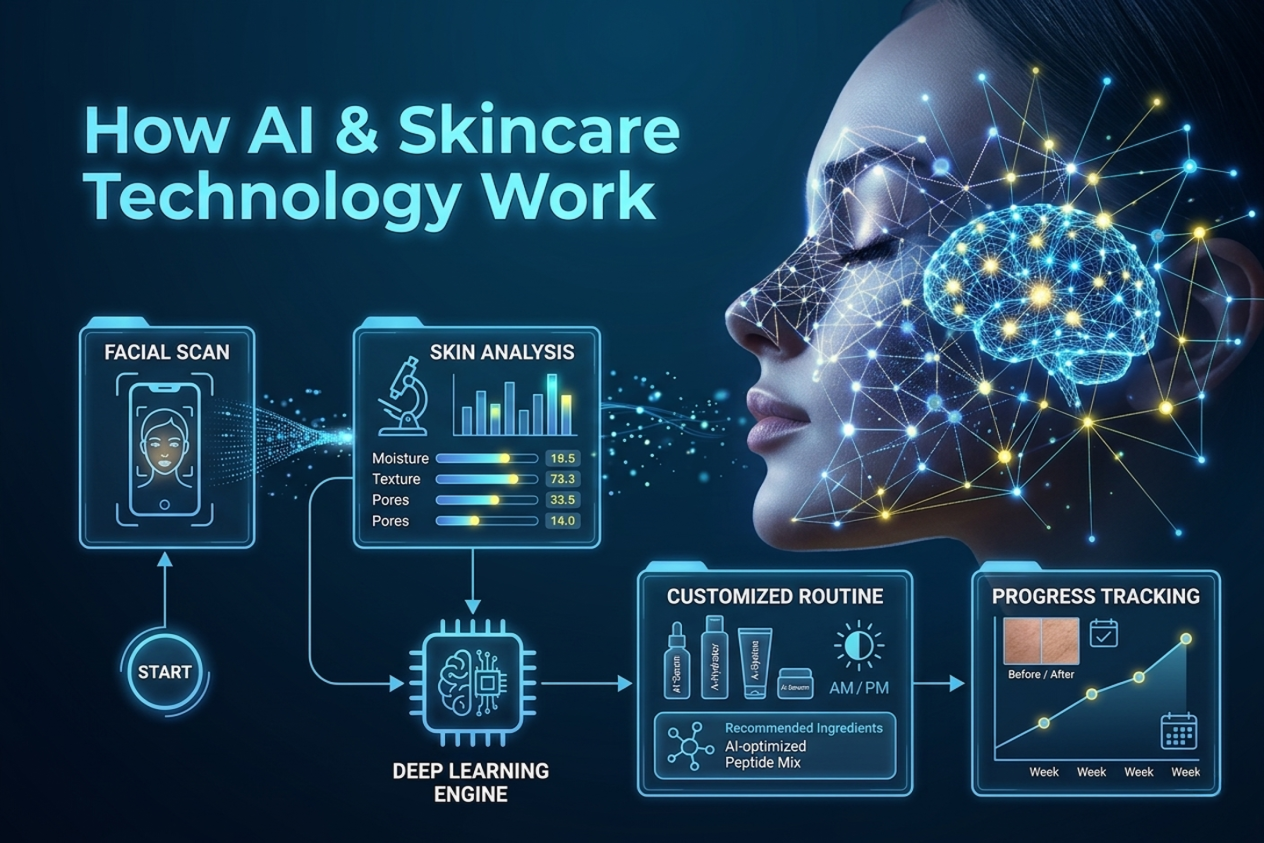
AI skincare patents focus on the technology behind the product. They protect systems that analyze skin, personalize recommendations, or help discover new ingredients using data and machine learning.
In simple terms, traditional patents protect the formulation, while AI skincare patents protect the technology that studies skin and creates personalized skincare solutions.
For most of history, skincare was a guessing game.
You walked into a store, picked up a cream labelled “for dry skin” or “anti-aging,” and simply hoped for the best. If it worked for your friend, maybe it would work for you too. If it didn’t, you moved on to the next product on the shelf.
The problem was never your skin. The problem was that skincare was built for everyone which really means it was built for no one.
So why did the same product work differently on different people?
Because every person’s skin is unique. Your skin type, your genes, your diet, your climate, your stress levels all of it affects how your skin looks and behaves. A moisturizer that transforms your friend’s skin might do absolutely nothing for yours. And for decades, the beauty industry simply ignored that reality.
That’s exactly where AI changed everything.
Today, technology companies are using Artificial Intelligence the same smart technology behind your phone’s face recognition or Netflix’s recommendations to study your skin the way no cream label ever could. AI can analyse thousands of data points about your unique skin, detect early signs of aging, identify problem areas, and recommend products or treatments built specifically for you.
Reach to us for full report for complete Skincare Industry Report
How AI Skincare Patents Are Filed and Protected?
AI-driven skincare patents work differently. They protect processes the computational methods by which a company analyses skin, discovers ingredients, personalises formulations, or handles sensitive biometric data. These are method and system claims, with characteristics IP practitioners need to understand:
They are often remarkably broad, covering a category of activity rather than a specific implementation.
They raise patentable subject matter questions under 35 U.S.C. § 101 in the US, since many touch on abstract ideas and mathematical algorithms.
They intersect with data protection law – GDPR in Europe, BIPA in Illinois – adding a regulatory dimension absent from traditional beauty patents.
They typically span multiple jurisdictions, requiring coordinated global prosecution strategies.
5 Start-ups Defining the AI Skincare Patent Landscape
1. PROVEN Skincare – Owning the Category
Problem
For years, skincare brands sorted customers into broad groups – oily skin, dry skin, combination skin and sold them the same products. There was nothing truly personal about it. A cream that worked perfectly for your friend could do nothing for you, because no two people’s skin is exactly alike.
Solution
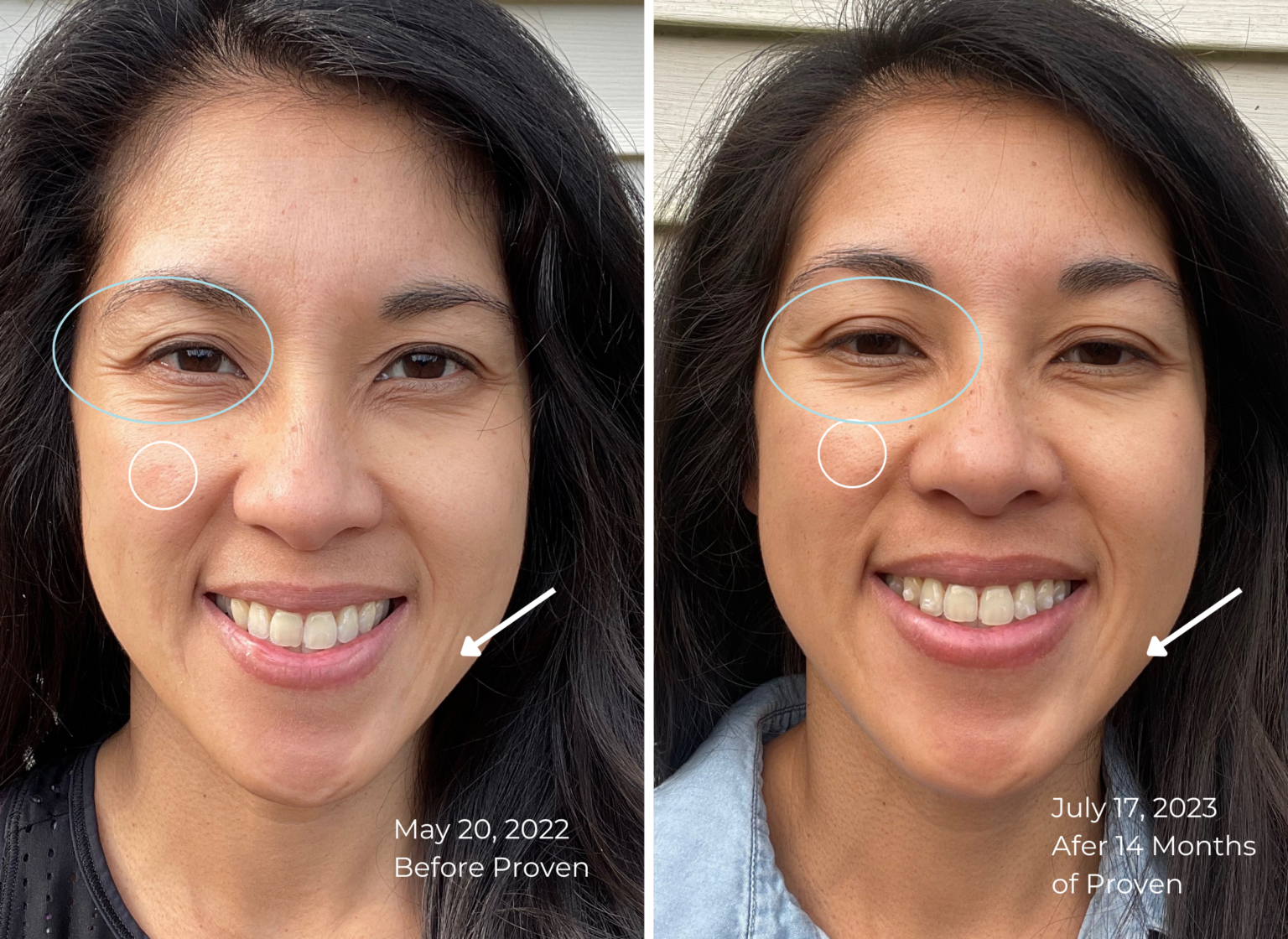
PROVEN built an AI system called the Skin Genome Project that takes over 40 personal inputs: your age, location, climate, lifestyle, skin history, and concerns and cross references them against 25 million consumer reviews and 4,000 scientific studies. The result is a skincare formulation made specifically for you. No two customers receive the same product.
The system does not stop there. It keeps learning. If you move to a new city, age into a new stage of life, or report a new skin concern, the AI updates your recommended formulation automatically in real time.
What the Patent Protects
The patent covers the entire process of using an AI algorithm to match skincare to an individual and adjust that match in real time. This is not a patent for a specific ingredient or cream. It is a patent for the method itself making it one of the broadest patents ever filed in the beauty industry. Any brand that now wants to build a genuine AI personalization system has to navigate PROVEN’s claim.
| Patent Number | US11328338B1 (July 2022) |
| Core Claim | Any skincare personalization process where an AI algorithm is used and a customer receives personalized outputs, with real-time adjustment based on changing personal & geographic data |
| AI Techniques | Machine learning on 25M+ consumer testimonials; Gabor/Hessian image filters; HSV color space analysis; region-mapping for facial zone scoring |
| Claim Breadth | Extraordinarily broad – covers methodology, not a specific product; horizontal coverage across entire personalized beauty category |
| Funding | $21M+ total; $12.2M Series A (Sept 2023); Y Combinator; Sephora partnership |
| Awards | 1. MIT AI Technology Award 2018; Best Use of Technology 2. Glossy Beauty Awards 2022 |
2. Haut.AI – Solving the Privacy Paradox
Problem
AI-powered skin analysis works by studying a person’s face. But a person’s face is biometric data it can identify who they are. That creates a serious legal problem. Privacy laws like GDPR in Europe and BIPA in Illinois place strict limits on how biometric data can be collected, stored, and used. For beauty brands and clinical researchers, this meant that building AI skin tools at scale came with enormous legal risk.
Solution
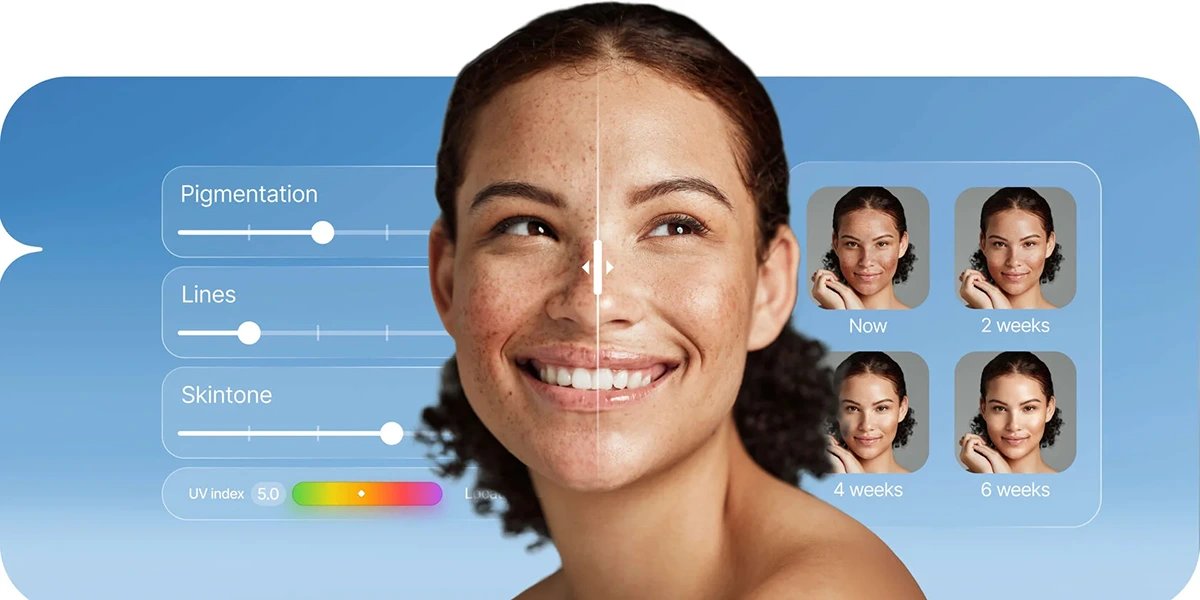
Haut.AI built a system called the Skin Atlas. Before any skin analysis happens, the AI removes all personal identifiers from the photo eyes, eyebrows, lips, hair, background and replaces them with AI-generated, photorealistic skin texture. What remains is a fully anonymized image that contains only the skin information needed for analysis. The original photo never leaves the user’s device. Only the anonymized version is transmitted.
This means brands can run detailed AI skin diagnostics without ever technically processing personal biometric data removing the legal liability entirely.
What the Patent Protects
The patent protects the method of anonymizing facial images using a generative AI system that replaces non-skin pixels with synthetic skin-textured content producing an image accurate enough for clinical-grade analysis but stripped of any personal identifying information. This directly addresses GDPR Article 9 and BIPA compliance in a single technical step.
| Patent Number | US12039768B2 – Method and System for Anonymizing Facial Image Data |
| Core Claim | Facial image anonymization via generative AI in-painting of non-skin pixels; creation of privacy-preserving ‘Skin Atlas’ for AI-based dermatological analysis |
| AI Techniques | Convolutional neural network for keypoint detection; semantic segmentation; Generative Adversarial Network (GAN) for photorealistic skin in-painting |
| Claim Breadth | Enables GDPR-compliant skin AI deployments; removes personal biometric identifiers before any data processing occurs – directly addresses BIPA and GDPR Article 9 |
| Funding | €2M seed (Nov 2023) led by LongeVC + Grupo Boticário VC; Microsoft Pegasus Program (2023) |
| Awards | 1. Beauty Innovation Award 2024 Finalist (GenAI) 2. BeautyMatter NEXT 2025 Finalist 3. CEO named Digiday Future Leader 2025 |
3. Revieve – Diagnostics That Drive Commercial Results
Problem
Skincare brands have always struggled to answer one simple question for their customers: what does your skin actually need right now? In a store, a sales assistant might make a judgment call. Online, brands had almost no tools to do this at all. Customers were left guessing and buying the wrong products as a result.
Solution
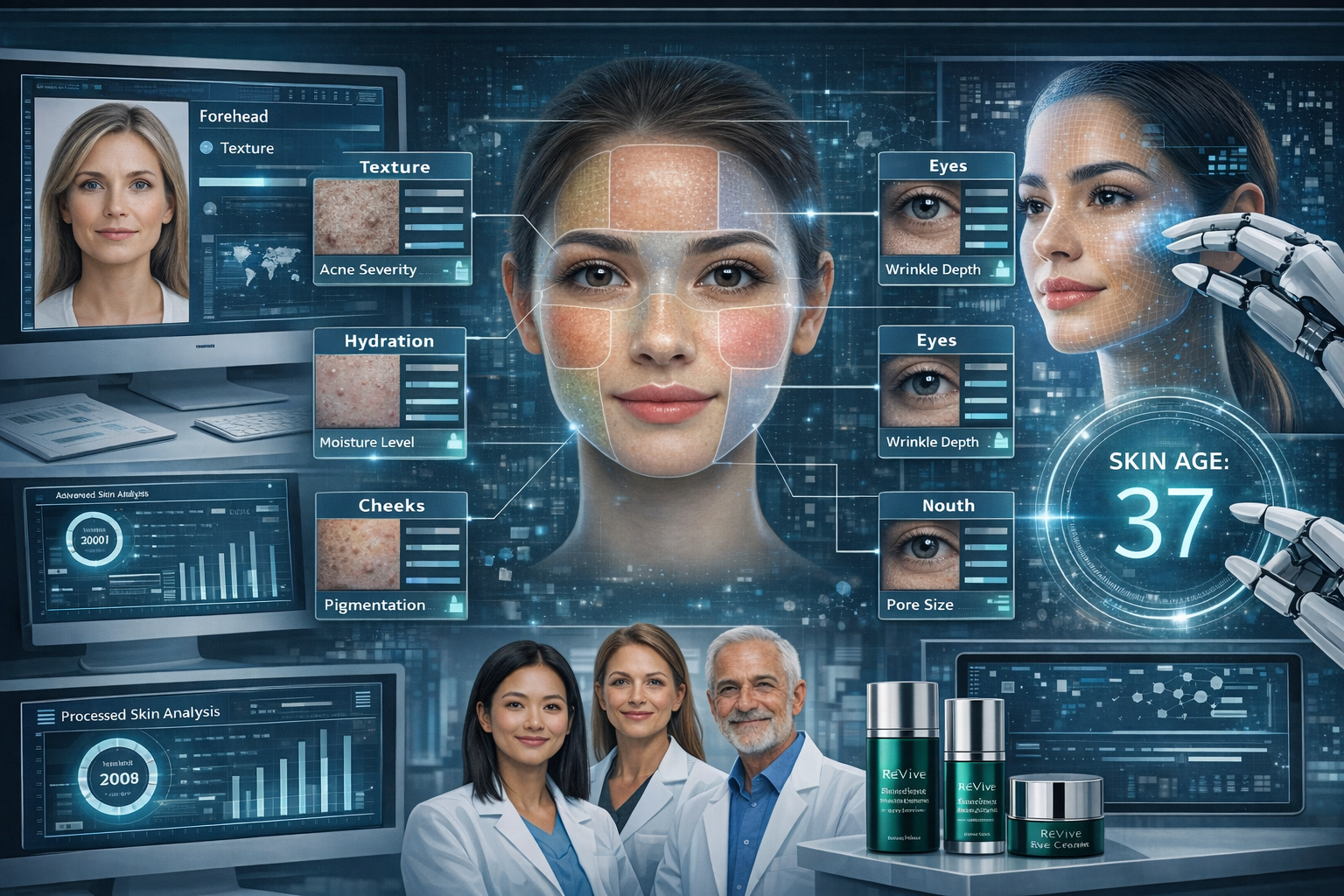
The system maps the face into distinct zones, applies independent analysis modules optimised for each zone, and scores granular metrics including acne severity, hydration, texture, pigmentation, wrinkle depth, and pore size. A final inference layer compares the consumer’s metric profile against a benchmark dataset of validated age-cohort profiles to generate a single ‘skin age’ score – a number that translates complex biological data into something a consumer can understand and track over time.
What the Patent Protects
The commercial outcomes are significant: one department store reported a 108% increase in product conversion after deployment; another beauty brand recorded a 442% increase. These figures matter for IP valuation – they provide concrete, auditable evidence of economic value directly attributable to the patented method.
| Patent Number | US12079854B2 – patent filed covering AI skin analysis algorithms and computer vision methodologies |
| Core Claim | Automated, computer-vision-based assessment of skin health sub-metrics from mobile-quality images; skin age estimation via comparison to biological age benchmark datasets |
| AI Techniques | Image illumination normalization; facial zone segmentation; Gabor filter analysis; HSV color space scoring; ML-based skin age inference from benchmark cohort comparison |
| Claim Breadth | – |
| Funding | – |
| Awards | 1. RoC Skincare Skin Age Diagnostics (Glossy Award 2024) 2. Best Beauty Industry Tech Innovation 2025 (Corporate Vision) |
4. Debut Biotechnology – AI-Generated Composition Claims
Problem
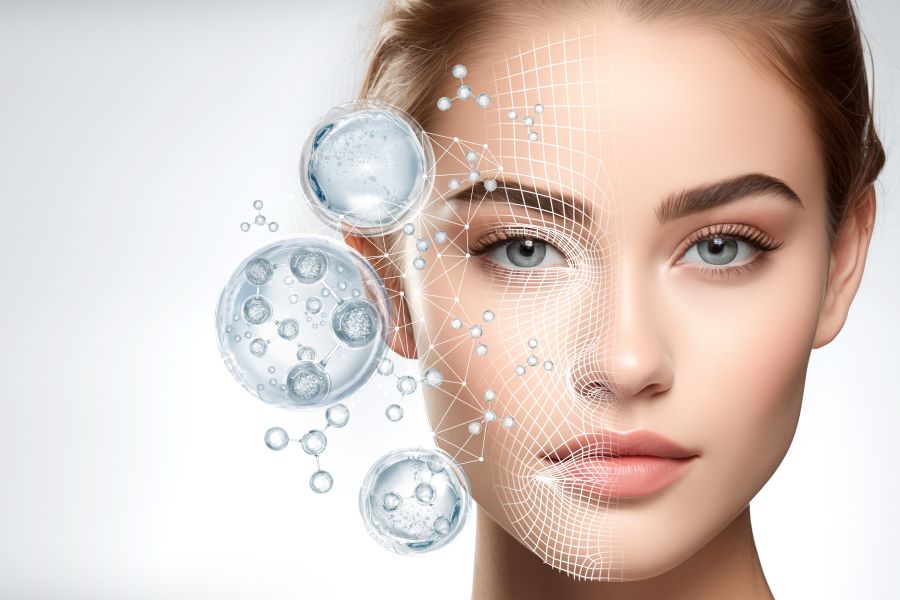
Finding a new skincare ingredient the traditional way takes decades. A chemist synthesises a compound, tests it, refines it, and slowly moves it toward market all while most candidates fail along the way. The beauty industry has been running on the same core ingredients for years, with very little genuine molecular innovation.
Solution
Revieve built a computer vision platform that can analyse a standard selfie taken on any mobile phone, in any lighting and measure over 200 skin health metrics across every zone of the face. It looks at wrinkles, pores, pigmentation, redness, texture, and more.
The most powerful feature is Skin Age Diagnostics. After measuring all of those metrics, the AI compares your skin profile to a database of validated skin profiles across different age groups. It then gives you a single number: your estimated skin age. A 40-year-old whose skin scores like a 34-year-old learns that their skin age is 34. That number becomes a personal goal and drives them back to track their progress.
What the Patent Protects
The patent covers the complete mobile skin diagnostics pipeline from image standardization and facial zone mapping to the 200+ metric scoring system and the skin age estimation method. Brands including JCPenney (which saw a 108% increase in conversions) and BABOR (442% increase) have deployed this system directly into their shopping experience.
| Patent Number | US2025049679A1, US2025057748A1 – DermCeutical InflammagePRO™, Barrier RepairPRO™, LongevityPRO™ |
| Core Claims | Novel bio-based molecular entities for specific skin aging pathways; method of AI-assisted discovery and topical application |
| AI Techniques | Generative AI for molecular structure prediction; 50B compound virtual screening; 99% predictive consistency on proprietary genomics datasets |
| Claim Breadth | InflammagePRO: 15x better than niacinamide; Barrier RepairPRO: 30% better than Vitamin C; LongevityPRO: 2x better than Vitamin C |
| Funding | $20M (Aug 2025): Fine Structure Ventures, EDBI, L’Oréal BOLD, GS Futures, Sandbox Industries, Material Impact |
| Awards | TIME100 Most Innovative Companies 2025 |
5. OneSkin – Where Science Anchors the Patent
Problem
Anti-aging skincare has always focused on how skin looks fewer wrinkles, brighter tone, firmer texture. But looking younger and actually being younger at a biological level are two very different things. No skincare product had ever been proven to reduce the biological age of skin at a cellular level. Until OneSkin
Solution
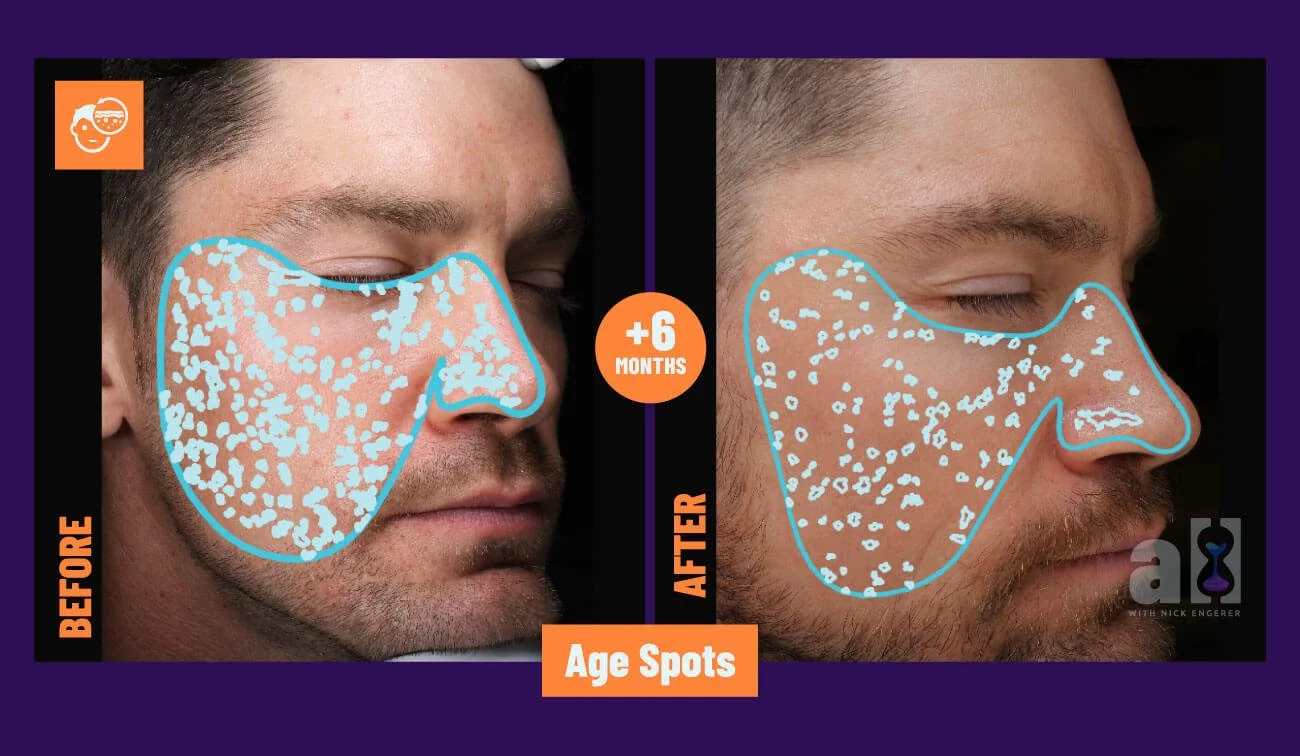
OneSkin’s four PhD co-founders used AI to screen a library of over 900 peptides, looking for one that could reduce cellular senescence the accumulation of damaged, non-dividing cells that drives visible aging. The AI identified a top candidate, then ran a second round of screening on 764 variations of that candidate to find the optimal version. The result was OS-01, a peptide that had never existed in any published scientific literature.
To prove it actually worked, OneSkin developed MolClock an AI algorithm that measures biological skin age using DNA methylation patterns. In clinical testing, OS-01 reduced biological skin age by 2.5 years. That result was published in the Journal of Cosmetic Dermatology in 2024 making it the first skincare ingredient in history with peer-reviewed, AI-measured proof of reducing biological skin age.
What the Patent Protects
The patent covers both the OS-01 peptide itself (as a novel molecular composition) and its method of use in topical skincare for reducing cellular senescence. The dual claim structure protecting both the molecule and the method mirrors the approach used in pharmaceutical patents and makes the IP significantly harder to design around. With five named co-founder inventors and the patent wholly owned by OneSkin Inc., the inventorship chain is clean, well-documented, and investment-grade.
| Patent Number | US20250235542A1, US2025352608A1 – Composition-of-matter patent on OS-01 (Decapeptide-52/Peptide 14) + method claims for topical senotherapeutic application; solely owned by OneSkin Inc. |
| Core Claim | Composition-of-matter patent on OS-01 peptide + method claims for topical senotherapeutic application; solely owned by OneSkin Inc. |
| AI Techniques | Computational peptide screening (900+ candidates); amino acid scanning (764-variant library); MolClock epigenetic age algorithm; published clinical AI validation |
| Claim Breadth | – |
| Funding | ~$20M ; Selva Ventures, Unilever Ventures, PLUS Capital, SOSV, Prelude Growth Partners ($20M Series A, Aug 2025 – largest Prelude investment to date) |
| Awards | Fast Company Most Innovative Companies (Beauty) 2024; celebrity advocates: Jennifer Aniston, Katy Perry; science advisors: Dr. David Sinclair (Harvard) |
50+ Startups Are Racing to Patent AI Skincare Technology. Who Is Actually Innovating? Not every startup files patents. We tracked which ones do and what they are protecting.
AI has permanently changed the skincare industry and the companies moving fastest are not just building smarter products, they are protecting them with patents.
What began as a few startups using algorithms to recommend moisturizers has grown into a serious intellectual property race. PROVEN Skincare, Haut.AI, Revieve, Debut Biotechnology, and OneSkin have already staked their claims. Others are following quickly.
The next five years will only accelerate this shift. Personalized skincare will become the standard expectation, not a luxury. AI will discover ingredients faster than any traditional lab ever could. Data privacy laws will push companies to build smarter, legally compliant technology. And patent filings will spread from the US into every major market across Europe and Asia.
Navigating the AI skincare patent landscape is complex. That is where we come in.
We support companies at every stage of the patent journey from finding the right technology and scouting innovative startups, to running deep patent searches and competitive analysis so you always know where you stand.
Request your Customized AI Skincare Industry Report – get tailored patent insights mapping your IP portfolio to the latest global trends.