The adoption of Artificial Intelligence (AI) in the automotive industry is growing rapidly, as seen from the publication of over 200K patents between 2019 and 2026, covering around 186K unique patent families. This reflects the increasing focus on building smarter and more connected vehicles.
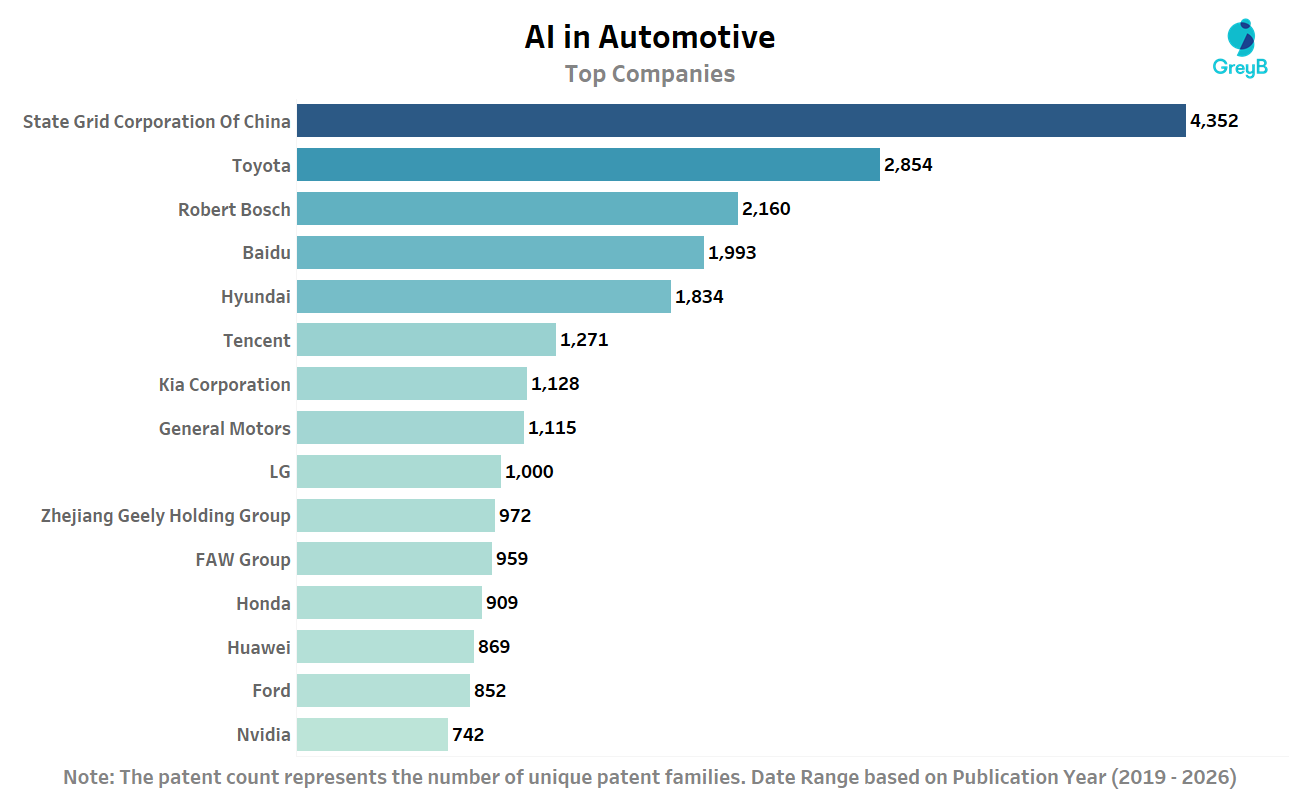
Among the key players, State Grid Corporation of China leads with close to 3K patent families, followed by Toyota 2.6K and Robert Bosch 2K, highlighting strong competition between automotive companies and technology-driven organizations.
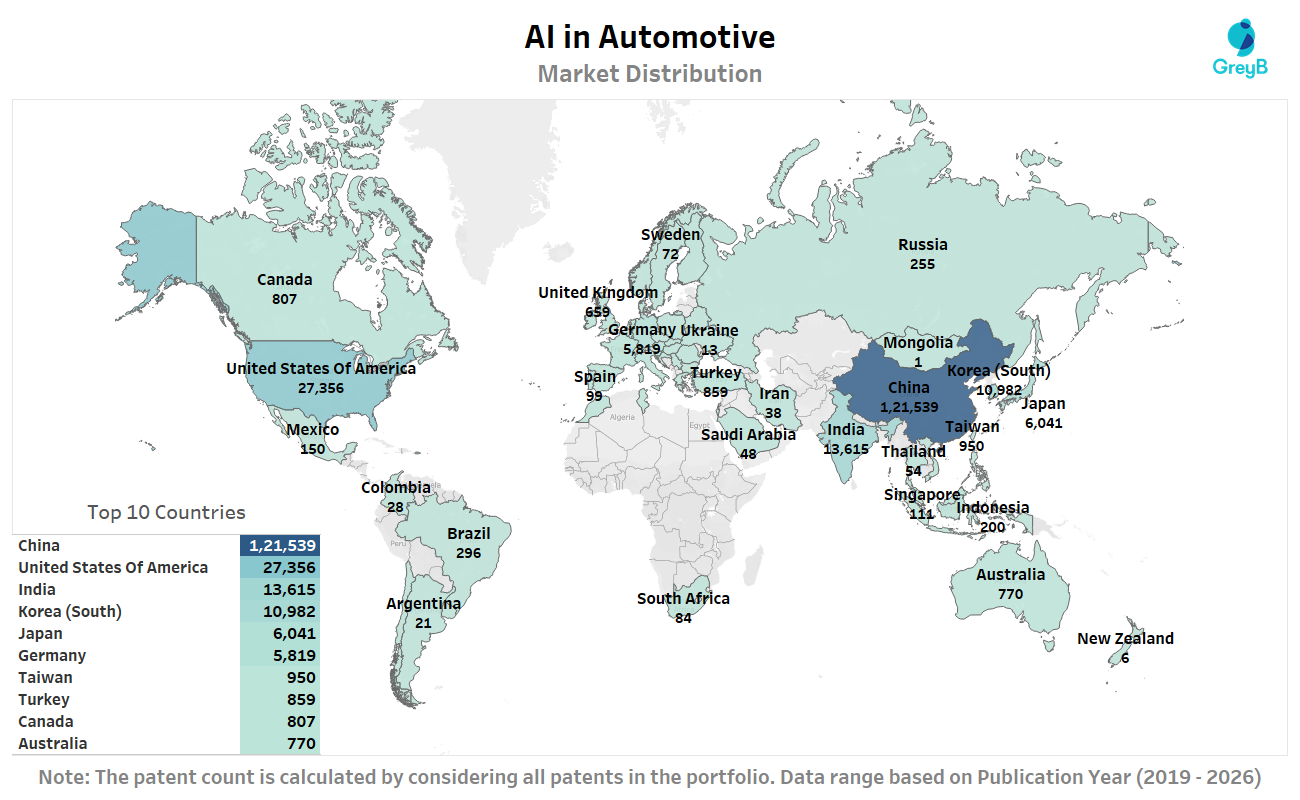
Geographically, China stands out as both the largest innovation hub and filing country, with over 117K patent families and 121K filings. The United States and India follow as important contributors, showing a broad global presence in this space.
Patent filings have consistently increased over the years, indicating steady growth and investment in AI-driven automotive solutions.
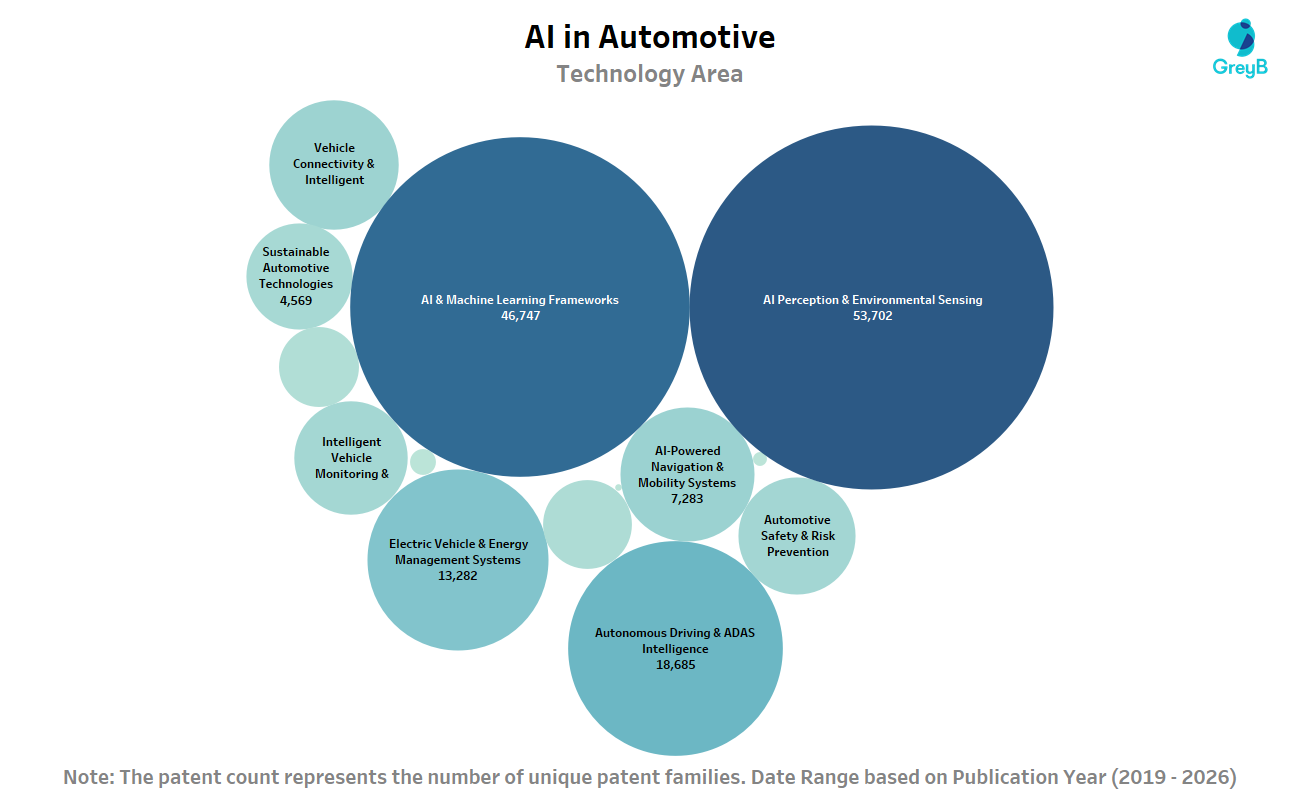
In terms of technology focus, most activity is centered around AI sensing, machine learning, and autonomous driving systems, showing where the industry is putting its efforts.
What are the problems with AI in Automotive Industry?
Sensor Reliability and Fusion Complexity
Multi-sensor systems struggle in real-world conditions
Autonomous systems rely on cameras, LiDAR, radar, and IMUs, but performance drops when sensors fail or weather degrades inputs. Ensuring accurate perception through robust sensor fusion and failure handling remains a critical challenge.
Real-Time Decision-Making and Latency
High computation must meet strict timing constraints
AI models must process perception and planning within milliseconds. Balancing model complexity with low latency is difficult, especially when distributing workloads across edge and cloud systems.
Functional Safety and Reliability
Meeting automotive safety standards is complex
Ensuring compliance with standards like ISO 26262 requires redundancy, fault tolerance, and predictable behavior. AI’s probabilistic nature makes safety validation and certification more challenging.
Cybersecurity and Data Privacy Risks
Connected vehicles increase attack surfaces
Autonomous systems are vulnerable to cyberattacks on sensors, communication networks, and control systems. Protecting vehicle data while enabling intelligent learning adds another layer of complexity.
Environmental and Weather Robustness
Performance degrades in adverse conditions
Rain, fog, snow, and poor lighting significantly impact perception systems. Building models that adapt reliably across diverse environmental conditions remains an unsolved challenge.
Data Quality and Bias Challenges
AI systems depend heavily on training data
Limited edge-case data and biased datasets can lead to unsafe decisions. Ensuring diverse, high-quality, and representative data is crucial for reliable system performance.
Which are the top players hold the most patents in AI in Automotive Industry?
In the AI in Automotive sector, State Grid Corporation of China stands out as the clear leader, holding a dominant 4,352 unique patent families between 2019 and 2026. Toyota follows strongly in second place with 2,854 patents, showcasing its deep commitment to AI innovation. Global giants like Robert Bosch (2,160), Baidu (1,993), and Hyundai (1,834) round out the top five, reflecting a mix of traditional automakers, tech firms, and Chinese state-backed players driving the industry forward. This patent landscape highlights how Chinese entities are rapidly shaping the future of AI-powered mobility alongside established automotive leaders.
How many patents were filed in Ai in Automotive Industry across the different Countries?
The global patent landscape for AI in automotive is highly concentrated, led by China with over 121,000 filings, significantly outpacing all other regions. The United States follows with around 27,000 patents, while India (~13,600) and South Korea (~11,000) are emerging as strong innovation hubs. Established automotive leaders like Japan and Germany also show solid contributions, each exceeding 5,000 filings. Overall, the data highlights a clear dominance of Asia, with growing participation from North America and selective European markets.
Which Technologies Dominate the AI in Automotive Patent Landscape?
In the AI in Automotive patent landscape (2019–2026), AI Perception & Environmental Sensing dominates with 53,702 patent families, followed closely by AI & Machine Learning Frameworks at 46,747. These two areas lead the innovation, forming the core foundation for intelligent vehicles. Autonomous Driving & ADAS Intelligence ranks third with 18,685 patents, while Electric Vehicle & Energy Management Systems (13,282) and AI-Powered Navigation & Mobility Systems (7,283) show moderate activity. Overall, perception, sensing, and core AI frameworks heavily dominate the patent filings.
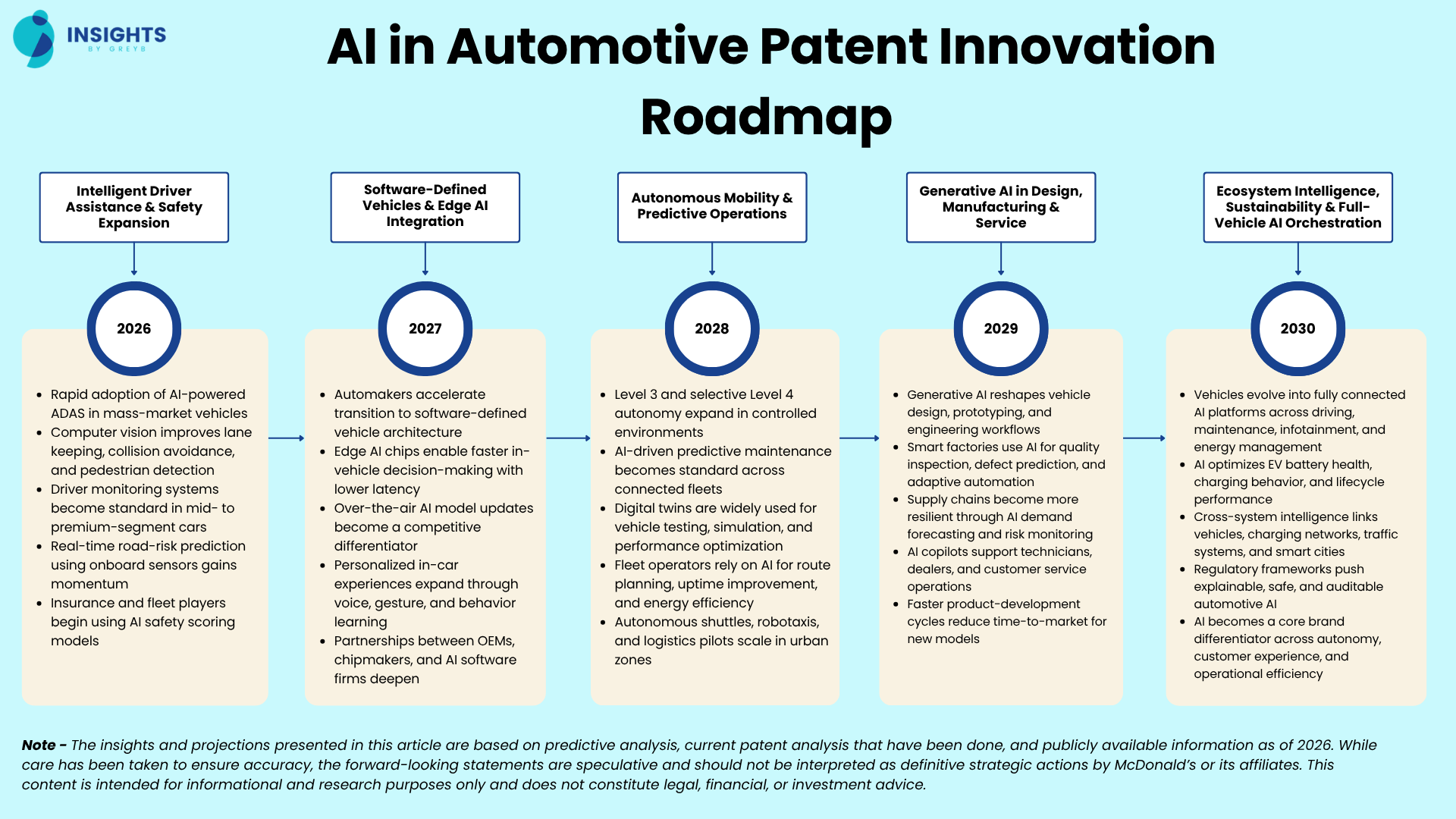
AI in Automotive Patent Innovation Roadmap
What is in the report?
Full breakdown of patent portfolios by technology area (autonomous driving, driver assistance, connectivity, in-vehicle systems, safety).
Year-wise evolution of filings by technology area from 2019 to 2025.
Rank-list of top companies/assignees in the automotive intelligence landscape and their filing trends.
Global distribution of filings: country-wise data & year-wise evolution.
Legal status analysis: how many are active, granted, abandoned etc.
Future directions & upcoming innovation hotspots in the automotive ecosystem.