
What if the future of your favourite drink isn’t being shaped in a brewery-but in a lab?
With over 23,000 patents filed globally, the alcoholic beverage industry is undergoing a quiet yet powerful transformation, driven more by science than tradition. The next competitive edge is shifting from branding and distribution toward IP. Companies are building strong innovation portfolios, racing to redefine fermentation and production.
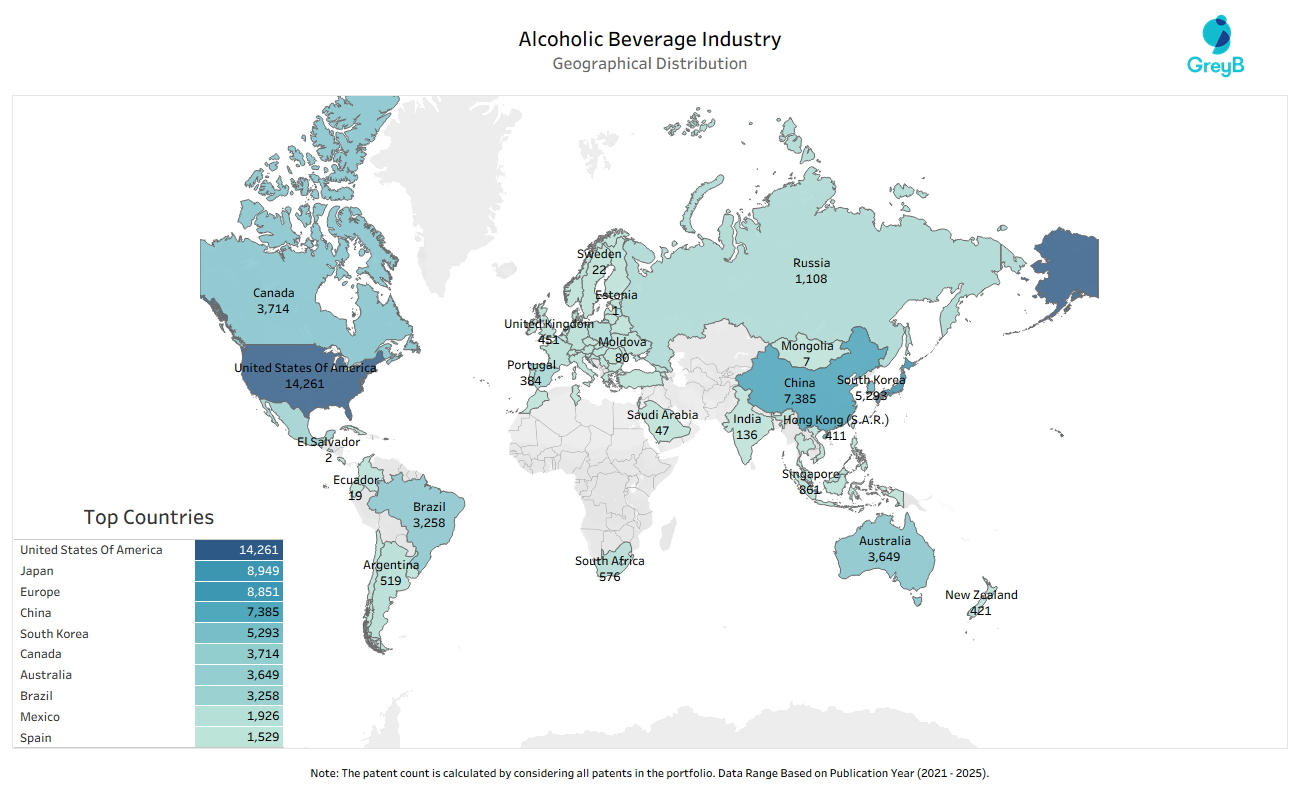
Traditionally rooted in craftsmanship, the industry is now embracing science-led advancements. From optimizing fermentation processes to engineering microorganisms and enhancing production efficiency, technology is becoming a key differentiator. Leading players such as Suntory Holdings, CJ CheilJedang, and Asahi Group Holdings are at the forefront, with the United States accounting for nearly 62% of all filings.
Fermentation technology dominates innovation (44%), followed by microorganisms and enzymes (23%) and wine preparation (11%). While patent publications appear to decline-from 3,271 in 2021 to 190 in 2025-this reflects the 18-month publication lag rather than reduced activity. In reality, companies are becoming more strategic, focusing on high-quality patents, trade secrets, and the growing demand for low- and no-alcohol beverages.
Packaging drives most beverage emissions, often exceeding raw materials. High water use and energy-intensive treatment reveal inefficiencies, while climate change impacts crops. Renewable and circular systems can cut emissions significantly but require systemic change.
Advanced technologies like membrane separation, pervaporation, and resin adsorption enable ultra-low alcohol levels while preserving aroma. Hybrid methods improve flavor retention, but achieving taste parity and cost-effective scaling remains challenging.
The low/no-alcohol market is rapidly growing, driven by Gen Z and Millennials seeking moderation. However, taste concerns, pricing, and authenticity challenges persist, pushing companies to innovate in flavor and product formulation.
New regulations, including “Alcohol Facts” labels and allergen disclosures, are reshaping compliance. Varying timelines, regional differences, sugar taxes, and ad restrictions are increasing pressure on manufacturers to rapidly adapt labeling, testing, and formulations.
AI-driven forecasting, digital twins, and IoT logistics are transforming beverage operations, improving demand accuracy by 20–30%, enhancing quality, and reducing waste. However, integration complexity, data reliance, and high infrastructure costs remain key challenges.
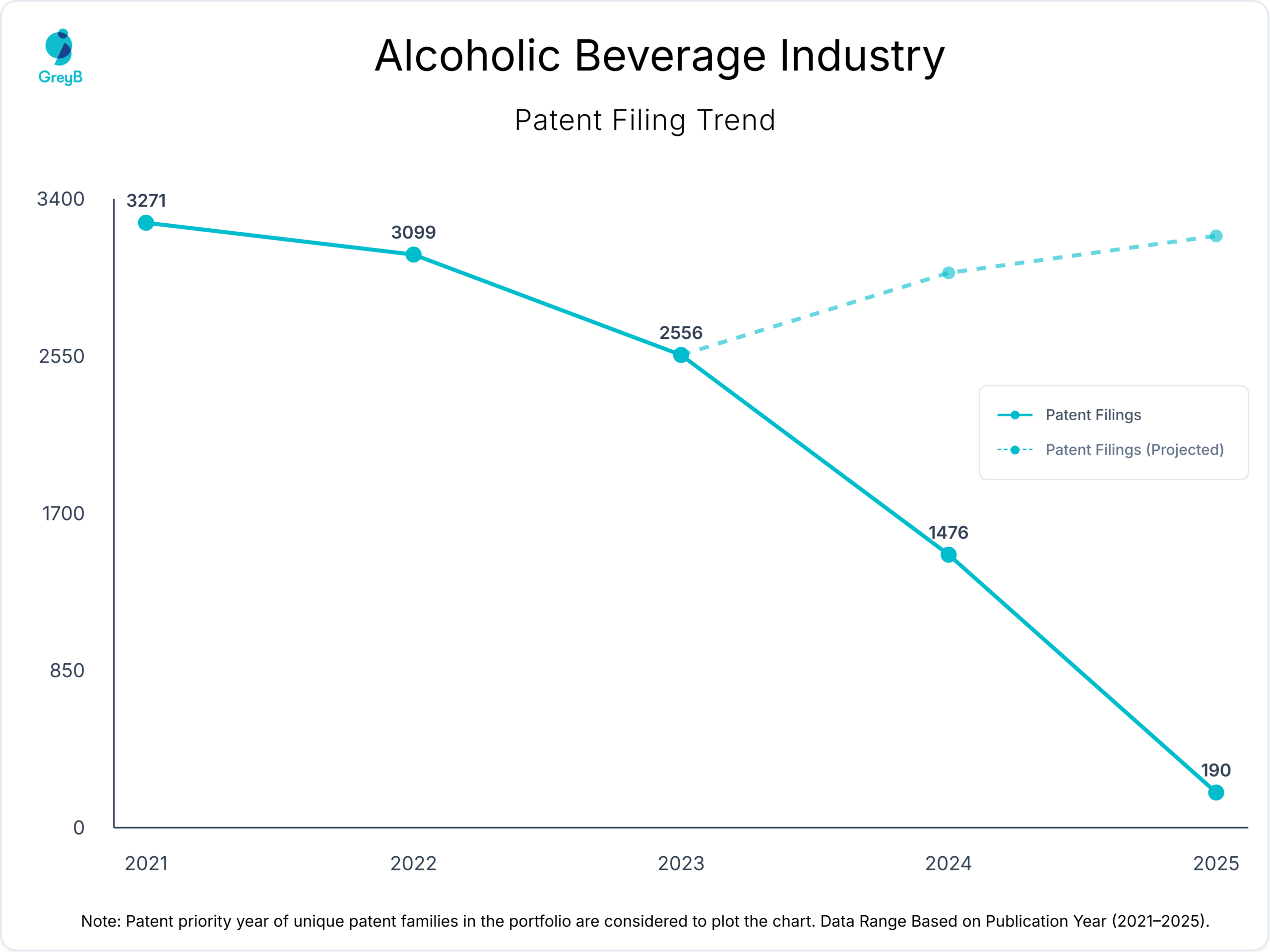
Although data suggest a decrease in patent publication, from 3,271 in 2021 to just 190 in 2025, this does not represent stagnation within the industry.
The decline of patent filings is due to the standard 18 month publishing delay, once the existing back log of patent filings becomes publicly available data predicts that there will be a significant increase in patent filings after 2022.
The beverage industry is not slowing down instead, beverage companies are being more selective in their pursuit of patents. The beverage industry continues to focus on developing new forms of low or no alcohol beverages and developing new trade secrets and higher quality patents.
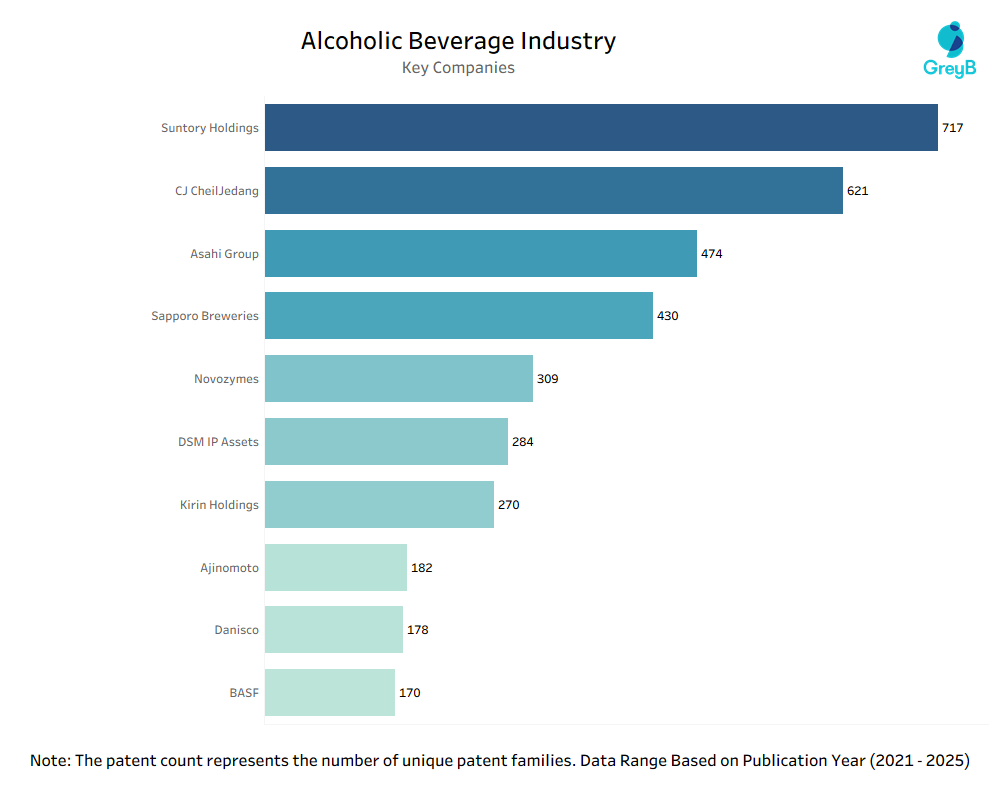
The alcohol beverage patent landscape is shaped by both global drink producers and biotechnology companies. Leaders such as Suntory Holdings, CJ CheilJedang, and Asahi Group Holdings dominate patent filings, with additional contributions from Japanese players like Sapporo Breweries and Kirin Holdings.
At the same time, the presence of biotech firms including Novozymes, DSM, and BASF underscores the growing importance of scientific innovation. This convergence reflects a broader industry shift, where innovation extends beyond traditional manufacturing processes to include advancements in ingredients, fermentation technologies, and product design.
As a result, competition is increasingly driven by integrated expertise across both beverage production and biotechnology.
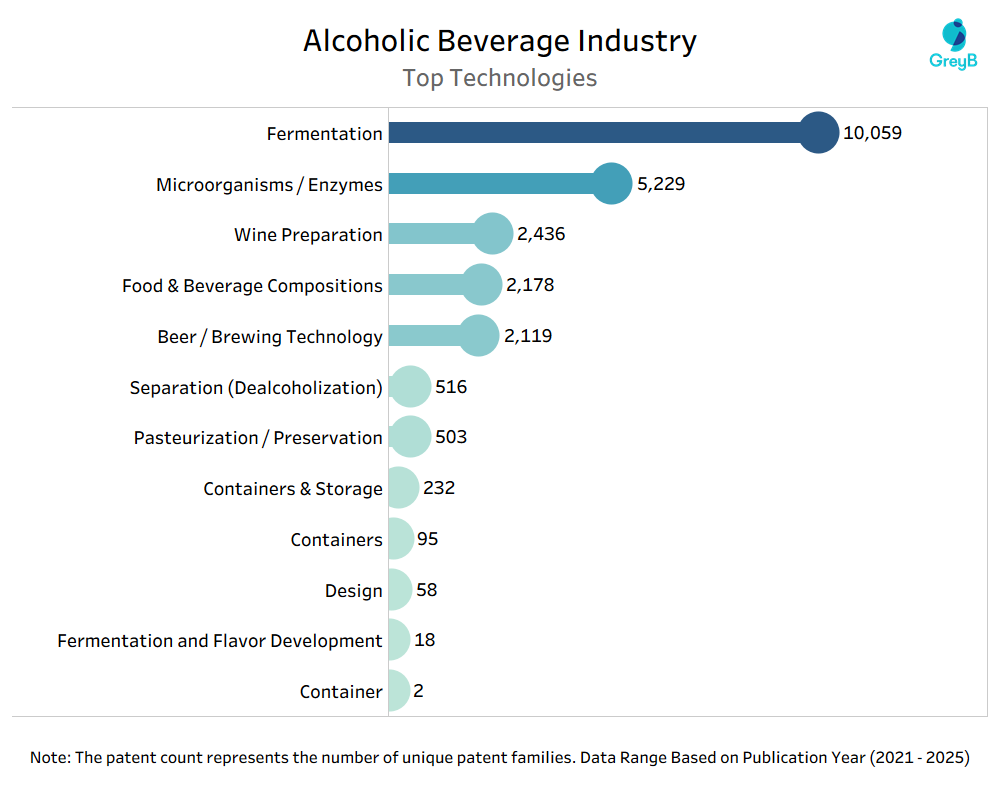
The field of fermentation technology holds a clear dominance as far as innovation is concerned, having the highest number of patents issued in the industry. It is an indicator of its important role in manufacturing operations.
A considerable level of activity is recorded in the domain of microorganisms and enzymes. This indicates that biotechnological innovations have a rising importance in this industry in view of increasing their effectiveness and product quality.
However, other fields, including winemaking, beer brewing, as well as ingredients used for food and beverages, are still witnessing steady innovation.
There is another trend, which relates to increased activities in such areas as dealcoholization and food preservation technologies. This development can be associated with the current need for low- and non-alcoholic drinks.
Competitive environment among the patents registered in the alcohol based drinks sector is dominated by international drinks producers as well as biotechnology companies.
Notable among those leading in the number of patent families are Suntory Holdings, CJ CheilJedang, and Asahi Group Holdings, while Sapporo Breweries and Kirin Holdings add more Japanese companies to the list of key market players.
In addition to that, the presence of companies like Novozymes, DSM, and BASF points to the importance that the industry places on innovation in the form of biotechnology and ingredient inventions.
This blend of drinks companies and biotech enterprises is indicative of the change in the approach towards innovation in the industry, which now focuses on more than just manufacturing processes but extends to ingredient innovation as well as innovations in product design.
Full breakdown of patent portfolios by technology area.
Year-wise evolution of filings by technology area from 2003 to 2025.
Rank-list of top companies/assignees in the alcoholic beverage patent landscape and their filing trends.
Global distribution of filings: country-wise data & year-wise evolution.
Legal status analysis: how many are active, granted, abandoned etc.
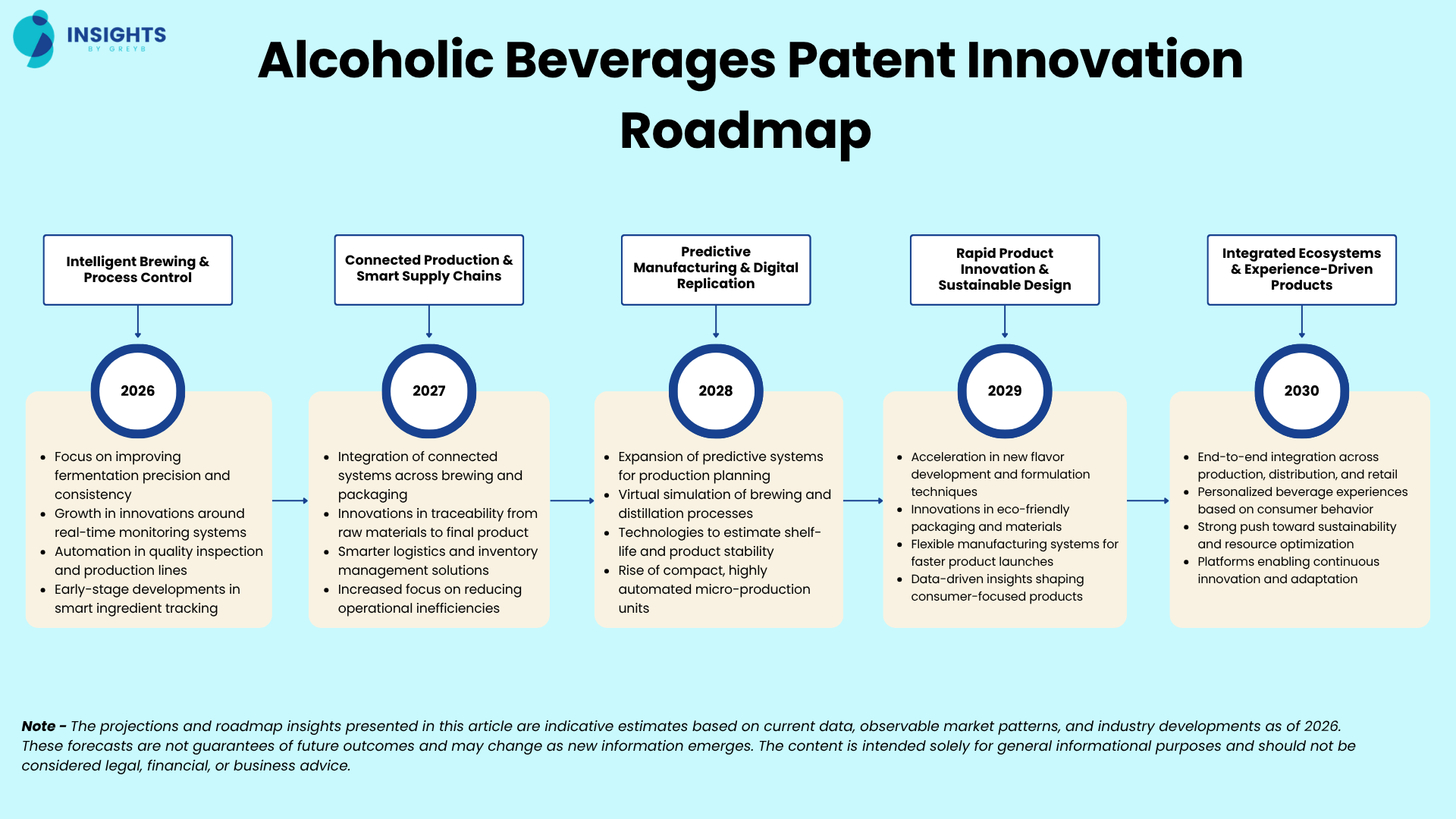
Future directions & upcoming innovation hotspots in the alcoholic beverage space.
We provide end-to-end intelligence and scouting services to help you navigate the complex innovation landscape and stay ahead of the competition.
Ready to explore a custom project?
Our analysts are ready to help you build your innovation roadmap.