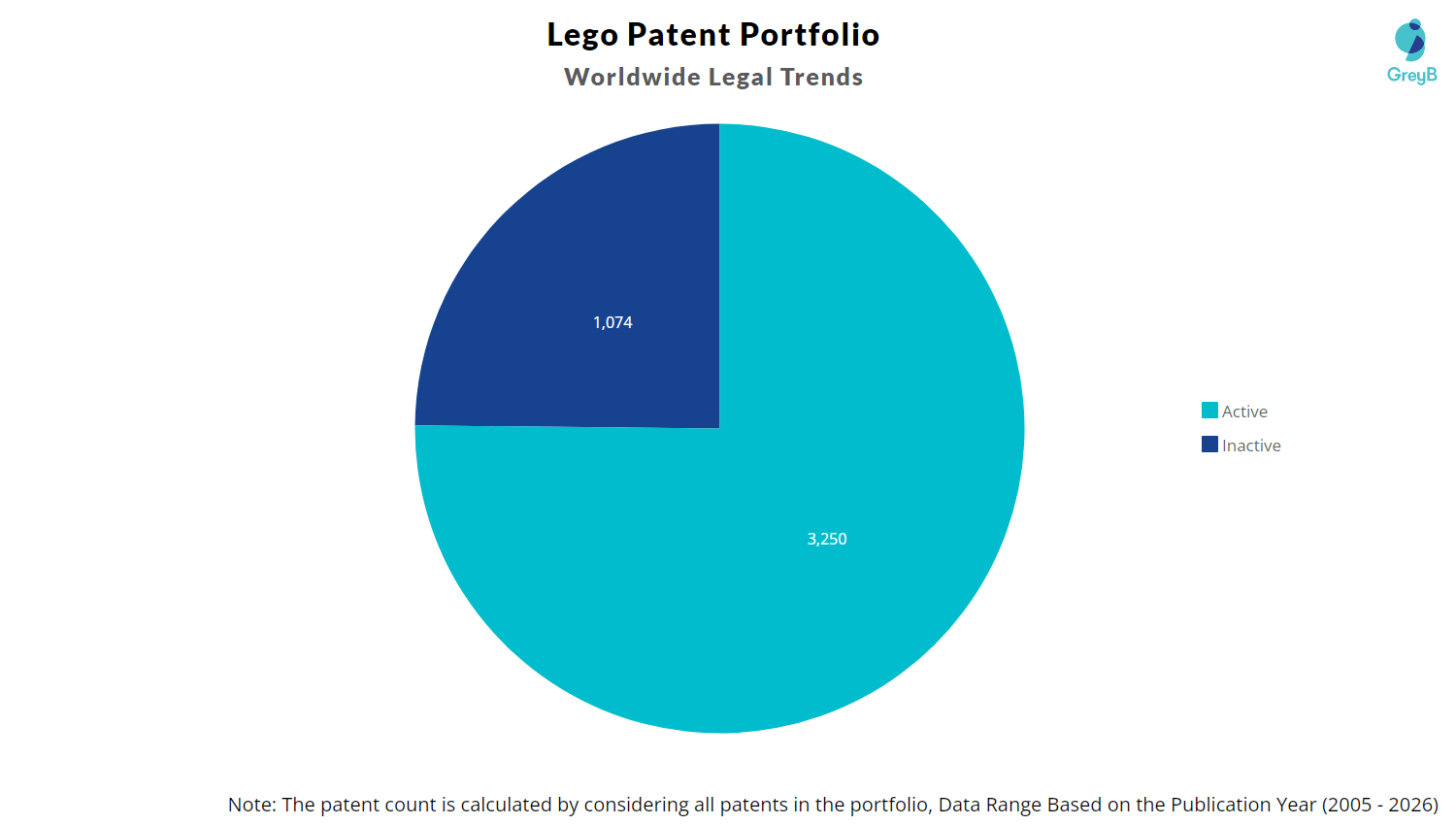
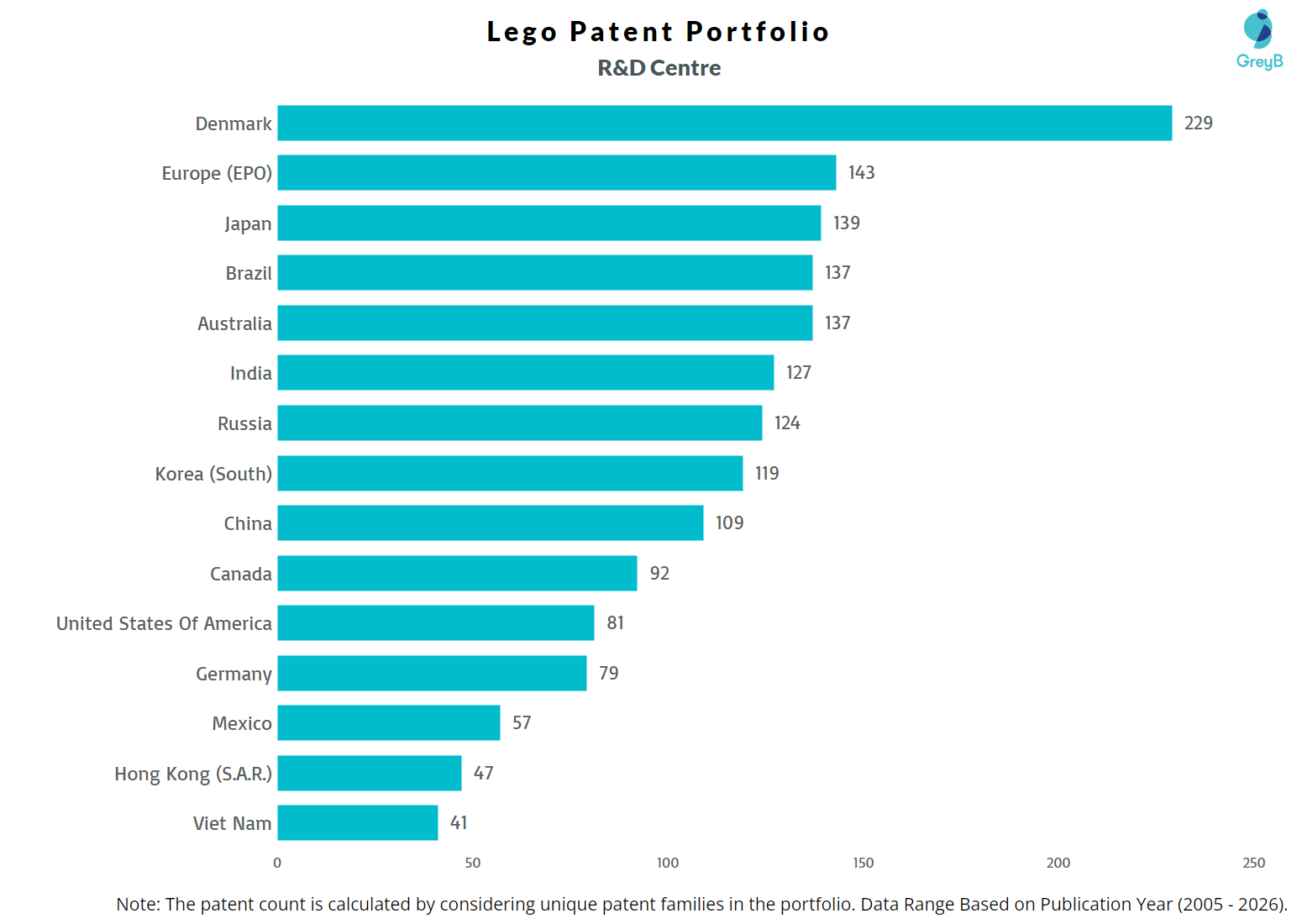
Lego has a total of 4324 patents globally, out of which 3725 have been granted. Of these 4324 patents, 75% patents are active. United States of America is where Lego has filed the maximum number of patents, followed by Japan and China. Parallelly, Denmark seems to be the main focused R&D center and is also the origin country of Lego.
Lego was founded in the year 1932 by Ole Kirk Christiansen. Company is doing business in manufacturing Lego-brand toys, consisting mostly of interlocking plastic bricks. The Lego Group has also built several amusement parks around the world, each known as LEGOLAND, and operates numerous retail stores.
Do read about some of the most popular patents of Lego which have been covered by us in this article and also you can find Lego’s patents information, the worldwide patent filing activity and its patent filing trend over the years, and many other stats over Lego’s patent portfolio.
Lego Innovation Prediction Roadmap: 2025–2030
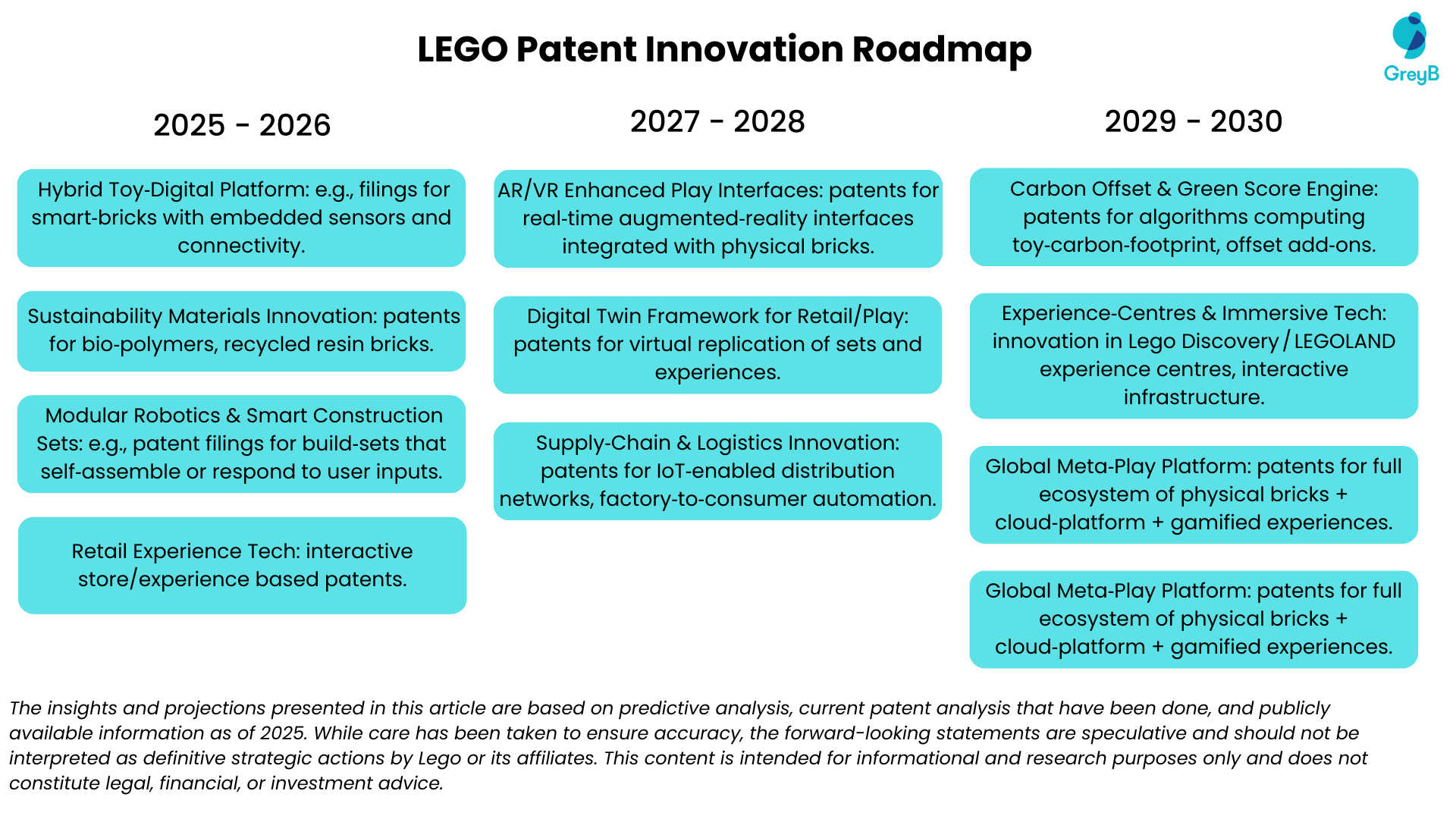
The insights and projections presented in this article are based on predictive analysis, current patent analysis that have been done, and publicly available information as of 2025. While care has been taken to ensure accuracy, the forward-looking statements are speculative and should not be interpreted as definitive strategic actions by Lego or its affiliates. This content is intended for informational and research purposes only and does not constitute legal, financial, or investment advice.
Keep track of every patent move and monitor competitor activity in real-time. Click here for full insights:
How many patents does Lego have?
Lego has a total of 4324 patents globally. These patents belong to 1768 unique patent families. Out of 4324 patents, 3250 patents are active.
How Many Patents did Lego File Every Year?
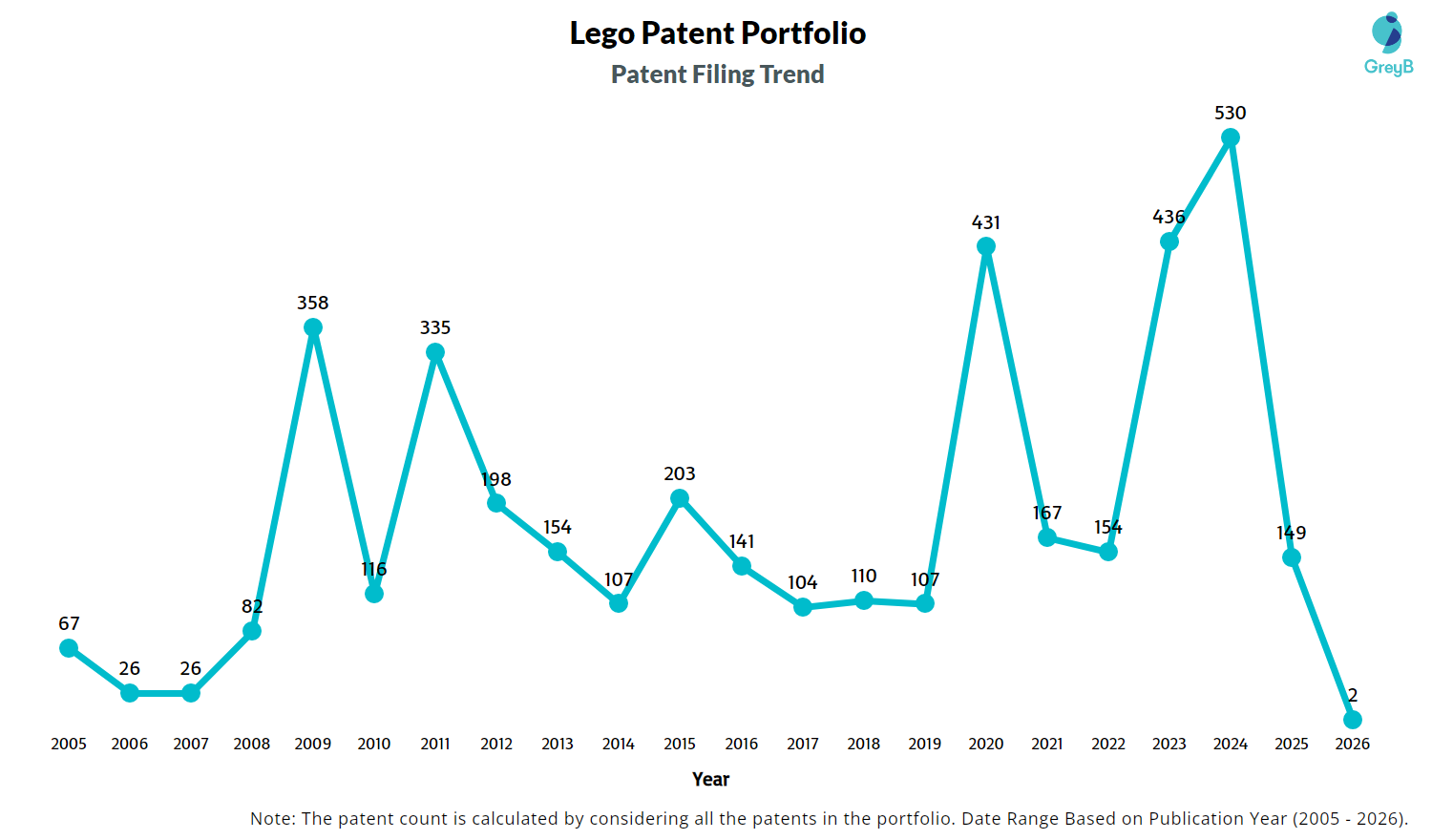
Are you wondering why there is a drop in patent filing for the last two years? It is because a patent application can take up to 18 months to get published. Certainly, it doesn’t suggest a decrease in the patent filing.
| Year of Patents Filing or Grant | Lego Applications Filed | Lego Patents Granted |
| 2026 | 2 | 61 |
| 2025 | 149 | 604 |
| 2024 | 530 | 372 |
| 2023 | 436 | 207 |
| 2022 | 154 | 204 |
| 2021 | 167 | 276 |
| 2020 | 431 | 213 |
| 2019 | 107 | 99 |
| 2018 | 110 | 75 |
| 2017 | 104 | 106 |
How many Lego patents are Alive/Dead?
Worldwide Patents
How Many Patents did Lego File in Different Countries?
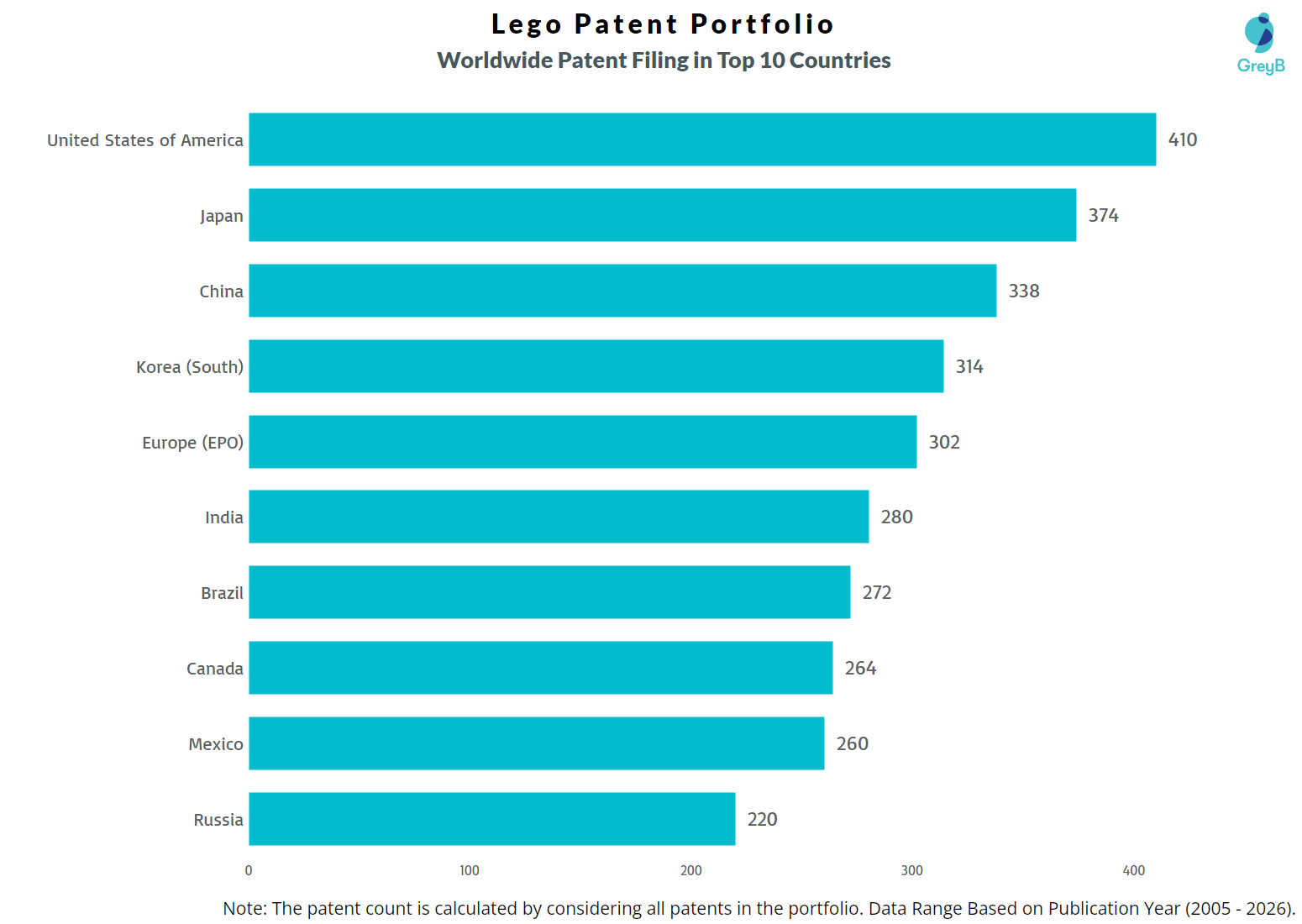
Countries in which Lego Filed Patents
| Country | Patents |
| United States of America | 410 |
| Japan | 374 |
| China | 338 |
| Korea (South) | 314 |
| Europe (EPO) | 302 |
| India | 280 |
| Brazil | 272 |
| Canada | 264 |
| Mexico | 260 |
| Russia | 220 |
| Hong Kong (S.A.R.) | 212 |
| Australia | 209 |
| Denmark | 166 |
| Germany | 143 |
| Norway | 61 |
| Spain | 48 |
| Poland | 44 |
| Viet Nam | 42 |
| United Kingdom | 41 |
| Austria | 23 |
| Indonesia | 21 |
| Russia | 19 |
| Portugal | 11 |
| Israel | 8 |
| Costa Rica | 7 |
| Argentina | 6 |
| Switzerland | 6 |
| Colombia | 5 |
| Singapore | 4 |
| United Arab Emirates | 2 |
| Turkey | 2 |
| Italy | 1 |
| Chile | 1 |
| Taiwan | 1 |
Where are Research Centers of Lego Patents Located?
10 Best Lego Patents
US6353170B1 is the most popular patent in the Lego portfolio. It has received 440 citations so far from companies like Snap Inc, Sony and Google.
Below is the list of 10 most cited patents of Lego:
| Publication Number | Citation Count |
| US6353170B1 | 269 |
| WO2016075081A1 | 200 |
| US20070262984A1 | 113 |
| US7708615B2 | 93 |
| US7596473B2 | 91 |
| US6939192B1 | 90 |
| US8753164B2 | 87 |
| US7695338B2 | 54 |
| WO2007137577A1 | 54 |
| USD539364S1 | 53 |
What Percentage of Lego US Patent Applications were Granted?
Lego (Excluding its subsidiaries) has filed 220 patent applications at USPTO so far (Excluding Design and PCT applications). Out of these 160 have been granted leading to a grant rate of 87.43%.
Below are the key stats of Lego patent prosecution at the USPTO.

Which Law Firms are managing US Patents for Lego?
| Law Firm | Total Applications | Success Rate |
| Day Pitney Llp | 187 | 84.67% |
| Gerald Levy | 16 | 100.00% |
| Pitney Hardin Kipp & Szuch Llp | 9 | 100.00% |
| Cantor Colburn Llp | 3 | 100.00% |
| 1Ane Dalsimer Sullivan Kurucz | 1 | 100.00% |
| Finnegan Henderson Farabow | 2 | 100.00% |
| Kane Dalsimer Sullivan Kurucz | 1 | 100.00% |
| Reza Green Esq | 1 | 100.00% |
What Was LEGO’s Original Patent and How Did It Build the Foundation of Its Success?
LEGO’s global success began with its early brick patents, particularly the 1958 invention of the interlocking brick with an internal tube system (granted as US3005282A in 1961).
This design improved stability and clutch power, forming the foundation of LEGO’s “System in Play,” where bricks remain compatible across generations. Although the core patent expired in 1978, LEGO sustained its dominance through strong branding, trademarks, and continuous innovation rather than relying solely on patent protection.
What Do LEGO’s 2026 Patent Publications Indicate about Its Future Strategy?
LEGO’s 2026 patent publications show that the company is preparing for the future by going beyond traditional building bricks. Many of the new patents relate to wireless features, motors, chargers, and interactive systems, which suggests that LEGO is focusing on smarter and more connected toys. This means the company wants children to not just build models, but also interact with them through movement, electronics, and possibly digital apps.
At the same time, some patents focus on improving durability, packaging, and easier assembly. This shows LEGO is also working on making its products stronger, longer-lasting, and more user-friendly. Overall, these filings suggest that LEGO’s future strategy is to combine physical play with technology while continuing to improve quality and customer experience.
Which 2026 LEGO Patents Highlight Its Shift Toward Smart and Connected Toys?
CN121419820A– System and Method for Group Wireless Broadcasting in a Toy or Educational System
This patent shows that LEGO is working on toys that can connect and communicate with each other wirelessly. Instead of playing with one set at a time, multiple LEGO elements could interact or work together in a synchronized way. This makes play more dynamic and engaging, especially in group or classroom settings.
It highlights LEGO’s shift toward smart and connected toys because the focus is no longer just on building physical models, but on creating toys that can share signals, respond together, and possibly connect with digital apps. This shows LEGO is moving toward interactive and technology-enabled play experiences.
Want to track LEGO’s patent activity and stay updated on upcoming patent expirations and new filings? Explore our patent monitoring service – click here to request a demo.
What are Lego Top innovation segments?
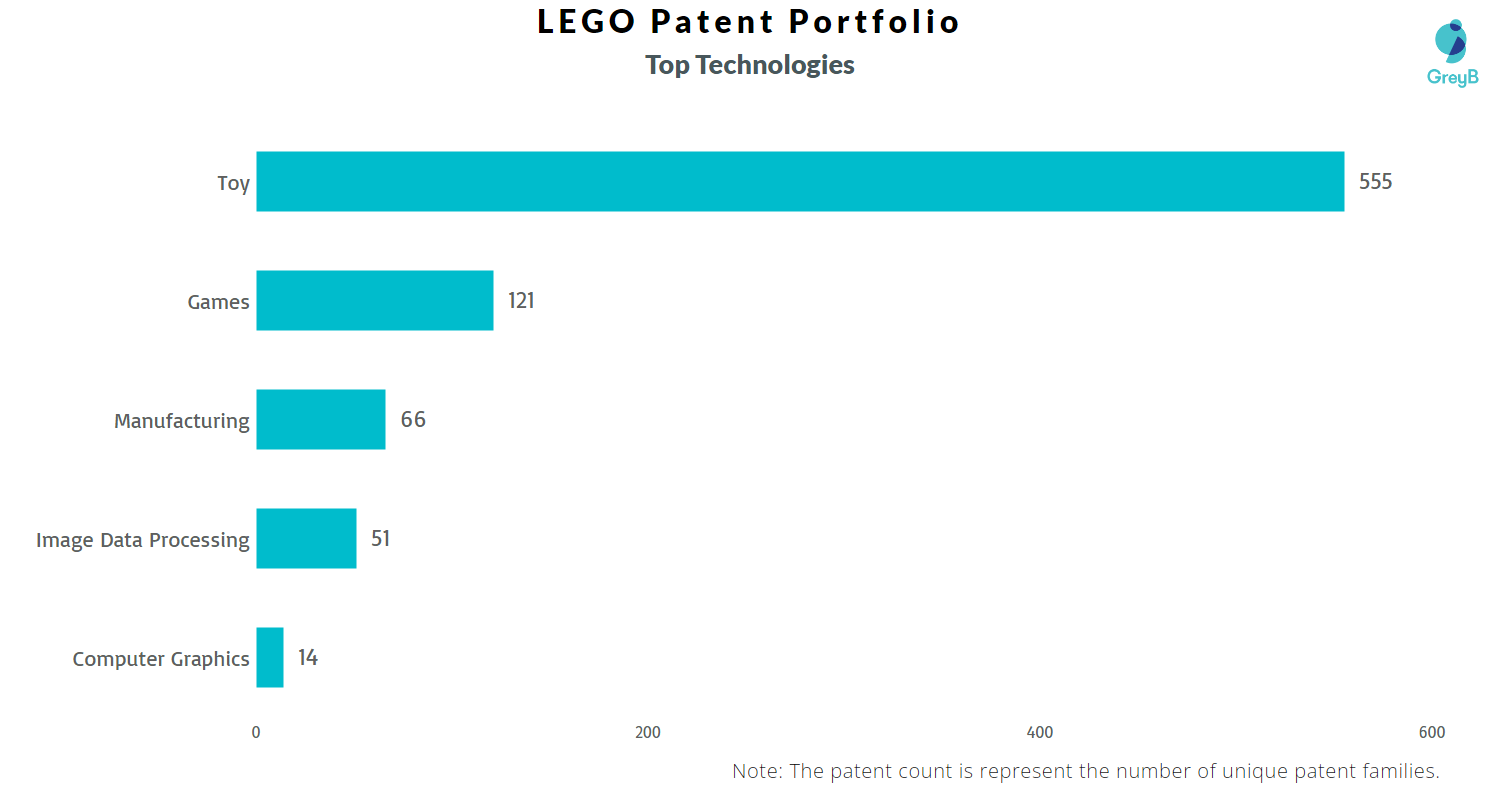
Top technologies in Lego’s patent portfolios relate mostly to Toy, Games, Manufacturing, Image data Processing and Computer Graphics.
Patents related to toy includes all types of toys that Lego build: Robot toys, vehicle toys, dolls, Lego plastic bricks and much more.
Games patents encapsulates board games, gaming systems, game dice, controllers and virtual games.
Manufacturing related patents describe the process of manufacturing of different kinds of plastics toys or products, injection-moulding, additives and shaping or moulding of plastic.
Patents related to image data processing indicates various processes of rendering of images and image pattern recognition.
Computer Graphics patents encapsulates 3D rendering of objects, ray tracing, 3D modelling, digital representation and graphics rendering.
Lego’s most cited patent US20040186623A1 relates to controlling process in a toy robot, the toy robot detects an object in a number of predetermined zones relative to the robot and for generating a detection signal identifying the zones; and further process the information for selecting and performing a predetermined action from a number of actions in response to a particular detection signal.
Top Emerging Technologies of Lego
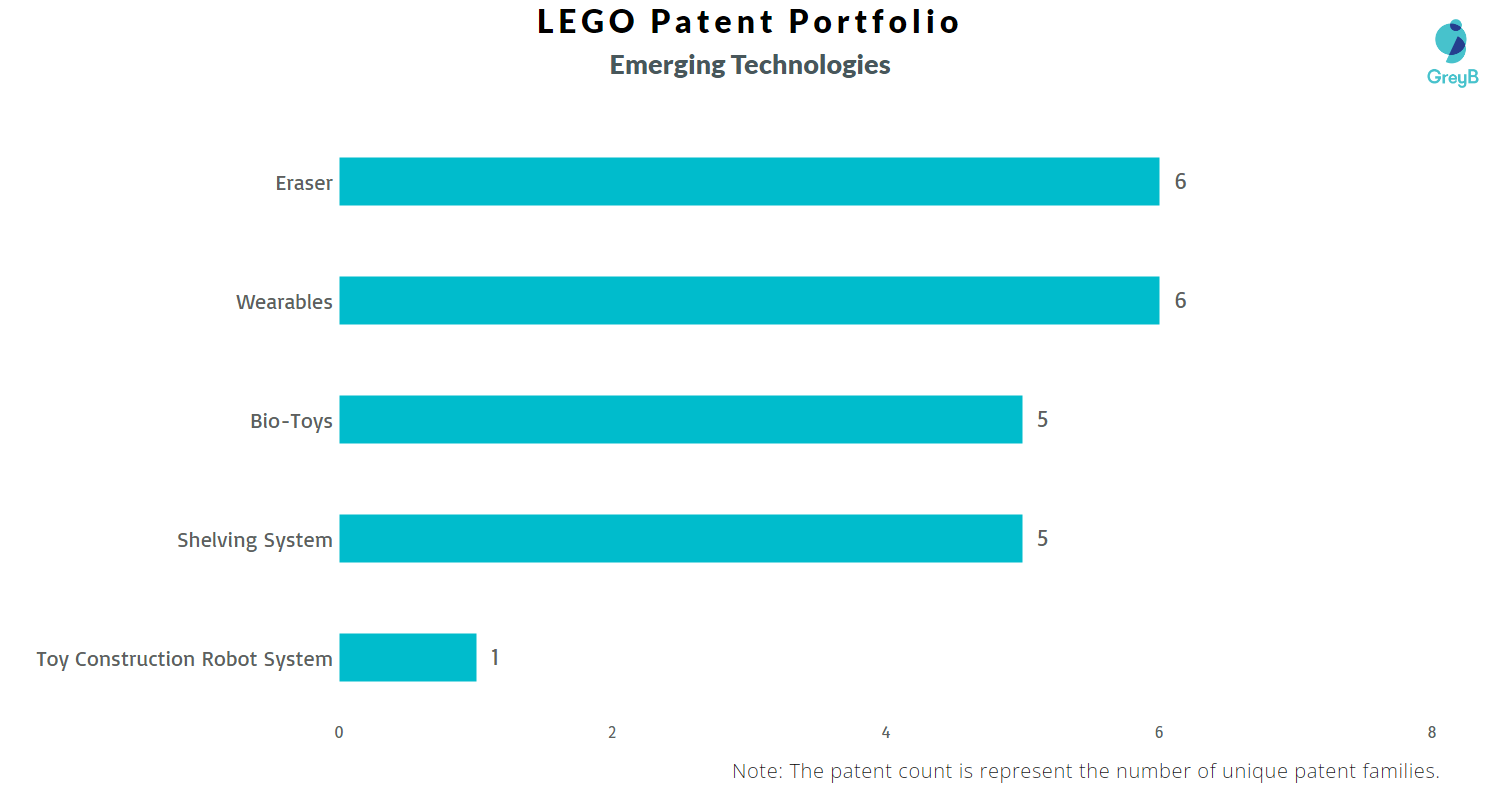
It was very interesting to note that Lego is also working on technologies such as eraser, wearables, bio-toys, shelving systems and toy construction robot systems.
Erasers patents relates to an eraser made from a relatively resilient material having eraser properties allowing it to be used for erasing.
Patents related to Wearables relates to a wearable toy system which includes a wearable component that has at least one fastening member for securing the wearable component to a section of the user’s body such as watches, bands, and more.
Bio-Toys patents particularly indicates the toys which are made of biopolymers and are biodegradable in nature and also toys which are made from recycled ABS (Acrylonitrile Butadiene Styrene) material.
Patents related to Shelving Systems relates to a shelving system comprising a mounting surface and at least one shelving unit. It is therefore an object to increase the variety of choices.
Patent related to Toy Construction Robot System relates in to a toy construction robot system comprising a robot control unit, the robot control unit comprises of a housing which includes a coupling element configured to releasably interconnect the robot control unit with a cooperating toy component; a processor including programmed instructions; and a plurality of I/O ports configured to communicate with the processor. It serves many functions such as providing a highly interactive and stimulating play experience to a user, particularly a child.
How Are LEGO’s Business Moves Redefining Its Innovation Ecosystem?
- In March 2025, Lego revealed its largest product portfolio yet at Toy Fair 2025: more than 340 sets across 30 themes including the first sets from the newly revealed LEGO® Bluey™ theme in partnership with BBC Studios.
- In H1 2025, Lego’s revenue grew 12% to DKK 34.6 billion and profit up 10%, driven by innovation, new sets, global expansion and sustainability efforts.
- Lego also announced the creation of a new entity, LEGO Digital Play, to explore innovative new branded gaming experiences beyond current offerings (including prior partnerships such as LEGO Fortnite).
- In September 2025, Lego agreed to acquire 29 LEGO® Discovery Centres and LEGOLAND® Discovery Centres from Merlin Entertainments.
- Lego announced the use of a new material rSEBS (from recycled fishing nets/engine oil) and e‑methanol derived materials for making rigid elements such as wheel axles and minifigure hands.
What Should IP Leaders Be Watching in LEGO’s Evolving Innovation Strategy?
As The LEGO Group expands its innovation footprint, several strategic shifts are beginning to shape the future direction of its IP strategy. The company’s aggressive move into digital spaces, evident through the launch of LEGO® Digital Play, signals a transition toward hybrid physical-digital ecosystems. This initiative, paired with prior partnerships like Fortnite and the recent Bluey™ collaboration, hints at an IP pipeline poised to grow in areas like augmented reality play, smart bricks and modular robotics. This might indicate increased filings around embedded sensors, interactive gameplay mechanics and AI-driven build experiences as LEGO seeks to future-proof its play formats.
Sustainability is becoming central to LEGO’s materials innovation. With 47% of raw materials now certified as sustainable and the integration of rSEBS and e-methanol-based compounds into manufacturing, the company is likely to accelerate filings related to bio-polymers, recyclable construction elements and low-emission production technologies. This also introduces a new layer of licensing and competitive differentiation, especially for portfolio managers and R&D teams building sustainable toy alternatives.
LEGO’s acquisition of Discovery Centres globally, combined with the opening of a new factory in Vietnam, suggests a dual strategy: deepening experiential brand engagement while reinforcing supply chain agility. These developments could drive IP activity around immersive retail experiences, IoT-driven engagement zones and advanced manufacturing processes. Meanwhile, with IP citations used in hundreds of rejections globally, LEGO’s patents are already shaping competitive boundaries in the toy-tech space.
Given technical insights are based on the (2003 to 2022), would you like to know what Lego updated in technical segments and where Lego increased its filing? Fill out the form to get the details.