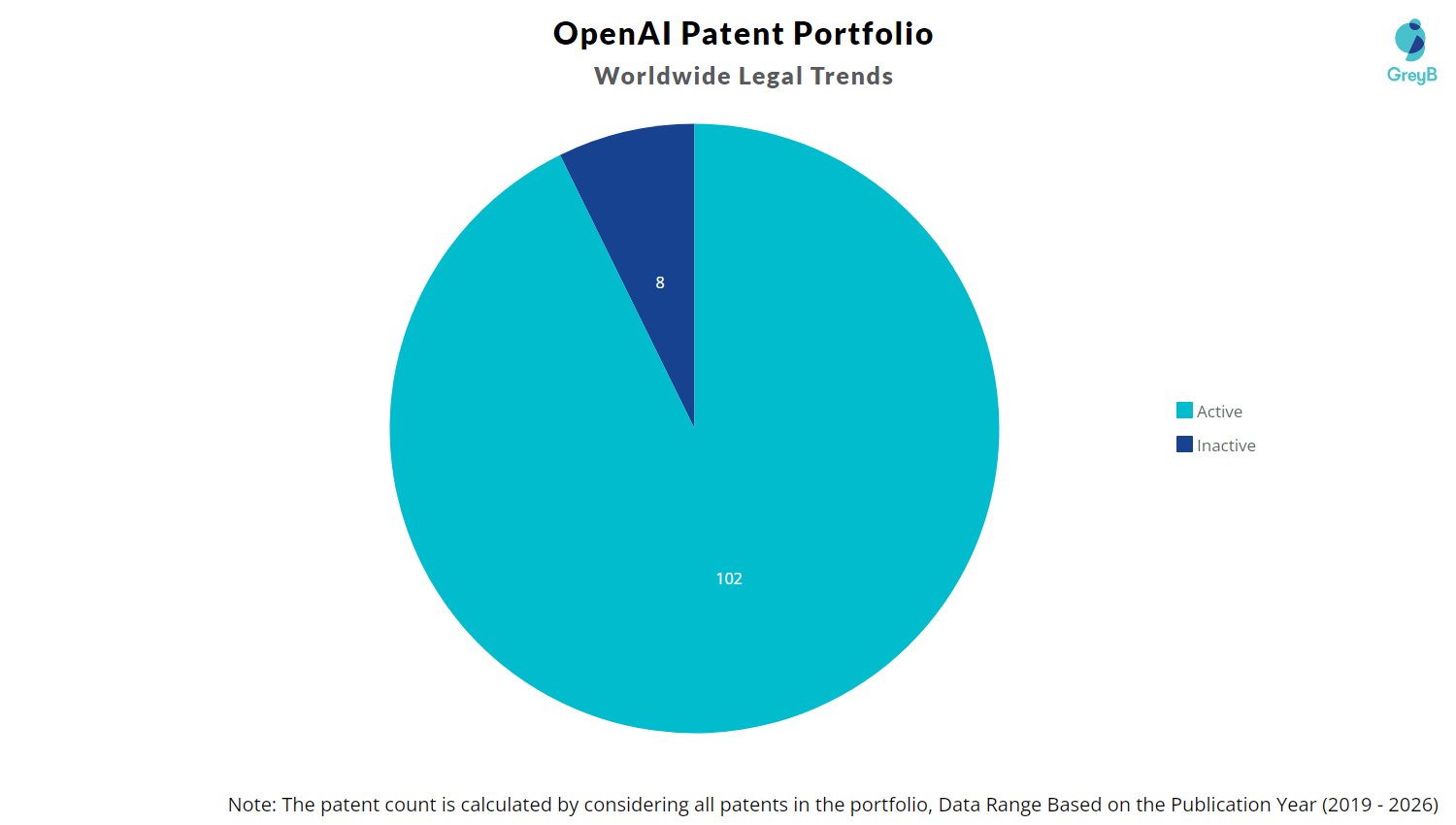
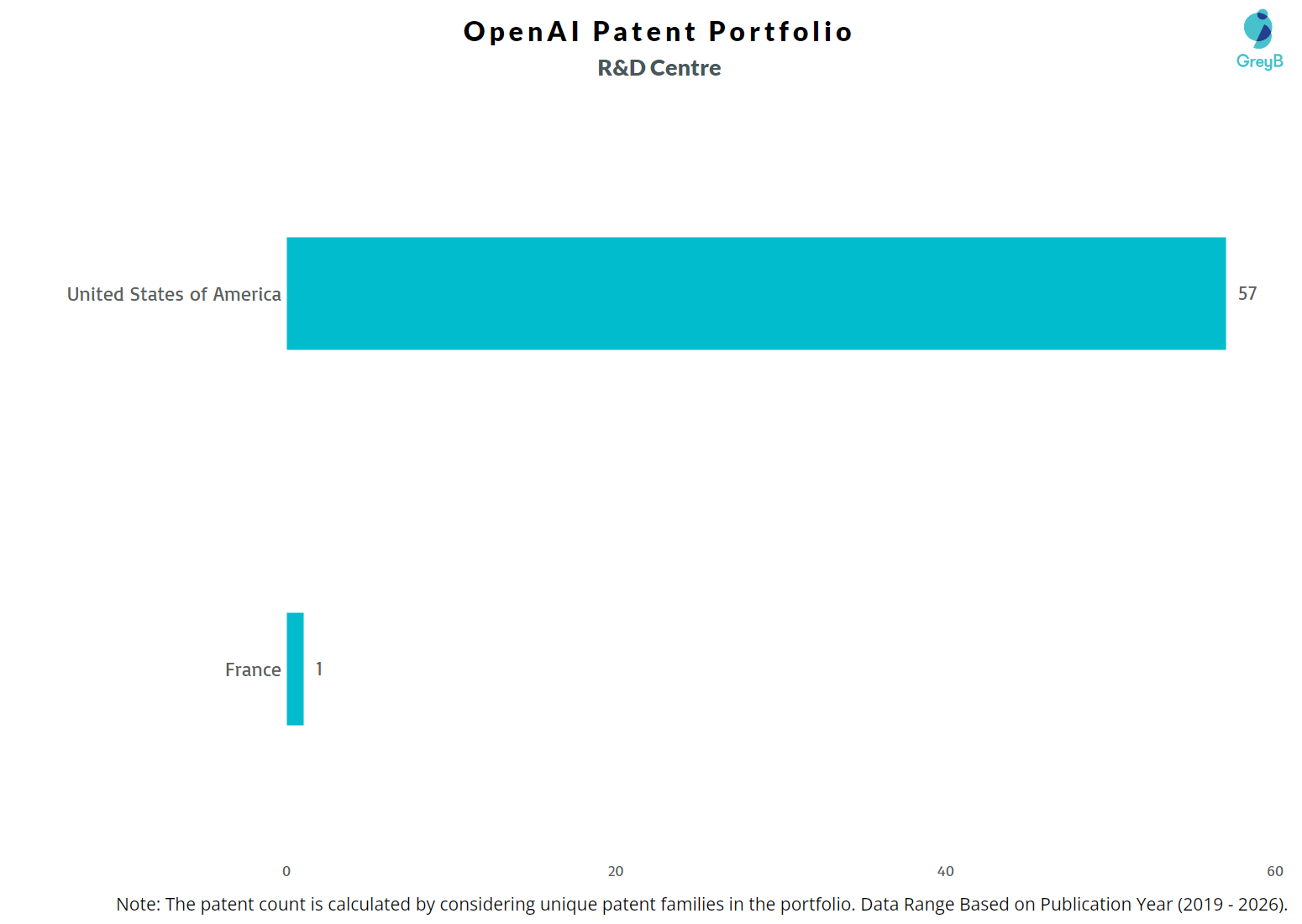
OpenAI has a total of 110 patents globally, out of which 42 have been granted. Of these 110 patents, more than 93% patents are active. The United States is where OpenAI has filed the maximum number of patents. Parallelly, the United States of America seems to be the main focused R&D center of OpenAI and is also the origin country of the firm.
OpenAI, also known by OpenAI OpCo LLC, was founded in the year 2015 by Elon Musk, Greg Brockman, Ilya Sutskever, John Schulman, Sam Altman and Wojciech Zaremba. The company is an AI research and deployment company that conducts research and implements machine learning.
Yes! This is the organisation that created ChatGPT. ChatGPT is a specific product built upon the foundation of OpenAI’s research in large language models (LLMs).
Do read about some of the most popular patents of OpenAI which have been covered by us in this article and also you can find OpenAI patents information, the worldwide patent filing activity and its patent filing trend over the years, and many other stats over OpenAI patent portfolio.
OpenAI Innovation Prediction Roadmap: 2025–2030
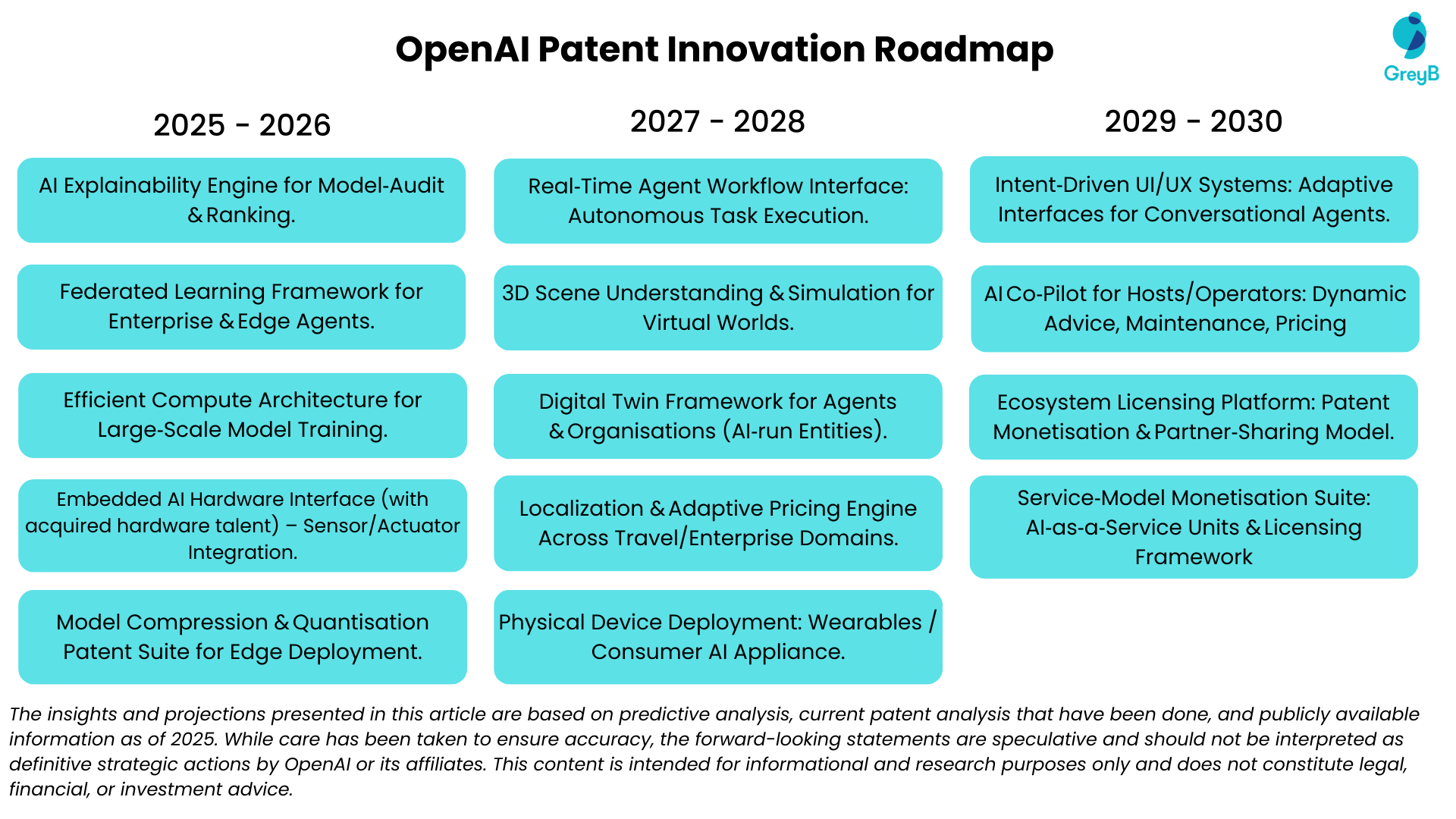
The insights and projections presented in this article are based on predictive analysis, current patent analysis that have been done, and publicly available information as of 2025. While care has been taken to ensure accuracy, the forward-looking statements are speculative and should not be interpreted as definitive strategic actions by OpenAI or its affiliates. This content is intended for informational and research purposes only and does not constitute legal, financial, or investment advice.
Want to explore which innovation areas OpenAI is likely to focus on next and where its future patent surge could occur? Fill out the form to get the details.
How many patents does OpenAI have?
OpenAI has a total of 110 patents globally. These patents belong to 58 unique patent families. Out of 110 patents, 102 patents are active.
How Many Patents did OpenAI File Every Year?
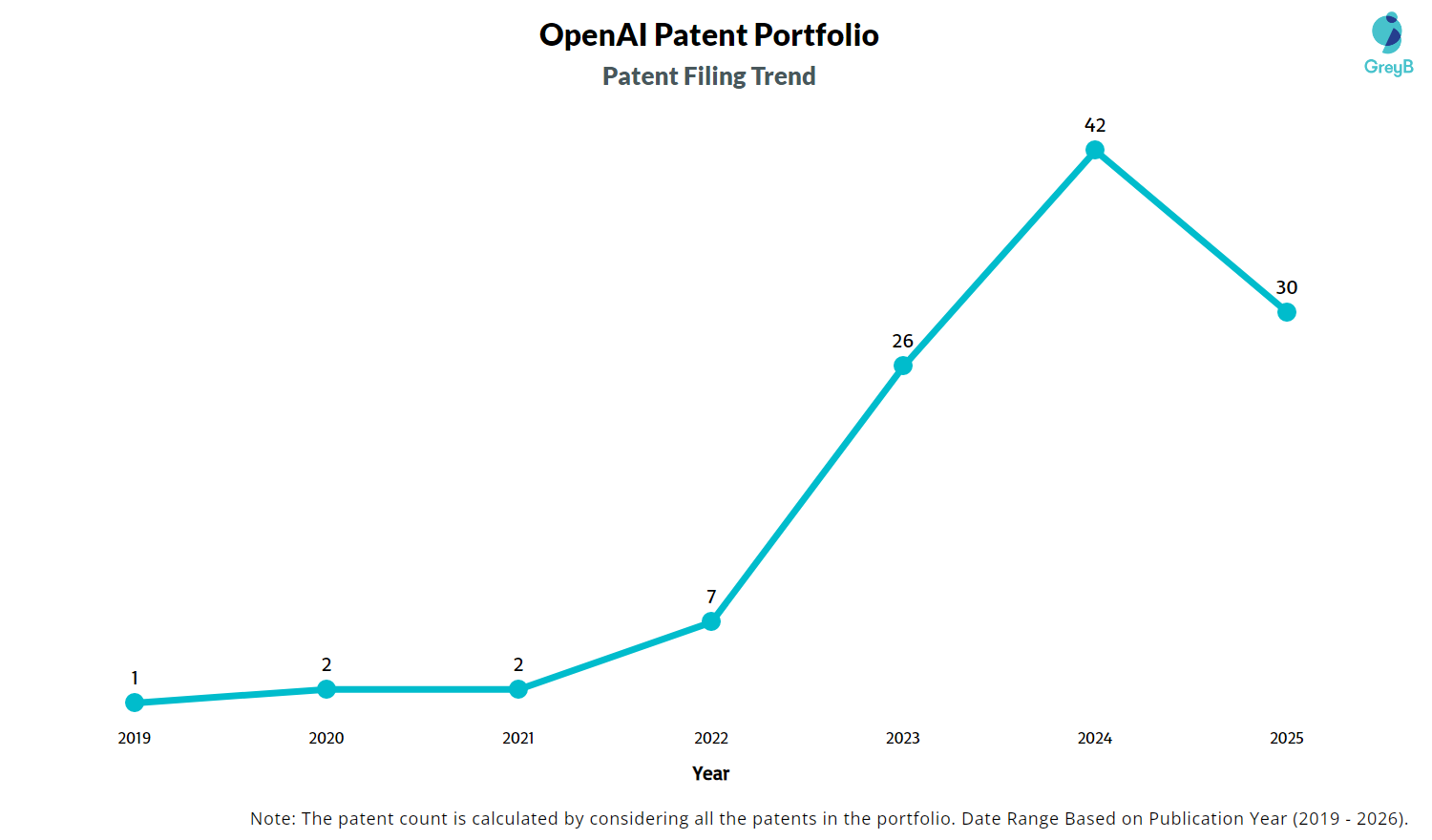
Are you wondering why there is a drop in patent filing for the last two years? It is because a patent application can take up to 18 months to get published. Certainly, it doesn’t suggest a decrease in the patent filing.
| Year of Patents Filing or Grant | OpenAI Applications Filed | OpenAI Patents Granted |
| 2025 | 30 | 5 |
| 2024 | 42 | 14 |
| 2023 | 26 | 16 |
| 2022 | 7 | 4 |
| 2021 | 2 | 2 |
| 2020 | 2 | 1 |
| 2019 | 1 | – |
How many OpenAI patents are Alive/Dead?
Worldwide Patents
How Many Patents did OpenAI File in Different Countries?
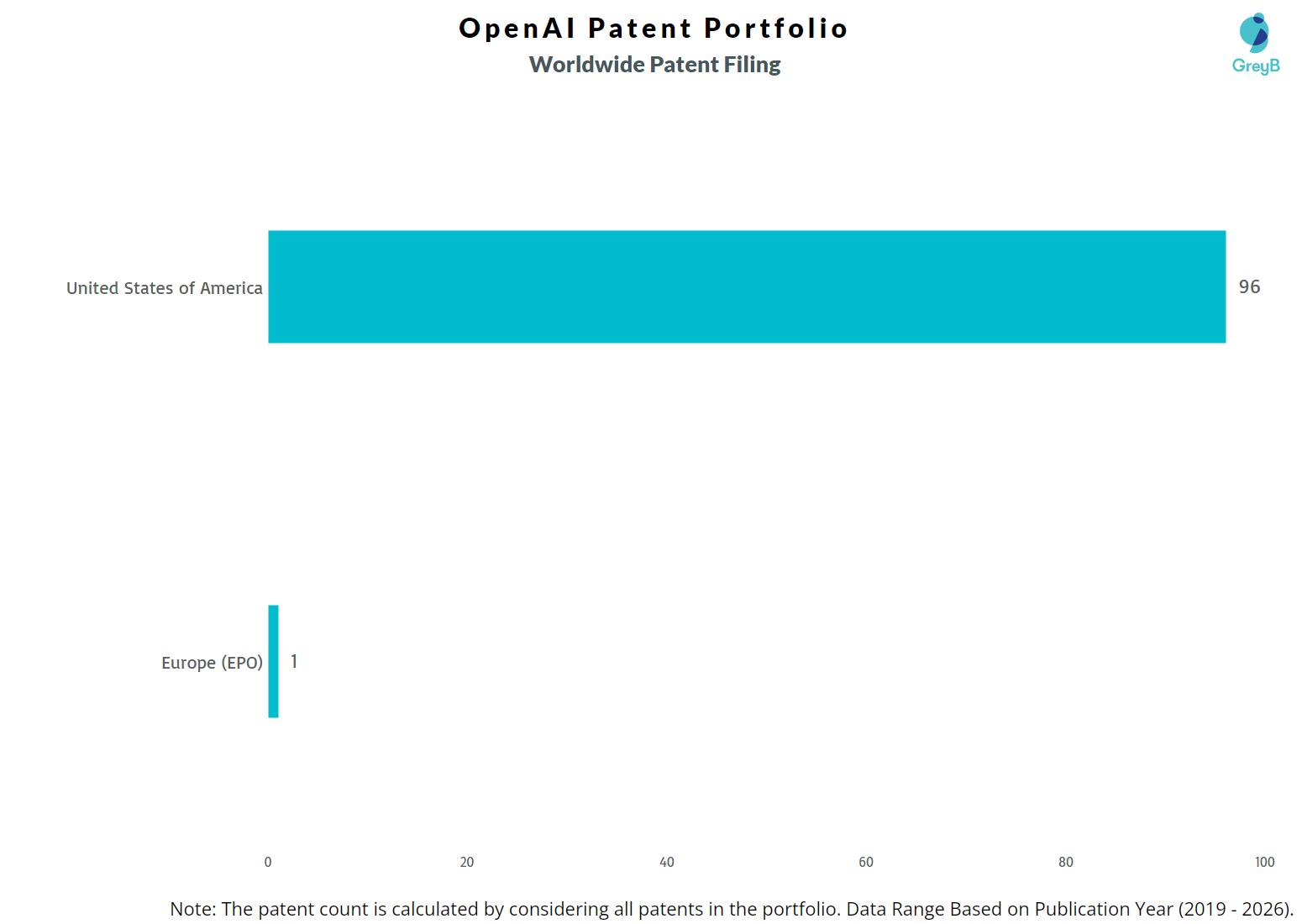
Countries in which OpenAI Filed Patents
| Country | Patents |
| United States of America | 96 |
| Europe (EPO) | 1 |
Where are Research Centres of OpenAI Patents Located?
10 Best OpenAI Patents
US11922550B1 is the most popular patent in the OpenAI portfolio. It has received 36 citations so far from companies like Google and Adobe.
Below is the list of 10 most cited patents of OpenAI:
| Publication Number | Citation Count |
| US11922550B1 | 36 |
| US11983806B1 | 27 |
| US11886826B1 | 15 |
| US20190311018A1 | 15 |
| US11983488B1 | 9 |
| US12051205B1 | 8 |
| US20240362421A1 | 8 |
| US12079587B1 | 7 |
| US11922144B1 | 7 |
| US20250103910A1 | 6 |
What Has OpenAI Been Building Behind the Scenes Between 2015 and 2025?
OpenAI has been undergoing a corporate restructuring, converting its business into a public‑benefit corporation structure, which opens the door to more commercial opportunity.
The firm announced a major multi‑year cloud/compute arrangement with Amazon (AWS) for tens of billions of dollars worth of infrastructure, underpinning its model‑training and deployment capabilities.
OpenAI signalled a pivot into consumer‑hardware/embedded AI via its acquisition of hardware startup io Products Inc. (co‑founded by Jony Ive) valued at ~$6.4 – 6.5 billion.
OpenAI’s acquisition of coding‑assistance firm Windsurf (previously Codeium) for ~$3 billion was reported in May 2025, enhancing its enterprise/coding ecosystem.
How Do OpenAI’s Recent Moves Reshape the IP Landscape?
OpenAI’s recent strategic pivots, from acquiring hardware design talent to scaling compute infrastructure and enterprise tools, signal a dramatic expansion in the scope of its innovation.
This trajectory suggests that its patent filings will likely evolve from software-centric inventions to cover integrated systems, hardware interfaces and agent-based architectures. The current US-only filing strategy, while focused, hints at untapped global protection opportunities, especially as OpenAI enters consumer markets.
For IP professionals, this presents a dual challenge: navigating potential overlaps in emerging agent technologies and anticipating cross-domain filings that combine software, hardware and services. In this context, OpenAI’s tightly held, high-citation patent families are not just protective, they are strategic levers that could shape licensing, enforcement, and innovation direction in the years ahead.
Need to know anything else? We got you covered!