Anthropic has a total of 39 patents globally, out of which 30 have been granted. Of these 39 patents, all the patents are active. The United States of America is where Anthropic has filed the maximum number of patents, followed by Germany and Australia. Parallelly, United States of America seems to be the main focused R&D centre and also is the origin country of Anthropic.
Anthropic was founded in 2021. Anthropic is an AI research company focused on building reliable and safe artificial intelligence systems. It develops advanced language models that can understand and generate human-like text.
The company emphasizes AI safety, alignment, and responsible deployment of technology. Its models are used by businesses and developers to power applications like chatbots, research tools, and automation solutions.
Do read about some of the most popular patents of Anthropic which have been covered by us in this article and also you can find Anthropic patents information, the worldwide patent filing activity and its patent filing trend over the years, and many other stats over Anthropic patent portfolio.
How many patents does Anthropic have?
Anthropic has a total of 39 patents globally. These patents belong to 18 unique patent families. Out of 39 patents, all the patents are active.
How Many Patents did Anthropic File Every Year?
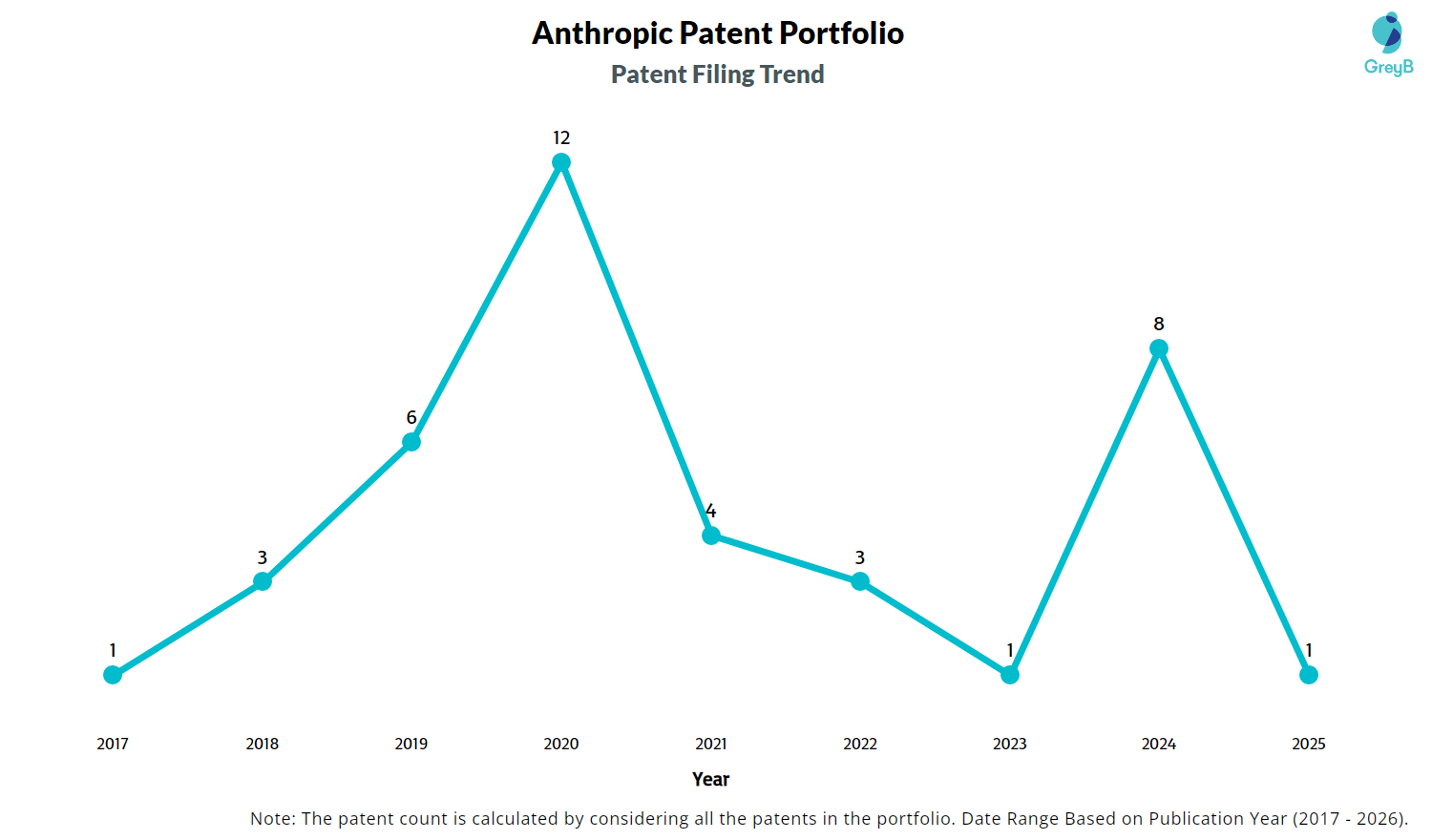
Anthropic’s patent activity shows clear ups and downs over the years. From 2017 to 2019, filings increased steadily, reaching a big peak in 2020. This suggests a strong push in innovation during that time.
After 2020, the number of filings dropped and stayed lower through 2023, which may mean the company focused more on developing existing technologies rather than filing many new patents.
In 2024, filings increased again, showing renewed research efforts. The lower number in 2025 could be due to fewer filings so far or delays in publication. Overall, the trend shows phases of strong innovation followed by more focused and selective patent activity.
Are you wondering why there is a drop in patent filing for the last two years? It is because a patent application can take up to 18 months to get published. Certainly, it doesn’t suggest a decrease in the patent filing.
| Year of Patents Filing or Grant | Anthropic Applications Filed | Anthropic Patents Granted |
| 2025 | 1 | 6 |
| 2024 | 8 | 2 |
| 2023 | 1 | 10 |
| 2022 | 3 | 6 |
| 2021 | 4 | 6 |
| 2020 | 12 | – |
| 2019 | 6 | – |
| 2018 | 3 | – |
| 2017 | 1 | – |
How many Anthropic patents are Alive/Dead?
All the Anthropic patents are alive.
How Many Patents did Anthropic File in Different Countries?
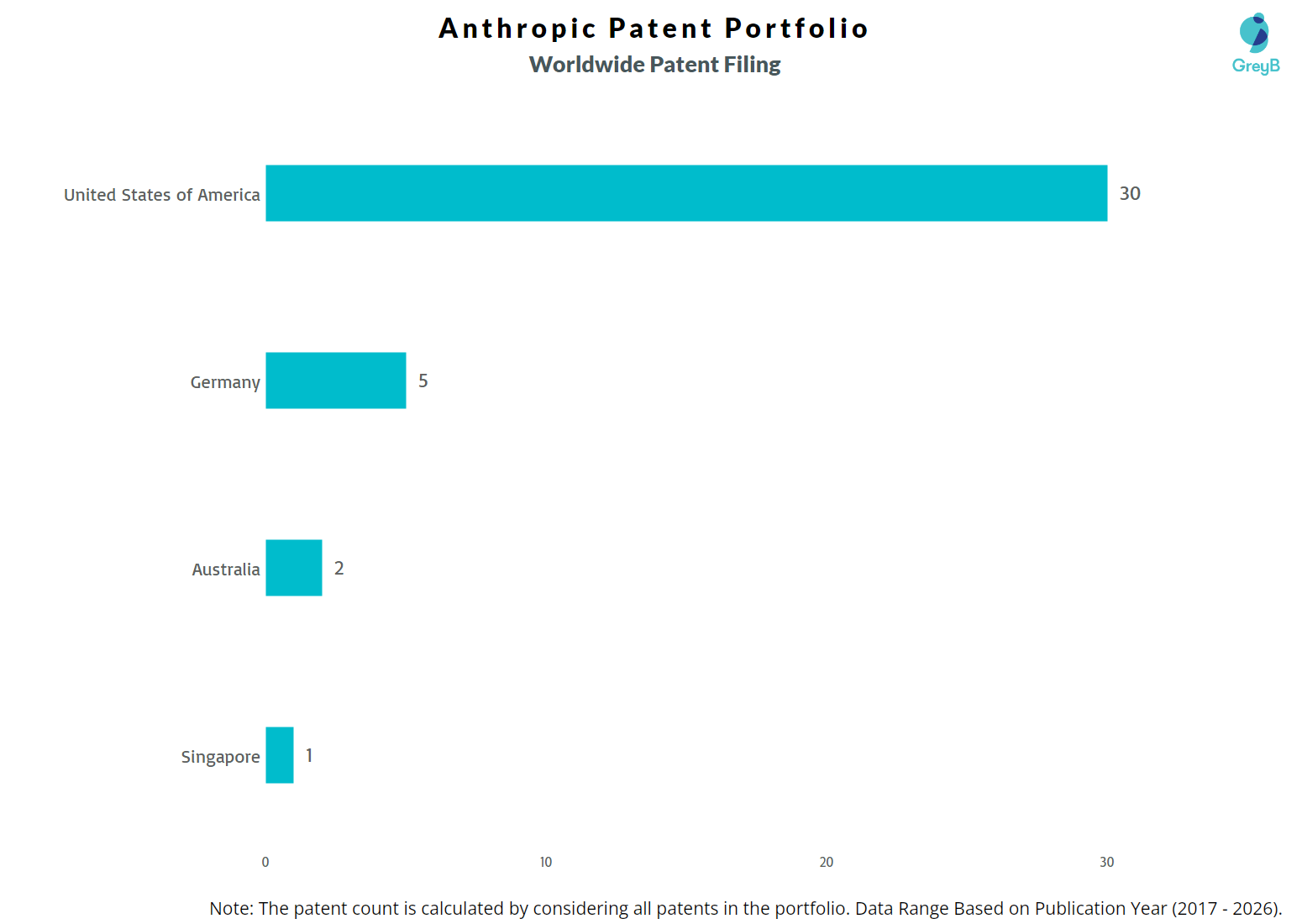
Countries in which Anthropic Filed Patents
| Country | Patents |
| United States of America | 30 |
| Germany | 5 |
| Australia | 2 |
| Singapore | 1 |
Where are Research Centers of Anthropic Patents Located?
The Research Centers of Anthropic Patents is the United States of America.
10 Best Anthropic Patents
US11361571B1 is the most popular patent in the anthropic portfolio. It has received 19 citations so far from companies like Google, Volkswagen, Huawei.
Below is the list of 10 most cited patents of Anthropic:
| Publication Number | Citation Count |
| US11361571B1 | 19 |
| US10977439B2 | 10 |
| US11010637B2 | 9 |
| US11501156B2 | 8 |
| US10949746B2 | 6 |
| US11586849B2 | 4 |
| US20220292401A1 | 4 |
| US11783811B2 | 3 |
| US11676011B2 | 3 |
| US11423042B2 | 3 |
What Percentage of Anthropic US Patent Applications were Granted?
Anthropic (Excluding its subsidiaries) has filed 12 patent applications at USPTO so far (Excluding Design and PCT applications). Out of these 2 have been granted leading to a grant rate of 18.18%.
Below are the key stats of Anthropic patent prosecution at the USPTO.

Which Law Firms are managing US Patents for Anthropic?
| Law Firm | Total Applications | Success Rate |
| Finnegan | 5 | 0% |
| Maier & Maier Pllc | 2 | 0% |
| Banner & Witcoff Ltd | 1 | 0% |
| Hamilton Brook Smith & Reynolds PC | 1 | 0% |
| Haynes And Boone Llp | 1 | 100.00% |
| Marshall Gerstein & Borun Llp | 1 | 100.00% |
| Norton Rose Fulbright Us Llp | 1 | 0% |
List of Anthropic patents
| Anthropic Patents | Title |
| US12437238B1 | Generation Of Agentic Trajectories For Training Artificial Intelligence Agents To Automate Multimodal Interface Task Workflows |
| US12430150B1 | Runtime Architecture For Interfacing With Agents To Automate Multimodal Interface Workflows |
| US12387036B1 | Multimodal Agent For Efficient Image-Text Interface Automation |
| US12288551B2 | Accuracy Of Streaming Rnn Transducer |
| DE112021004199B4 | Accuracy Of A Data Stream Conversion Function For Recurrent Neural Networks |
| SG11202204720UB | Identifying Optimal Weights To Improve Prediction Accuracy In Machine Learning Techniques |
| US20250299074A1 | Data Flow Logic For Providing Artificial Intelligence Agents That Automate Multimodal Software Usage |
| US20250298495A1 | Artificial Intelligence Agents To Automate Multimodal Interface Task Workflows |
| US20250299023A1 | Systems And Methods For Configuring Artificial Intelligence Agents To Automate Multimodal Interface Workflows |
| US20250299024A1 | Magnitude Invariant Multimodal Agent For Efficient Image-Text Interface Automation |
| US20250299510A1 | Training Data For Training Artificial Intelligence Agents To Automate Multimodal Software Usage |
| WO2025199330A1 | Artificial Intelligence Agents For User Interface Task Workflow Automation |
| DE112020004348B4 | Detecting And Recovering Out-Of-Vocal Words In Speech-To-Text Transcription Systems |
| DE112020003449B4 | Soft-Forgetting For Automatic Speech Recognition Based On Connectionist Temporal Classification |
| US11829879B2 | Detecting Adversarial Attacks Through Decoy Training |
| US11783811B2 | Accuracy Of Streaming Rnn Transducer |
| US11763082B2 | Accelerating Inference Of Transformer-Based Models |
| US11755657B2 | Training A Question-Answer Dialog System To Avoid Adversarial Attacks |
| US11734509B2 | Controllable Style-Based Text Transformation |
| US11676011B2 | Private Transfer Learning |
| US11625609B2 | Integration Of External Applications Into Deep Neural Networks |
| US11586849B2 | Mitigating Statistical Bias In Artificial Intelligence Models |
| AU2020369228B2 | Private Transfer Learning |
| AU2020385049B2 | Identifying Optimal Weights To Improve Prediction Accuracy In Machine Learning Techniques |
| DE112021004694T5 | Training A Question-Answer Dialogue System To Avoid Opponent Attacks |
| US11520829B2 | Training A Question-Answer Dialog Sytem To Avoid Adversarial Attacks |
| US11501156B2 | Detecting Adversarial Attacks Through Decoy Training |
| US11443235B2 | Identifying Optimal Weights To Improve Prediction Accuracy In Machine Learning Techniques |
| US11423042B2 | Extracting Information From Unstructured Documents Using Natural Language Processing And Conversion Of Unstructured Documents Into Structured Documents |
| US11392753B2 | Navigating Unstructured Documents Using Structured Documents Including Information Extracted From Unstructured Documents |
| US11361571B1 | Term Extraction In Highly Technical Domains |
| US20220292401A1 | Identifying Optimal Weights To Improve Prediction Accuracy In Machine Learning Techniques |
| DE112020005610T5 | Identifying Optimal Weights To Improve Prediction Accuracy In Machine Learning Methods |
| US11183194B2 | Detecting And Recovering Out-Of-Vocabulary Words In Voice-To-Text Transcription Systems |
| US11158303B2 | Soft-Forgetting For Connectionist Temporal Classification Based Automatic Speech Recognition |
| US11037049B2 | Determining Rationale Of Cognitive System Output |
| US11010637B2 | Generative Adversarial Network Employed For Decentralized And Confidential Ai Training |
| US10977439B2 | Controllable Style-Based Text Transformation |
| US10949746B2 | Efficient Parallel Training Of A Network Model On Multiple Graphics Processing Units |
What are Anthropic key innovation segments?
What Technologies are Covered by Anthropic?
The chart below distributes patents filed by Anthropic in different countries on the basis of the technology protected in patents. It also represents the markets where Anthropic thinks it’s important to protect particular technological inventions.
R&D Focus: How has Anthropic search focus changed over the years?
EXCLUSIVE INSIGHTS COMING SOON!
Interested in knowing about the areas of innovation that are being protected by Anthropic?