
The Problem with Wired Neural Monitoring
The current landscape of neurological monitoring is defined by a difficult trade off between data quality and patient safety. For individuals living with conditions like epilepsy the most reliable way to find the source of seizures is through electrocorticography. This process traditionally requires placing electrodes directly on the surface of the brain. Physical wires protrude through the skull and scalp to connect to external recording equipment.
This configuration presents a constant risk of infection and hemorrhage. It often confines patients to hospital settings and limits the ability to monitor brain activity in natural everyday environments. Researchers have sought to develop wireless alternatives to solve this. Existing electronic implants often rely on internal batteries or complex power management circuits. These components increase the size of the device and can generate heat that risks damaging sensitive neural tissue.
A Passive Wireless Breakthrough
A new patent US12575794В2 from Florida International University titled Systems and Methods for Wireless Neurosensing describes a technical breakthrough that moves past these limitations. The innovation centers on a fully passive and battery free implantable sensor. It’s designed to record and transmit neural signals without the need for an internal power source. The system allows for long term and high fidelity monitoring while maintaining a small biocompatible footprint by leveraging radio frequency backscattering and advanced impedance matching.
How the Subharmonic Mixer Works
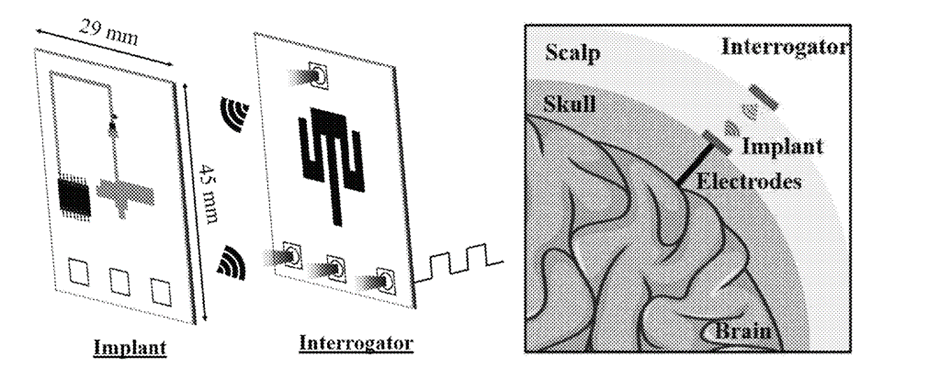
The engineering of the wireless neurosensing system relies on a sophisticated interaction between an external interrogator and the implanted sensor. The process begins when the external interrogator generates and transmits a 2.4 gigahertz carrier signal. The implant receives this electromagnetic signal through its own antenna and uses it to facilitate communication. The implant uses a Schottky diode to perform two critical tasks simultaneously instead of processing the signal with power hungry digital components.
It rectifies the incoming signal to provide a self biasing voltage for the internal circuitry. It also acts as a mixer. This mixer combines the high frequency carrier signal with the low frequency electrical signals of interest from the brain. These low frequency signals include those indicating epileptic activity.
The system then backscatters this modulated signal to the external interrogator at a frequency of 4.8 gigahertz. This choice of the second harmonic is a deliberate engineering decision to reduce noise. The system ensures that the sensitive neural data isn’t drowned out by the power of the original transmission by transmitting the data back at a frequency different from the incoming carrier.
This backscattering method allows the device to operate with extremely low power consumption measured at approximately 98 microwatts. This low power draw significantly reduces the risk of thermal injury to the brain.
Overcoming the Impedance Mismatch
One of the primary technical hurdles in passive neurosensing is the massive impedance mismatch between brain electrodes and wireless antennas. Neural probes typically have high impedances in the range of hundreds of kiloohms or even megaohms. Standard antennas operate at low impedances around 50 ohms. Most of the signal would be lost to reflection without a way to bridge this gap.
The patent addresses this through a passive impedance matching network that uses a bipolar junction transistor as a buffer. This transistor allows the system to recognize and capture signals as low as 20 microvolts peak to peak even when electrode impedance is high. This level of sensitivity is essential for detecting the subtle electrical shifts that precede a seizure.
Biocompatible Design and Miniaturization
The physical design of the implant is equally specialized. The device uses a multi layer structure that integrates the antenna and the circuitry into a single miniature package. The engineers incorporated shorting pins into the antennas to keep the size as small as possible. This reduced their total footprint by approximately 50 percent compared to previous designs.
The resulting implant measures 45 by 29 millimeters with a thickness of only 1.6 millimeters. The entire unit is coated in a thin layer of polydimethylsiloxane to ensure it can remain in the body safely for extended periods. This is a highly biocompatible polymer.
Multichannel Optical Operation
The primary focus is on neural monitoring but the patent indicates that this technology has broader applications in biological sensing. The same backscattering architecture can be integrated with other types of sensors like conductive stents to monitor blood pressure or heart rate wirelessly. The system also includes provisions for multichannel operation using optical components.
The implant uses a photovoltaic cell and photodiodes to trigger a multiplexer in this configuration. This allows the device to switch between different electrode channels at a sampling rate of at least 10 kilohertz per channel. This high sampling rate provides a comprehensive map of activity across different regions of an organ.
Broader Implications for Health Diagnostics
Experimental validation included in the patent documentation shows that the system is capable of surviving and functioning in complex biological environments. The researchers successfully recorded somatosensory evoked potentials over a one month period in a porcine model. These results confirmed that the wireless link could maintain integrity through layers of skin and bone while accurately capturing neural responses to external stimuli. The data demonstrated a significant improvement in the minimum detectable signal compared to existing passive recorders.
The development of this wireless neurosensing system represents a shift toward more sustainable and less invasive medical diagnostics. The innovation eliminates the most common failure points in chronic neural implants by removing the battery and the wires. It provides a path toward permanent and invisible health monitoring that doesn’t interfere with a patient’s quality of life.
The ability to safely and efficiently extract high quality data from within the body will be a foundational requirement for both clinical treatment and neuroscientific research as the field of brain computer interfaces continues to grow.
Exploring next-gen neural monitoring solutions? Fill out the form to receive a customized patent insight brief tailored to your focus areas, key technologies, and emerging applications. Understand design approaches, safety improvements, and potential use cases shaping future diagnostics.