
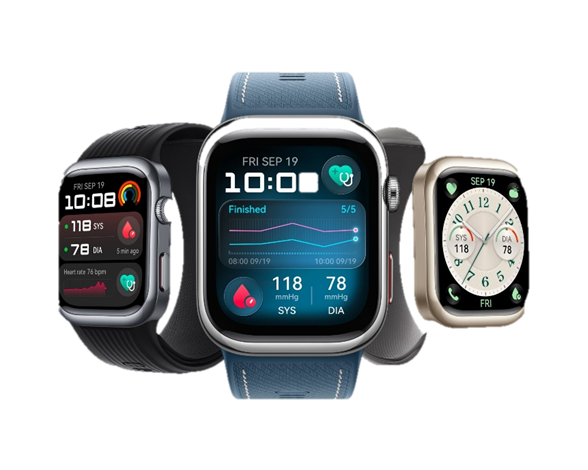
Why Wrist-Based Blood Pressure Measurement Is Not a Trivial Problem
Smart watches have steadily expanded their health-related capabilities, but blood pressure measurement remains fundamentally different from most wrist-based metrics.
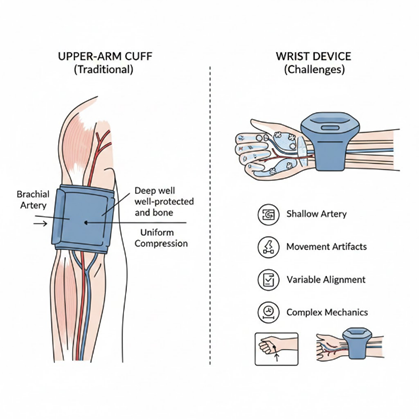
Unlike heart rate or motion tracking, blood pressure estimation requires:
- Controlled external pressure application
- Stable alignment with the radial artery
- High-fidelity pulse wave capture
- Mechanical consistency across wrist sizes and movement
This is why many mainstream smart watches including Apple Watch and Samsung Galaxy Watch continue to focus on indirect indicators such as heart rhythm irregularities or optical pulse trends rather than offering direct blood pressure values.
Huawei Watch D2 approaches this challenge differently, reflecting design choices that align closely with long-standing patent work in wrist-based pressure sensing.
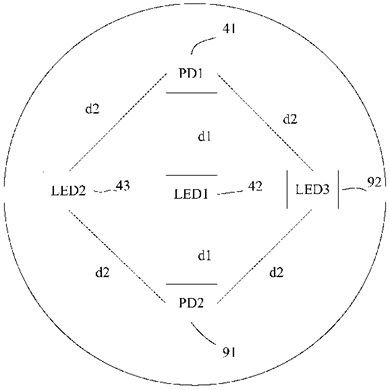
Sensor Architecture Designed for Variable Measurement Conditions (WO2019237281A1)
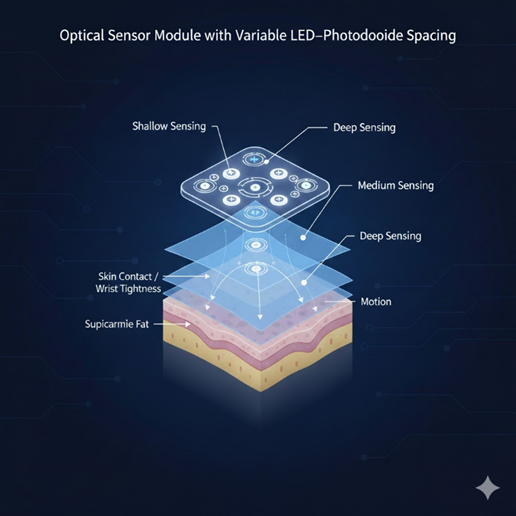
Several Huawei-related patents describe optical sensor modules with non-uniform LED–photodiode spacing. Instead of relying on a single fixed optical path, these designs enable different sensing depths and signal behaviors under varying conditions.
This approach contrasts with devices such as Fitbit Sense and Garmin health-focused watches, which largely depend on fixed optical layouts optimized for continuous heart rate and wellness tracking rather than pressure-modulated measurements.
By designing for variability in skin contact, wrist tightness, and motion, Huawei’s sensor architecture reflects a focus on robust signal acquisition under non-ideal conditions a prerequisite for wrist-based blood pressure monitoring.
Airbag-Based Pressure Application at the Wrist (US2025248653A1 and WO2024131506A1)
A defining characteristic of Huawei Watch D2 is the use of controlled pressure application through an integrated airbag structure.
This concept has been explored earlier by companies such as Omron, whose wrist-based blood pressure monitors rely on inflatable cuffs to achieve clinical-grade measurements. However, Omron’s devices are typically single-purpose medical instruments rather than multi-function smart watches.
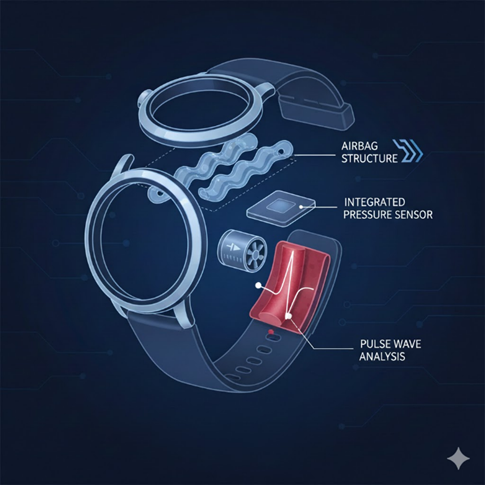
Huawei’s patents describe how similar pressure-based principles can be miniaturized and embedded into a smartwatch form factor, combining:
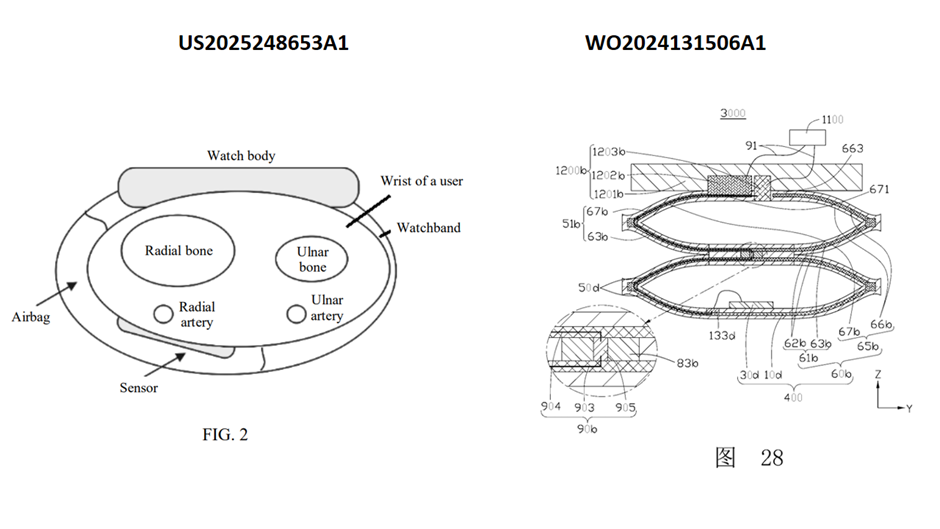
- Compact air pumps
- Integrated pressure sensors
- Pulse wave analysis under varying pressure levels
This hybrid mechanical–sensor approach represents a clear architectural divergence from purely optical estimation strategies.
Mechanical Stability as a Measurement Requirement (CN211243345U and CN115429243A)
Mechanical instability is one of the most underappreciated challenges in wearable blood pressure devices.
Some earlier attempts at cuff-integrated wearables including first-generation concepts from smaller medical device startups struggled with airbag wrinkling, strap displacement, and inconsistent arterial contact.
Huawei’s patent filings address this through strap–airbag coupling mechanisms that:
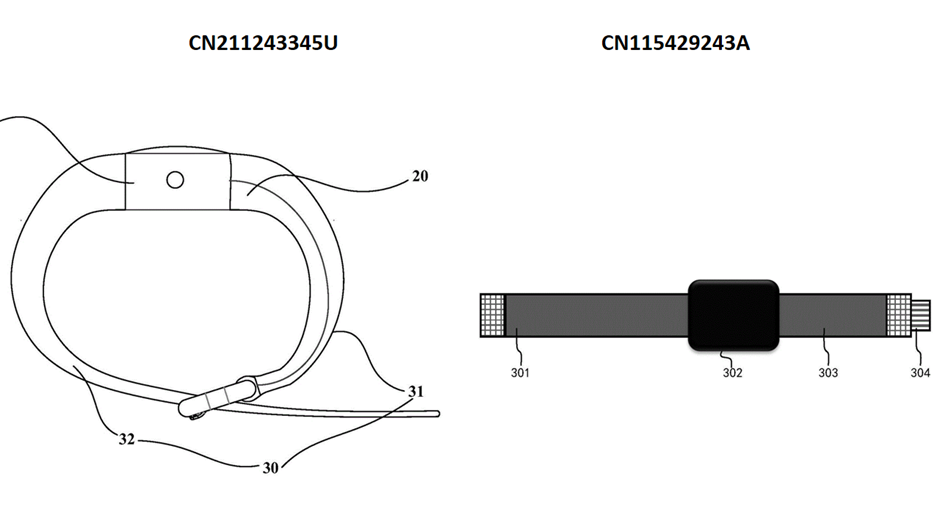
- Limit transverse movement
- Allow controlled sliding along the strap length
- Maintain consistent pressure geometry during wrist bending
In contrast, most mainstream smartwatches prioritize strap comfort and aesthetics, as their sensing requirements are less mechanically demanding
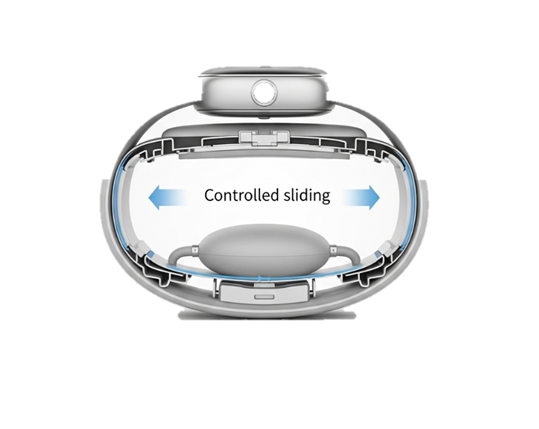
Caption: Controlled movement between strap and airbag helps maintain consistent arterial contact across wrist sizes. (AI Generated)
Where Huawei Watch D2 Sits Among Competitors
Viewed through a patent and architecture lens, Huawei Watch D2 occupies a distinct position:
| Company / Device | Approach to Blood Pressure |
| Huawei Watch D2 | Direct wrist-based measurement using airbag-assisted pressure sensing |
| Apple Watch | Focus on indirect cardiovascular indicators; no direct BP output |
| Samsung Galaxy Watch | Calibration-based BP estimation (region-dependent) |
| Fitbit Sense | Wellness tracking without direct BP measurement |
| Omron Wrist Monitors | Clinical-grade BP accuracy, limited smartwatch functionality |
Rather than competing head-on with fitness-oriented smartwatches, Huawei Watch D2 appears to bridge the gap between consumer wearables and medical-grade monitoring devices.
From Patent Concepts to Product Architecture
Taken together, the patent themes map cleanly to Huawei Watch D2’s functional design:
| Patent Focus Area | Architectural Outcome |
| Adaptive sensor geometry | Robust signal acquisition |
| Airbag-based pressure control | Wrist-based BP measurement |
| Strap–airbag mechanics | Fit consistency and comfort |
| Embedded EMI shielding | Improved signal integrity |
Such convergence typically reflects long-term architectural planning, not short-term feature layering.
Closing Perspective
Huawei Watch D2 illustrates how patent-backed engineering choices shape the feasibility of advanced health features in wearables.
As blood pressure monitoring moves closer to mainstream consumer adoption, differentiation is increasingly defined by mechanical design, sensing architecture, and structural signal control areas that are difficult to retrofit after product launch.
In this context, Huawei Watch D2 provides a clear example of how intellectual property quietly transitions into real-world product capability, setting a reference point for future developments in wrist-based health monitoring.
Curious which companies are innovating in wrist-based blood pressure monitoring and cuffless BP tech? Request a full patent landscape report by filling out the form below.