5G is quietly rewriting how the world connects and the real power lies in the patents behind it. As industries, devices, and networks align around 5G, the technology’s foundation is increasingly shaped by Standard Essential Patent (SEP) claims, which signal which inventions companies believe are indispensable to making 5G work. These claims offer an early view into who is influencing the technical direction of the standard and where future licensing discussions are likely to concentrate.
At the time of its public disclosures, Nokia reported around 7,000 patents families as essential to 5G in its January 2025 report. According to updated data, the number of declared 5G patent families has increased to around 8,190 patents families, reflecting continued expansion of its 5G patent portfolio. Nokia also publicly states that its 5G technology patent portfolio is available for licensing under fair, reasonable and non‑discriminatory (FRAND) terms, meaning companies that implement standardized technologies can obtain authorized access to its SEPs through licensing agreements.
Rather than appearing at a single point, Nokia 5G SEP claims have emerged across multiple years, mirroring the evolution of 5G itself. A year‑wise examination helps reveal how Nokia technical focus has shifted, where innovation efforts have remained consistent, and how its role in 5G has strengthened over time.
How Nokia 5G SEP Portfolio Has Grown Over Time?
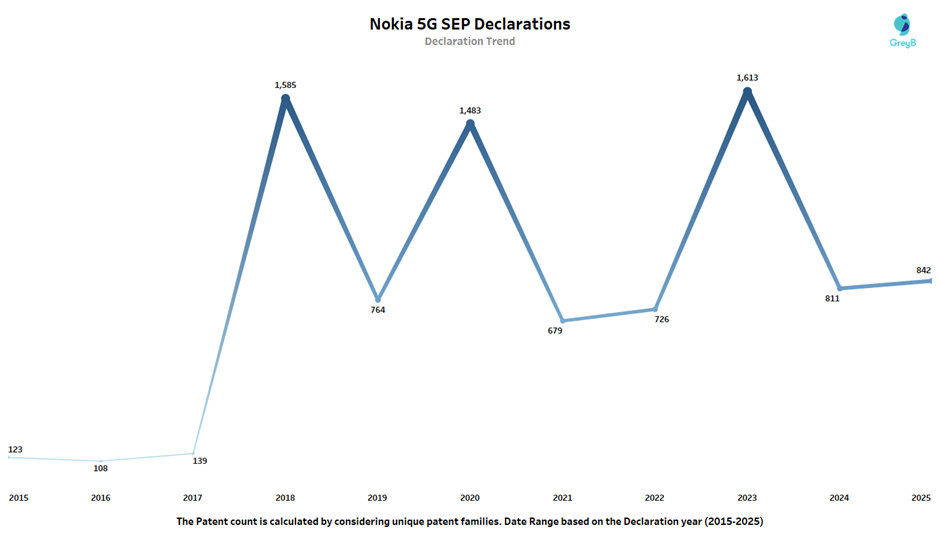
Nokia 5G SEP declarations show a steady and long-term build-up, totalling 8,190 patent families over the period shown. An early foundation was established between 2015 and 2017, followed by the first major surge in 2018. After some fluctuation, activity remained strong, with another peak in 2023 the highest annual contribution in the chart. Declarations in 2024 and 2025 stay at solid levels, indicating continued and consistent involvement in 5G standard development rather than a short-term spike.
Nokia consistent and phased approach to 5G SEP declarations, with strong contribution waves aligned to key stages of 5G development, underscoring its long-term commitment to advancing 5G technology.
Want to identify the true SEPs in your portfolio for upcoming licensing discussions?
Over-declaration is a common strategy used to strengthen a company’s position as an SEP holder in the market. During licensing negotiations, portfolios often contain a mix of truly essential patents and non-SEP assets. Accurately separating these can significantly impact valuation, negotiation strength, and risk assessment.
What Is the Legal Status of Nokia 5G SEP Families?
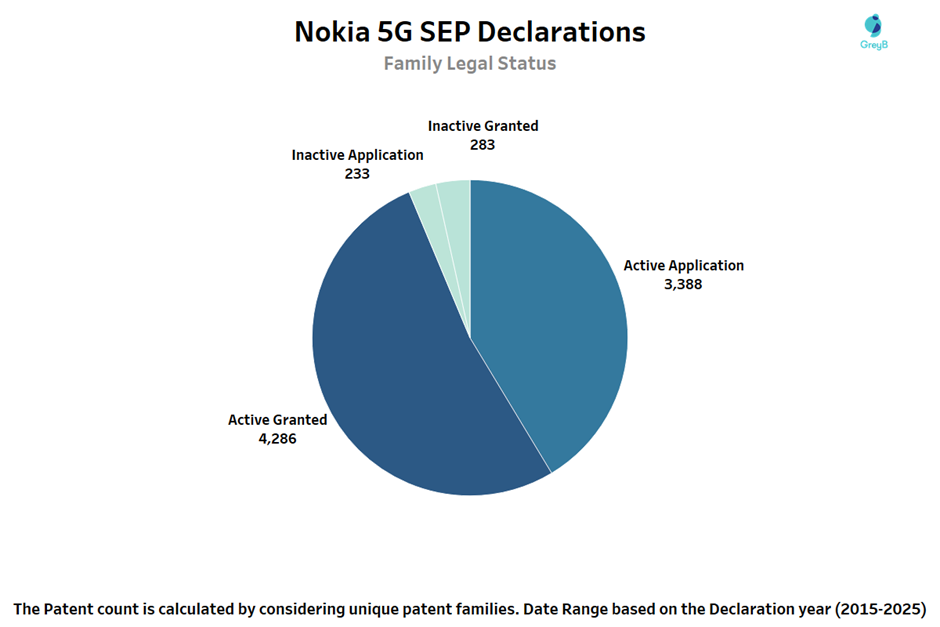
Nokia has 8,190 patent families declared in ETSI SEP, reflecting the scale of its contribution to 5G standards. The chart clearly shows that a major share of these families are active granted patents, which highlights the legal strength and enforceability of Nokia portfolio. Alongside this, a large number of active applications indicates that the portfolio is still growing, ensuring continued relevance in future 5G developments.
The portion of inactive families is very less in comparison, showing strong portfolio maintenance and value retention. Overall, Nokia SEP portfolio appears highly comprehensive, well-managed, and technologically significant, reinforcing Nokia position as one of the key and most reliable innovators in the global 5G ecosystem.
Technology Breakdown of Nokia 5G SEP Declarations
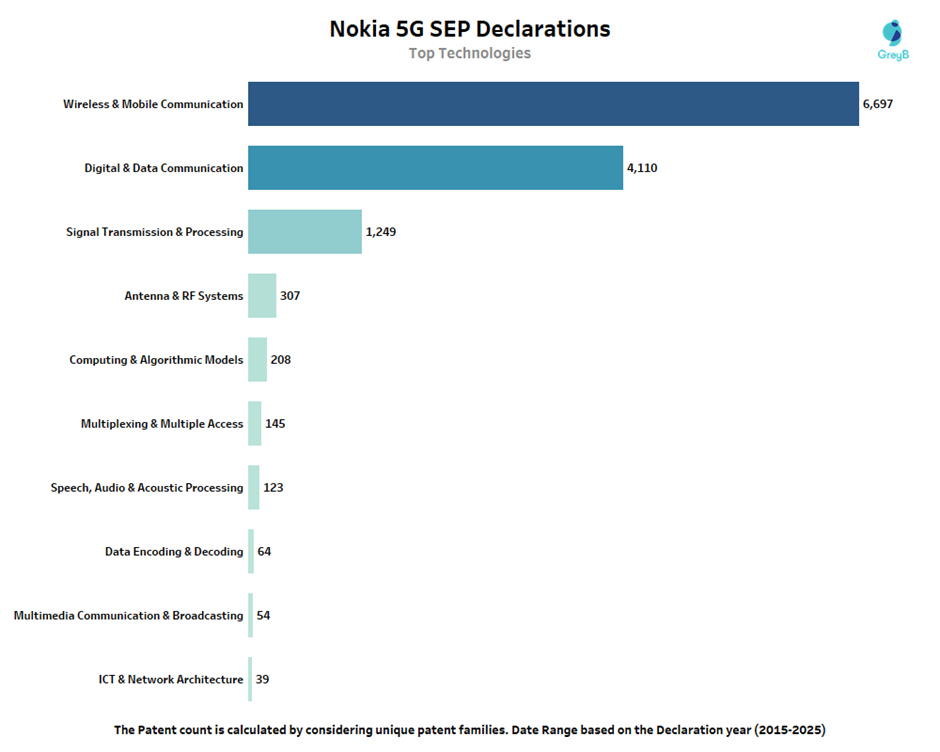
Nokia 5G standard-essential patents are mainly concentrated in Wireless & Mobile Communication (6,697 patent families) and Digital & Data Communication (4,110 patent families). This shows a strong focus on the main technologies that allow 5G devices to connect and data to move smoothly across networks.
Signal Transmission & Processing is another major area (1,249 patent families). Smaller but still important areas include Antenna & RF Systems, Multiplexing & Multiple Access, and Computing & Algorithmic Models, which help improve network performance, manage spectrum, and support smarter network operations.
Overall, the spread of patents suggests Nokia is particularly strong in the key technologies that make 5G connections fast, stable, and reliable across different types of networks.
5G Standard Essential Patents: Who Holds the Competitive Edge?
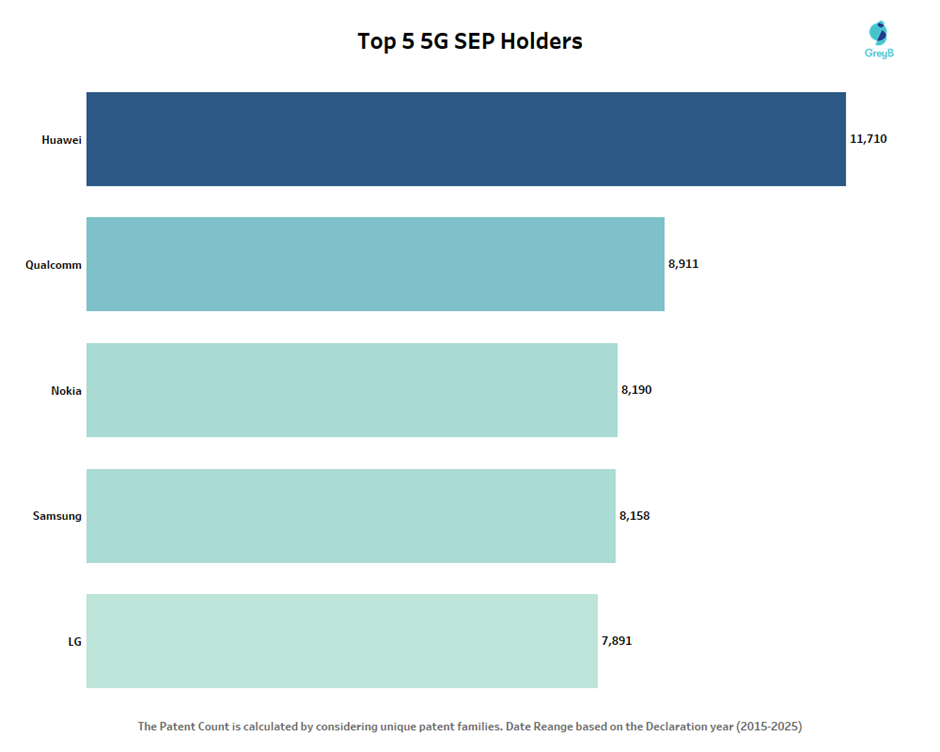
Huawei leads the 5G SEP landscape with a significant margin in declared patent families, highlighting its strong standardization influence. Qualcomm, Nokia, and Samsung follow closely, demonstrating intense competition among major telecom innovators. The concentration of SEPs among these top players reflects a highly competitive and strategically controlled 5G ecosystem.
Competitive Landscape Analysis of the Top 5 5G SEP Holders
| Company | Total Declared 5G SEP Families | % Share of Total SEP | R&D Centre Concentration | % of Active Granted Families | % of Active Pending Families |
| Huawei | Xxxx | xx % | xx % | xx % | xx % |
| Qualcomm | Xxxx | xx % | xx % | xx % | xx % |
| Nokia | 8190 | 7.5% | US-45% | 48% | 38% |
| Samsung | Xxxx | xx % | xx % | xx % | xx % |
| LG | Xxxx | xx % | xx% | xx % | xx % |
Is Nokia building early 6G dominance? See how today’s 5G SEP filings are shaping future 6G control.
Our “5G-Advanced & 6G Readiness Outlook – SEP Evolution Forecast” provides a complete competitive breakdown, detailed portfolio metrics, and jurisdiction-level insights to help you understand where leading SEP holders are driving innovation.
If you are looking to conduct a comprehensive competitive analysis of SEP holder companies and gain deeper strategic visibility, we can help.
Fill out the form to access actionable 5G patent intelligence and stay ahead in the evolving 5G-Advanced and 6G landscape.
Technology Focus Trends of Nokia 5G SEP by Patent Declaration Year
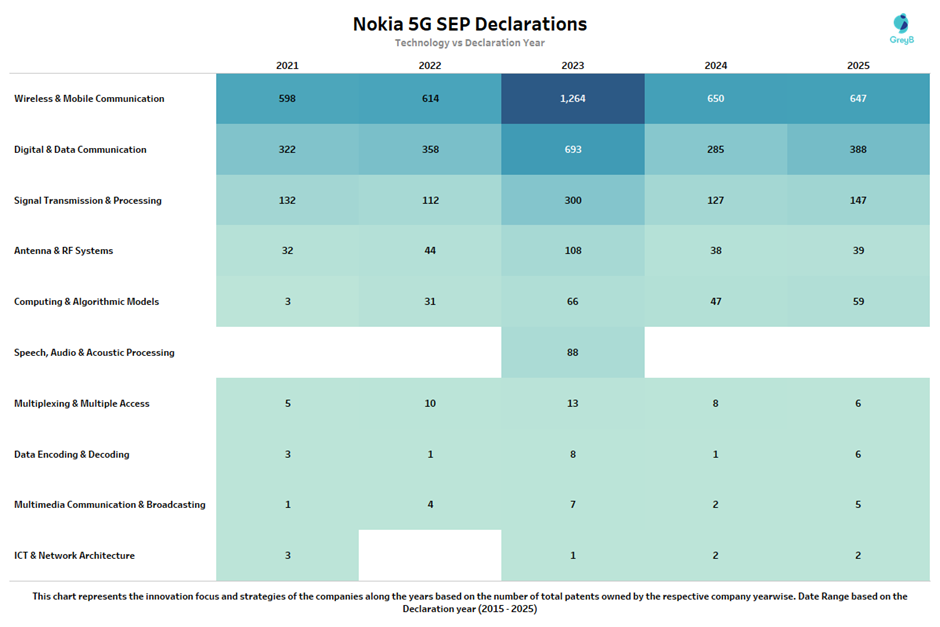
Nokia 5G patent activity tells a story of a major innovation push at just the right time. Between 2021 and 2023, the company sharply increased its patent declarations, especially in Wireless & Mobile Communication and Digital & Data Communication, with 2023 standing out as a peak year. This suggests a strong effort to secure positions in the most important technologies that make 5G networks function.
After this surge, activity in 2024 and 2025 remains steady rather than dropping off, showing continued commitment rather than a short-term spike. Areas like Signal Transmission & Processing and Antenna & RF Systems also show gradual growth, while smaller fields such as data encoding and multimedia remain limited, pointing to a clear focus on the technologies with the broadest impact. Overall, the trend highlights how Nokia strengthened its hold in key 5G technology areas and then maintained that position over time.
Where Are Nokia 5G SEP Declared Patent R&D Centre Located?
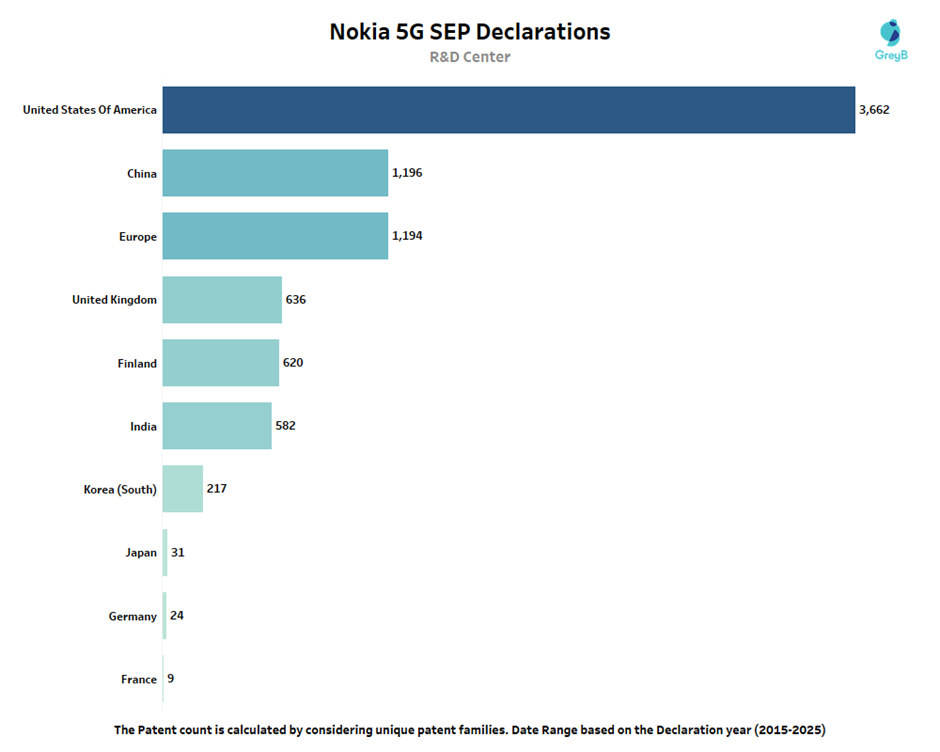
Nokia 5G patent declarations are heavily concentrated in the United States, with more than 3,662 patent families declared there far more than any other region. China and Europe are nearly tied with around 1,190+ patents each, showing strong patent activity in those major markets as well. The UK, Finland, and India also contribute meaningful numbers, but much smaller in scale. Countries like South Korea, Japan, Germany, and France show relatively low patent counts by comparison.
This pattern suggests Nokia innovation and patent protection strategy focuses first on the US market, likely because of its large telecom industry and licensing value, while also maintaining a significant presence in other key technology and mobile markets across Europe and Asia.
How Nokia 5G SEP Declared Patents Are Distributed Worldwide?
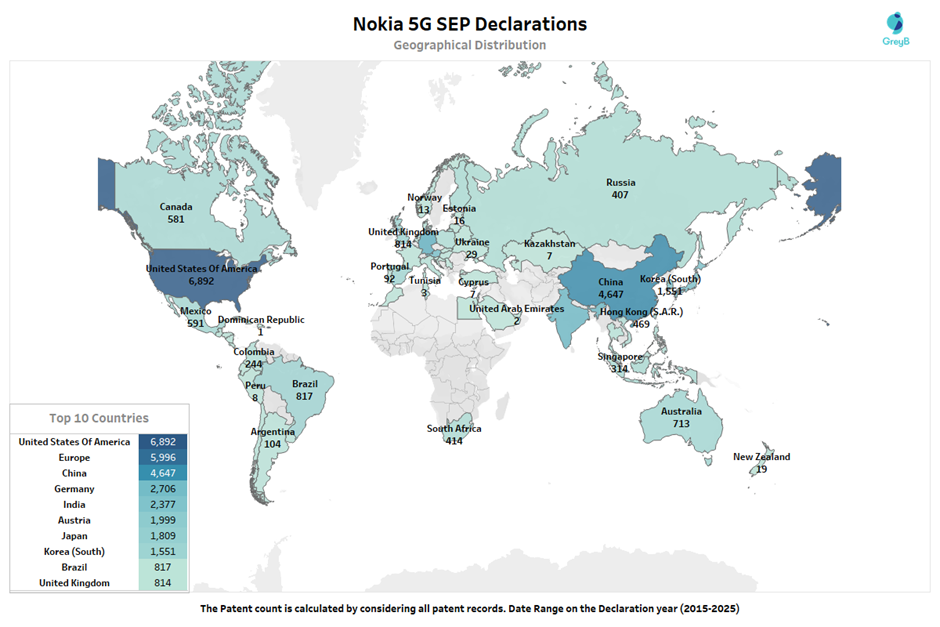
Nokia 5G patent filings are highly concentrated in a few major markets. The United States leads by a wide margin, followed by Europe & China, showing these as Nokia key regions for protecting 5G innovation.
Strong patent presence in countries like Germany, India, Japan, and South Korea further highlights focus on major technology and telecom hubs, while many other regions show comparatively limited activity. Overall, Nokia patent footprint aligns with the world’s largest and most influential 5G markets.
Who Are the Key Inventors for Nokia 5G SEP Declared Patents?
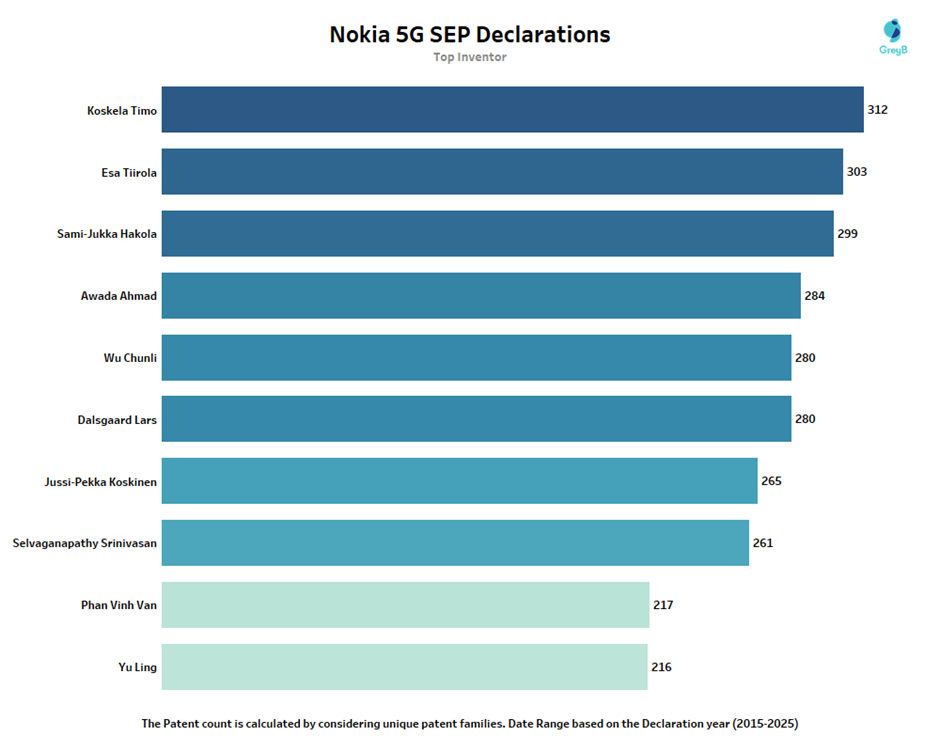
Nokia 5G SEP innovation is driven by a group of leading inventors rather than a single individual. Multiple contributors consistently play a major role in developing standard-relevant technologies. This highlights a strong, collaborative R&D foundation behind Nokia 5G leadership.
What Are the High Licensing Potential Patents in Nokia 5G SEP Portfolio?
| Patent Number | Estimated Expiry Date |
| US9642118B2 | February 20, 2032 |
| US11323934B2 | March 19, 2039 |
| US11792172B2 | October 26, 2037 |
| US11387974B2 | November 15, 2037 |
| US11064461B2 | September 28, 2038 |
Nokia is placing strong focus on strengthening its patent licensing business, viewing the current period as a major opportunity to realize the value of its technologies. The company’s IP strategy reflects its important role in developing global communication standards. This is evident from how several of Nokia key SEP patents are not only valuable from a technology perspective but also act as strong positions when assessed against other major patent holders.
A notable point is that the patents highlighted in this analysis have been used in examination processes where applications from other companies were rejected based on these Nokia patents. Many of these affected companies are among the top SEP patent holders globally, including Samsung, Qualcomm, LG, Huawei, IBM, Docomo, Ericsson, and Microsoft. Importantly, most of these rejections were issued directly by patent examiners, showing that these Nokia patents are considered strong prior art and technically significant.
The table below summarizes the technical benefits of the disclosed patents, their respective technology areas, and their industry impact.
| Patent Number | Technical Method | Benefit | Technology Area |
| US9642118B2 | Adaptive selection of MCS tables (64QAM / 256QAM) based on channel conditions and UE capability | Higher spectral efficiency via 256QAM with backward compatibility and unchanged signalling complexity | Modulation order & wireless communication systems |
| US11323934B2 | UE configures APN-AMBR during PDU session establishment/modification for continuity across 5G and 4G | Seamless inter-system handover with maintained session continuity and QoS | Session management & interworking between 5G/4G networks |
| US11792172B2 | Use of privacy indicators and SLF-based decryption to manage encrypted subscription identifiers | Improved privacy protection with reduced computational load and efficient cross-generation authentication | Privacy-preserving authentication in 5G/4G communication systems |
| US11387974B2 | UE autonomously switches from a non-RACH uplink bandwidth part to a RACH-supported bandwidth part to perform random access | Avoids scheduling errors and reduces resource waste while enabling reliable random access and synchronization | Random access procedures in wireless communication systems |
| US11064461B2 | Unified side link channel design using dual PSCCHs for resource reservation and transmission format signalling | Efficient scheduling for periodic & aperiodic V2X traffic with better spectrum use and lower interference | Side link control channel design for V2X communications |
Your SEP portfolio holds more value than it appears.
Identify high-potential patents for licensing and focus on the assets that truly drive revenue and negotiation power.