When the world debated Bitcoin’s next price rally in 2020, few realized another, quieter revolution was already underway not on exchanges, but in patent offices.
Social listening across platforms like Twitter, Reddit, and Telegram reveals a striking shift in conversation. Between 2020 and 2025, discussions have evolved from token hype to deeper debates around security, regulation, and real-world adoption — signaling a maturing narrative in how the public perceives cryptocurrency.
Patent data tells the same story from another angle. More than 27,000 cryptocurrency patents published globally since 2020 highlight continued innovation in cross-chain interoperability, zero-knowledge proofs, and digital asset infrastructure. Industry leaders such as nChain, IBM, and State Grid Corporation of China are shaping the intellectual backbone of this new financial era.
Together, these social and IP signals reveal a single truth while the market’s noise may rise and fall, the foundations of tomorrow’s blockchain economy are being quietly, relentlessly engineered.
What are the problems with Cryptocurrency?
Regulatory Complexity
Global compliance differences
Cryptocurrency operates across borders, but regulations differ drastically from one country to another. This creates uncertainty for businesses and investors, slowing innovation and adoption. Harmonizing global standards remains a critical challenge for the industry.
Scalability Issues
High transaction costs and limited throughput
Blockchain networks often face congestion, leading to slower transactions and high gas fees. Without scalable solutions such as Layer-2 protocols or sharding, mass adoption and real-time financial use cases remain limited.
Privacy vs Transparency
Balancing user anonymity with accountability
Cryptocurrencies must protect user privacy while complying with anti-money laundering (AML) and know-your-customer (KYC) regulations. Striking this balance is crucial, as excessive transparency exposes users, whereas total anonymity risks regulatory backlash.
Cross-Chain Interoperability
Overcoming blockchain silos
Most blockchains operate as isolated ecosystems, limiting the seamless transfer of assets and data. The lack of standardized communication protocols hinders liquidity, cross-chain DeFi, and multi-network applications.
Quantum Threat
Preparing encryption for a post-quantum world
Future quantum computers could break today’s cryptographic algorithms, posing a significant risk to blockchain security. Research into quantum-resistant cryptography is essential to safeguard digital assets and maintain trust in decentralized systems.
Smart Contract Vulnerabilities
Bugs and hacks in smart contracts, bridges, and wallets
Errors in code and poorly audited smart contracts frequently lead to exploits and massive financial losses. Enhancing security standards, auditing practices, and automated verification is vital to maintain user confidence and ecosystem stability.
Who are the key companies in Cryptocurrency?
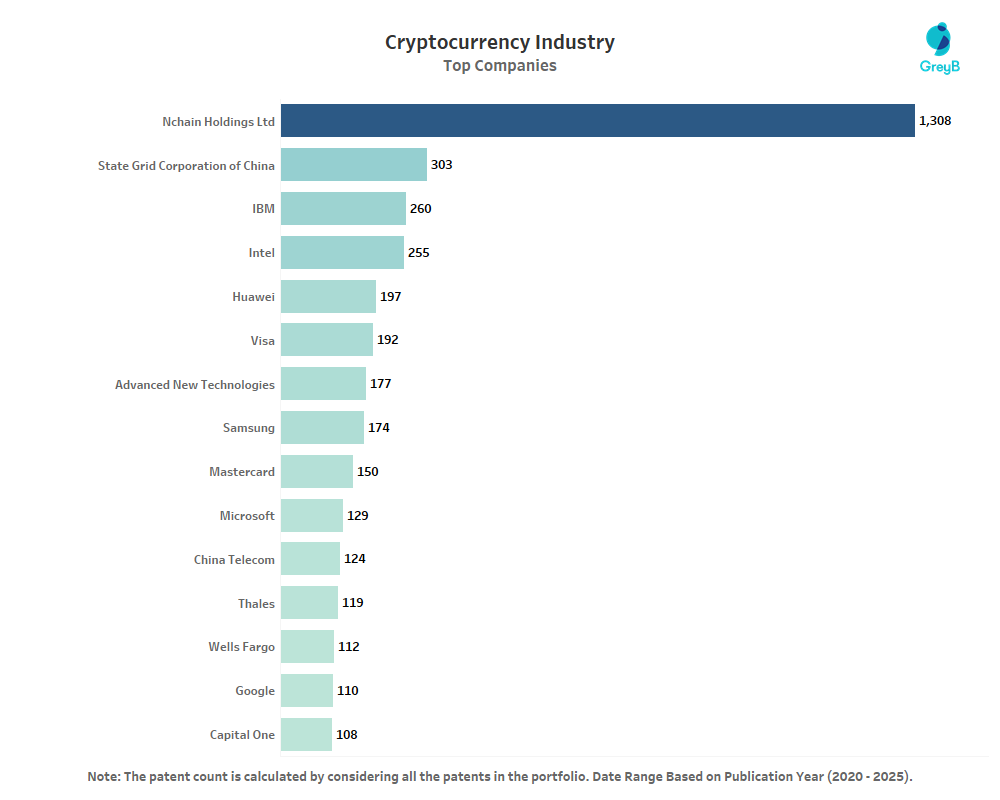
A few tech giants are quietly shaping the future of blockchain. From Nchain Holdings dominating with over 1,300 crypto patents to IBM, Intel, and Huawei expanding blockchain’s reach across finance, AI, and 5G — the race for IP leadership is on.
Curious where your competitors stand?
Which Countries Are Leading the Global Race for Cryptocurrency Patents?
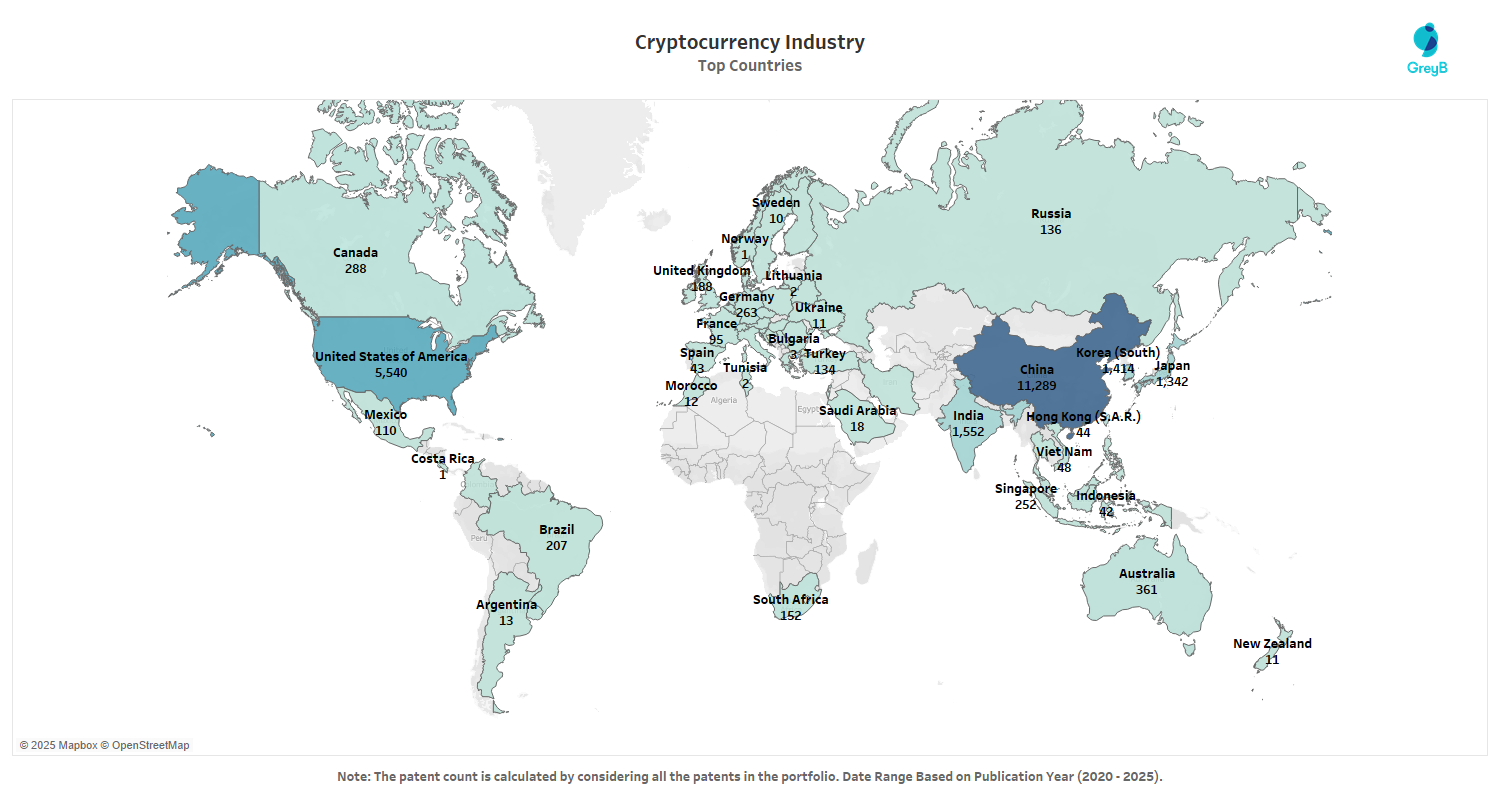
Innovation in cryptocurrency isn’t just about tech — it’s a global race for dominance. China leads the charge with over 11,000 patents, fueled by its national blockchain strategy, while the US follows with strong enterprise-driven filings from tech and fintech giants. Europe, meanwhile, focuses on compliance and fintech infrastructure, reflecting its steady, regulation-led approach.
Curious how your region stacks up?
Which Technologies Dominate the Cryptocurrency Patent Landscape?
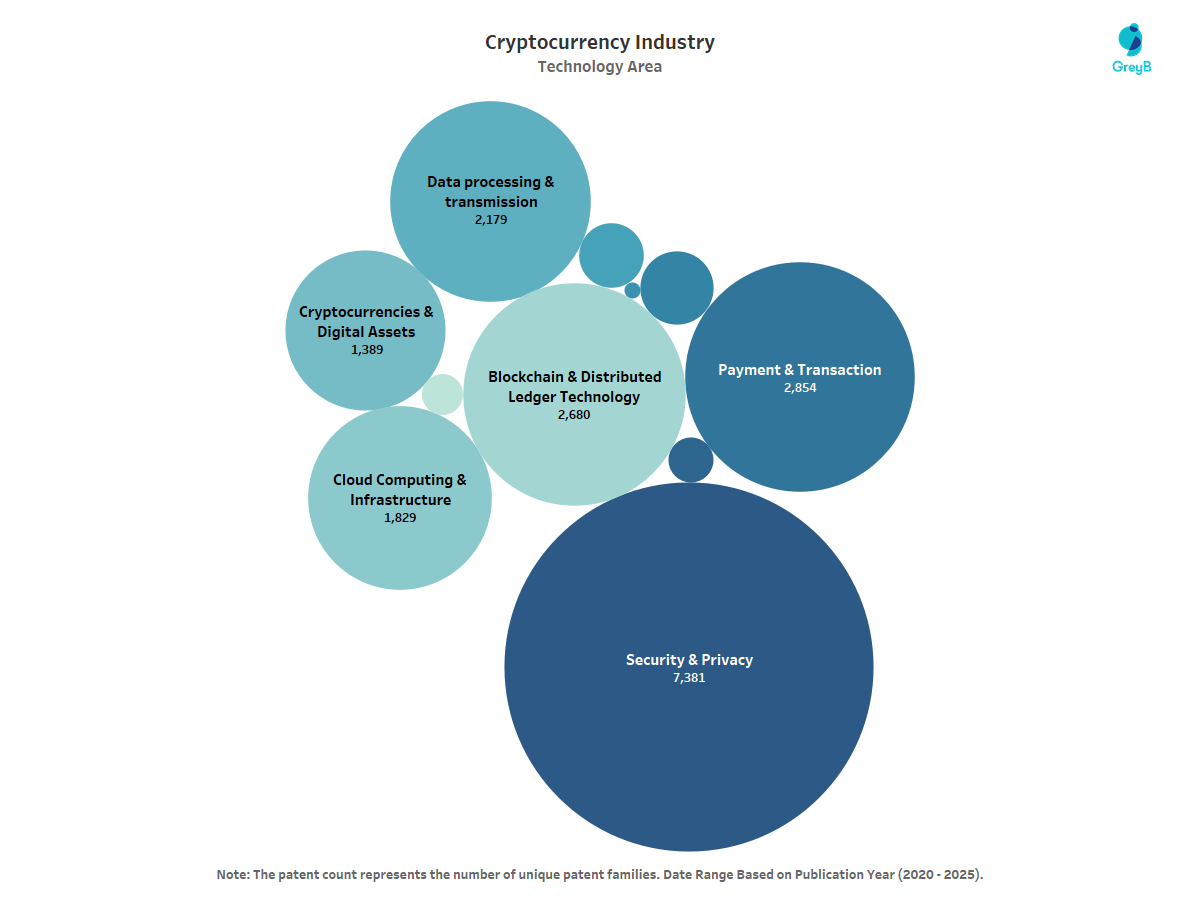
Security and privacy lead the charge, with over 7,000 patents focused on protecting digital assets and ensuring trust in crypto transactions.
Closely following are breakthroughs in payment systems, blockchain infrastructure, and cloud computing, showing how innovation is expanding from core security to real-world usability.
Want to see where the next wave of crypto patents is heading?
Cryptocurrency Innovation Prediction Roadmap
What is in the report?
Full breakdown of patent portfolios by technology area (security, payments, infrastructure, compliance).
Year-wise evolution of filings by technology area from 2003 to 2025.
Rank-list of top companies/assignees in the crypto patent landscape and their filing trends.
Global distribution of filings: country-wise data & year-wise evolution.
Legal status analysis: how many are active, granted, abandoned etc.
Future directions & upcoming innovation hotspots in the crypto space.