As plastic waste regulations tighten worldwide, PET recycling has moved from an environmental obligation to a strategically important innovation domain. Regulatory frameworks such as Extended Producer Responsibility (EPR) in India and recycled-content mandates across the US and Europe including the EU’s requirement for 25% recycled PET in bottles by 2025 are directly influencing how companies invest, innovate, and protect intellectual property.
This regulatory push is clearly reflected in patent activity. Over the past two decades, more than 39,000 PET recycling patents have been filed globally across 70+ countries, with China leading (11,000+ filings), followed by the United States and Europe with 8000+ patents. At the assignee level, Eastman Chemical Company dominates with 700+ patents, ahead of Toyobo and Sidel SA, highlighting strong participation from chemical and packaging technology leaders.
Recent patent trends reveal a decisive shift in innovation focus. Over the last five years, packaging and container technologies have emerged as the most active area, accounting for 1,900+ patent families, followed by recycling process innovations and polymer technologies. These trends underline how PET recycling patents are increasingly being used as tools for regulatory compliance, competitive positioning, and long-term market control.
PET waste collection remains fragmented across regions, leading to contamination and inefficient sorting. Mixed plastics, labels, and additives lower recycling yields and increase processing costs. Innovations protected through patents such as AI-based sorting, sensor-driven identification, and automated material separation are critical to improving feedstock quality.
Recycling PET for food-contact applications requires extremely high purity standards. Many mechanical recycling processes struggle to remove contaminants effectively. Patent activity around advanced decontamination, chemical recycling, and purification processes is rising to enable compliant, food-grade recycled PET (rPET).
PET recycling, especially chemical recycling, often involves high energy consumption and operational costs. Without process optimization, recycled PET struggles to compete with virgin plastics. Patented innovations in low-temperature depolymerization, catalyst efficiency, and process integration aim to reduce cost and improve scalability.
Each recycling cycle can degrade PET’s molecular structure, impacting strength, clarity, and durability. This limits reuse in high-value applications. Patent filings focusing on chain extenders, stabilizers, and polymer rejuvenation technologies seek to restore material properties and extend PET’s lifecycle.
Regulations such as EPR mandates and recycled-content requirements demand transparency across the recycling value chain. Many players lack systems to track recycled content accurately. IP-backed digital solutions—covering traceability, material tracking, and compliance verification—are emerging as strategic enablers.
Despite PET being recyclable, a significant portion still ends up in landfills or incineration. Limited infrastructure for closed-loop recycling and secondary-use applications restrict circularity. Patents around modular recycling systems, second-life applications, and closed-loop material recovery are key to enabling a sustainable PET ecosystem.
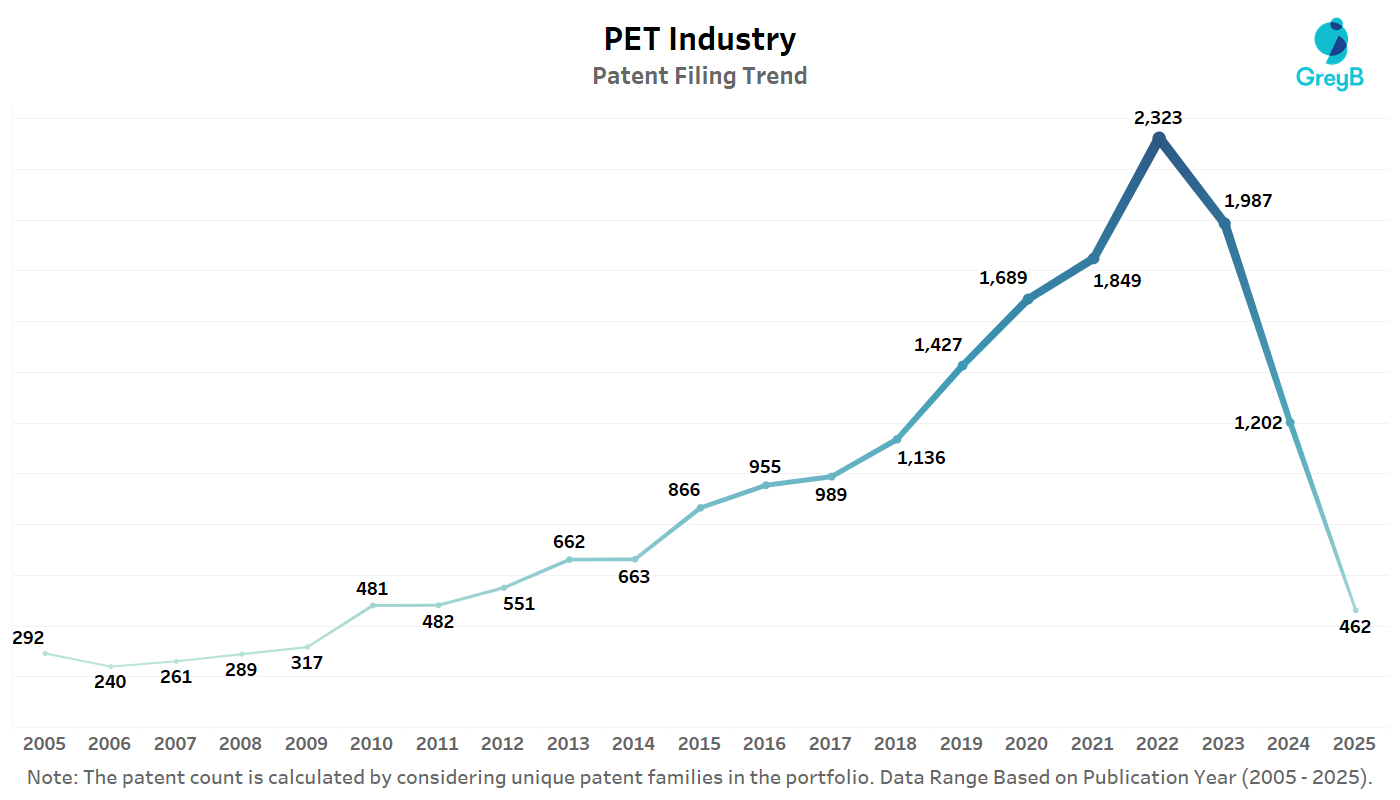
The PET recycling patent trend shows a gradual buildup of innovation from 2005 to around 2012, when filings remained modest and largely focused on basic mechanical recycling and sorting processes. This period reflects an early, compliance-driven phase, with limited emphasis on advanced technologies or large-scale circular economy solutions.
From 2013 onward, patent activity accelerated sharply, peaking around 2022, driven by stricter environmental regulations, corporate sustainability commitments, and breakthroughs in chemical recycling, food-grade rPET, and high-efficiency recovery technologies. The decline after 2023 indicates consolidation and commercialization of mature technologies, signaling that PET recycling has evolved into a strategically important and IP-intensive industry supporting global sustainability goals.
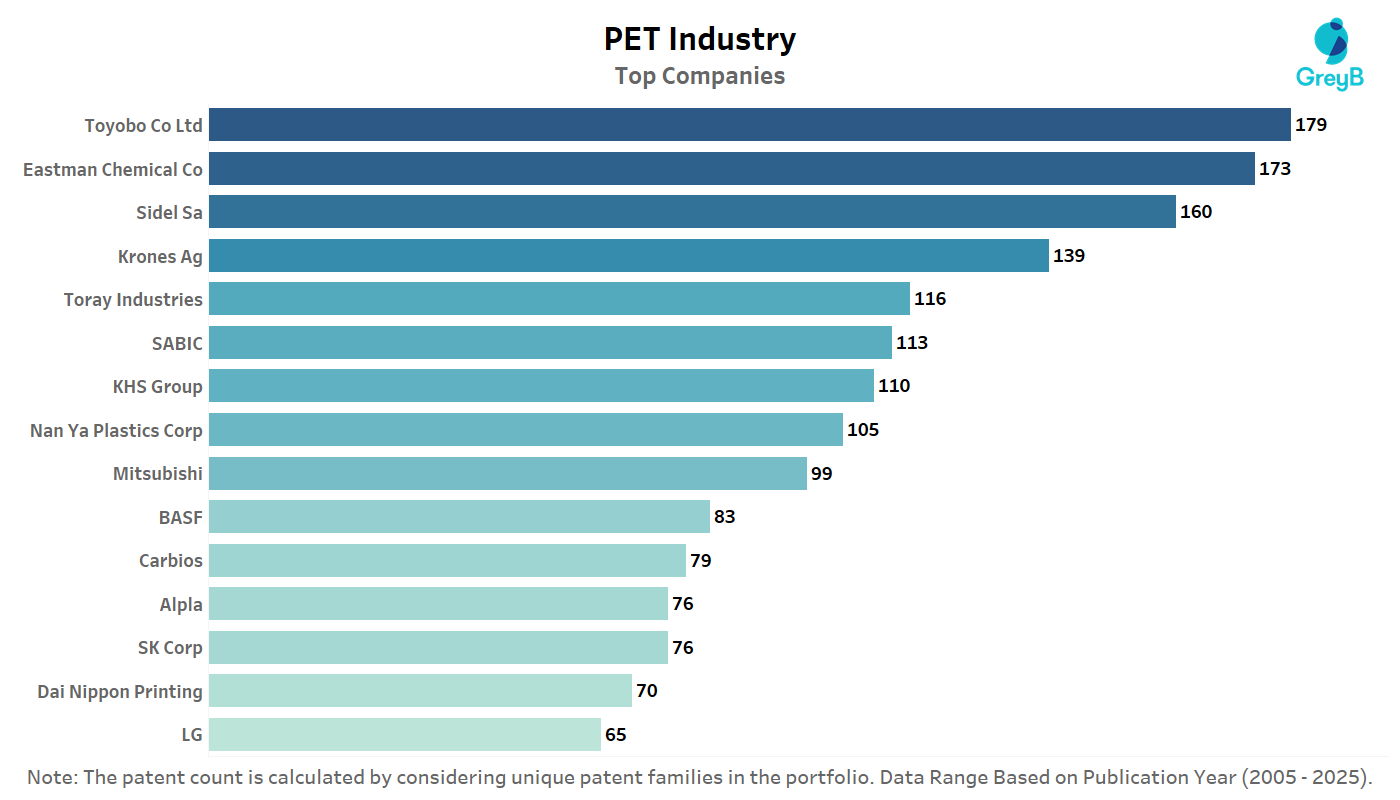
Patent activity in the PET recycling industry is led by a mix of material science giants and packaging technology specialists. Companies such as Toyobo, Eastman Chemical, and Sidel dominate filings, reflecting strong focus on advanced polymer processing, chemical recycling, and food-grade rPET production. Equipment and system innovators like Krones and KHS further highlight the importance of end-to-end recycling and bottling solutions in building scalable circular PET ecosystems.
The presence of global chemical majors (BASF, SABIC, Toray) alongside packaging and printing leaders (Alpla, Dai Nippon Printing) indicates that PET recycling innovation is no longer siloed. Instead, it spans the full value chain, from resin chemistry and depolymerization to bottle design and high-throughput recycling systems, underscoring the industry’s transition toward integrated, commercially deployable sustainability solutions.
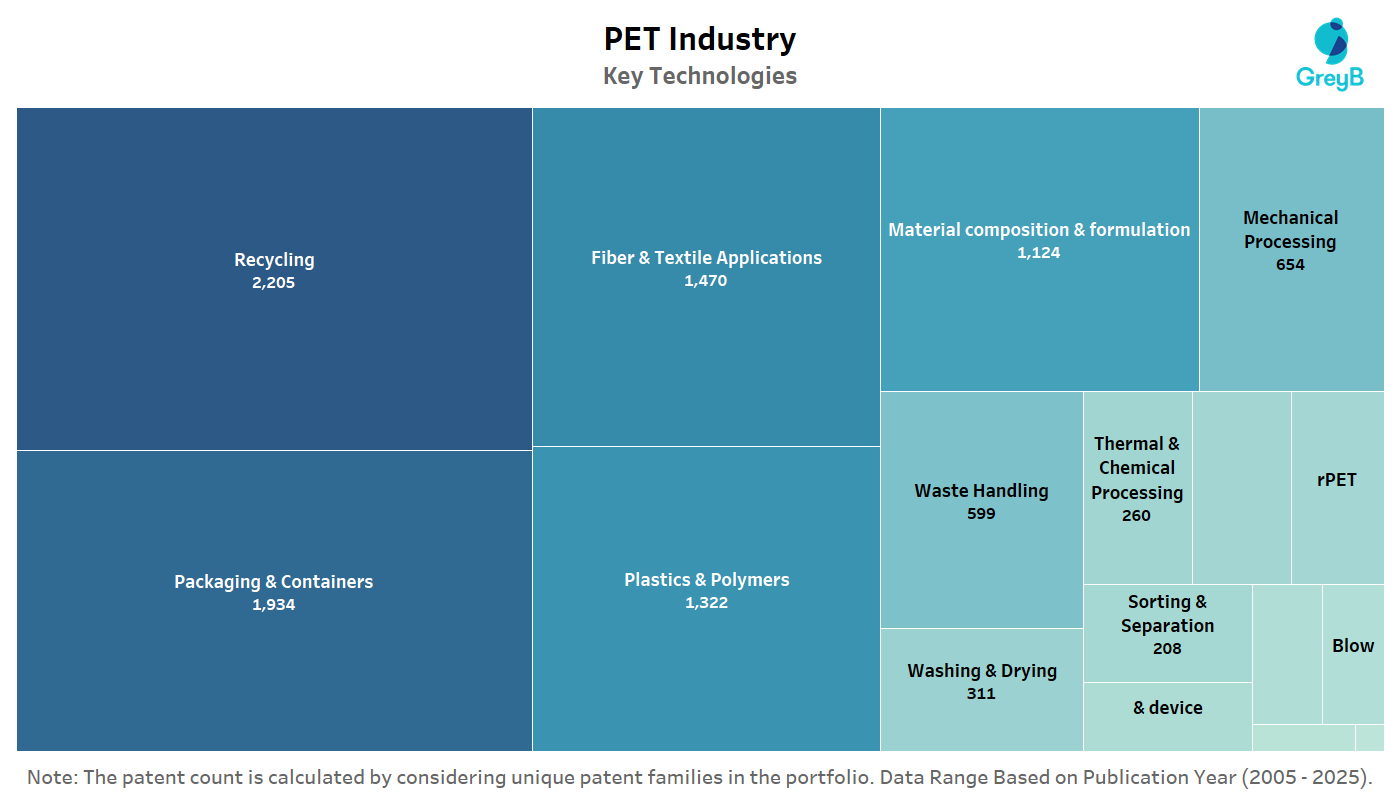
Patent activity in the PET industry is heavily concentrated in recycling and packaging-related technologies, underscoring the sector’s strong push toward circularity and large-scale reuse. Recycling technologies form the largest share, reflecting sustained innovation in reclaiming PET waste, while packaging and container technologies remain a major focus due to ongoing demand for lightweight, durable, and recyclable packaging solutions across food and beverage applications.
Beyond core recycling, significant patenting in fiber & textile applications, plastics & polymer engineering, and material formulation highlights efforts to diversify PET’s end uses and improve material performance. Supporting technologies such as waste handling, washing and drying, sorting and separation, and thermal or chemical processing indicate a maturing ecosystem where efficiency, purity, and process optimization are critical to enabling high-quality rPET production and commercial scalability.
Full breakdown of patent portfolios by technology area.
Year-wise evolution of filings by technology area from 2005 to 2025.
Rank-list of top companies/assignees in the PET Recycling Industry patent landscape and their filing trends.
Global distribution of filings: country-wise data & year-wise evolution.
Legal status analysis: how many are active, granted, abandoned etc.
Future directions & upcoming innovation hotspots in the PET Recycling Industry space.