While gaming was once seen purely as entertainment, it has quietly evolved into a complex digital ecosystem driven by technology, platforms, and intellectual property.
Since 2020, conversations around video games have shifted beyond graphics and gameplay to topics like cloud gaming, cross-platform access, virtual worlds, esports, and player data security. Gamers now expect seamless experiences across devices, real-time interaction, and immersive environments signaling a more mature and demanding audience.
Patent activity mirrors this shift. Thousands of gaming-related patent families filed in recent years highlight rapid innovation in game engines, real-time rendering, cloud streaming, haptic feedback, AR/VR environments, and AI-driven player interaction. Industry leaders such as Sony, Microsoft, Nintendo, Tencent, and Epic Games are securing the core technologies behind future gaming platforms, while startups push boundaries in immersion, monetization, and virtual economies.
Together, these market and innovation signals make one thing clear: gaming is no longer just about playing games, it’s about building persistent digital experiences, and the future of gaming is being patented today.
What are the problems with Video Gaming Industry?
Platform Fragmentation
Games don’t work smoothly across all devices
Players use consoles, PCs, and mobile devices, but many games are still locked to a single platform. This limits reach and frustrates users. Patents around cloud gaming, cross-platform engines, and adaptive rendering can help create seamless play across devices.
High Development Costs
Making modern games is expensive and time-consuming
Advanced graphics, open worlds, and live updates require large teams and budgets. Innovation in AI-assisted game design, automated testing, and reusable game engines can reduce costs and speed up development.
Latency and Performance Issues
Online games suffer from lag and unstable connections
Surging EV charging demand risks grid instability. Patent solutions such as smart charging, bi-directional V2G (vehicle-to-grid), and energy storage optimization can balance peak loads efficiently.
Player Data Privacy & Security
More player data means higher risk of misuse
Modern games collect behavioral, payment, and interaction data. Security breaches can damage trust. Innovations in secure authentication, encrypted game sessions, and fraud detection help protect players and platforms.
Cheating and Fair Play
Unfair advantages ruin the gaming experience
Cheating tools and bots harm competitive balance, especially in esports. Patents focused on real-time cheat detection, behavior analysis, and AI-based monitoring can support fair gameplay.
Content Moderation & Toxic Behavior
Online harassment affects player retention
Toxic chat and behavior drive players away. Technology that automatically detects abusive language, voice patterns, and in-game actions can help create safer gaming communities.
How many patent families were filed annually in the Video Gaming Industry?
The patent filing trend shows consistent growth from 2015 to 2021, highlighting increasing innovation in India’s video gaming industry, supported by the expansion of mobile gaming and digital infrastructure.
The lower figures observed for 2024–2025 do not reflect reduced innovation activity. This is mainly due to the 18-month time lag between patent filing and publication or grant. Many recent applications are still under examination and have not yet appeared in published patent data.
The projected trend indicates that overall patent activity remains strong, and filing numbers are expected to align once pending applications are published.
Who are the key companies in Video Gaming Industry?
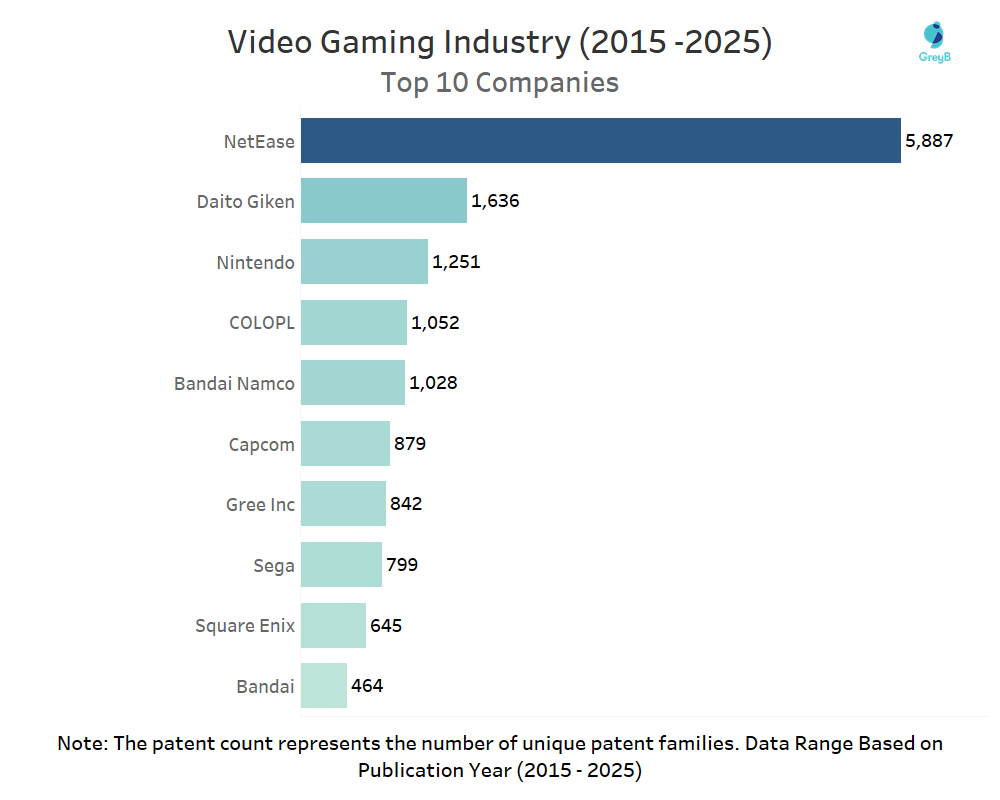
Over the 2015–2025 period, NetEase emerges as the clear patent leader, reflecting its early commitment to online and mobile gaming, live-service models, and long-term platform development. Its strong IP position aligns with sustained investments in proprietary technologies and global studio expansion rather than short-term game releases.
Japanese companies such as Nintendo, Bandai Namco, Capcom, Sega, and Square Enix continue to hold strong patent portfolios built over decades, focusing on gameplay mechanics, user interaction, and hardware–software integration. Meanwhile, companies like Daito Giken, Gree, and Colopl highlight Japan’s strength in arcade-style and mobile gaming innovation. Overall, the data shows that long-term success in gaming is closely tied to owning foundational technologies that support gameplay, engagement, and platform longevity.
Which Countries Are Leading the Global Race for Video Gaming Industry Patents?
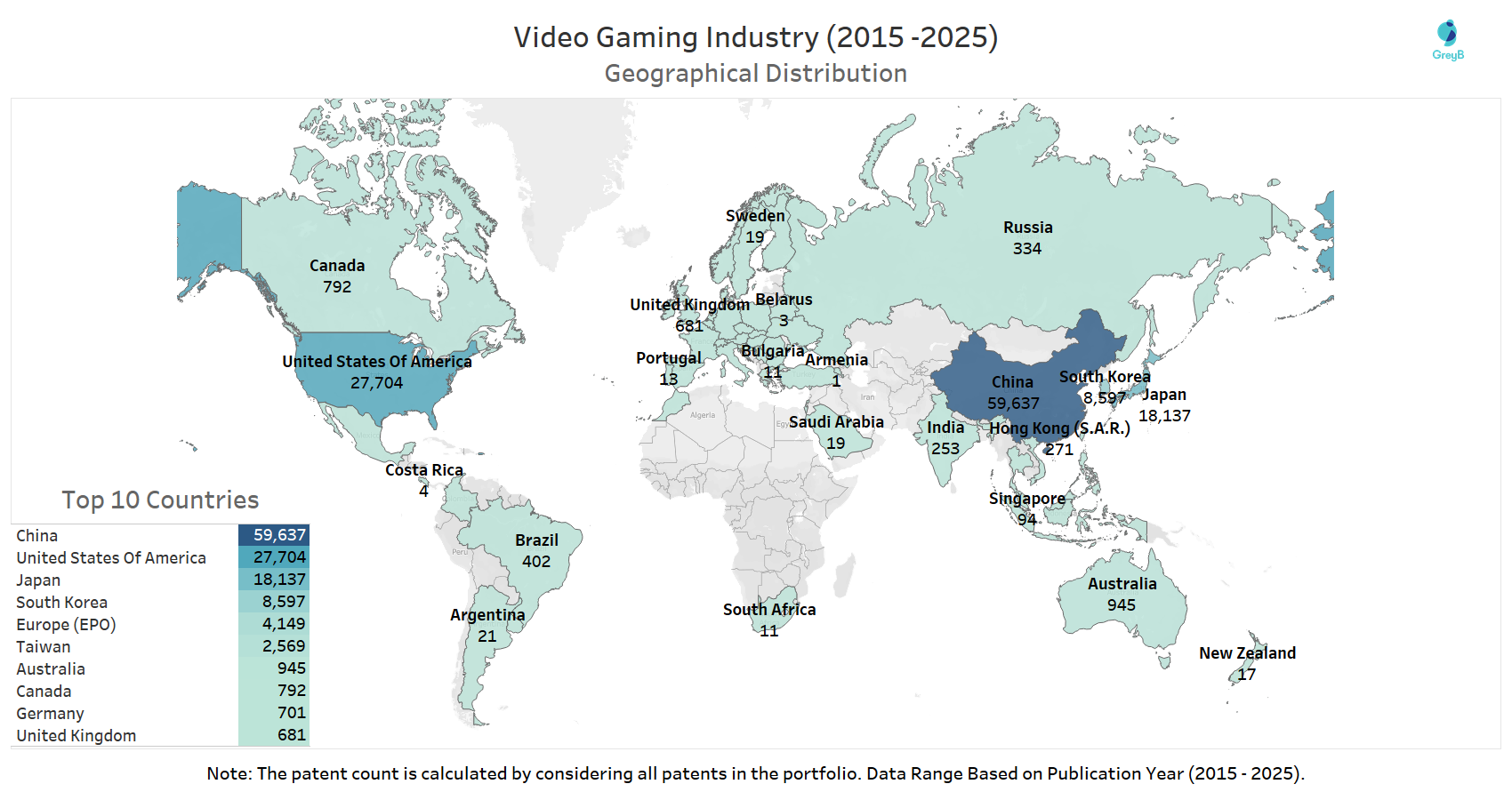
From 2015 to 2025, video gaming innovation has been clearly concentrated in East Asia and North America, with China and the United States dominating global patent filings. China’s leadership reflects its early and sustained focus on online, mobile, and large-scale multiplayer gaming platforms, while the U.S. continues to drive innovation in game engines, platforms, and immersive experiences.
Japan and South Korea remain critical innovation hubs, supported by decades of expertise in console gaming, graphics, and network-based play. Europe shows consistent but fragmented activity across multiple countries, indicating steady innovation without a single dominant center. Overall, the geographic spread confirms that gaming innovation is shaped by regions with strong digital infrastructure, large player bases, and long-term investment in interactive entertainment.
Which Technologies Dominate the Video Gaming Industry?
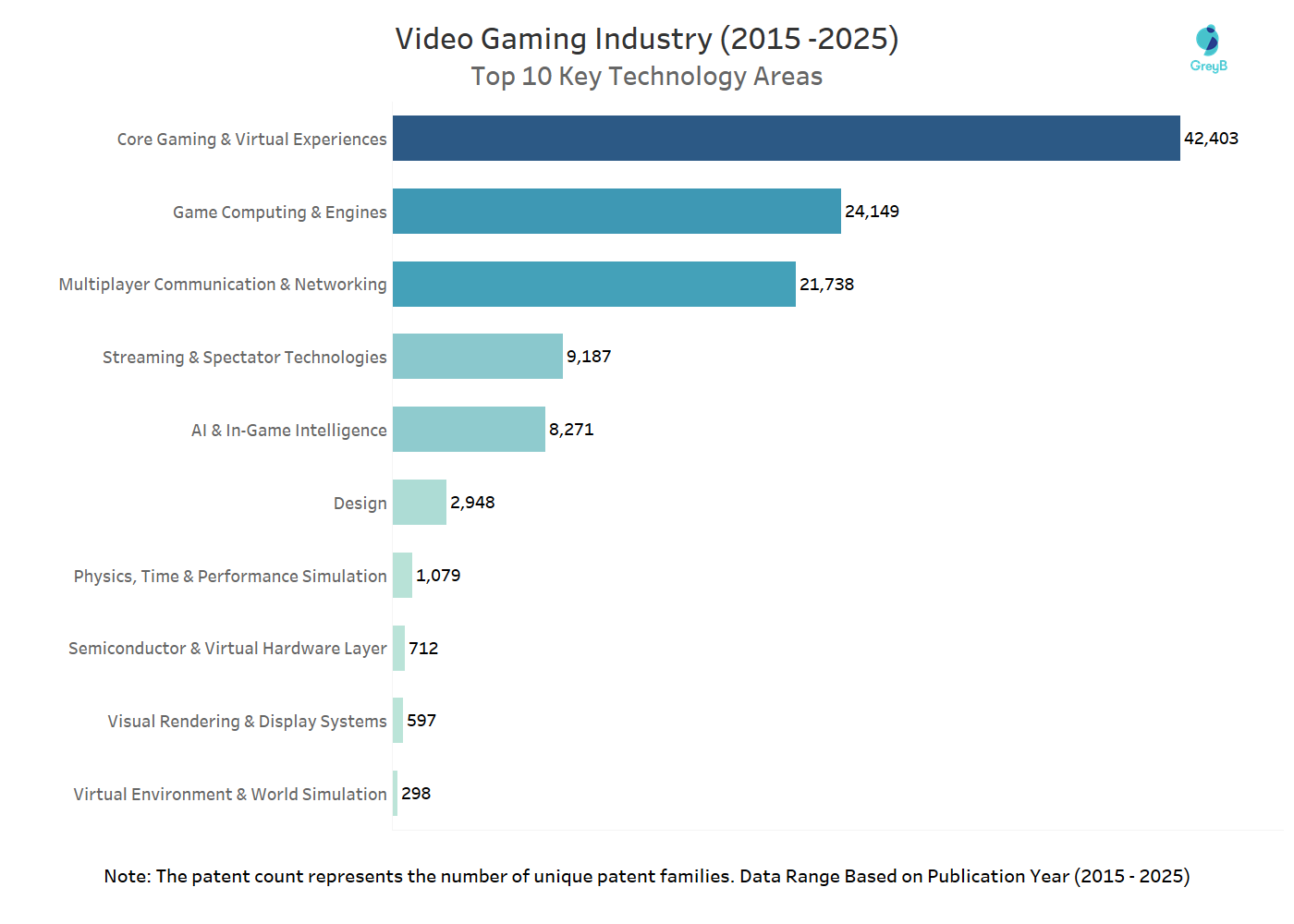
Over the last decade, patent activity in the video gaming industry has been strongly led by core gaming and virtual experience technologies, showing that gameplay innovation remains the heart of the industry. High filing volumes in game engines, computing systems, and multiplayer networking reflect the long-term shift toward online, real-time, and cross-platform gaming that began well before 2020.
The steady rise of patents in AI-driven gameplay and streaming technologies highlights how gaming has evolved from a standalone activity into a connected, intelligent, and spectator-friendly experience. Lower patent counts in simulation, rendering, and virtual hardware suggest these areas are still emerging and may see stronger growth as cloud gaming, XR, and immersive worlds mature further.
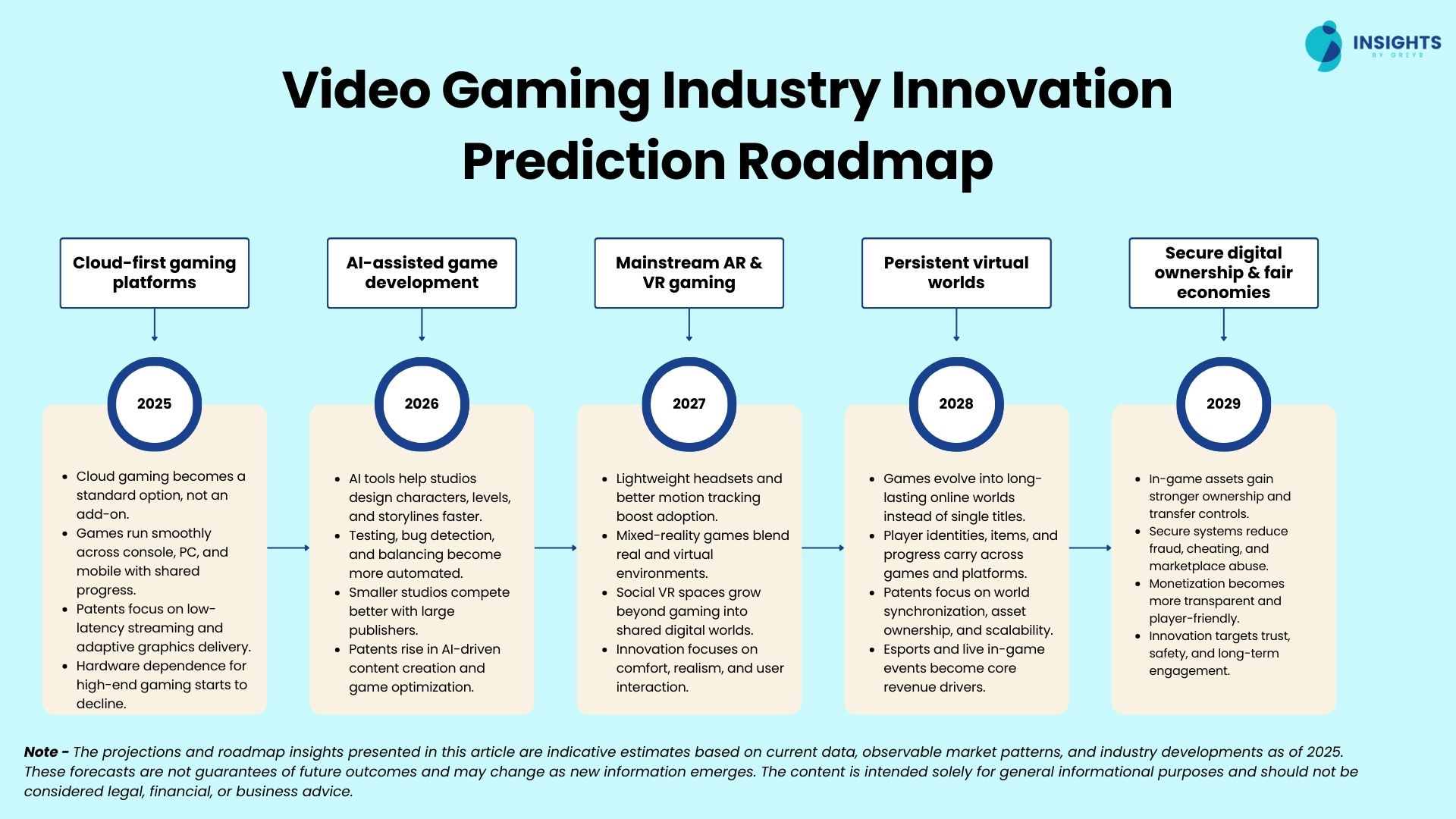
Video Gaming Industry Innovation Prediction Roadmap
What is in the report?
Full breakdown of patent portfolios by technology area.
Year-wise evolution of filings by technology area from 2020 to 2025.
Rank-list of top companies/assignees in the Video Gaming patent landscape and their filing trends.
Global distribution of filings: country-wise data & year-wise evolution.
Legal status analysis: how many are active, granted, abandoned etc.
Future directions & upcoming innovation hotspots in the Video Gaming space.