
In the last five years, 1,975 new pet food products were launched in the U.S. – a number that tells a clear story about how seriously brands are taking innovation in this space. Pet owners are reading ingredient labels more carefully, seeking out products with real protein sources, functional health benefits, and cleaner formulations.
What was once a straightforward purchase – a bag of kibble or a can of wet food – has evolved into a considered decision driven by nutrition, lifestyle, and a deep emotional bond between owners and their animals.
This innovation is playing out across six core categories: Dog Snacks & Treats, Dog Food Wet, Dog Food Dry, Cat Snacks & Treats, Cat Food Wet, and Cat Food Dry. Each of these segments is evolving in its own way, shaped by different consumer priorities, price sensitivities, and health trends. Treats and snacks are seeing a surge in functional claims, while wet and dry formats are being reimagined through premium ingredients and life-stage specific nutrition.
With more choices available than ever – both on physical shelves and online – the pressure on brands to differentiate is only growing. This article takes a close look at how pet food product innovation in the U.S. has evolved between 2021 and 2026, which categories are driving the most activity, who the key players are, and where the real opportunities lie for brands thinking ahead.
Year-wise Product Launch Trends in the U.S. Pet Food Market
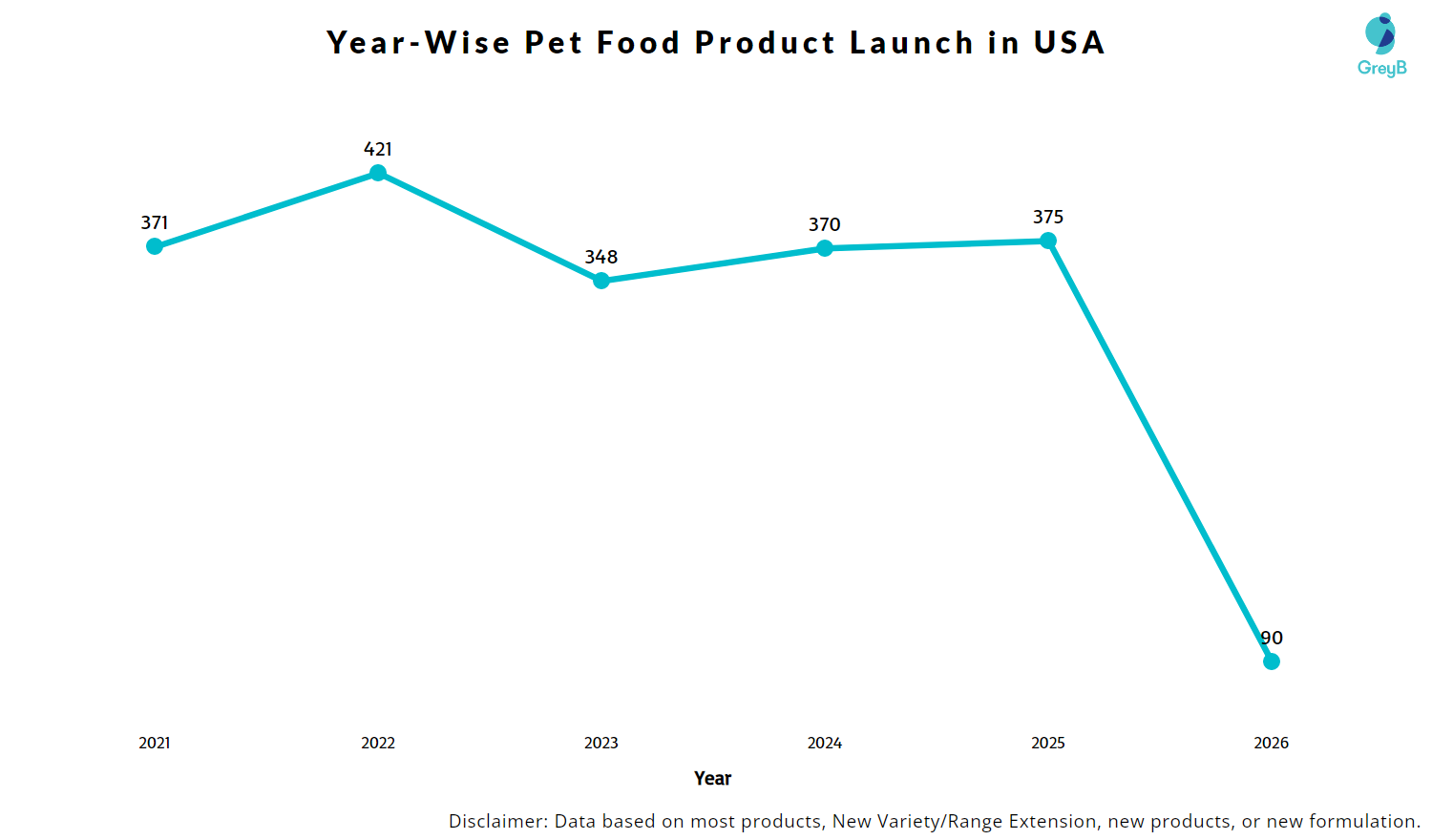
Pet food product launches in the U.S. have followed an uneven but resilient path over the last five years, reflecting both market adjustments and sustained long-term investment in innovation.
The period opened with 371 new launches in 2021, followed by a jump to 421 in 2022 – the highest single-year total in the period analyzed. This peak likely reflects post-pandemic momentum, as brands responded to a surge in pet ownership and growing consumer demand for premium, health-focused options.
2023 saw a notable pullback to 348 launches, the lowest point in the five-year window. This dip points to a period of consolidation, where brands paused to manage costs in an inflationary environment and refine their innovation pipelines rather than launch broadly.
Recovery followed in 2024 with 370 launches, continuing steadily into 2026 with 375. This stabilization signals that while the peak of 2022 has normalized, the industry’s commitment to product development remains solid and consistent.
The 90 launches recorded in 2026 reflect partial-year data and should not be read as a slowdown. Overall, the trend paints a picture of a maturing market where innovation is becoming more deliberate and targeted rather than purely volume-driven.
Top Product Categories in the U.S. Pet Food Market
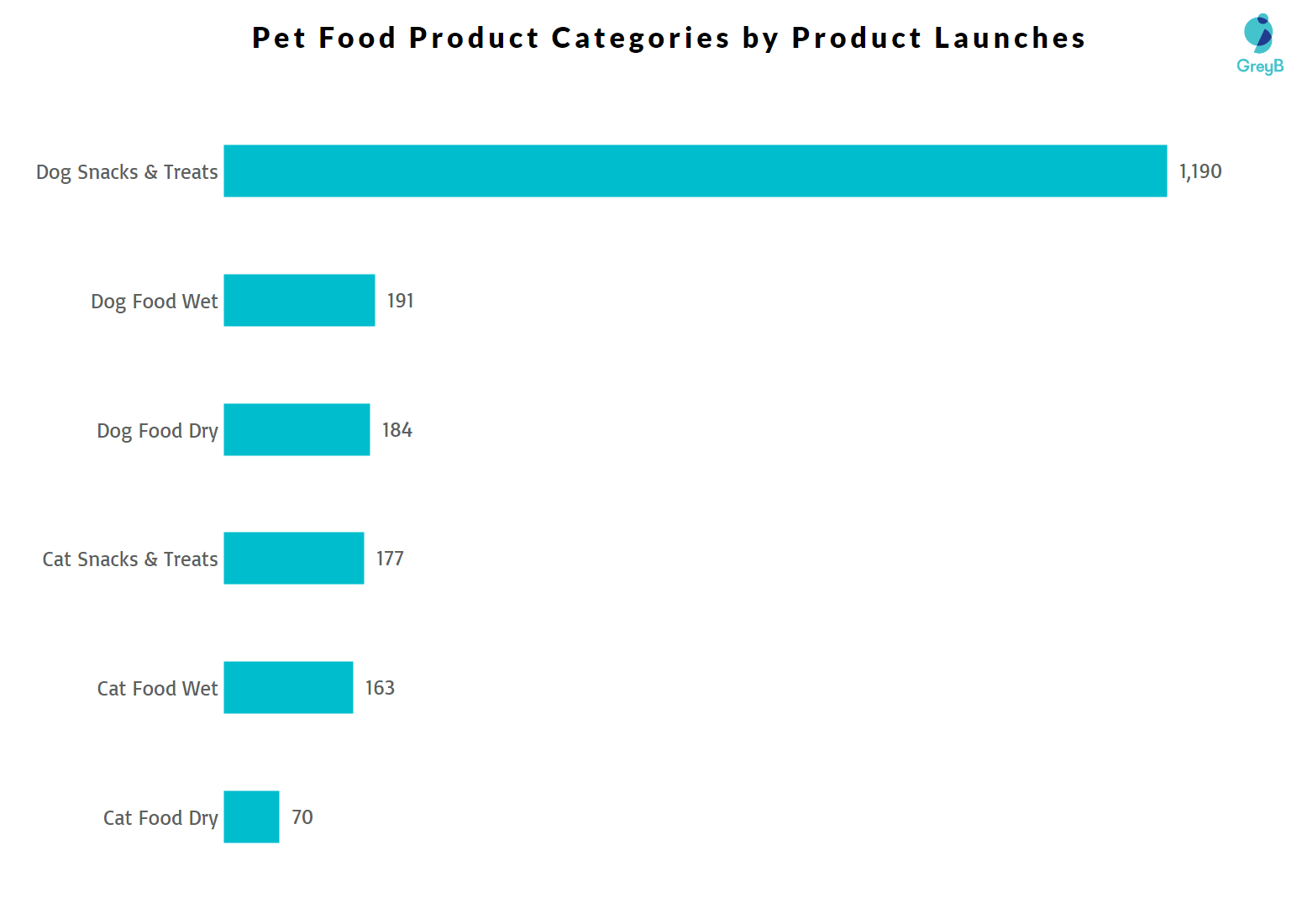
Dog Snacks & Treats dominates the U.S. pet food innovation landscape, consistently recording the highest number of launches across all five years. However, after peaking at 264 launches in 2022, the category has stabilized in the 218–227 range, suggesting it is maturing. Cat Snacks & Treats, on the other hand, shows a steady climb from 25 launches in 2021 to 39 in 2025, making it the clearest growth story in the feline segment.
Dog Food Dry stands out as a category on the rise, bouncing back from a low of 28 launches in 2023 to 47 in 2025 – its highest point in the entire period. Cat Food Dry follows a similar recovery pattern, while both wet food categories for dogs and cats show a gradual declining trend, easing from their earlier highs and receiving less innovation attention over time.
Overall, the data points to a market that is shifting its energy toward treats, snacks, and dry formats. Wet food innovation is slowing, while functional and premium positioning in dry and treat categories is clearly where brands are placing their bets.
Top 10 Pet Food Companies by Product Launches in the U.S.
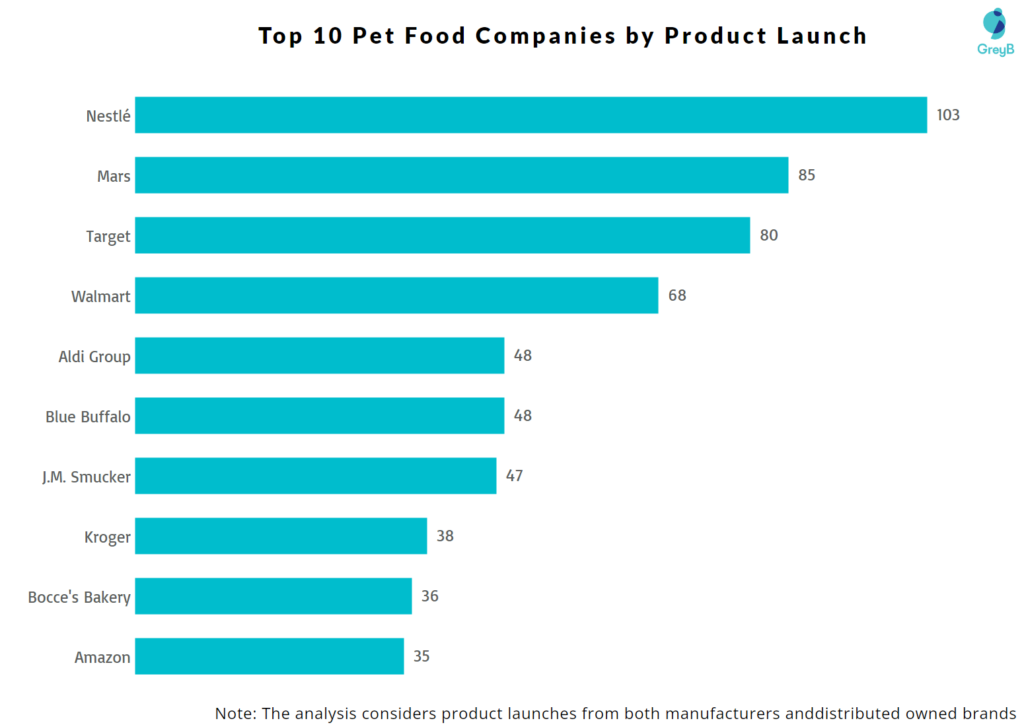
Nestlé leads overall with 103 total launches, followed by Mars at 85, and both stand out as the most well-rounded innovators with active presence across all six categories. Nestlé shows particular strength in Cat Food Wet and Cat Snacks & Treats alongside a solid dog category presence, while Mars maintains a balanced split between dog and cat segments including a strong showing in Dog Food Dry. This cross-category breadth reflects the depth of their R&D capabilities and their ability to serve both dog and cat owners at scale.
Target (80) and Walmart (68) rank among the top launchers but follow a different pattern — strong in Dog Snacks & Treats with limited presence in several cat categories. Aldi Group (48) takes this further, showing almost no activity beyond dog-focused segments, pointing to a selective, value-driven approach rather than broad portfolio experimentation. Kroger (38) strikes a slightly more balanced profile, with moderate activity across both dog and cat segments.
J.M. Smucker (47) and Bocce’s Bakery (36) concentrate nearly all their launches in Dog Snacks & Treats, leaving significant white space in cat-oriented and wet food categories. Blue Buffalo (48) and Amazon (35) show a more measured spread across segments. Overall, true cross-category innovation remains the territory of global players like Nestlé and Mars, while specialists and retailers tend to double down on segments where they already have established scale.
Which Pet Food Categories Are Growing, Plateauing, or Declining?
Dog Snacks & Treats dominates the U.S. pet food innovation landscape, consistently recording the highest number of launches across all five years. However, after peaking at 264 launches in 2022, the category has stabilized in the 218–227 range, suggesting it is maturing. Cat Snacks & Treats, on the other hand, shows a steady climb from 25 launches in 2021 to 39 in 2025, making it the clearest growth story in the feline segment.
Dog Food Dry stands out as a category on the rise, bouncing back from a low of 28 launches in 2023 to 47 in 2025 – its highest point in the entire period. Cat Food Dry follows a similar recovery pattern, while both wet food categories for dogs and cats show a gradual declining trend, easing from their earlier highs and receiving less innovation attention over time.
Overall, the data points to a market that is shifting its energy toward treats, snacks, and dry formats. Wet food innovation is slowing, while functional and premium positioning in dry and treat categories is clearly where brands are placing their bets.
How Are Pet Food Categories Evolving Over the Past Five Years?
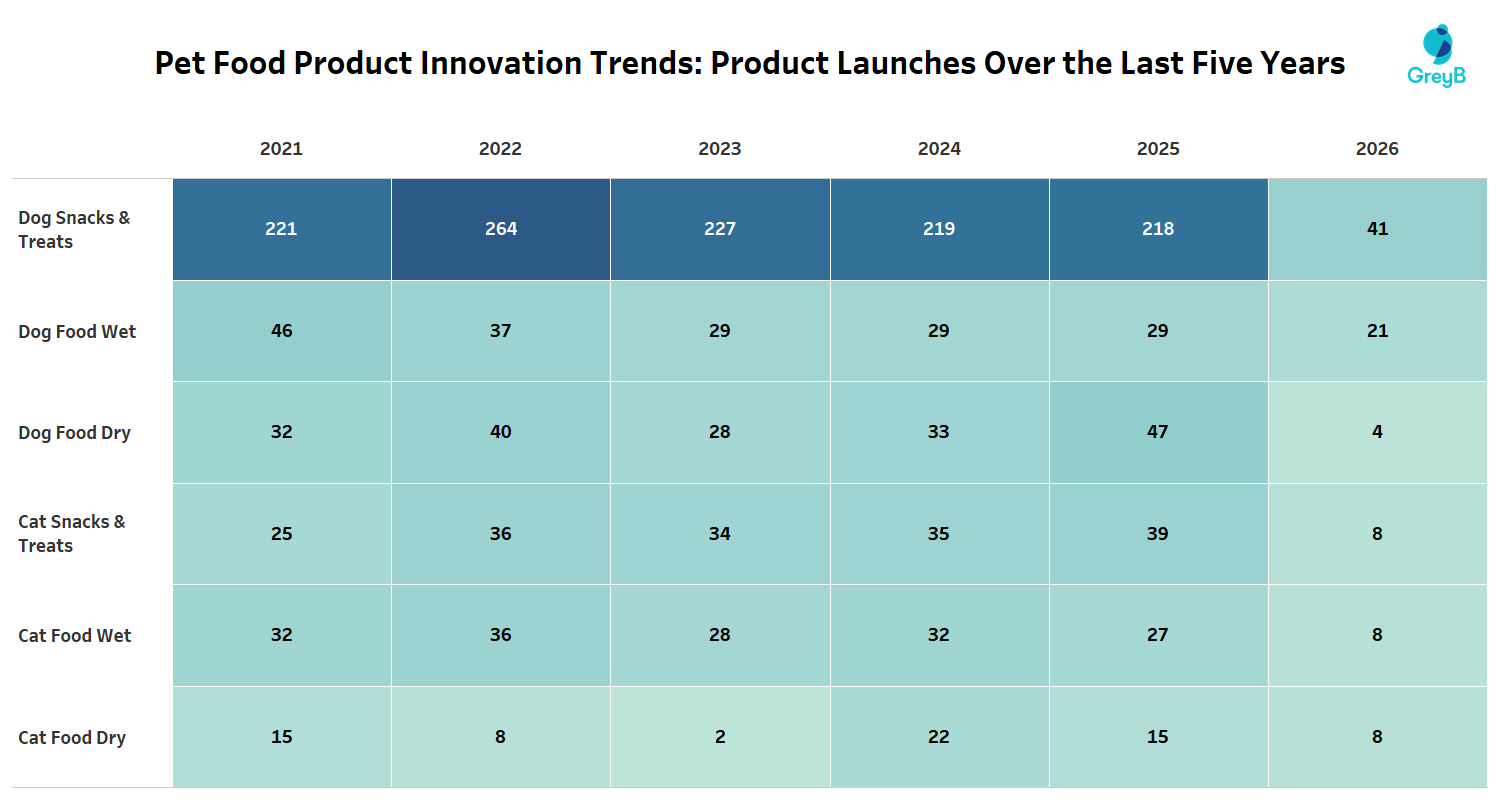
Over the five-year period, Dog Snacks & Treats peaked in 2022 and has since settled into a steady range, suggesting the category is maturing rather than expanding. Dog Food Dry, however, tells a more dynamic story – after a quiet 2022 and 2023, it climbed to its highest point in 2025, signaling renewed brand investment and growing consumer interest in premium dry formats.
On the cat side, Cat Snacks & Treats has grown consistently year on year, emerging as one of the most promising innovation segments of the period. Cat Food Dry, though still low in overall volume, showed a meaningful rebound in 2024 after an unusually quiet 2023. Both trends suggest that cat-focused innovation is gradually catching up with the dog category, as brands recognize the underserved potential in the feline market.
Wet food for both dogs and cats has lost innovation momentum over the period. Dog Food Wet peaked early and has trended downward since 2022, while Cat Food Wet has remained flat with no meaningful growth. The overall five-year picture points to a market becoming more treat-led and dry-format focused, with cats emerging as a quiet but important growth opportunity.
Which Pet Food Companies Are Innovating Across the Widest Range of Sub-Categories?
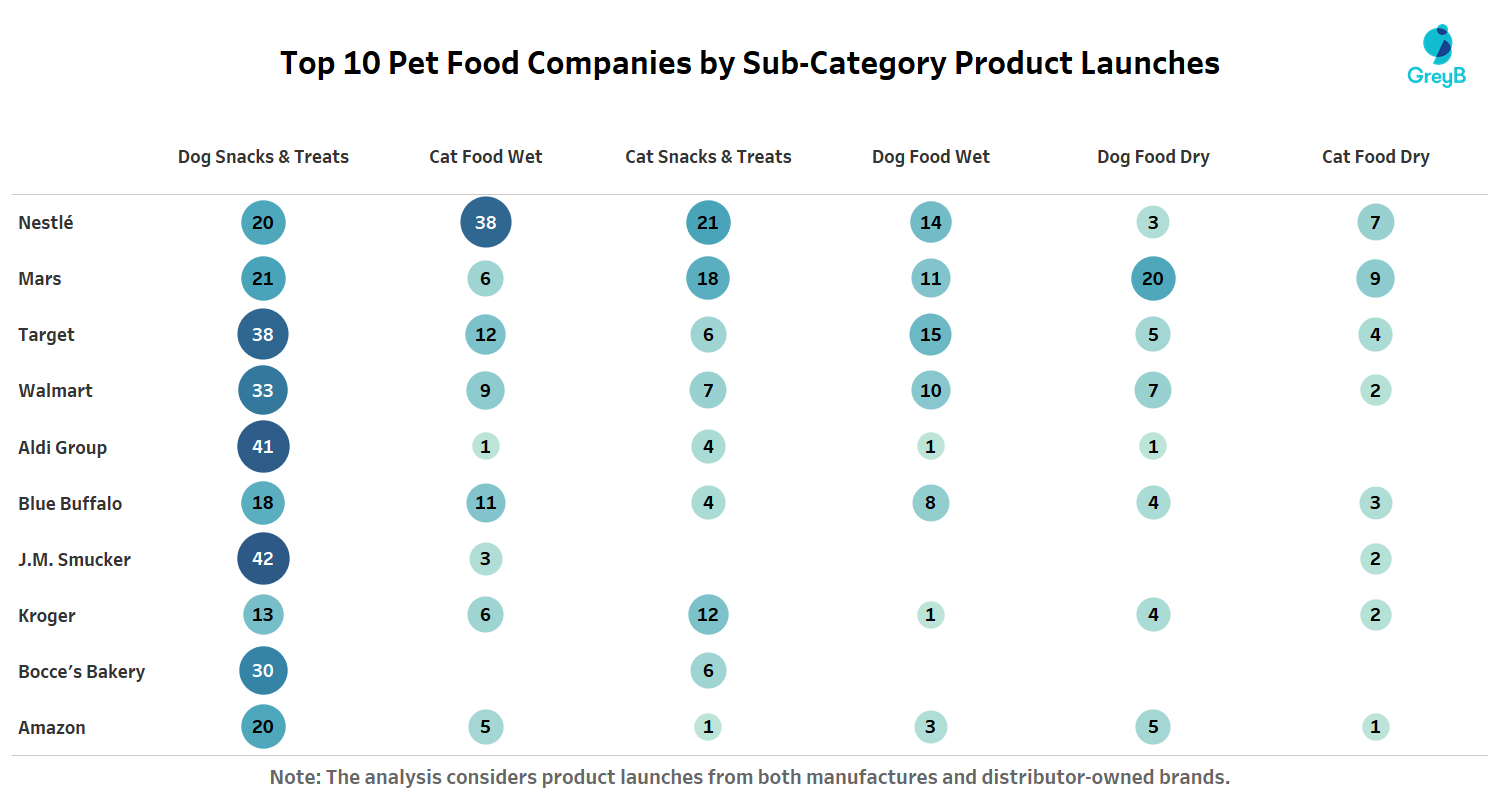
Nestlé and Mars emerge as the most well-rounded innovators, with active launches spread across all six categories. Nestlé shows particular strength in Cat Food Wet and Cat Snacks & Treats alongside a solid dog category presence, while Mars maintains a balanced split between dog and cat segments including a strong showing in Dog Food Dry. This cross-category breadth reflects the depth of their R&D capabilities and their ability to serve both dog and cat owners at scale.
Retail-led players like Target, Walmart, Kroger, and Aldi Group show a different pattern – strong in Dog Snacks & Treats but with limited or no presence in several cat categories. Their strategies appear volume-driven, anchoring on high-demand staples rather than broad portfolio experimentation. Aldi Group in particular shows almost no activity beyond dog-focused segments, pointing to a selective, value-focused approach.
J.M. Smucker and Bocce’s Bakery sit at the other end of the spectrum, concentrating nearly all their launches in Dog Snacks & Treats with minimal presence elsewhere. While this focused strategy has clearly worked in terms of launch volume, it leaves significant white space in cat-oriented and wet food categories.
Overall, the data suggests that true cross-category innovation remains the territory of global players, while specialists and retailers tend to double down on segments where they already have scale.
What ingredient or whitespace opportunities exist in the Pet Food?
How is sustainability driving innovation in the Pet Food?

How Is the Pet Food Market Advancing Health-Focused Product Innovation?
Interested in accessing the complete list of active products in the Pet Food Industry or detailed innovation benchmarking? Fill out the form to access it now!