Remember when karaoke meant renting bulky machines and sifting through piles of CDs? Today, AI-powered vocal removers are making karaoke (and professional music editing) as easy as a tap on your phone.
With advanced algorithms, AI vocal removers can instantly strip vocals from any song – whether for karaoke, music remixing, or forensic audio analysis. And much of this innovation is protected by groundbreaking patents.
What Is an AI Vocal Remover?
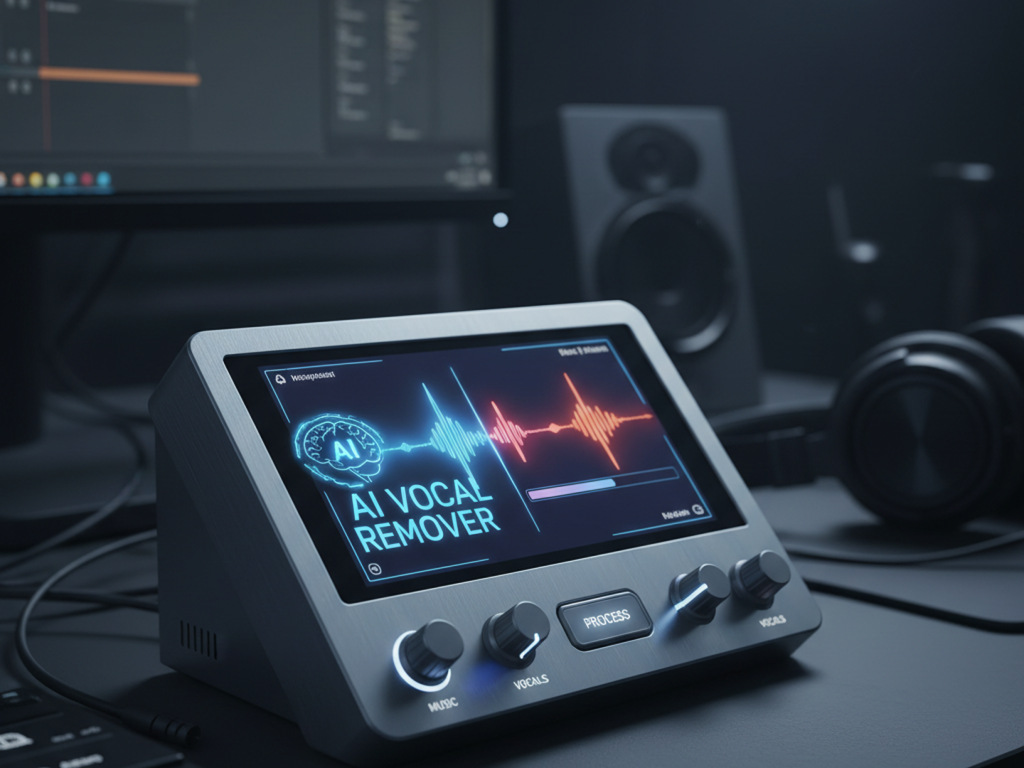
An AI vocal remover is a software system designed to separate vocals from background music in real time. Unlike older tools that required preprocessed music files, today’s systems leverage deep learning and signal processing to analyze raw audio streams and split them into vocal and accompaniment tracks.
Modern AI vocal removers use a combination of:
– Spectrogram Analysis – transforming audio into a time-frequency image for precise feature detection
– Deep Neural Networks – convolutional encoder-decoder architectures for isolating vocals
– Masking & Reconstruction – generating vocal/accompaniment probability masks and reconstructing tracks with minimal artifacts
– Embedded Optimization – running on ARM platforms with quantization for low-latency performance.
Fill out the form to get started with Slate.
How It Works
The process generally follows a multi-stage pipeline:
- Audio Ingestion & Preprocessing – The system applies short-time Fourier transforms (STFT) with overlapping windows to generate spectrograms.
- Feature Extraction – Mel-frequency cepstral coefficients (MFCCs), timbre features, and spectral fingerprints are computed.
- Neural Network Separation – Convolutional neural networks (CNNs) process the spectrogram, generating probability masks for vocals and instrumentals.
- Reconstruction – Inverse FFT and overlap-add methods convert separated signals back to time-domain audio.
- Optimization – Lightweight models (via TensorFlow Lite) allow deployment on edge devices, enabling real-time karaoke track generation.
Patents Powering the Technology
Here are some key patents driving AI vocal remover innovation:
| Publication No. | Assignee | Problem Addressed | Solution Proposed | Industry Impact |
| CN118737184A | Wuzhou University | Difficulty isolating vocals in opera recordings | Two-stage vocal separation algorithm | Enhances clarity for cultural archiving and music training |
| US20230306943A1 | Harman | Need for real-time vocal removal | CNN-based system for live audio processing | Enables consumer-grade vocal removal in entertainment devices |
| WO2022082607A1 | Harman International | Scalability across formats | Neural network architecture adaptable to multiple audio formats | Forms the basis for productized vocal remover features in Harman systems |
| CN117198317A | Changan Automobile | Integration of voice separation in vehicles | Dual-segmentation vocal separation | Expands in-car karaoke and hands-free voice enhancement |
| CN104464727B | Fuzhou University | Limitations in single-channel processing | Two-stage AI separation for monophonic audio | Improves remixing and single-source track editing capabilities |
Curious About How the Latest Patents Are Tackling AI Vocal Removal Challenges? Get your hands on a complete list of these innovative patents, the problems they target, and the solutions they offer.
Use Cases
- Entertainment & Music Production: Karaoke apps, remixing tools, and music learning platforms leverage AI-based vocal removal to enhance user experience.
- Automotive: In-car karaoke, passenger entertainment, and hands-free communication are improved by integrating AI separation.
- Broadcast & Media: Broadcasters and streaming platforms use AI separation to adjust or mute vocals for licensing, dubbing, and accessibility purposes.
Future Aspects of AI Vocal Removal
In the future, AI vocal removers will become smarter and more flexible. Users will be able to pick and choose which voices or instruments to keep or remove, making music editing more personalized. These tools will work both on devices and in the cloud for smooth performance anywhere.
Generative AI will create clearer, studio-quality tracks even from noisy audio. People will be able to remix songs live by adjusting vocal volume, pitch, or effects in real time. We’ll also see this technology in AR/VR concerts, live streams, and music collaboration apps. Finally, new rules and guidelines will help protect copyrights and prevent misuse of isolated vocals.
Conclusion
Patent activity underscores the rapid evolution of AI vocal remover technologies, with significant contributions from Harman and Chinese universities. As adoption spreads into entertainment, automotive, and broadcasting, stakeholders must navigate regulatory, technical, and operational hurdles.
Companies that invest in patent landscaping and standards participation will gain strategic advantage in shaping this emerging market.