In early 2024, a quiet revolution began in nurseries worldwide. Parents discovered they could reduce bottle cleaning time from 15 minutes of manual scrubbing to just 6 minutes of automated sanitization while achieving 99.99% pathogen reduction instead of the 95% typical of hand washing. The catalyst wasn’t just convenience; it was a new generation of intelligent baby bottle washers combining UV-C sterilization, integrated drying and smartphone connectivity that fundamentally changed how families approach infant feeding hygiene.
The market response validates this transformation. The intelligent baby bottle washer segment is projected to surge from $150-170 million in 2024 to $400-451 million by 2032-2033, representing a compound annual growth rate of 12-13%. The broader baby bottle sterilizer and dryer market shows even more dramatic expansion, growing to $1.5 billion by 2033 with a 6.8% CAGR. Consumer willingness to pay 20-35% premiums for machines integrating bottle warmers, drying functions, one-touch self-cleaning and real-time sterilization reports via smartphone signals a fundamental market shift toward multifunctional automated systems.
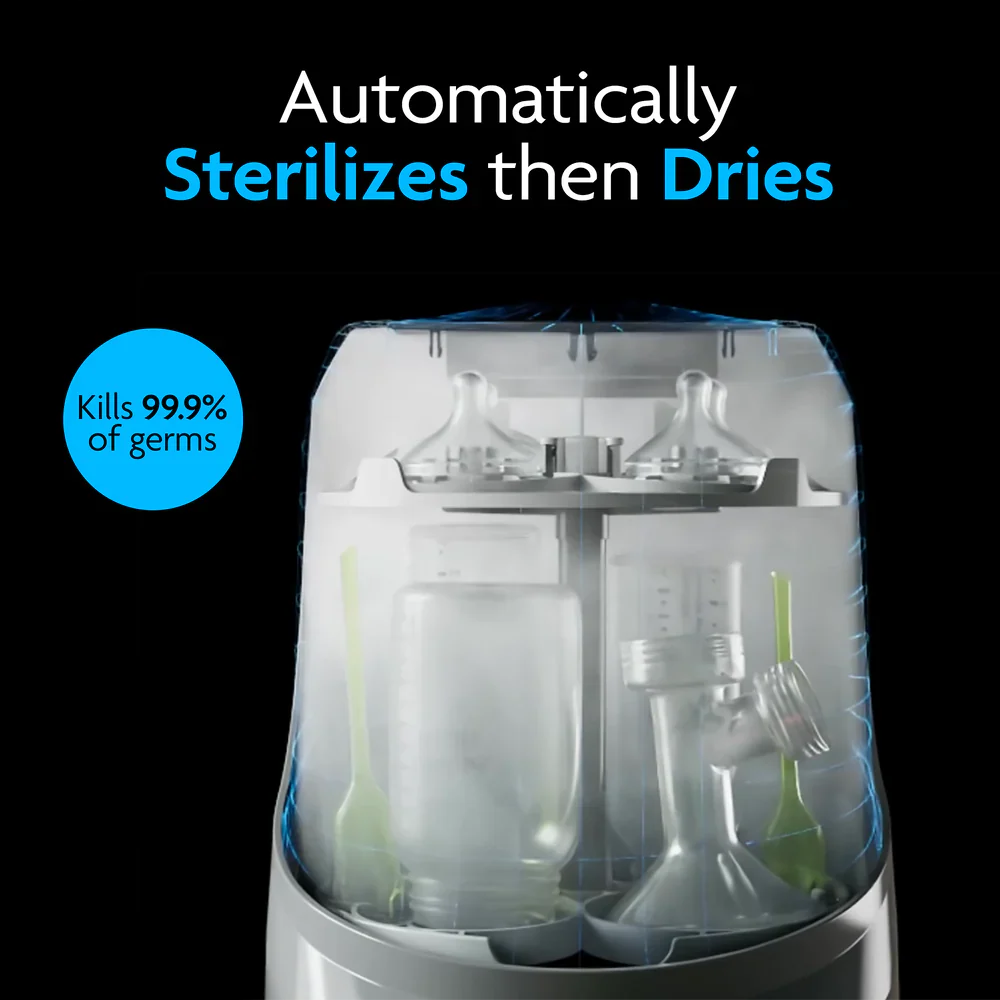
This is where patent innovation becomes the competitive differentiator. Companies racing to capture this opportunity are filing intellectual property addressing critical pain points: from high-speed washing systems completing full cycles in 30 seconds, to smart bottle bases with UV-C LEDs and weight sensors, to integrated shelf systems providing directed inner-wall cleaning with HEPA-filtered hot air drying, to conveyor-based pharmaceutical-grade sterilizers eliminating residual moisture contamination.
In this analysis, we’ll decode the key patents driving baby bottle washer innovation, examine how major brands are positioning their technology features and identify the unresolved technical challenges that separate current products from their potential as healthcare-grade sanitization platforms.
How Major Brands Are Positioning Their Technology
Current market leaders demonstrate distinct technology positioning strategies based on sterilization methods, integration features and target demographics:
| Company | Key Strengths | Market Position |
| Philips Avent | Sterilization effectiveness, ease of use | Market leader |
| Dr. Brown’s | Consistent top performer | Premium segment leader |
| Tommee Tippee | User-friendly designs | Strong consumer loyalty |
| Munchkin | Innovation focus | Growing market share |
| MAM | Specialized designs | Niche market leader |
Recent Patents Shaping Baby Bottle Washer Innovation
The following patents represent the current frontier in baby bottle washing technology each addressing specific technical barriers that have historically limited sanitization efficacy and consumer adoption:
| Patent Number | Publication Date | Problem Disclosed | Solution Proposed |
| US20243068444A1 | 2024-09-26 | Traditional manual cleaning fails to properly sanitize bottles, leaving milk residue and microorganisms that can cause infections in infants | Comprehensive dual-tower system integrating heated water whirl cleaning, filtered hot air drying, UV sterilization, and automated milk dispensing with remote mobile control |
| IN202541017053A | 2025-03-21 | Hand washing cannot effectively remove all milk residue and bacteria; boiling bottles is time-consuming and may degrade bottle materials | AI-powered automated system that disassembles bottles, uses ultrasonic cleaning with temperature control, and UV-C drying for chemical-free sterilization |
| KR20240065930A | 2024-05-02 | Conventional sterilizers struggle to dislodge dried milk stains and provide inadequate coverage | Smart bottle base with vertically-aimed UV-C LED (254nm), weight sensors for operation control, tilt detection for safety, and integrated heating for milk preparation |
| US12011132B2 | 2024-10-15 | Conventional dishwashers are too slow and bulky for retail environments; hand-cleaning risks contamination | High-speed countertop system with 30-second cycles, rotating spray manifold with UV-C LED arrays, and recirculating wash fluid for rapid sanitization |
| CN223787601U | 2024-02-27 | Conventional spray-arm machines require energy-intensive pumps and precise positioning of small parts | Drum-type washing machine using centrifugal force for water circulation, eliminating pump requirements while providing gentle tumbling wash action and integrated steam sterilization |
| CN223555213U | 2024-01-09 | UV-based sterilizers struggle to dislodge dried milk stains effectively | Portable sterilizer combining rotating mechanical cleaning brushes with high-temperature water spray for comprehensive cleaning of both bottles and nipples |
| CN223737703U | 2024-08-14 | Stand-alone bath or spray units cannot guarantee residual moisture below detectable limits, risking re-contamination | Conveyorized water-bath sterilizer with five heated water nozzles, compressed-air drying, and integrated sterilization lamp for pharmaceutical-level hygiene confidence |
| IN202541055711A | 2025-01-16 | Traditional washing requires separate equipment for washing and sterilization, increasing complexity and contamination risk | Single-chamber automated system using PIC16F877A microcontroller to sequentially wash, drain, and hot-water sterilize bottles in one compact device |
| CN121264915A | 2024-05-10 | Conventional units poorly wash and dry inner walls of bottles and nipples, leaving moisture that promotes bacterial growth | Integrated shelf system with dedicated water and hot-air circuits, positioning bottles over rhombic water outlets and providing directed inner cleaning with HEPA-filtered hot air drying |
| CN222587586U | 2024-01-16 | Reciprocating-nozzle systems are complex, costly, and require precise operator positioning | Fixed modular spray manifold with 65° fan-shaped nozzles arranged at specific angles, eliminating reciprocating mechanisms while providing 100% lateral coverage |
Get the list of Baby Bottle Washer patents. Discover the problems they solve and the solutions they offer. Fill out the form to access it now!
Commercially Available Products Based on These Patents
Based on the patent analysis, several commercial products appear to incorporate technologies from these recent patents:
- Philips Avent Advanced Bottle Sterilizer and Dryer – Incorporates UV-C sterilization technology similar to KR20240065930A, featuring integrated drying and smartphone connectivity
- Baby Brezza Bottle Washer Pro – Uses multi-step cleaning cycles with heated water and integrated drying, reflecting technology from US20243068444A1
- Dr. Brown’s Deluxe Bottle Sterilizer – Features steam sterilization with integrated drying, incorporating concepts from CN223787601U
- Tommee Tippee Ultra UV Sterilizer – Uses UV-C LED technology for chemical-free sterilization, similar to the smart bottle base concept in KR20240065930A
- Munchkin UV Mini Sterilizer – Portable UV sterilization device incorporating UV-C technology concepts from multiple recent patents
Key Challenges in Baby Bottle Washer Technology
While these patents represent significant progress, several fundamental technical and commercial hurdles remain unsolved. The following challenges define the current research frontier and present opportunities for breakthrough innovation:
| Challenge | Industry Impact if Resolved |
| Drying Effectiveness and Moisture Retention: Current systems struggle with achieving complete drying, leaving residual moisture that creates conditions for bacterial regrowth. Evaporative cooling effects during steam sterilization leave moisture on bottle surfaces, particularly in complex geometries like nipple and vent areas. CFD modeling shows opportunities for 50% reduction in drying time through optimized chamber design. | Market expansion opportunity of $800M+: Complete drying would eliminate the primary consumer complaint about sterilization systems. This would accelerate adoption in developed markets where 40% of consumers cite incomplete drying as their main concern. Energy savings from optimized drying could reduce operational costs by 35%, making systems more accessible to price-sensitive segments. |
| Energy Consumption and Sustainability: Traditional steam-based systems require significant energy input, with drying cycles consuming 30-40 minutes of additional energy. High energy consumption limits adoption in eco-conscious and sustainability-mandated markets. Current systems average 0.4-0.6 kWh per cycle, with premium UV systems requiring complex multi-stage treatments. | $500M cost savings opportunity: Reducing energy consumption by 50% would lower operational costs by $100-150 per unit annually for commercial users. This would open new market segments in eco-conscious regions and ensure compliance with emerging energy efficiency regulations. Combined UV-C and hot air treatments showing 40% time reduction could become industry standard. |
| Material Compatibility and Degradation: Sterilization effectiveness varies significantly across bottle materials, with silicone achieving highest pathogen reduction, followed by PA, PPSU, and glass. Repeated sterilization cycles cause material degradation, particularly in plastic components exposed to high temperatures. Limited research exists on long-term material performance across different sterilization methods. | Extended product lifecycle worth $300M: Universal material compatibility would eliminate consumer confusion and reduce product returns by 25%. This would enable premium pricing for systems that handle all bottle types, creating a $50-75 price premium opportunity. Manufacturers could expand into bottle manufacturing partnerships, creating new revenue streams. |
| Sterilization Method Limitations: Individual UV-C irradiation or hot air treatment achieves only marginal pathogen reduction (<1-log reduction at standard exposure). Combined UV-C and hot air treatments show superior effectiveness but require complex system integration. Current systems struggle with achieving consistent 99.99% pathogen reduction across all bottle geometries and materials. Steam sterilization faces challenges with non-condensable gas removal affecting heat transfer rates. | Healthcare-grade market penetration worth $1.2B: Achieving consistent 99.99% pathogen reduction would enable entry into medical and healthcare markets, expanding beyond consumer applications. This would justify premium pricing of $300-500 per unit and create opportunities in hospitals, daycare centers, and pharmaceutical applications. Four times market size could triple by accessing institutional buyers. |
| Standardization Gaps and Testing Protocols: Limited research exists on standardized testing protocols for evaluating integrated washer-sterilizer-dryer systems. Most studies focus on individual functions rather than combined system performance. Current research lacks comprehensive longitudinal data examining sustained effectiveness over extended periods (beyond 180 cycles). Microbiological validation methods from medical equipment haven’t been adapted for consumer systems. | Regulatory compliance market worth $400M: Development of industry standards would enable regulatory approval in medical markets and premium positioning. This would reduce product liability risks and enable insurance reimbursement in some markets. Standardized testing would accelerate innovation cycles by 30% and reduce R&D costs by providing clear performance targets. |
The baby bottle washer market stands at a critical inflection point. The category has validated consumer demand, with premium brands commanding $150-300 price points and strong margins. Clinical evidence is mounting that integrated washing, sterilization, and drying systems improve infant health outcomes by reducing exposure to harmful pathogens. Yet fundamental barriers, complete moisture removal, energy efficiency, universal material compatibility, consistent pathogen reduction and standardized testing protocols, continue to separate current products from their full potential as healthcare-grade sanitization platforms.
The patents filed between 2024-2026 reveal an industry systematically addressing these challenges. High-speed systems tackle the time efficiency problem. Smart bottle bases with integrated sensors enable real-time monitoring. Pharmaceutical-grade conveyorized systems promise complete moisture elimination. AI-powered automated disassembly and cleaning ensures comprehensive coverage. The innovation pipeline is robust and accelerating.
Consumer preference data reinforces this trajectory. Parents demonstrate willingness to pay 20-35% premiums for machines that integrate bottle-warming and drying functions, offer one-touch self-cleaning and provide real-time sterilization reports via smartphone.
The defining question is not whether intelligent systems will transform baby bottle sanitization, but which organizations will capture the value from this $400-450M opportunity by 2033. The patents analyzed here provide a roadmap for that future, one where baby bottle washers evolve from convenience devices to preventive healthcare platforms that reduce infant illness, lower healthcare costs and provide parents with confidence in the safety of their feeding equipment.
Interested in a deeper Baby Bottle Washer patent analysis?
Request a tailored report or claim-to-product mapping to explore competitor strategies.