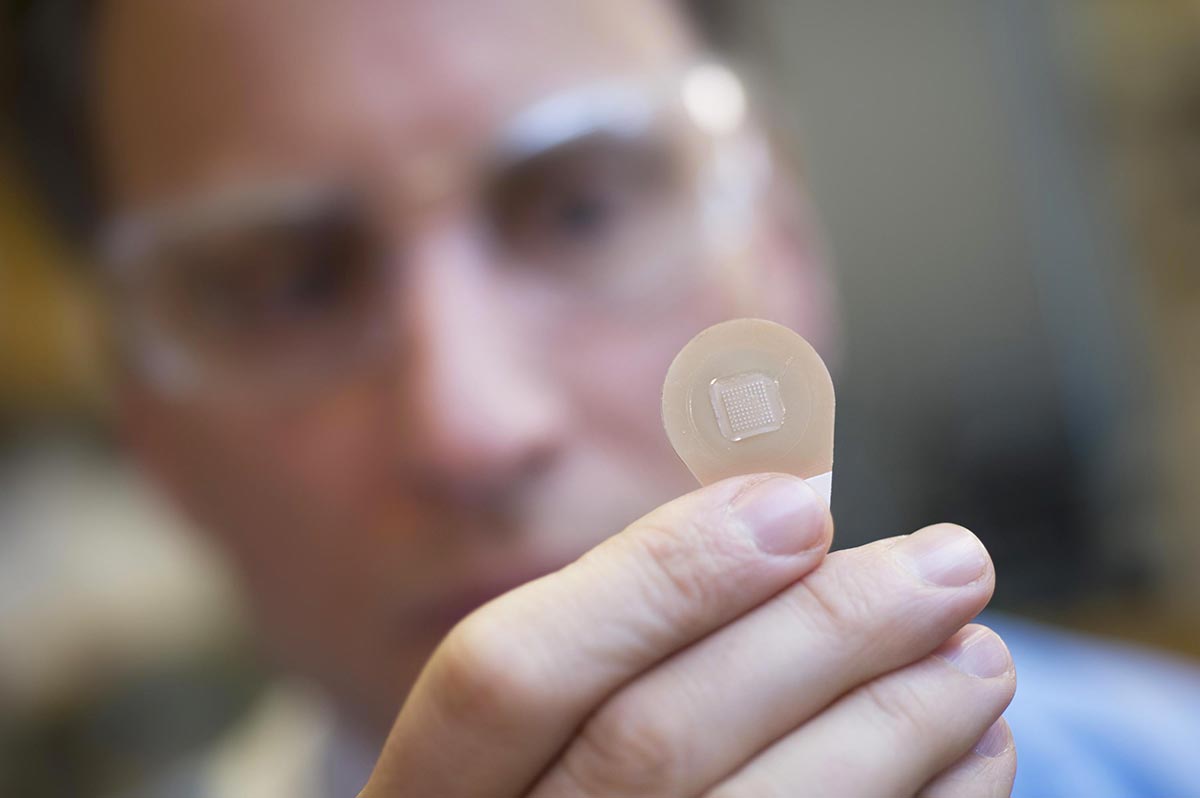
Microneedle patches look deceptively simple, a thin film that delivers drugs through the skin without needles, pain or specialized administration. But beneath that simplicity lies one of the most competitive and IP-intensive delivery technologies in modern healthcare. Every breakthrough in microneedle architecture, whether dissolving matrices, hydrogel swelling, polymer–drug composites or metal-etched arrays sits on layers of patents that determine who can innovate, who can manufacture and who can commercialize at scale.
The market signals match this momentum. Even the conservative estimates forecast the microneedle patch segment rising from USD 1.27 billion in 2024 to USD 2.06 billion by 2032, with a 6.2% CAGR, driven by demand for painless vaccination, high-precision transdermal delivery and self-administered therapeutics. But rapid growth also intensifies the IP race: companies are filing aggressively around tip geometry, controlled-release mechanisms, dissolvable polymers and fabrication methods that minimize residual waste.
In a field where tiny structural changes can unlock patentability and where unmet challenges in dose loading, mechanical strength and biologic stability remain, the real question isn’t whether microneedle patches will scale. It’s which patented technologies will define the next generation, and what technical barriers still stand between concept and widespread clinical adoption.
Check out Microneedle Patches patents filed in 2025:
Market & Technology Context for Microneedle Patches
A. Regional Growth Engines (Source)
| Region | Share 2024 | CAGR 2024-30 | Unique Demand Signal |
| Asia-Pacific | 28 % | 18.7 % | Government cos-investment for local vaccine security |
| North America | 35 % | 16 % | Payer willingness for chronic-disease adherence |
| Europe | 26 % | 14 % | Eco-regulations favor biodegradable formats |
| Latin America | 6 % | 22 % | Tender-based, price-sensitive but volume-large |
| Middle East & Africa | 5 % | 20 % | Cold-chain-free vaccine priority |
B. Application-Based Opportunity Matrix
| Application Area | Market Share (2024) | Projected CAGR | Key Market Drivers |
| Drug Delivery | 53.6-61.3% | 16.9-18.6% | Chronic disease prevalence (537M diabetics), self-administration trend (Source) |
| Vaccine Delivery | 41.89% (of drug delivery) | 19.8% | Cold-chain cost reduction, pandemic preparedness (Source) |
| Cosmetics | Emerging | 15-18% | $145.3B cosmetic industry, minimally invasive procedures (Source) |
| Diagnostics | <10% | 20%+ | Biosensor integration, personalized medicine (Source) |
| Biosensing Integration | <5% | 25%+ | AI-IoT integration, precision medicine (Source) |
C. Technology Type Opportunities
| Technology Type | Current Market Share | Growth Potential | Key Advantages |
| Solid Microneedles | 53.6-56.8% | 12-15% CAGR | Established technology, cost-effective (Source) |
| Dissolvable Microneedles | 33.82% | 18.6% CAGR | Reduced sharps waste, patient-friendly (Source) |
| Hydrogel-forming | <10% | 7.12% CAGR | Controlled drug release, enhanced delivery (Source) |
Patents Shaping Microneedle Patch Innovation
Behind the acceleration of microneedle patch adoption lies a competitive IP landscape. Companies are filing aggressively to secure advantages in mechanical strength, controlled release, biocompatible materials and scalable manufacturing. The following table summarizes the key patents defining this race, along with the specific problems each invention attempts to solve.
| Publication Number | Patent Holder | Publication Date | Problem Addressed | Proposed Solution | Related Products |
| IN202417096047A | Georgia Tech Research Corporation | 2024-06-14 | Traditional microneedle patches cannot provide extended drug release for medications needing sustained delivery | Core-shell microneedle with biodegradable shell/cap that delays release for 6+ months | Extended-release patches for chronic conditions (e.g., long-acting contraception) |
| US20250018162A1 | Industry-Academic Cooperation Foundation Gyeongsang National University | 2025-01-16 | Limited drug loading (<10 mg/cm²) restricts use for high-dose drugs | Microneedle system carrying up to 100 mg/cm² via micropore formation plus gel reservoir | High-dose transdermal hormones, pain meds, chronic-disease therapies |
| IN202411092324A | Guru Kashi University | 2024-05-17 | Oral/IV/injections for chronic pain have poor permeability, systemic side effects, discomfort | Micro-needle patch creating micro-channels for direct bloodstream entry with controlled release | Chronic pain patches (arthritis, neuropathy) reducing oral NSAID use 40 % and opioid dose 30 % |
| JP2024500424A | Institute of Science and Technology, CAS; Chushin Fine Needle (Beijing) | 2024-01-18 | Soluble microneedles have short action and leave residue; insoluble types lack efficient drug release | Cross-linked sodium alginate insoluble microneedles that swell with interstitial fluid, then peel off | Patient-applied long-acting transdermal systems |
| CN119097591A | Beijing Anzhen Hospital, Capital Medical University | 2024-04-30 | Paclitaxel’s poor solubility/bioavailability limits transdermal use | Hyaluronic acid gel microneedles loaded with paclitaxel for intradermal delivery | Localized chemo patches for skin cancer/post-surgical therapy (>8 % release in 6 h, 24 h+ sustain) |
| US20240382543A1 | Veradermics Incorporated | 2024-11-28 | Topicals can’t treat perilesional skin around psoriasis/eczema lesions | Dissolvable microneedle patch for perilesional delivery using biodegradable polymer needles | Inflammatory-skin and wound-healing patches (≥50 % lesion reduction for warts, alopecia areata) |
| US11904126B2 | City University of Hong Kong | 2024-02-06 | Microneedles struggle to preserve proteins/antigens during storage/delivery | Cryo-formulated frozen microneedles that melt on skin contact to release bio-actives | Vaccine and protein-therapeutic patches (demonstrated mRNA delivery) |
| US12296131B1 | Leili E. Singer | 2024-11-19 | Adhesive patches compress skin, reduce blood flow, and detach with movement | Force-calibrated magnetic attraction maintaining 0.1-0.8 N/cm² without impairing perfusion | Active-patient extended-wear patches, sports-medicine and long-term drug systems |
| IN202511051053A | Noida Institute of Engineering & Technology | 2025-01-31 | Single-layer microneedles can’t provide both immediate and sustained release | Dual-layer array: fast-dissolving upper layer (immediate dose) + slower lower layer (maintenance) | Combination therapy patches for diabetes, HRT, loading-dose + maintenance needs |
| US20240050726A1 | Allergan, Inc. | 2024-02-15 | Drug distribution throughout needle wastes expensive actives | Active ingredient placed only in distal portion/internal zone for efficient delivery | High-value cosmetic (botulinum toxin), ophthalmic, and costly therapeutic “poke-and-release” patches |
Get the list of Microneedle Patches patents. Discover the problems they solve and the solutions they offer. Fill out the form to access it now!
Key Limitations Shaping the Future of Microneedle Patches
Despite rapid progress in fabrication methods, polymer chemistry and drug-loading strategies, the microneedle ecosystem still faces several engineering bottlenecks that constrain performance, scalability and regulatory acceptance. The following challenges highlight the critical areas where current patents offer only partial solutions and where ongoing R&D continues to push for breakthroughs.
| Challenge Area | Technical Challenge | Impact on Adoption & Innovation |
| Biofouling and Long-Term Biosensor Degradation | Protein adsorption and electrochemical drift progressively foul microneedle electrodes within hours to days, degrading accuracy for continuous glucose/metabolite monitoring. (Source) | Functional life is limited to 2–3 days, far short of the weeks-to-months needed for chronic disease management. Leads to frequent patch replacement and poor patient adherence. |
| Manufacturing Scalability and Quality Consistency | Current fabrication routes: micro-molding, MEMS, laser machining, 3-D printing, cannot simultaneously achieve high resolution, mechanical strength, drug-loading uniformity, and low-cost scalability. (Source) | Batch variability and high production cost keep many formats stuck in pre-clinical stages. Commercial suppliers struggle to reach pharmaceutical-grade reproducibility, limiting regulatory progress. |
| Precise, Extended Controlled Drug Release | Hydrophobic actives load poorly in dissolvable/hydrogel matrices; most systems cannot suppress burst release or sustain delivery beyond ~4 days. (Source) Macromolecules (DNA, RNA, peptides) face additional epidermal-barrier constraints. (Source) | Chronic indications requiring weeks-long zero-order delivery (e.g., osteoporosis, contraception) remain unachievable, forcing reliance on depot injections and restricting market expansion. |
| Reliable Skin Penetration Across Diverse Populations | Differences in stratum-corneum thickness, elasticity, and bed-of-nails effects cause shallow or uneven penetration, especially in pediatric and elderly skin. Tip breakage rates increase as needles are thinned for painless insertion. (Source) | Dose accuracy varies across patients and anatomical sites, weakening therapeutic equivalence and complicating universal dosing claims in regulatory submissions. |
| Standardized Testing Protocols & Regulatory Harmonization | No unified standards for sterility, stability, fracture-force testing or IVIVC. Regulators treat microneedles as bespoke combination products, with inconsistent requirements across regions. (Source) | Approval timelines remain long and uncertain, discouraging investment. Lack of harmonized benchmarks slows scientific alignment and delays industry convergence. |
Microneedle patches have reached a point where incremental improvements will no longer move the market, they need breakthroughs. The patents shaping the field today solve important problems, but they also reveal where the technology still hesitates: scalable fabrication, long-horizon drug release, biosensor durability and skin-interface variability. As more countries invest in self-administration infrastructure and vaccine security, the commercial pull for reliable microneedle systems will only intensify.
What comes next will be defined less by new concepts and more by engineering maturity. The companies that can translate polymer science, microfabrication and biologics handling into predictable, regulator-friendly platforms will set the pace. And as the market expands from USD 1.27 billion toward its projected multi-billion trajectory, IP around manufacturability, stability and multi-payload delivery will become the true competitive filters.
Interested in a deeper Microneedle Patches patent analysis?
Request a tailored report or claim-to-product mapping to explore competitor strategies.