
As the wireless industry looks beyond 5G, much of the excitement around 6G centers on scale. Larger antenna arrays, higher frequencies, and tighter beam control promise dramatic gains in capacity and latency. But beneath that optimism lies a geometric problem that current network designs are not prepared to handle.
As antenna arrays grow denser and frequencies move into the millimeter-wave and sub-terahertz range, many user devices no longer experience radio waves as flat, uniform fronts. Instead, signals arrive as curved waveforms that interact differently with each antenna panel. This near-field behavior quietly breaks the assumptions that modern beamforming and channel feedback systems rely on.
Patent US12529937B2, assigned to Waveryde, addresses this growing disconnect between physical signal propagation and network logic. Rather than treating near-field effects as edge cases, the patent introduces a structured approach to channel feedback that accounts for the geometry of multi-panel antenna systems.
If left unaddressed, this mismatch risks turning next-generation hardware into an efficiency trap-where larger arrays and richer feedback increase system complexity without delivering proportional performance gains.
Why Existing Beamforming Models Start to Fail
Most current wireless systems are built on a simplifying assumption: that users operate in the “far field,” where signals reach the antenna array as parallel planes. This allows beamforming to rely on statistical averages and standardized codebooks to steer energy toward devices.
That assumption begins to collapse when antenna arrays become extremely large. In dense urban deployments or high-frequency scenarios, users often sit well within the near field of a base station. Each antenna panel sees the same device from a slightly different angle, yet existing feedback mechanisms treat those panels as if they were seeing identical wavefronts.
To compensate, systems increase channel feedback volume. But this brute-force approach creates its own problem. The overhead required to track near-field behavior grows so quickly that it erodes the very spectral efficiency these advanced arrays were designed to deliver.
The Core Problem: Too Much Feedback, Too Little Structure
The real issue is not a lack of channel information, but how that information is represented. Near-field conditions introduce structure-geometry, spacing, and physical offsets-but traditional reporting methods treat each antenna element as an independent variable.
As a result, networks waste resources describing redundant information rather than exploiting the underlying physics that ties those observations together.
Geometric Rethink of Channel Reporting
The approach outlined in this innovation replaces statistical guesswork with geometric consistency.
Instead of reporting full channel information for every antenna panel, the system establishes a reference panel and describes how all other panels differ relative to it. Those differences are expressed as angular offsets derived from the known physical spacing of the array.
By encoding the relationships between panels rather than treating them as isolated entities, the system compresses channel feedback dramatically-without losing accuracy. Near-field complexity becomes an advantage rather than a liability.
This shift allows beamforming logic to remain precise even as arrays scale and user positions vary dynamically.
Where This Fits in the Modern 6G Architecture
This geometric intelligence does not operate in isolation. It integrates naturally into disaggregated radio access networks.
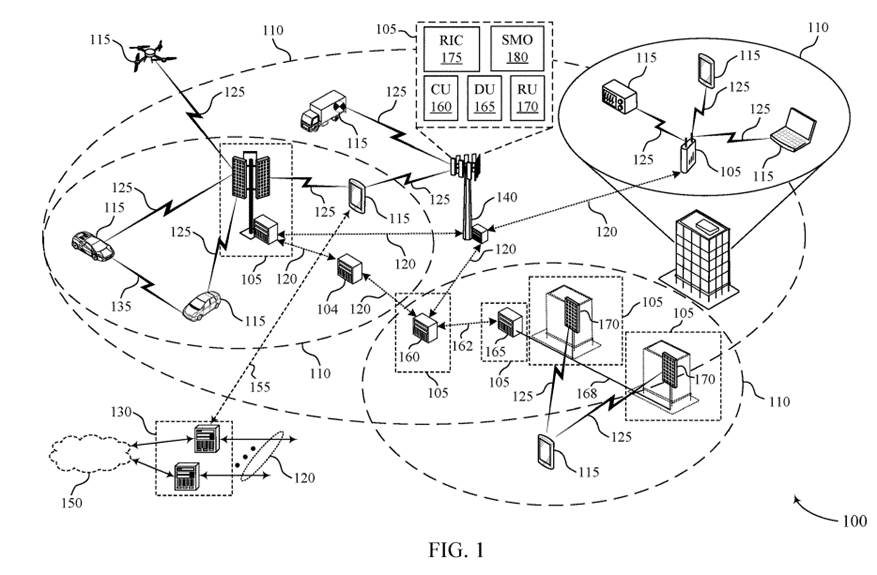
High-level control functions manage network policies and orchestration, while centralized and distributed processing units interpret compressed channel feedback. Radio units then apply the derived geometric offsets to steer beams that account for spherical wave behavior, not idealized plane waves.
The result is a system where physical layout, signal propagation, and network intelligence work in alignment-rather than at odds.
Why This Matters for the 6G Ecosystem
As networks move toward larger arrays and higher frequencies, near-field operation will become the norm rather than the exception. Without a structural change in how channel information is handled, network performance will degrade precisely where demand is highest.
This innovation sets a direction for the industry: future-proof wireless systems will need to move beyond statistical abstractions and embrace geometry as a first-class design principle. Vendors that continue relying on legacy feedback models risk running into scalability limits that software optimization alone cannot fix.
From Quantum Curiosity to Operational Intelligence
Patent US12529937B2 represents a turning point in quantum sensing. By resolving the tension between sensitivity and bandwidth, Waveryde removes the primary obstacle that kept Rydberg sensors out of real-world systems.
The broader implication is clear. As sensing technologies mature, success will depend not just on precision, but on adaptability. Quantum systems that can observe the spectrum as it actually behaves-wide, fast, and unpredictable-will define the next phase of signal intelligence. Waveryde’s patent points squarely in that direction.
Want to monitor patents addressing near-field challenges in 6G networks? Fill out the form to receive focused insights on channel feedback design, beamforming evolution, and multi-panel antenna systems.