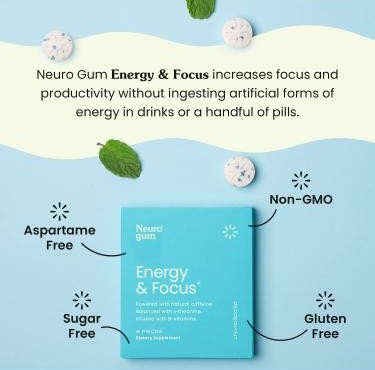
In the crowded world of cognitive enhancers, where caffeine pills, adaptogenic drinks and smart supplements compete for attention, one product has quietly rewritten the rules of convenience: Neuro Gum. Marketed as a fast-acting nootropic delivered through an everyday habit, it taps into a scientific insight long known but rarely commercialized at scale: the oral mucosa can absorb active compounds far quicker than the digestive tract.
This simple shift in delivery mechanism has sparked unusually high consumer interest, especially among students, programmers, traders and shift-based workers seeking instant clarity without relying on yet another cup of coffee. But when a wellness product promises faster onset, cleaner energy, and scientifically calibrated dosing, it naturally invites deeper questions.
What science supports these claims? What intellectual property protects them? And what blind spots still exist in this fast-evolving niche of functional chewing gums?
Neuro Gum sits at the intersection of consumer hype, evolving nutraceutical science and a still-fragmented patent landscape making it a perfect case for closer IP-led investigation.
Check out NeuroGum patents filed in 2025:
NeuroGum’s Nootropic Patent Family
The company’s nootropic delivery platform is anchored by a three-member patent family covering the formulation architecture, cold-compression manufacturing, and active-ingredient integration of caffeine and L-theanine within a functional chewing gum matrix. The table below outlines the key patents, the problem addressed and the proposed solution in the patents.
| Patent Number | Publication Year | Problem Addressed | Proposed Solution |
| US20160303042A1 | 2016 | Coffee consumption causes negative side effects including halitosis, stained teeth, and gastrointestinal upset while providing slow absorption through digestion | Cold-compressed chewing gum delivering caffeine and L-theanine in a 2:3 ratio (40mg caffeine:60mg L-theanine) through sublingual/buccal absorption, achieving peak plasma levels within 1-2 minutes while eliminating coffee’s side effects. |
| US10441535B2 | 2019 | Traditional caffeine consumption methods cause jitters, anxiety, GI issues, stained teeth, and halitosis while providing inconsistent absorption | Multi-layer chewing gum tablet with precise 2:3 caffeine-to-L-theanine ratio using cold compression manufacturing that maintains L-theanine concentration above caffeine for 40-140 minutes, providing rapid alertness without negative side effects. |
| WO2017105564A1 | 2017 | Oral ingestion of caffeine requires up to an hour for effects while causing various negative side effects, and traditional manufacturing methods degrade active ingredients | Cold-compressed nutraceutical chewing gum with 1:1 to 1:2 caffeine-to-L-theanine ratio (optimal 2:3) that enables 30-120 second absorption through oral mucosa while preserving 100% of active ingredients without heat or moisture exposure. |
Get the list of NeuroGum patents. Discover the problems they solve and the solutions they offer. Fill out the form to access it now!
Key Technical Innovations in NeuroGum’s Patents
- Rapid Absorption: All patents emphasize achieving effects within 30 seconds to 2 minutes through sublingual/buccal absorption, compared to 30-60 minutes for traditional oral ingestion.
- Synergistic Ratio: The 2:3 caffeine-to-L-theanine ratio is consistently highlighted as optimal across all patents, designed to provide alertness without jitters or anxiety.
- Cold Compression Manufacturing: This manufacturing method preserves 100% of active ingredients by avoiding heat and moisture exposure that degrades compounds in traditional gum manufacturing.
Key Challenges for the Nootropic Gum Industry
Nootropic gums have made rapid strides in convenience, formulation science and consumer adoption, but several foundational challenges remain unsolved. These gaps limit dosing precision, ingredient diversity, sensory quality and global scalability. The following table outlines the most critical barriers identified across current research and industry discussions along with the potential market impact if each challenge were successfully addressed.
| Challenge Area | Current Technical Challenge | Industry Impact if Solved |
| Controlled-Release System Optimization | Chewing mechanics release the majority of actives within 2–5 minutes, with large variability between users due to differences in chewing force and frequency. This makes precise dosing and predictable pharmacokinetics impossible, preventing gums from carrying drug-like or medically regulated claims. | Solving this would allow milligram-accurate dosing and reproducible blood-level curves unlocking opportunities in medical, defense, athletic and clinical-nutrition markets. Industry penetration could increase 40–60%, enabling premium pricing tiers. |
| High-Dose Bitter Taste Masking | Caffeine levels above ~100 mg, or bitter nootropics such as phenylethylamine or L-tyrosine, overwhelm current coating and sweetening systems. This causes a bitter rebound after 5–10 minutes. Natural masking agents remain weaker, conflicting with clean label positioning. | Effective masking would make high-potency gums comparable to pills and energy drinks, expanding the addressable market from $1.2B today to ~$4B by 2032. It would also support new product lines in focus, mood and adaptogen-based formulations. |
| Bioavailability Enhancement for Large Molecules | Buccal absorption favors molecules under 500 Da. Larger actives, phosphatidylserine, polysaccharides, several B-vitamins, exhibit poor barrier permeability and experience high first-pass loss, causing up to 5× variability in bioavailability. | Breakthroughs here would enable gum-based delivery of previously impossible actives, creating entirely new functional categories (e.g., neuroprotective, anti-stress gums). Market volumes could grow 10×, and medical-channel validation would become attainable. |
| Heat-Sensitive Compound Stability | Moisture levels above 5% and storage temperatures over 25 °C accelerate degradation of B-vitamins, CoQ10, and botanical actives. Gum polymers can catalyze oxidation, limiting shelf-life to 6–12 months compared to 24+ months for capsules. | Enhancing stability could cut product waste and returns by 30–40%, allow distribution in hot climates, and bring shelf-life on par with traditional supplements. This would simplify global logistics and justify premium pricing. |
| Regulatory Classification Ambiguity | Nootropic gums fall into a grey zone between food, supplement and drug categories. Permitted doses vary up to 10× by region, and no harmonized guidelines exist for chronic multi-piece use or gum-specific bioequivalence testing. | Clear regulatory pathways would enable institutional adoption (schools, military, healthcare), support performance or disease-risk-reduction claims, and increase industry CAGR from today’s ~12% to over 20% by reducing compliance uncertainty that discourages investment. |
NeuroGum sits at a pivotal moment in the evolution of functional gums. Operating at the intersection of the energy-gum category and the rapidly expanding nootropics market, NeuroGum is competing in a space valued at $2.81 billion in the US alone, with expectations of reaching $4.68 billion by 2030. Against this backdrop, the company’s financial trajectory growing from $3.5 million in 2019 to an estimated $20–30 million in 2025, with valuations projected to cross $200 million by 2027.
Its reach is equally notable: over 75 million units sold and distribution across 20,000+ retail locations demonstrate that NeuroGum has achieved what many nutraceutical startups struggle with: true mainstream penetration. As the industry pushes toward controlled-release systems, advanced taste-masking and gum-optimized bioavailability for larger molecules, new IP battles will likely define the competitive frontier.
Looking forward, the next wave of growth for NeuroGum and for the entire nootropic gum segment will depend on how effectively innovators navigate these unresolved scientific and regulatory challenges. Companies that succeed in engineering predictable dosing, stabilizing heat-sensitive actives, and expanding the range of deliverable compounds will shape the future landscape of cognitive performance products.
Interested in a deeper NeuroGum patent analysis?
Request a tailored report or claim-to-product mapping to explore competitor strategies.