
Remember when lithium-ion batteries were the revolutionary tech that made smartphones and EVs possible?
Well, we’re now facing resource limitations, supply chain risks, and rising costs for lithium. Enter sodium-ion batteries – the cheaper, more sustainable alternative that might just redefine the energy storage game.
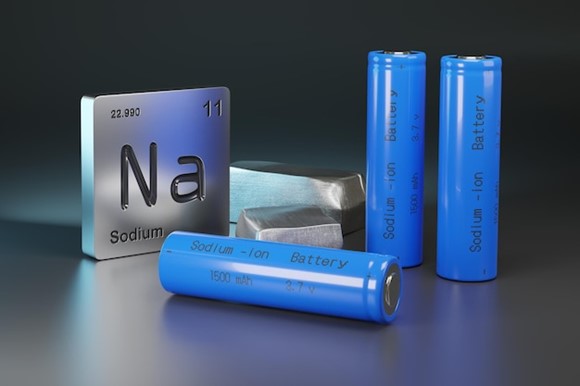
What is a Sodium-Ion Battery?
A sodium-ion battery (SIB) is a rechargeable battery technology that operates similarly to lithium-ion batteries but uses sodium ions as the charge carriers.
Sodium is more abundant and cheaper than lithium, which makes SIBs a promising solution for large-scale energy storage and cost-sensitive markets.
SIBs generally consist of:
- Cathode: Layered transition metal oxides, polyanionic compounds, or Prussian blue analogues
- Anode: Hard carbon or sodium titanates
- Electrolyte: Sodium salts in carbonate/ether solvents
- Separator: Microporous polymer membrane, optimized for Na+ transport
These components work together to shuttle sodium ions back and forth during charge and discharge cycles – storing and releasing energy.
Check out Sodium-Ion Battery patents filed in 2025:
How It Works
When a sodium-ion battery is charged, sodium ions move from the cathode through the electrolyte and are inserted into the anode material.
During discharge, the process reverses, allowing the ions to move back to the cathode while releasing stored energy.
Key differences from lithium-ion batteries include:
- Larger ionic radius: Sodium ions are bigger, so cathode/anode materials must have wider diffusion channels
- Lower voltage: Slightly lower energy density compared to lithium-ion, but safer and cheaper
- Wider temperature tolerance: Ideal for grid storage and harsh environments
Recent advances focus on improving cycle life, rate capability, and energy density to make sodium-ion competitive with lithium-ion in EVs and consumer electronics.
Patents Behind the Sodium-Ion Battery Technology
| Patent Number | Company / Institution | Problem | Patented Innovative Solution | Impact of the Patent |
| CN119447421A | Contemporary Amperex Tec | Low Energy Density & Poor Cycling Stability | Novel Layered Oxide Cathode With Optimized Na Content And Doping Strategy | Improves Energy Density While Extending Cycle Life, Making Sibs Suitable For Ev Applications |
| DE102023107385B3 | Fraunhofer Institute | High Internal Resistance At Low Temperatures | Solid Electrolyte Formulation With Enhanced Na-Ion Conductivity | Boosts Performance In Cold Climates, Enabling Stationary Storage In Wider Geographies |
| CN117747918A | Hina Battery | Cathode Dissolution During Cycling | Surface Coating Technique For Prussian Blue Cathodes | Reduces Capacity Fade, Improving Battery Lifespan |
| KR20230152277A | Samsung | Slow Diffusion Kinetics Of Na+ | Nano-Engineered Hard Carbon Anode With Expanded Interlayer Spacing | Enhances Rate Capability, Making Fast Charging Feasible |
| CN113921812B | Chinese Academy Of Sciences | Electrolyte Instability At High Voltage | Electrolyte Additive Preventing Na Dendrite Formation | Improves Safety And Allows Higher Voltage Operation |
| CN116093417A | BYD | Low Initial Coulombic Efficiency (Ice) | Pre-Sodiation Technique For Hard Carbon Anodes | Raises Ice, Improving Energy Efficiency And Reducing Waste |
| CN109888411B | Tsinghua University | Poor Thermal Stability Of Cathodes | Doping Strategy With Multivalent Metals | Enhances Thermal Safety, Critical For Large-Scale Storage |
| KR20160063773A | Lg Chem | Compatibility Issues With Existing Li-Ion Production Lines | Hybrid Design Enabling Drop-In Manufacturing | Lowers Barrier For Industry Adoption By Using Current Li-Ion Infrastructure |
Get the list of Sodium-Ion Batteries patents. Discover the problems they solve and the solutions they offer. Fill out the form to access it now!
Real-World Applications
Sodium-ion batteries are gaining traction in:
- Grid Storage: Large-scale renewable energy storage where cost and safety matter more than energy density
- Two- & Three-Wheelers: Affordable electric mobility solutions in emerging markets
- Backup Power: Data centers, telecom towers, and microgrids in remote areas
- Low-Speed EVs: Buses and commercial vehicles that prioritize cost over range
Regulation & Industry Momentum
China is leading in SIB deployment, with CATL and HiNa building gigafactories dedicated to sodium-ion cells. The EU has included sodium-ion in its strategic battery plan, and several automakers are exploring SIB-powered budget EV models.
Industry groups are working on standardization for sodium-ion performance metrics – similar to what we saw for lithium-ion in the past decade – to accelerate certification and adoption.
Performance Benchmarks
SIB prototypes are reaching:
- Energy density: 160–180 Wh/kg (approaching entry-level Li-ion)
- Cycle life: >3000 cycles for grid storage applications
- Charging times: <20 minutes to 80% SOC (with nano-engineered anodes)
- Operating temperature: -20°C to 60°C with minimal capacity loss
These breakthroughs position sodium-ion as a viable alternative for applications where lithium supply is a bottleneck.
The Future of Sodium-Ion Batteries
Sodium-ion batteries are on the cusp of a breakthrough moment. Over the next few years, we can expect:
- Gigafactory Scale-Up: CATL and other players will bring multi-GWh production capacity online, driving costs below $50/kWh for stationary storage.
- Higher Energy Densities: With cathode material innovations, energy densities could reach 200+ Wh/kg, making SIBs competitive for passenger EVs.
- Hybrid Systems: Pairing sodium-ion with lithium-ion or supercapacitors for optimal cost-performance balance in applications like hybrid buses or grid peak-shaving.
- Circular Economy Integration: Easier recycling processes compared to lithium will make SIBs a centerpiece of sustainable battery supply chains.
- Global Diversification: As countries seek to avoid lithium dependency, sodium-ion technology could democratize battery manufacturing, particularly in regions with abundant sodium resources.
If lithium-ion defined the last decade of energy storage, sodium-ion may very well define the next. From renewable integration to affordable EVs, the future of sodium-ion batteries is not just about replacing lithium – it’s about expanding what’s possible in the global electrification journey.
Unlock 90% of Global Sodium-Ion Battery Insights
Curious about the future of energy storage? We’ve compiled the latest patents, breakthroughs, and real-world applications of sodium-ion batteries in one place. Want research tailored to your needs? Simply fill out the form below, and we’ll send you focused, actionable insights!