
Imagine a world where every rooftop becomes a miniature power station, silently converting sunlight into clean electricity. Many people now look to solar energy for home and solar energy for companies as a clean, renewable energy option.
This is the reality being built by solar energy innovators today. Solar power has transformed from an expensive technology into one of the fastest-growing energy sources globally, with panel prices dropping over 90% in the last decade.
In the coming years, solar energy will also support smart cars, with panels built into roofs and body panels to charge batteries and power on-board systems while driving or parked. Major automakers are already testing such solar-roof electric vehicles, showing how mobility and clean energy will work together to reduce charging needs and emissions in daily transport
This dramatic shift is reflected in the surge of patent filings, signalling robust innovation and massive investment in solar technologies. From high-efficiency perovskite cells to AI-powered energy management systems, the patent landscape reveals how companies are racing to capture market share in an industry projected to be worth hundreds of billions of dollars in the global renewable energy market.
This report explores the trajectory of solar energy patents, offering insights into innovation trends, key players.
Key Challenges
| Category | Challenge | Description |
| Cross-Domain Overlap | Hard to isolate solar-specific patents | Many inventions blend solar with electronics, materials, or energy storage, making classification tricky. |
| Dense Patent Clustering in Core PV Areas | Highly concentrated filings around cell architectures, passivation, doping, and metallization create crowded spaces with overlapping rights. | Increases infringement risk and litigation, raises entry barriers. |
| Global Patent-Filing Complexity & Legal Variability | Different rules, costs, timelines, and examination standards across key markets (CN, US, EP, JP, KR). | Harder to maintain global coverage; increases costs and delays. |
| Rising Litigation & Supply-Chain IP Exposure | UPC cases, U.S. ITC actions, and CN lawsuits are increasing, while downstream buyers may unknowingly import infringing modules. | Creates significant compliance risks, import bans, and market disruption. |
| Patent Clustering | Dense filings around core technologies | Areas like PV cells or solar inverters have many overlapping patents, creating entry barriers. |
| Low Academic Filing | Research often not patented | Universities and labs may publish findings but skip patenting, leaving gaps in trend tracking. |
Why Solar Energy is needed?
Real-World Example: The Perovskite Race
The Challenge: Traditional silicon solar panels have dominated for 70 years but are approaching their efficiency limits, with high manufacturing costs due to energy – intensive production.
The Solution: Perovskite Solar Cells Researchers discovered that perovskite materials could achieve higher efficiency at a fraction of the cost. Unlike silicon, perovskites can be made using simple printing processes at room temperature.
What Happened: Companies like Canadian Solar Inc, Toyota Motor Corporation and Chinese manufacturers recognized the game-changing potential. Since 2012, patent filings for perovskite solar cells have exploded.
Each company races to patent unique formulations, manufacturing methods, and applications. The winner of this patent race will control the next generation of solar technology – potentially worth hundreds of billions in market value.
What is the patent filing trend in the Solar Energy Industry?
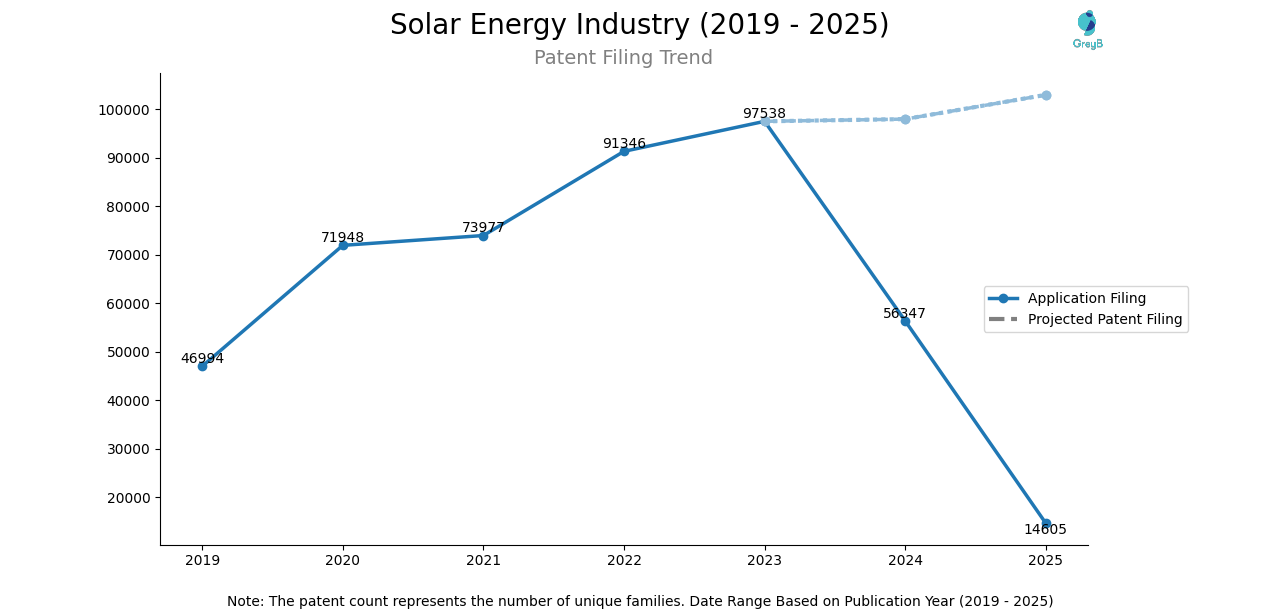
Are you wondering why there is a drop in solar patent filings in 2024 and 2025? The reason is simple: patent applications take time to get published, often up to 18 months. So, the recent dip doesn’t mean innovation has slowed down – it just means many filings are still waiting to appear in the records.
These trends guide every solar energy company that wants to grow in the solar energy world and offer better solar energy solutions.
Even with the recent dip, the filings show that solar innovation is booming, and patents are becoming key assets in the global push for affordable, sustainable power.
Want to identify which emerging technologies could disrupt your current R&D pipeline? Request our Solar Innovation Radar.
How many patents were filed in Solar Energy Industry across the Different Countries
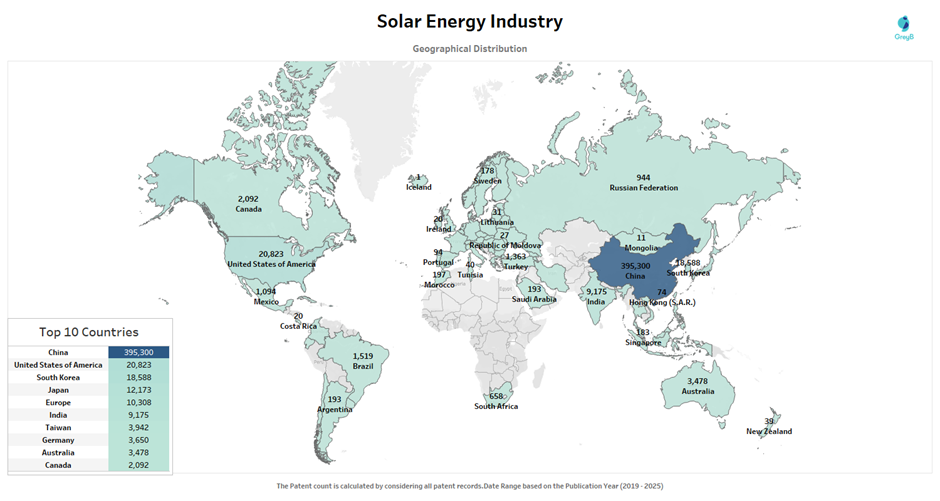
This chart shows the global distribution of solar energy patent filings. China leads by a wide margin with 395,300 filings, showing its strong focus on clean energy innovation and manufacturing. The United States comes next with 20,823 filings, followed by South Korea (18,588) and Japan (12,173) – both known for their advanced R&D in solar technologies.
In many of these countries, home solar energy and solar energy for households are growing fast, supported by solar energy tax credit schemes and other benefits of solar energy.
Together, these top six countries account for a major share of global solar patents, highlighting where innovation is most active. Their filings suggest a strategic push to lead the future of renewable energy through technology protection and development.
Where are the Top Research Centres of solar energy Industry patents located?
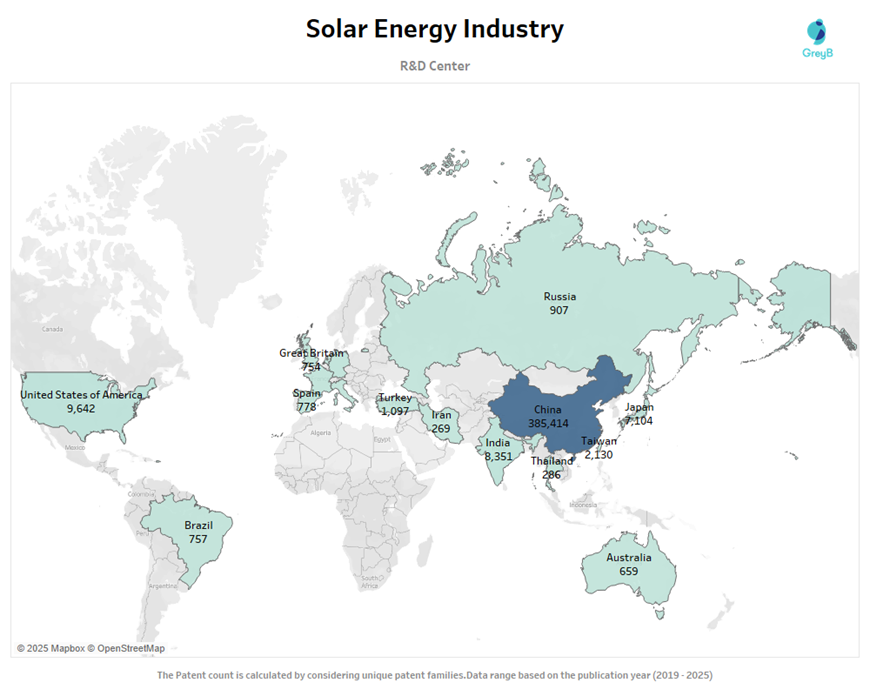
This chart shows where solar energy innovation is most active around the world. China leads by far with 385,414 patent filings, making it the global hub for solar technology development. South Korea follows with 13,363 filings, while the United States ranks third with 9,642 filings. India (8,351) and Japan (7,104) round out the top five, with Germany close behind at 2,689 filings.
These numbers reflect where companies, research labs, and governments are investing heavily in solar R&D and protecting their inventions through patents.
Top technologies bifurcation of Solar Energy Industry
These top technologies in solar energy support everything from solar energy battery storage and solar energy storage to grid‑scale solar energy power plant projects.
Many solar‑related inventions are not grouped in a single solar class but spread across multiple CPC and IPC codes, such as general electronics, materials, or energy‑storage categories. This cross‑domain tagging makes it harder to capture the full picture of solar innovation from one chart, because relevant patents may sit in several overlapping classes.
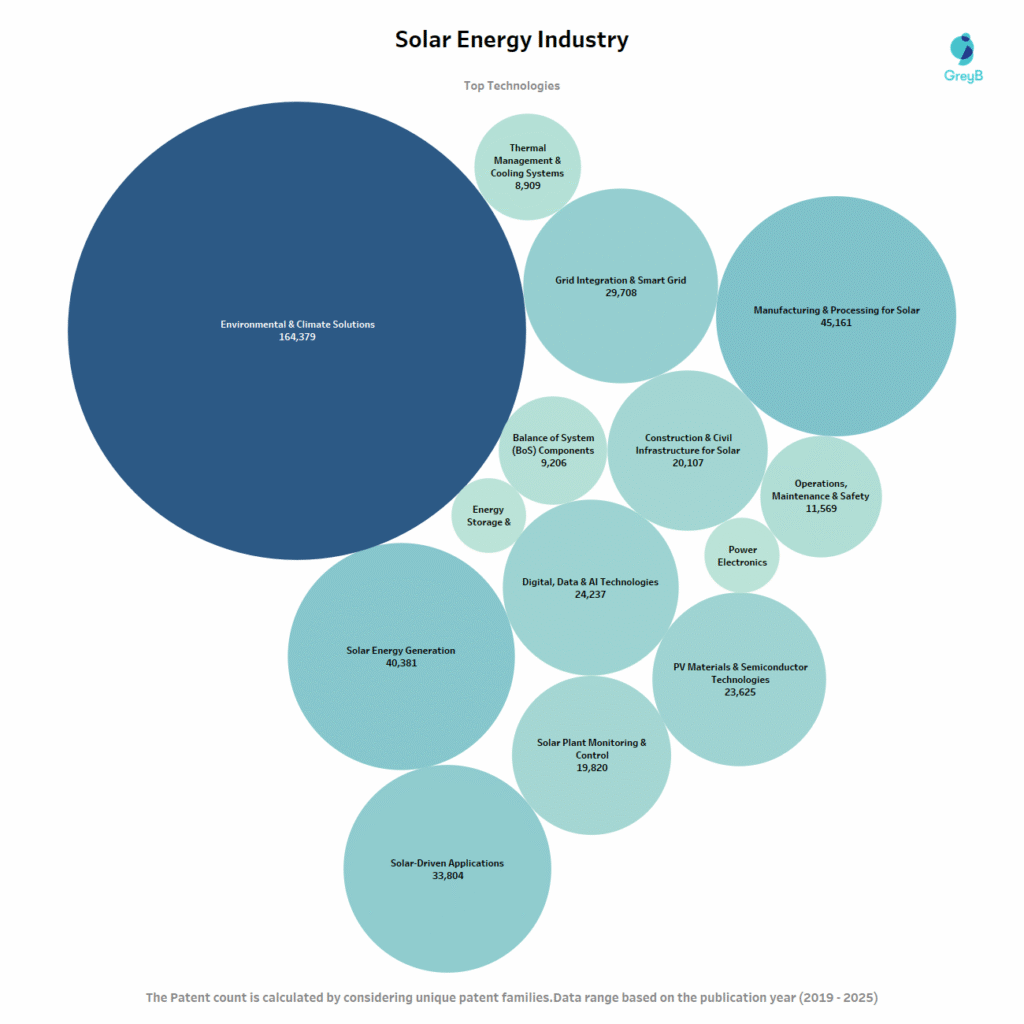
The chart highlights the top technologies in solar energy, ranked by their patent counts, showing where innovation is most active in this field. These top technologies in solar energy reflect strong and growing research efforts to make solar power more efficient, reliable, and widely used.
Digital, data and AI technologies are making solar power smarter at every step, from choosing the best panel locations to managing daily power flows. AI tools read weather and performance data to predict solar output, spot faults early, and guide maintenance teams before breakdowns happen. These systems also help batteries charge and discharge at the right time, so more clean solar energy is used and less is wasted.
Fill out this form for a custom comparison of top technologies with leading companies.
R&D Focus: How has solar energy industry search focus changed over the years?
Which Companies are filing most patents in solar energy Industry?
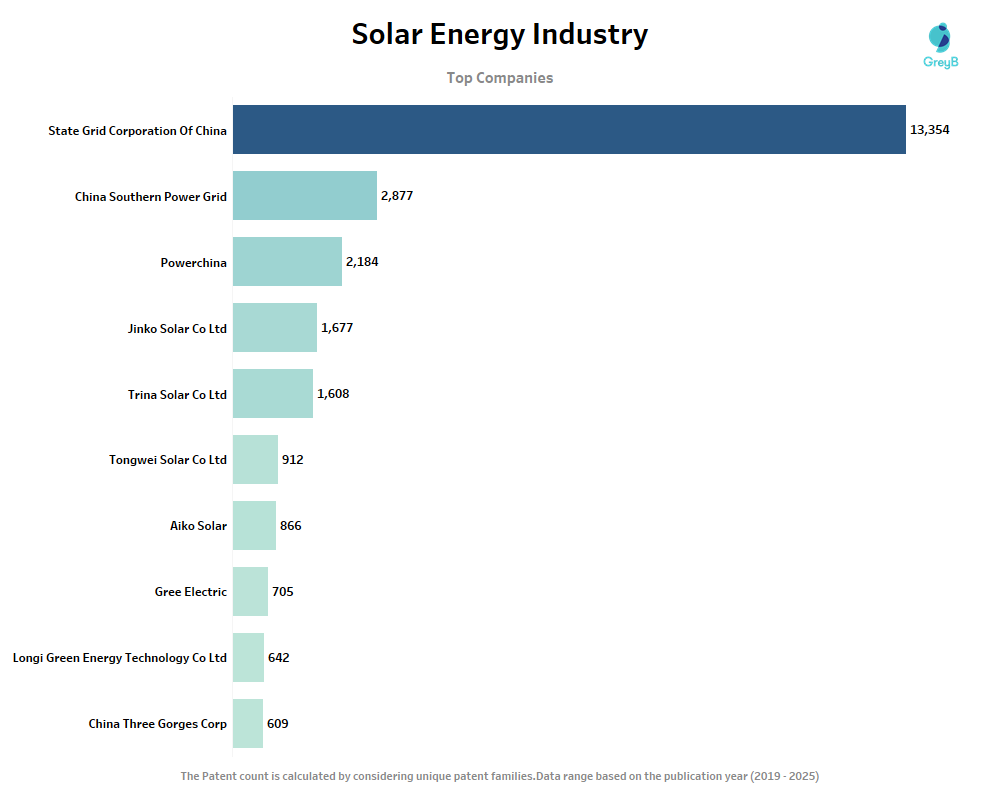
On the manufacturing and solutions, Jinko, Trina, Tongwei, Aiko, Longi andJA Solar record solid patent counts, pointing to continuous advances in high‑efficiency cells, modules, inverters, and energy storage systems. JA Solar, in particular, is a large global supplier of high‑performance photovoltaic products with manufacturing bases and sales across more than 170 countries, underlining why it appears among the leading assignees in this chart.
Overall, utilities focus on making solar easier to connect and run reliably, while PV makers focus on turning sunlight into more power at lower cost; together they explain why these names lead the chart.
Top companies (Excluding Chinese Players) filing patents in Solar Energy Industry
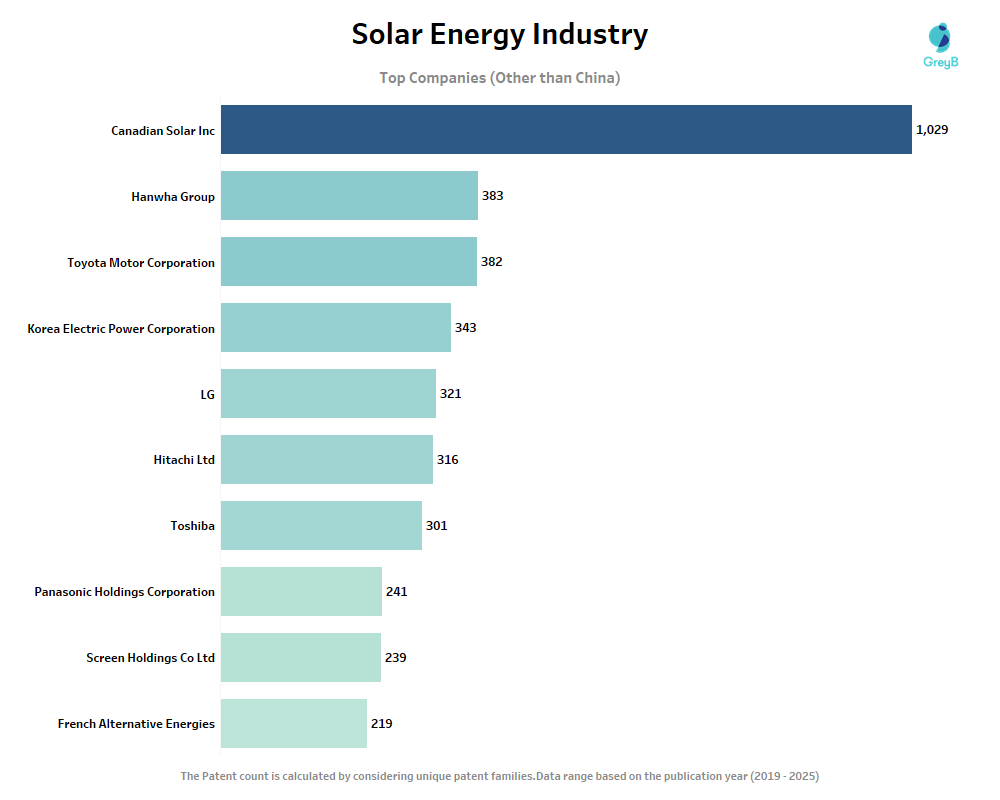
Canadian Solar stands first with 1,029 filings, showing strong, steady work from panels to projects. Close behind, Hanwha Group and Toyota are active with 383 and 382 filings, reflecting practical advances that reach real products. KEPCO and Siemens add depth on the power side with 343 and 204 filings, helping solar fit smoothly into existing networks.
Get a competitor-specific patent landscape tailored to your IP strategy – request your briefing now.
Which Universities were filing most patents in Solar Energy Industry
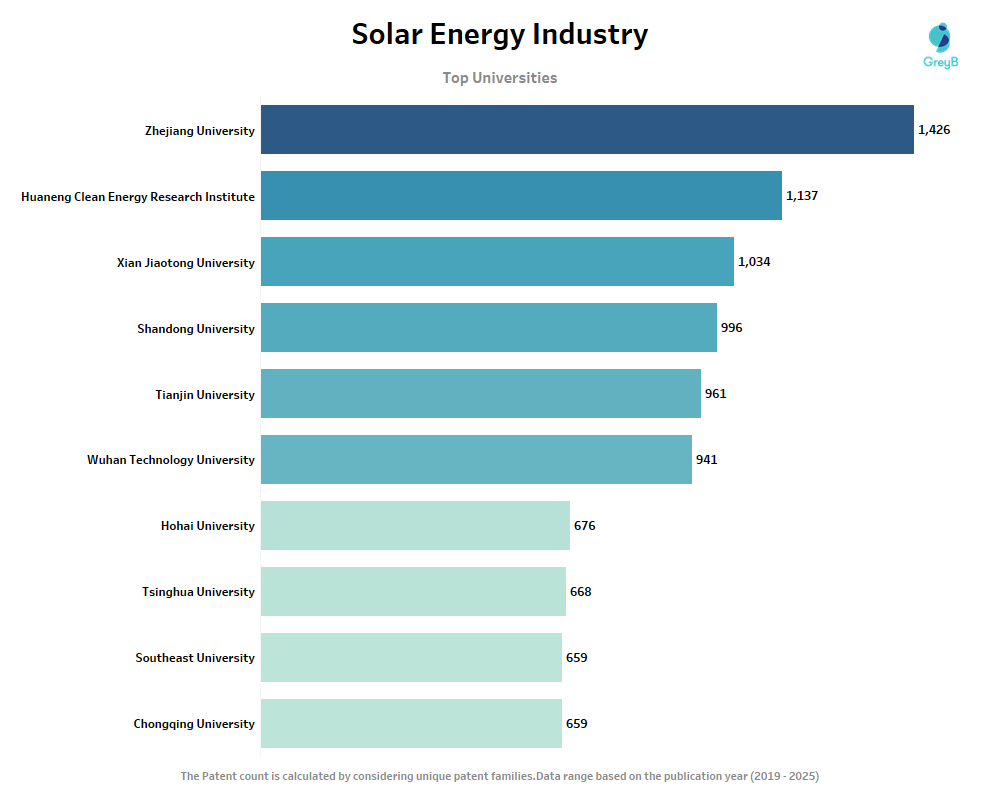
Zhejiang University leads in solar energy patents, with over 1,400 filings, showing a big focus on real-world solutions. Many other top Chinese universities and research groups, like Huaneng Clean Energy and Xi’an Jiaotong, are also very active, helping turn research into useful ideas for industry.
Did you know – Why Are India’s Most Surprising Solar Innovators are Universities, Not Companies?
Why universities lead in India: public R&D support and mission‑driven labs push early‑stage work and proofs of concept, which naturally file at universities before companies scale them. For citation, you can reference MNRE’s R&D programs that fund academic institutes and the OECD overview showing public research organizations’ role in renewable energy patents.
With over 100 GW of installed solar capacity and a target of 500 GW non-fossil capacity by 2030, India has firmly positioned itself as a global renewable energy frontrunner.
Solar already accounts for roughly half of India’s 234 GW renewable mix, with double-digit GW additions in just the first half of 2025.
Much of this momentum is powered by universities that not only generate patents and advanced solar technologies, but increasingly partner with industry through MoUs and specialized programmes – from manufacturing tie-ups with Loom Solar and Ecoprogetti to skill-focused collaborations.
Our analysis of leading global and Indian institutions highlights where patents, pilot projects and industry partnerships are quietly shaping the next generation of solar technologies.
If you want to see which universities are already collaborating with companies in your focus area – and where white-space opportunities exist – fill in the form provided.
Top Indian Universities filing patents in Solar Energy Industry
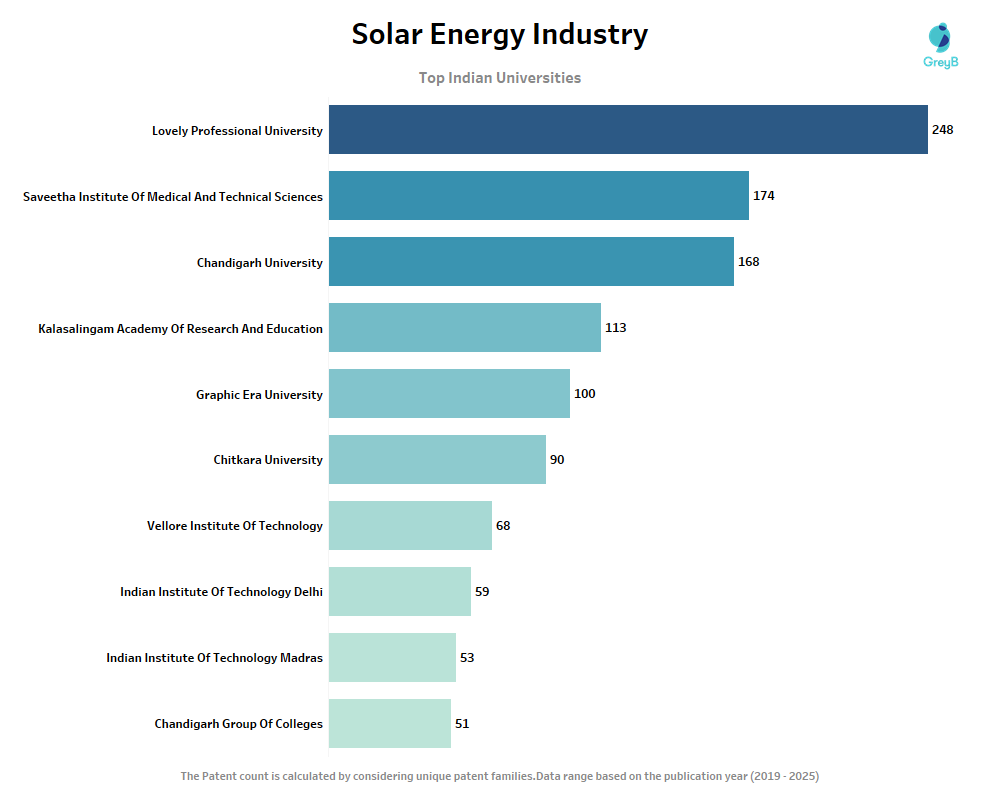
This chart highlights Indian universities that are actively building solar energy portfolios through patent filings between 2019 and 2025. Lovely Professional University stands out with the highest number of unique solar patent families, while institutes like Saveetha, Chandigarh University, and leading IITs also show strong engagement in solar research and innovation.
What is the Patent Legal Status of solar energy Industry?
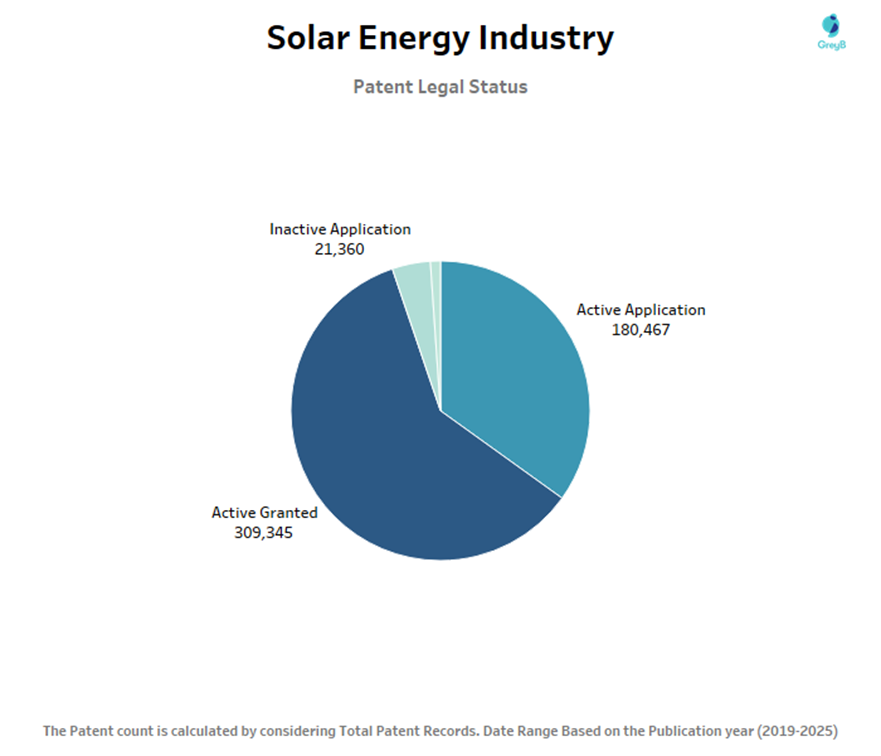
This chart shows the current status of solar energy patent filings. Out of a total of 516,648 patents, a large majority are still active – either granted or alive (309,345) or pending as active applications (180,467). This means that 95% of all filings are still in play, showing strong interest and ongoing innovation in the solar sector.
The large share of active rights shows that solar energy industries association members and other players see long‑term value in solar energy systems and related inventions.
Only a small portion of patents are no longer active – with 21,360 inactive applications and 5,476 dead granted patents. This low drop-off rate suggests that companies are serious about protecting their solar inventions and see long-term value in their intellectual property.
Patent Grant Time Analysis in the solar energy Industry
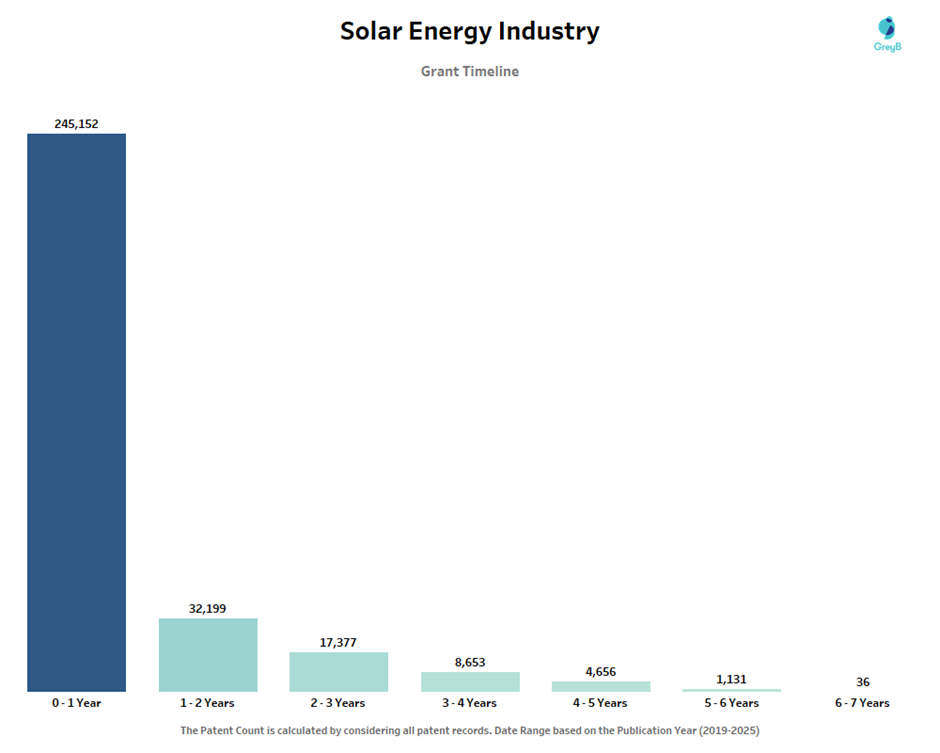
This chart shows how quickly solar energy patents are being granted. A huge number – 245,152 patents – were granted within just 0 to 1 year, which is unusually fast compared to typical patent timelines. Another 32,199 patents were granted within 1 to 2 years, and 17,377 within 2 to 3 years, showing that most solar patents are approved within the first few years of filing.
Why so fast? Solar technologies are often well-documented, with clear use cases and strong technical backing. Many filings may come from experienced companies with complete data, making the examination process smoother. Also, governments and patent offices may prioritize clean energy innovations due to their global importance – leading to faster approvals.
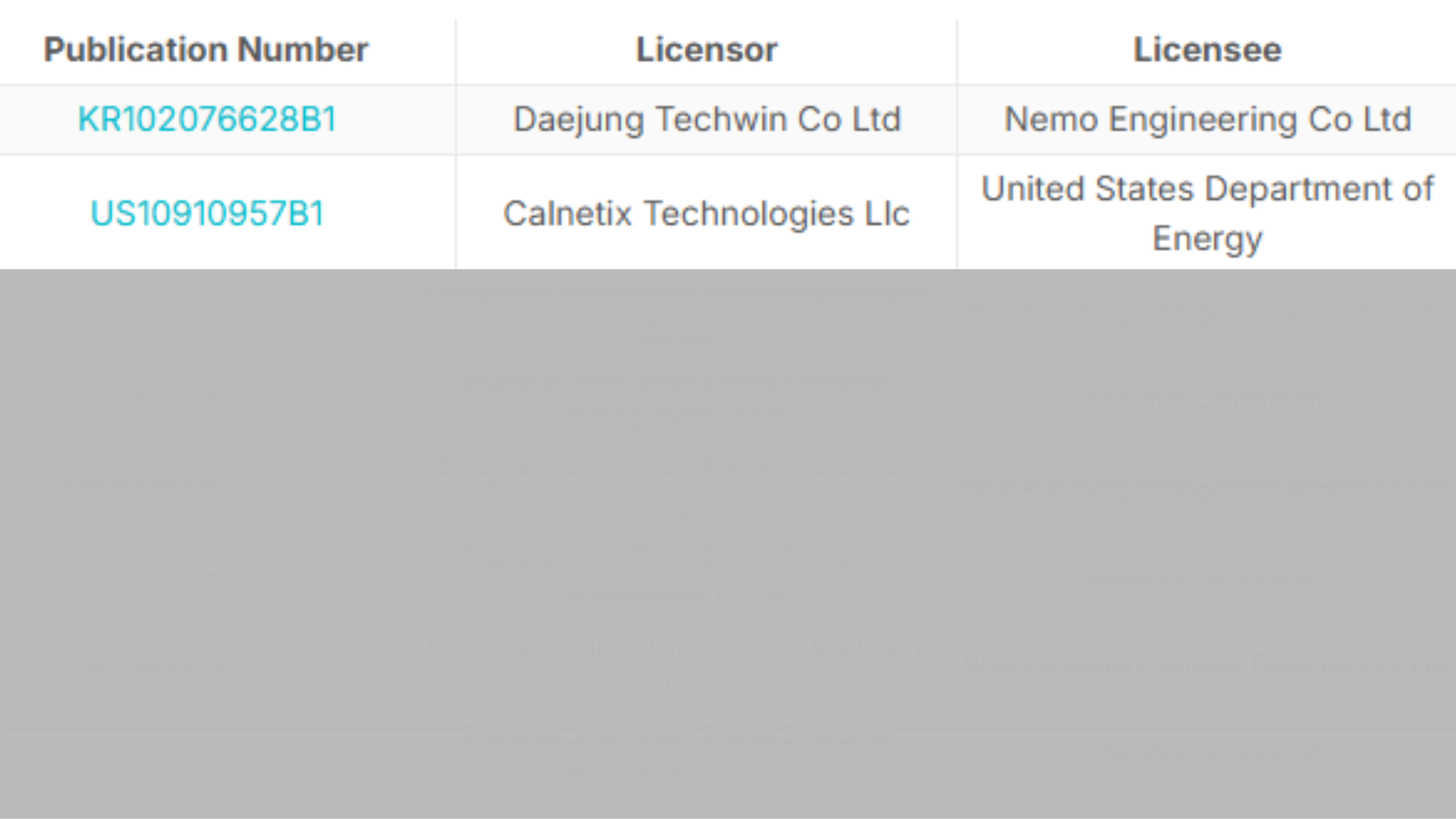
Who are involved in licensing in solar energy Industry?
Many solar brands do not build every idea in‑house. They license ready‑to‑use ideas that make their products safer, smaller, or easier to install. This speeds launches and cuts cost, which is why licensing keeps growing in solar hardware and controls.
This is helpful for any solar energy contractor or solar energy installation business that wants ready‑to‑use designs for solar energy system installation.
Why this helps your roadmap
Licensed ideas can lift product performance without long R&D cycles, and they open doors to new regions through partners who already have market access.
Did you know there are more than 2000+ licensing patents involved in solar energy? We provide licensing services – scouting sellers and buyers, mapping claims to products, and benchmarking deals – so you can reach out to us for licensing support end‑to‑end.
Who are involved in litigation in solar energy Industry?
Patent litigation is on the rise in the solar industry as companies work to protect their new ideas and market share. When disagreements happen, court cases over patents can decide who gets to sell or use a technology.
| Publication Number | Plaintiff | Defendant |
| CN210628335U | Changzhou Jiejiachuang Precision Machinery Co Ltd | Wuxi Kunsheng Intelligent Equipment Co Ltd |
| US11581454B1 | Shanghai Jinko Green Energy Enterprise Management Co Ltd | Abalance Corporation |
Why this matters: When companies fight over patents in court, it can slow down product launches, change who makes money from an idea, or push companies to work together – or drop a project.
We provide help in patent litigation too. If you want to know who is suing, who is being sued, or need support with a case in solar technology, you can reach out to us for full support.
Conclusion:
Solar energy is growing quickly, and strong patent strategies are helping companies protect their new technologies and lead the market. As the industry continues to evolve, owning the right patents will be important for success and to avoid legal risks.
With so much innovation happening, patents support fair competition and encourage even more progress in clean energy. This makes the solar sector both exciting and promising for the future
Our team supports clients across the patent lifecycle with services such as open innovation, technology and start-up scouting, patent landscape and competitive analysis, and in‑depth patent searches. We also help with data mining and patent monetization, including infringement checks, acquisition and excavation studies, claim amendment support, reverse engineering, and SEP analysis, so that companies can use their IP with confidence.
Request your Customized Solar energy innovation Report – get tailored insights mapping your IP portfolio to the latest global trends