
For decades, recreational vehicles have followed a simple rule: the tow vehicle does the thinking, and the trailer follows. Hitching, reversing, and manoeuvring a trailer have remained some of the most stressful aspects of RV ownership, often requiring experience, patience, and more than one person.
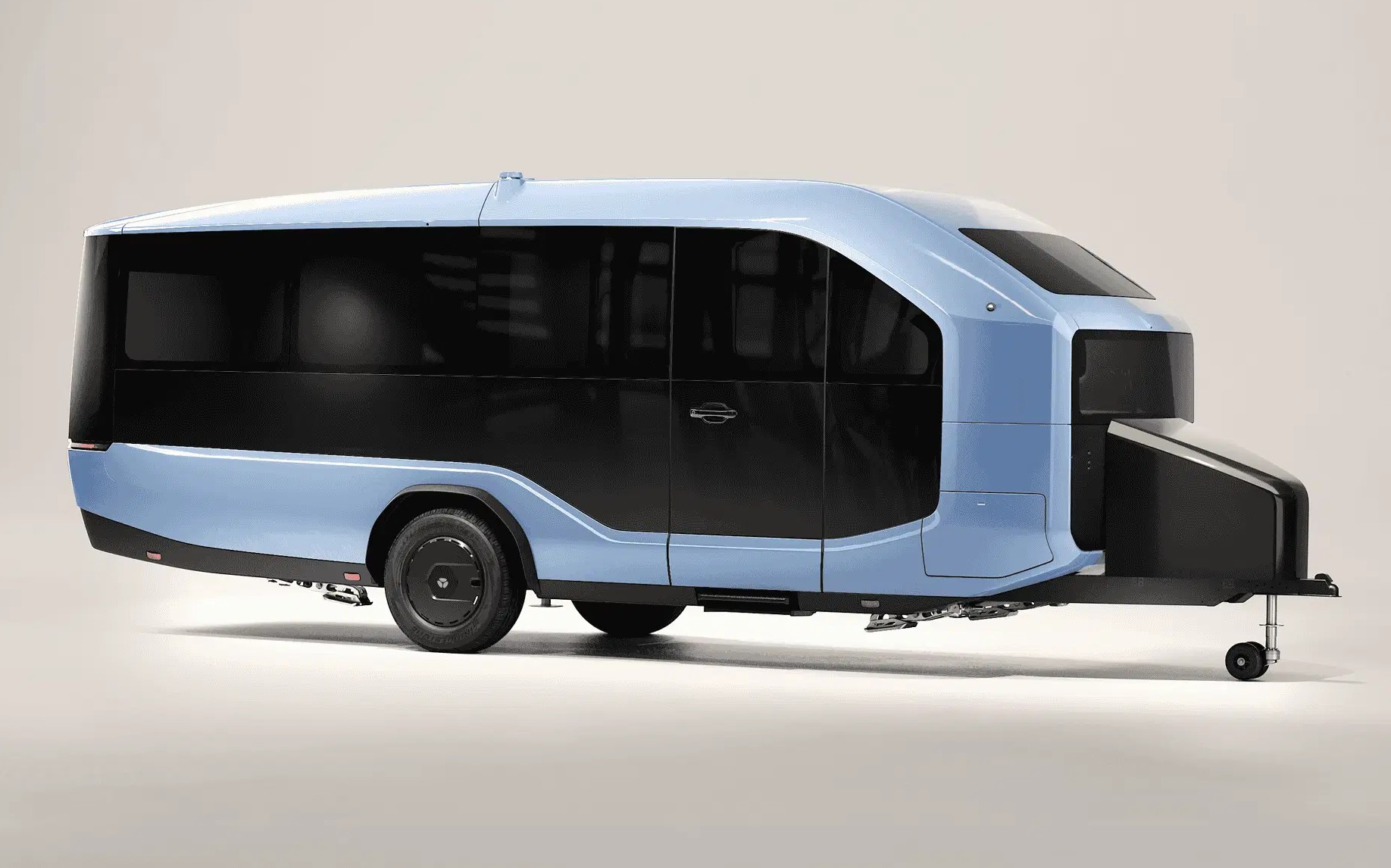
Patent US12528321B2, assigned to Pebble Mobility, challenges that long-standing dynamic. Instead of treating the trailer as a passive load, the patent describes a system in which the trailer becomes an active participant-capable of sensing, moving, and aligning itself with the tow vehicle. In doing so, Pebble reframes the travel trailer not as deadweight, but as a robotic system with its own intelligence and mobility.
Why Trailer Hitching Has Remained a Pain Point
Traditional trailer hitching is difficult not because of a lack of technology, but because of geometry and physics. Even with modern driver-assist features, the tow vehicle must reverse a large mass with high precision. Small steering inputs translate into exaggerated trailer movements, and visibility is often limited by blind spots and uneven terrain.
Existing “assist” systems largely operate from the truck’s perspective. Cameras and steering automation help guide the vehicle toward the trailer, but the trailer itself remains inert. The burden of alignment still falls on the tow vehicle, which must compensate for every miscalculation.
This asymmetry has made towing a barrier to entry for many potential RV users, particularly first-time buyers and EV owners unfamiliar with traditional trailers.
Problem and Solution: Making the Trailer an Active Agent
The problem with conventional hitching is that all intelligence and control reside in the tow vehicle, while the trailer contributes nothing to the process.
Pebble’s solution is to reverse that relationship. The patent describes a trailer equipped with its own sensors, onboard computing, and electric drivetrain. Instead of the truck backing into position, the trailer autonomously navigates toward the tow vehicle and aligns itself with the hitch.
This changes hitching from a coordination problem into a targeting problem: the trailer identifies the hitch ball as a destination and moves itself into place.
Keep track of every patent move and monitor competitor activity in real-time. Click here for full insights:
How the Robotic Trailer Works
The system relies on three core components.
First, sensor fusion. Cameras and ultrasonic sensors mounted on the trailer’s A-frame detect the tow vehicle’s hitch and surrounding obstacles. This allows the trailer to understand its environment independently of the truck.
Second, onboard computation. An automotive-grade compute platform processes sensor data in real time, calculating a path that accounts for terrain slope, surface irregularities, and alignment tolerances.
Third, dual-motor actuation. Each wheel is driven independently, allowing the trailer to perform differential steering. Unlike a towed trailer constrained by the truck’s turning radius, the Pebble trailer can make fine lateral and rotational adjustments, effectively pivoting in place.
Together, these elements enable precise “last-inch” alignment-something that is extremely difficult when reversing a long vehicle-trailer combination.
Strategic and Market Implications
This patent has implications beyond convenience. By automating the most intimidating part of RV ownership, Pebble lowers the cognitive and skill barrier associated with towing. Hitching becomes a supervised, push-button task rather than a learned maneuver.
From a product strategy standpoint, the patent positions the trailer as a software-defined vehicle. The chassis, motors, and battery form a hardware platform, but the user experience is driven by autonomy software. This mirrors broader trends in the automotive industry, where differentiation increasingly comes from control systems rather than mechanical design alone.
The approach also raises new questions for regulation and insurance. A trailer that can move autonomously-even at low speeds-blurs existing classifications. Liability, certification, and operational rules may need to evolve as self-propelled trailers become more common.
From Deadweight to Distributed Mobility
Patent US12528321B2 signals a structural shift in how trailers are conceived. By decoupling movement and intelligence from the tow vehicle, Pebble Mobility transforms the trailer into a robotic subsystem rather than a passive attachment.
The long-term significance lies in this reclassification. Once a trailer can sense, decide, and move independently, hitching is only the first application. Future extensions could include automated campsite positioning, self-leveling navigation, or coordinated movement with electric tow vehicles.
In that sense, Pebble’s patent is less about simplifying a single task and more about redefining the role of the trailer itself-marking the transition from deadweight to active mobility.
Want to know how autonomy-enabled mobility components are redefining freedom to operate across EV and robotics platforms? Fill out the form to receive a customized patent insight.