
Samsung has spent decades shaping consumer electronics through smartphones, televisions, home appliances, semiconductors, and display technologies. But what could the company’s next wave of innovation look like?

One of the best ways to answer that question is by studying its patents.
Although patents don’t guarantee commercial products, they often reveal where a company is investing its research and development efforts. They provide early signals about technologies that may eventually reach consumers sometimes years before an official announcement.
Samsung’s recent patent filings paint a fascinating picture. Beyond refining smartphones, the company appears to be building entirely new product categories, including flying displays, rollable devices, projector smartwatches, AI-powered robots, smart rings, and even augmented reality contact lenses.
Some of these innovations have already made their commercial debut, while others remain experimental, offering a glimpse into Samsung’s long-term vision for connected, intelligent consumer technology.
Here’s a look at the future products Samsung’s patents reveal and how they could transform the way we interact with technology.
1. Samsung Flying Display: A Screen That Comes to You

Imagine watching a recipe while cooking, joining a video call while moving around your home, or receiving navigation instructions from a display that follows you instead of remaining fixed on a wall.
That’s exactly the future Samsung is exploring.
Samsung’s patent describes a Flying Display Device capable of autonomously navigating indoor environments while continuously positioning itself for the best viewing experience.
Unlike conventional televisions, tablets, or monitors, the display isn’t stationary. Instead, it flies toward the user whenever needed.
Patent Spotlight
Patent: Flying Display Device (US9891885B2)
The patent illustrates a compact flying display equipped with:
- Multiple propellers for autonomous flight
- Cameras for obstacle detection
- Distance sensors
- Facial recognition
- Voice recognition
- Gesture control
- Automatic user tracking
The system continuously determines the user’s location and adjusts its position accordingly.
Instead of asking users to walk toward the display, the display comes to them.

Another interesting aspect of the patent is Samsung’s focus on environmental awareness. The flying display can recognize walls, furniture, and other obstacles to safely navigate indoor spaces while maintaining an optimal viewing angle.
Why Does It Matter?
Today’s displays are fixed.
Whether it’s a television mounted on a wall or a monitor sitting on a desk, users must adapt to the display’s location.
Samsung’s concept completely reverses that relationship.
Potential applications include:
- Smart homes
- Interactive education
- Industrial maintenance
- Warehouses
- Hospitals
- Emergency response
- Outdoor advertising
Imagine a technician receiving repair instructions from a floating display that follows them throughout a factory. Or a doctor reviewing patient information while moving between hospital rooms.
The concept extends beyond entertainment it’s about making digital information available wherever it’s needed.
Samsung’s flying display patent demonstrates how the company is thinking beyond larger screens or higher resolutions. Instead of improving the display itself, Samsung is reimagining where displays exist and how they interact with users.
While commercial adoption may still be years away, the patent reflects Samsung’s broader ambition to create adaptive devices that respond to human movement rather than requiring humans to adapt to technology.
Read the complete patent analysis: https://insights.greyb.com/samsung-flying-display-patent/
2. Samsung Smartwatch Projector: Expanding the Screen Beyond Your Wrist

Smartwatches continue to become more capable, but one limitation has remained unchanged the size of the display.
Samsung believes the solution isn’t necessarily making watches larger.
Instead, it may involve projecting the interface beyond the watch itself.
A recently published Samsung patent describes a smartwatch capable of projecting images directly onto the user’s hand or nearby surfaces, dramatically increasing the available viewing area without increasing the size of the wearable.
Patent Spotlight
Patent: Electronic Device Including Projection Module (US20230033151A1)
According to the patent, the smartwatch integrates:
- Miniature projection optics
- Automatic brightness adjustment
- Hand detection
- Gesture recognition
- Image correction
- Dynamic projection alignment
Rather than projecting onto arbitrary surfaces, the watch intelligently detects the user’s hand and automatically adjusts the projected interface to match its shape and orientation.

The projected interface could display notifications, navigation, fitness metrics, video content, or even a virtual keyboard.
Why Is This Different?
Current smartwatches are constrained by their small displays.
Samsung’s projection system could overcome this limitation without sacrificing portability.
Possible applications include:
- Reading longer messages
- Viewing maps
- Controlling smart home devices
- Fitness dashboards
- Mobile gaming
- Quick presentations
Instead of interacting with a one-inch display, users could access a significantly larger interface projected directly onto their hand.
Projection-based wearables have appeared in research for years, but Samsung’s patent suggests continued investment in making them practical for everyday use.
If combined with gesture recognition and AI assistants, projector smartwatches could become a new interaction model that bridges smartphones and augmented reality devices.
Read the complete patent analysis: https://insights.greyb.com/samsung-smartwatch-projector-patent/
3. Samsung Rollable Phone: The Next Step Beyond Foldables

Samsung pioneered the foldable smartphone market with the Galaxy Fold series.
But the company’s patents suggest it isn’t stopping there.
Instead of folding, future Samsung phones may expand.
Rollable smartphones use flexible OLED displays stored inside the device’s chassis. When users need additional screen space, the display extends outward, creating a larger screen while maintaining a compact form factor.
Patent Spotlight
Patent: Rollable Electronic Device (US12619288B2)
Samsung’s patent describes:
- Flexible OLED panel
- Internal rolling mechanism
- Sliding frame
- Automatic screen expansion
- Reinforced support structure
- Durable rolling guides
Unlike foldable phones, the display remains hidden inside the device until expansion is required.
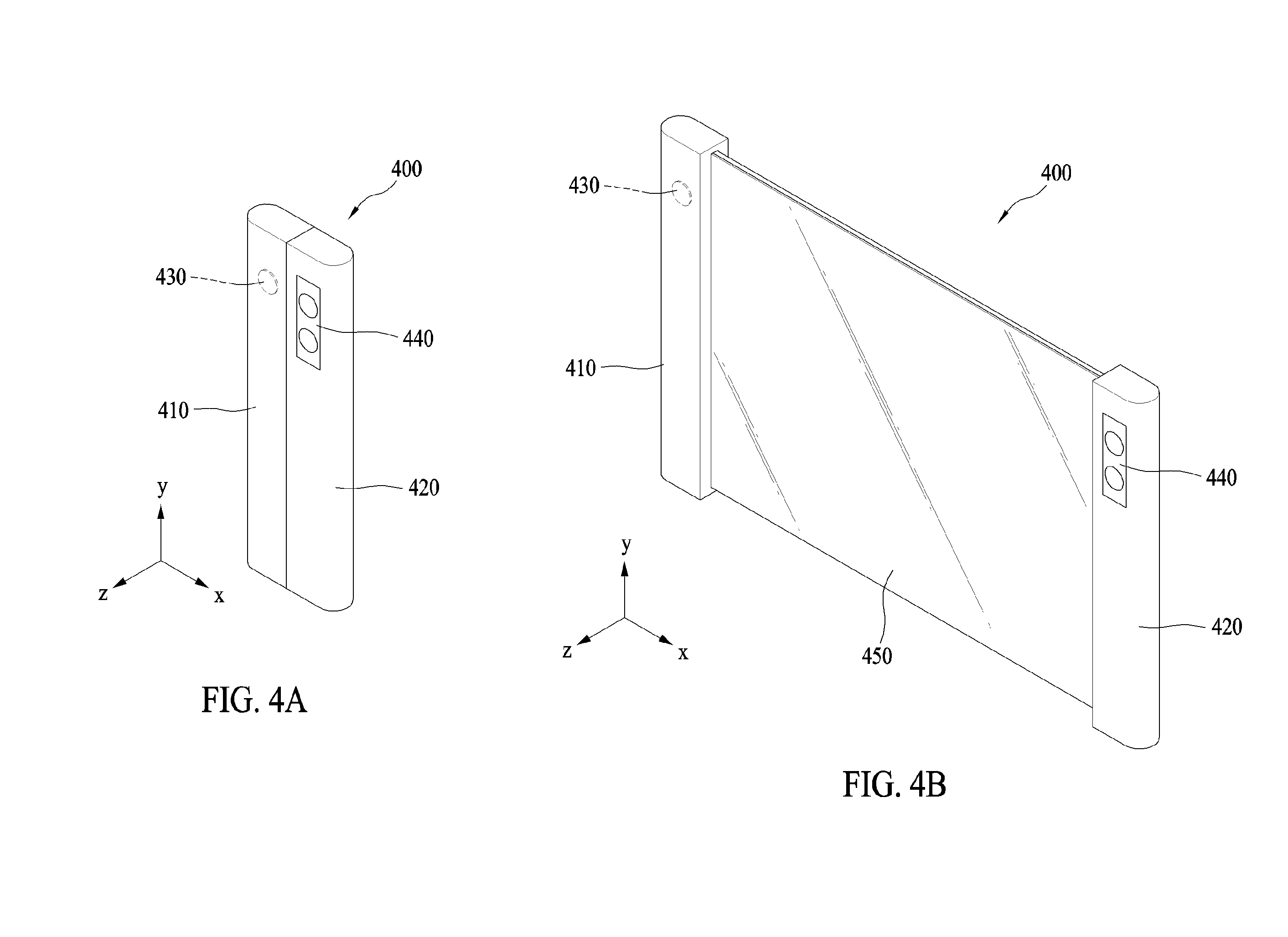
The design eliminates visible folding lines while allowing users to switch between smartphone and tablet-sized screens.
Foldable vs Rollable
| Foldable Phones | Rollable Phones |
| Fixed display sizes | Variable screen sizes |
| Visible crease | Minimal or no crease |
| Hinged mechanism | Rolling mechanism |
| Thicker profile | Potentially slimmer design |
Rather than replacing foldables immediately, rollable phones could represent Samsung’s next evolution in display technology.
Why It Matters
Consumers increasingly expect smartphones to handle productivity, entertainment, and gaming.
Expandable displays allow devices to remain pocket-friendly while offering larger screens whenever needed.
Applications include:
- Multitasking
- Video streaming
- Gaming
- Digital reading
- Productivity
Samsung’s continued investment in rollable display patents demonstrates that the company views flexible displays as a long-term platform not just a single product category.
Rollable devices may eventually complement foldables by offering a different balance between portability and screen size.
Read the complete patent analysis: https://insights.greyb.com/samsung-rollable-phone-patents/
4. Samsung UWB Earbuds: Earbuds That Understand Their Surroundings

Wireless earbuds have evolved from simple audio accessories into intelligent wearable devices.
Samsung’s patents suggest the next evolution involves giving earbuds spatial awareness.
Instead of relying solely on Bluetooth, future Galaxy Buds could integrate Ultra-Wideband (UWB) technology to understand their precise location relative to users and nearby devices.
Patent Spotlight
Patent: Wireless Audio Device Using Ultra-Wideband Communication (US20250039604A1)
The patent describes earbuds capable of:
- Precise indoor positioning
- Direction-aware audio transmission
- Device discovery
- Spatial communication
- Multi-device synchronization
- Enhanced proximity detection
Unlike Bluetooth, UWB enables centimetre-level positioning accuracy.

This additional spatial awareness allows earbuds to understand not only which device they’re connected to but also where that device is located.
Why Is UWB Important?
Ultra-Wideband could significantly improve everyday interactions.
Imagine:
- Audio automatically switching to the nearest device
- Direction-aware notifications
- More immersive spatial audio
- Accurate indoor navigation
- Improved smart home interactions
As Samsung expands its connected ecosystem, UWB-enabled earbuds could become an intelligent bridge between smartphones, wearables, smart TVs, and home appliances.
Samsung’s investment in UWB goes beyond improving wireless audio.
The patent suggests the company is positioning earbuds as context-aware computing devices capable of understanding user location, nearby devices, and surrounding environments an important step toward ambient computing.
Read the complete patent analysis: https://insights.greyb.com/samsungs-patented-uwb-earbud-technology/
5. Samsung G Fold: Redefining Foldable Smartphones with Three Screens

Foldable smartphones have already changed how users think about mobile devices, but Samsung’s patents suggest the company is already planning the next evolution.
Instead of a device that folds once, Samsung is exploring tri-fold smartphones capable of transforming from a conventional phone into a tablet-sized device with an even larger display area.
The concept, often referred to as the Galaxy G Fold, represents Samsung’s ambition to maximize screen real estate without compromising portability.
Patent Spotlight
Patent: Multi-Folding Electronic Device (KR20250142733A)
Samsung’s patent illustrates a smartphone featuring:
- Two inward-folding hinges
- Three connected display sections
- Flexible OLED display spanning all panels
- Reinforced hinge mechanism
- Optimized stress distribution across folds
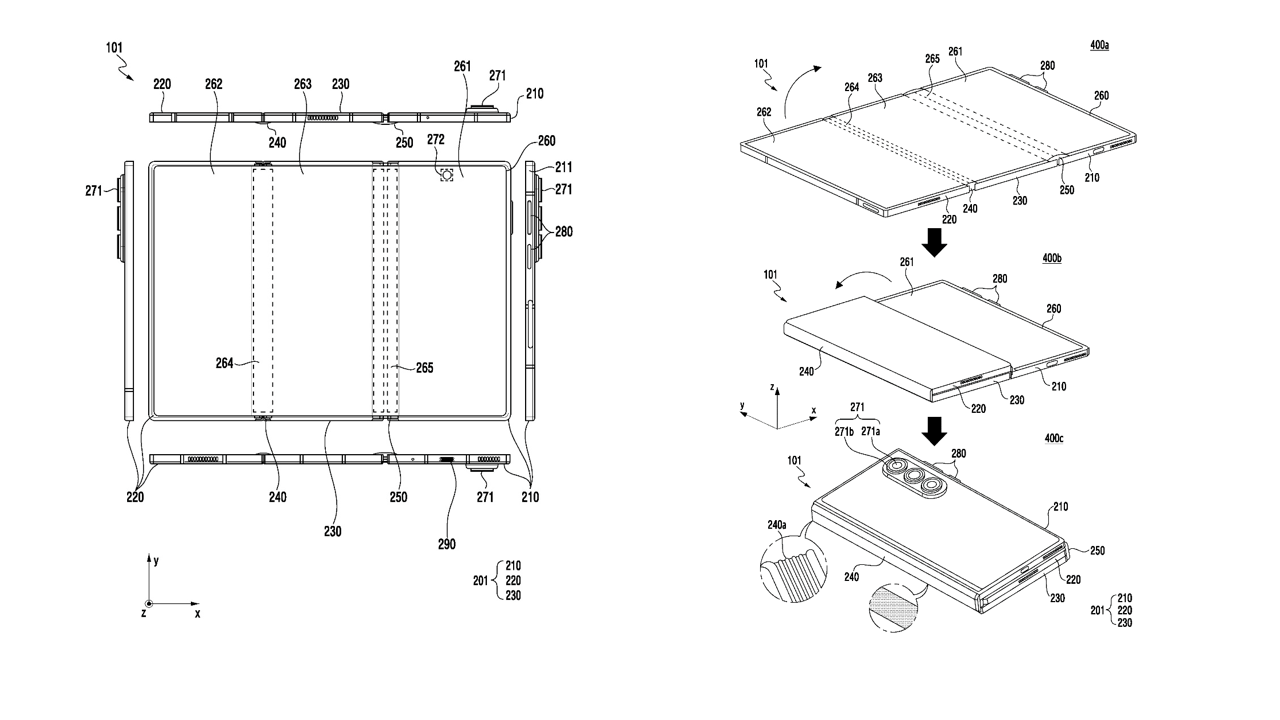
Unlike outward-folding concepts, Samsung’s design folds both outer panels inward, protecting the flexible display when the device is closed.
A second patent also focuses on improving hinge durability and reducing mechanical stress, ensuring the display maintains its integrity after repeated folding cycles.

Why Three Folds?
Today’s foldable phones typically double the available screen area.
Samsung’s tri-fold concept goes even further.
A G Fold device could seamlessly switch between:
- Standard smartphone mode
- Dual-screen productivity mode
- Full tablet mode
This flexibility makes it suitable for:
- Document editing
- Gaming
- Video conferencing
- Digital sketching
- Split-screen multitasking
Why It Matters
As smartphones continue replacing laptops for many everyday tasks, larger displays become increasingly valuable.
Samsung’s G Fold concept demonstrates that future smartphones may no longer have a fixed form factor. Instead, users could dynamically choose the screen size that best fits their activity.
Samsung’s repeated investment in tri-fold designs suggests the company isn’t treating foldables as a finished product category. Instead, it continues exploring entirely new form factors that blur the line between smartphones, tablets, and portable workstations.
Read the complete patent analysis: https://insights.greyb.com/samsung-g-fold-patents/
6. Samsung Rollable Displays: Expanding Screens Beyond Smartphones

While rollable smartphones attract significant attention, Samsung’s patents indicate the technology extends far beyond mobile devices.
The company is exploring rollable displays that could be integrated into laptops, tablets, televisions, automotive dashboards, and portable monitors.
Rather than designing products around fixed screen sizes, Samsung is developing displays that expand only when additional space is required.
Patent Spotlight
Patent: Rollable Display Apparatus (US20220295651A1)
The patent describes:
- Flexible OLED display
- Internal rolling cylinder
- Extendable support mechanism
- Reinforced sliding rails
- Automatic display expansion

Another patent focuses on maintaining display flatness after expansion by introducing structural support layers beneath the flexible panel.

What Makes Rollable Displays Different?
Traditional displays are constrained by physical dimensions.
Rollable displays eliminate that limitation.
Possible applications include:
- Portable monitors
- Automotive infotainment systems
- Smart televisions
- Tablet computers
- Foldable laptops
Imagine carrying a compact device that unfolds into a full-sized workstation whenever needed.
Why It Matters
Consumers increasingly expect portability without sacrificing productivity.
Rollable displays could provide large-screen experiences while reducing storage space and improving device portability.
Samsung’s patents reveal that rollable technology is more than a smartphone feature it’s becoming a display platform capable of transforming multiple consumer electronics categories.
Read the complete patent analysis: https://insights.greyb.com/samsung-rollable-display/
7. Samsung Flex In & Out: A Foldable Display That Works Both Ways

Most foldable smartphones bend in only one direction.
Samsung believes future devices shouldn’t have that limitation.
Its Flex In & Out display technology introduces a flexible OLED panel capable of folding both inward and outward, eliminating the need for separate cover displays while increasing design flexibility.
Patent Spotlight
Patent: Bi-Directional Folding Display Device (WO2024154952A1)
Samsung’s patent describes:
- 360-degree folding mechanism
- Flexible OLED display
- Advanced hinge architecture
- Reduced mechanical stress
- Continuous display protection

Unlike conventional foldables, the display remains accessible regardless of how the device is folded.
Why Is This Important?
Current foldables require:
- Internal display
- External display
- Additional components
- Increased thickness
Flex In & Out simplifies this architecture by allowing a single display to serve multiple purposes.
Potential benefits include:
- Thinner devices
- Reduced manufacturing complexity
- Better durability
- More immersive user experience
Real-World Applications
Samsung’s bi-directional display technology could enable:
- Smartphones
- Tablets
- Dual-screen productivity devices
- Foldable gaming systems
- Automotive interfaces
Flex In & Out demonstrates Samsung’s continued leadership in display engineering. Instead of simply improving existing foldables, the company is rethinking how flexible displays should function altogether.
Read the complete patent analysis: https://insights.greyb.com/samsung-flex-in-out-patents/
8. Samsung Bespoke Jet Bot Combo: Smarter Cleaning Through AI and Robotics

Robot vacuum cleaners are no longer limited to basic navigation and scheduled cleaning.
Samsung’s patents suggest the company is building autonomous home robots capable of understanding their surroundings, adapting to changing environments, and performing multiple cleaning tasks with minimal user intervention.
Patent Spotlight
Patent: Autonomous Cleaning Robot (US10918250B2)
The patent describes:
- AI-powered object recognition
- LiDAR-based navigation
- Obstacle avoidance
- Floor-type identification
- Automatic cleaning optimization

Additional patents focus on integrating vacuuming and mopping functions into a single autonomous platform capable of selecting the most appropriate cleaning mode based on detected floor conditions.
Beyond Robot Vacuums
Samsung’s AI-powered cleaning robots can potentially:
- Detect obstacles
- Avoid cables
- Recognize pets
- Differentiate flooring materials
- Adjust suction power automatically
- Learn room layouts over time
These capabilities transform cleaning from simple automation into intelligent decision-making.
Why It Matters
As smart homes become more connected, consumers increasingly expect appliances to require less manual intervention.
Samsung’s Jet Bot patents reflect this shift toward autonomous household management.
Rather than competing solely on suction power or battery life, Samsung is using AI and sensor technologies to make robotic appliances more context-aware. This approach aligns with the company’s broader vision of intelligent, self-managing homes.
Read the complete patent analysis: https://insights.greyb.com/samsungs-bespoke-jet-bot-combo-patents/
9. Samsung AR Contact Lenses: A Glimpse into the Future of Wearable Computing

Smart glasses have become one of the most active areas of wearable innovation.
Samsung’s patents suggest the company is already looking beyond glasses toward an even more seamless interface augmented reality contact lenses.
Although still in the research stage, these patents reveal Samsung’s interest in creating displays that users can wear directly on their eyes.
Patent Spotlight
Patent: Smart Contact Lens Device (US10359648B2)
The patent describes:
- Integrated micro-display
- Wireless communication
- Eye-tracking sensors
- Miniaturized antenna
- Image projection system
- External processing support

Some patent embodiments also discuss interaction between contact lenses and companion devices such as smartphones or wearable controllers.
Why Contact Lenses?
Compared to AR glasses, contact lenses could provide:
- Greater comfort
- Wider field of view
- Improved portability
- More natural user interaction
- Reduced hardware visibility
Potential applications include:
- Navigation
- Translation
- Medical visualization
- Remote assistance
- Gaming
- Education
The Challenges
Despite their potential, AR contact lenses remain one of the most technically demanding wearable concepts.
Key challenges include:
- Miniaturizing displays
- Safe power delivery
- Heat management
- Biocompatible materials
- Long battery life
- Regulatory approvals
Samsung’s AR contact lens patents represent a long-term vision rather than an imminent commercial product. However, they illustrate the company’s willingness to explore interfaces that move beyond smartphones and even smart glasses, pointing toward a future where digital information is delivered directly within the user’s field of view.
Read the complete patent analysis: https://insights.greyb.com/samsung-ar-contact-lenses-patents/
What These Patents Reveal
Across these five innovations, a clear pattern emerges. Samsung isn’t merely refining existing products it is experimenting with entirely new form factors and interaction models.
Whether it’s tri-fold smartphones, rollable displays, AI-powered robots, or augmented reality wearables, the company’s patents consistently focus on making technology more adaptable, intelligent, and seamlessly integrated into everyday life.
These inventions also reinforce Samsung’s leadership in flexible displays and hint at a future where hardware evolves to meet user needs, rather than requiring users to adapt to fixed devices.
11. Samsung Ballie: Your AI-Powered Home Companion
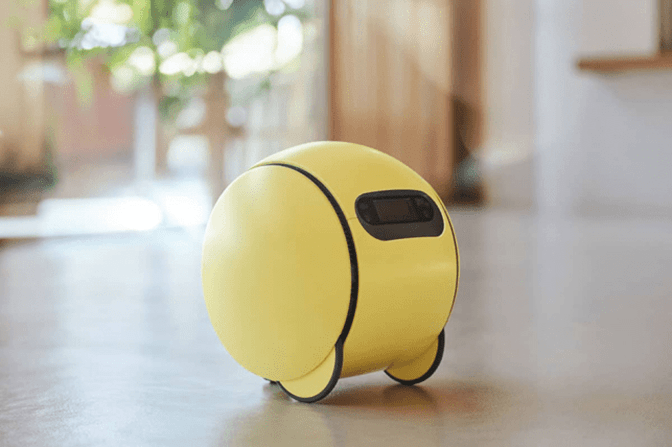
Few Samsung products have generated as much excitement as Ballie. Originally introduced as a rolling home companion robot, Ballie represents Samsung’s vision for AI-powered personal robotics. Rather than functioning as a single-purpose robot, Ballie is designed to become an intelligent assistant capable of understanding its environment, interacting with users, and managing connected devices throughout the home.
While Ballie has already made the transition from concept to a commercial product, Samsung appears to be actively shaping its next generation. Recent patent acquisitions from Panasonic, along with Samsung’s own patent filings, suggest the company is expanding Ballie’s capabilities beyond basic home assistance. The patents point to advancements in autonomous navigation, environmental awareness, AI-powered interactions, and deeper integration with connected smart home devices. Together, these developments indicate that Samsung continues to invest in making Ballie a more capable and intelligent household companion rather than treating its current version as the finished product.
Read how Samsung’s patent acquisitions are shaping Ballie’s future: https://insights.greyb.com/samsungs-panasonic-robot-patent-acquisition
Patent Spotlight
Patent: Intelligent Mobile Robot (EP4327989A1)
Samsung’s patents describe Ballie as incorporating:
- Autonomous indoor navigation
- AI-based object recognition
- Facial recognition
- Voice interaction
- Smart home control
- Personalized recommendations

Additional patents reveal technologies enabling Ballie to project information onto nearby surfaces, monitor household activities, and coordinate with connected appliances.
Why It Matters
Ballie isn’t just another robot vacuum.
It represents Samsung’s ambition to create an AI companion capable of assisting users throughout the day.
Potential applications include:
- Home monitoring
- Elderly assistance
- Pet care
- Smart home automation
- Security monitoring
- Personalized reminders
Ballie demonstrates Samsung’s belief that AI assistants will eventually move beyond smartphones and smart speakers. Future digital assistants may become mobile, autonomous, and capable of interacting naturally within physical spaces.
Read the complete patent analysis: https://insights.greyb.com/samsung-ballie-patents-insights-stats/
What Samsung’s Patents Reveal About Its Future Product Strategy
Looking across these thirteen innovations, a clear pattern begins to emerge.
Samsung isn’t investing in isolated ideas. Instead, its patent portfolio points toward a future built around four interconnected technology pillars.
1. Reinventing Displays
From rollable phones and tri-fold devices to flying displays and projector smartwatches, Samsung continues to redefine how screens are used. Rather than treating displays as fixed components, the company is exploring adaptive form factors that expand, fold, project, or even move independently.
2. AI in Everyday Living
Products such as Ballie and Jet Bot Combo demonstrate Samsung’s vision of AI extending beyond smartphones into every corner of the connected home.
3. Smarter Wearables
Samsung’s investments in UWB earbuds, projector smartwatches, and AR contact lenses indicate that future wearables will move beyond notifications and fitness tracking. They are evolving into context-aware devices capable of health monitoring, spatial interaction, and seamless communication across the Galaxy ecosystem.
4. Building an Intelligent Ecosystem
Perhaps the most important insight is that these products are not intended to operate independently.
Imagine a future where:
- Ballie adjusts lighting, starts your robot vacuum, and recommends your morning routine.
- UWB Earbuds automatically switch audio as you move between devices.
- A rollable phone expands into a productivity display while your projector smartwatch presents controls on your hand.
Individually, each product solves a specific problem. Together, they create a connected ecosystem where devices collaborate intelligently to simplify everyday life.
Samsung’s patent portfolio offers a fascinating glimpse into the company’s long-term innovation strategy. While not every patent will become a commercial product, these filings provide valuable signals about where Samsung is directing its research and development efforts.
Across foldable displays, AI-powered robotics, smart appliances, health-focused wearables, and immersive computing, one theme remains consistent: technology is becoming more adaptive, more intelligent, and more seamlessly integrated into everyday life.
Some of these innovations, such as Ballie, have already begun reaching consumers. Others, including AR contact lenses, flying displays, and projector smartwatches, remain longer-term concepts that showcase Samsung’s willingness to explore bold new product categories.
Taken together, these innovations reveal a company preparing for a future where displays can change shape, robots become household companions, and wearable devices fade into the background while becoming increasingly capable.
If Samsung’s patent activity is any indication, the next decade of consumer electronics will be defined not by a single breakthrough product, but by an ecosystem of intelligent devices working together to deliver more personalized, connected, and adaptive experiences.
Discover the Patents Behind Tomorrow’s Products
Patents provide one of the earliest indicators of where technology is headed. By analyzing patent filings, businesses can identify emerging product trends, monitor competitors, and uncover innovation opportunities long before products reach the market.
We analyze global patent data to uncover the technologies shaping the future of industries from consumer electronics and AI to mobility, healthcare, and sustainability.
Want to know what your competitors are building next? Explore our patent intelligence solutions and stay ahead of emerging innovation trends.
