
Samsung’s latest patent reveals more than a smartwatch with a built-in projector. It offers a glimpse into a future where wearable interfaces are no longer confined to a tiny display but can dynamically expand into the user’s surroundings, potentially changing how people interact with digital information.
Executive Summary
Imagine asking your smartwatch to summarize your next meeting while you are carrying groceries.
Instead of squeezing text onto a display barely larger than a postage stamp, the watch projects your schedule onto the back of your hand. As you move naturally, the projected interface remains sharp, correctly aligned, and easy to read. You glance once, understand what matters, and continue walking without taking out your phone.
That experience does not exist today.
But Samsung’s patent application US20230033151A1 suggests the company is exploring the technologies that could make it possible.
At first glance, the invention appears to describe a smartwatch with an integrated miniature projector. A closer examination reveals something more significant. Samsung is not simply trying to make smartwatch displays larger. It is exploring a new interaction model in which the interface can temporarily move beyond the watch whenever additional visual space is needed.
More importantly, the patent focuses on solving the engineering problems that have historically prevented wearable projection from becoming practical. Through adaptive optics, motion sensing, automatic focus adjustment, and real-time image correction, Samsung describes a system capable of maintaining usable projection even while the user’s wrist is constantly moving.
Whether projector-enabled smartwatches ultimately become commercial products remains uncertain. Competing technologies such as augmented reality glasses, AI-driven ambient interfaces, and gesture-based interaction may prove equally compelling. Yet the patent provides an important strategic signal. It shows Samsung investing in a future where wearable computing is no longer defined only by the size of a watch display, but by the flexibility of the interface itself. For IP professionals, the filing illustrates how companies establish early positions around enabling technologies before markets mature. For R&D teams, it highlights the multidisciplinary engineering required to create next-generation wearable experiences. And for business leaders, it offers insight into one possible direction for the evolution of wearable computing.
Patent Intelligence Snapshot
| Patent | US20230033151A1 |
| Company | Samsung |
| Technology Area | Wearable Projection Display |
| Core Innovation | Adaptive smartwatch projection system with dynamic focus and image correction |
| Strategic Signal | Extending wearable interfaces beyond the physical smartwatch display |
| Analysis Type | Single-patent strategic intelligence analysis |

The Smartwatch Has Become More Powerful Than Its Display
Over the past decade, smartwatches have evolved from simple notification companions into sophisticated computing devices. Modern models can monitor heart rhythm, detect falls, guide workouts, provide turn-by-turn navigation, make contactless payments, translate languages, and increasingly serve as AI-powered personal assistants.
In terms of computing capability, today’s smartwatch bears little resemblance to the first generation of wearable devices.
Its interface, however, has evolved much more slowly.
Despite major improvements in processors, sensors, and software, users still interact with most smartwatch functions through a display measuring little more than one inch across. Software designers have responded by increasing pixel density, reducing bezels, introducing gesture controls, and redesigning interfaces to fit more information into the available space.
These improvements make smartwatches easier to use, but they do not fundamentally solve the underlying problem.
As wearable devices become capable of supporting richer applications, including generative AI assistants, contextual recommendations, productivity tools, and increasingly complex health insights, the available interaction space is becoming the primary limitation rather than the hardware itself.
Imagine asking your smartwatch to explain the key points of a twenty-page report before your next meeting.
The AI can generate the summary within seconds.
Displaying it meaningfully is another challenge.
A one-inch display forces users to scroll repeatedly, switch screens, or move the task to another device entirely. The bottleneck is no longer intelligence. It is presentation.
This shift changes the design challenge facing smartwatch manufacturers.
Instead of asking:
How can we fit more information onto the display?
Samsung’s patent suggests a different question:
Why should the interface remain confined to the display at all?
That subtle change transforms how the invention should be interpreted.
Rather than representing another attempt to improve smartwatch screens, Samsung appears to be exploring an interaction model in which the watch becomes the computing hub while the interface expands into the user’s immediate environment whenever additional visual space is required.
The display is no longer treated as a permanent boundary. Instead, it becomes only one of several possible places where information can appear.
That philosophy aligns with a broader industry movement toward spatial and context-aware computing. Companies across the technology industry are experimenting with ways to reduce dependence on fixed displays, whether through augmented reality, ambient computing, AI assistants, or entirely new interaction models.
Samsung’s approach is distinctive because it attempts to preserve the familiar smartwatch while allowing the interface to extend beyond it only when necessary.
Rather than replacing the watch, the patent seeks to make it more adaptable.
For IP professionals, this represents an early attempt to secure intellectual property around a possible new interaction paradigm. For product teams, it suggests that future wearable competition may be defined less by hardware specifications and more by how naturally users interact with digital information.
Samsung’s Idea: Expand the Interface, Not the Watch
At first glance, increasing the size of a smartwatch display seems like the most obvious way to improve usability.
In practice, every additional millimeter introduces trade-offs.
A larger display requires a larger battery to maintain operating time. Larger batteries increase thickness and weight. Bigger enclosures reduce comfort, limit styling options, and make continuous wear less practical, one of the defining characteristics of successful smartwatches.
These constraints explain why smartwatch dimensions have remained relatively stable even as their internal capabilities have expanded dramatically.
Samsung’s patent proposes a different trade-off.
Instead of permanently increasing display size, the watch creates additional interface space only when the user actually needs it.

Routine interactions, such as checking the time, viewing notifications, or starting a workout, can remain on the watch face. More information-intensive tasks can temporarily shift beyond the display.
Imagine arriving at a train station in an unfamiliar city.
Rather than repeatedly raising your wrist to read tiny navigation instructions, the watch projects a clear directional arrow and the next two route changes onto the back of your hand. As you walk, the projected interface automatically adjusts to your movement, keeping the information readable without requiring conscious effort.
Or imagine reviewing a long AI-generated email summary while boarding a flight.
Instead of scrolling through multiple watch screens, key points appear as a larger projected panel beside your wrist. Once you have finished reading, the projection disappears and the watch returns to its normal mode.
These scenarios are not features claimed by the patent. Rather, they illustrate the kinds of interaction experiences Samsung’s projection-based approach could eventually support if the underlying technology matures.
Seen from this perspective, projection is not simply an alternative display technology.
It is a way of making interface size dynamic.
Instead of treating the display as a fixed hardware characteristic, Samsung treats visual space as a resource that can expand and contract according to the user’s immediate needs. That is a fundamentally different design philosophy from simply building a larger smartwatch, and it is the idea that connects the rest of the patent.
How Samsung’s Projector Smartwatch Works
At its core, Samsung’s invention combines several technologies that already exist: miniature projection, optics, motion sensing, image processing, and embedded computing. None of these components is particularly groundbreaking on its own.
The innovation lies in how Samsung combines them into a system capable of functioning on one of the most dynamic devices people wear every day.
Unlike a smartphone or tablet, a smartwatch is almost never stationary. Every gesture, wrist rotation, or arm movement changes the distance, angle, and orientation between the watch and the projection surface.
That makes wearable projection fundamentally different from conventional projection.
A traditional projector assumes the projection surface remains relatively fixed.
A smartwatch cannot make that assumption.
Samsung’s patent is therefore less concerned with creating a projector than with creating a projection system that continuously adapts to movement.
The patent describes an integrated architecture consisting of:
- a miniature projection module,
- a compact light source,
- multiple optical elements,
- motion and orientation sensors,
- a processor,
- image rendering and correction software.
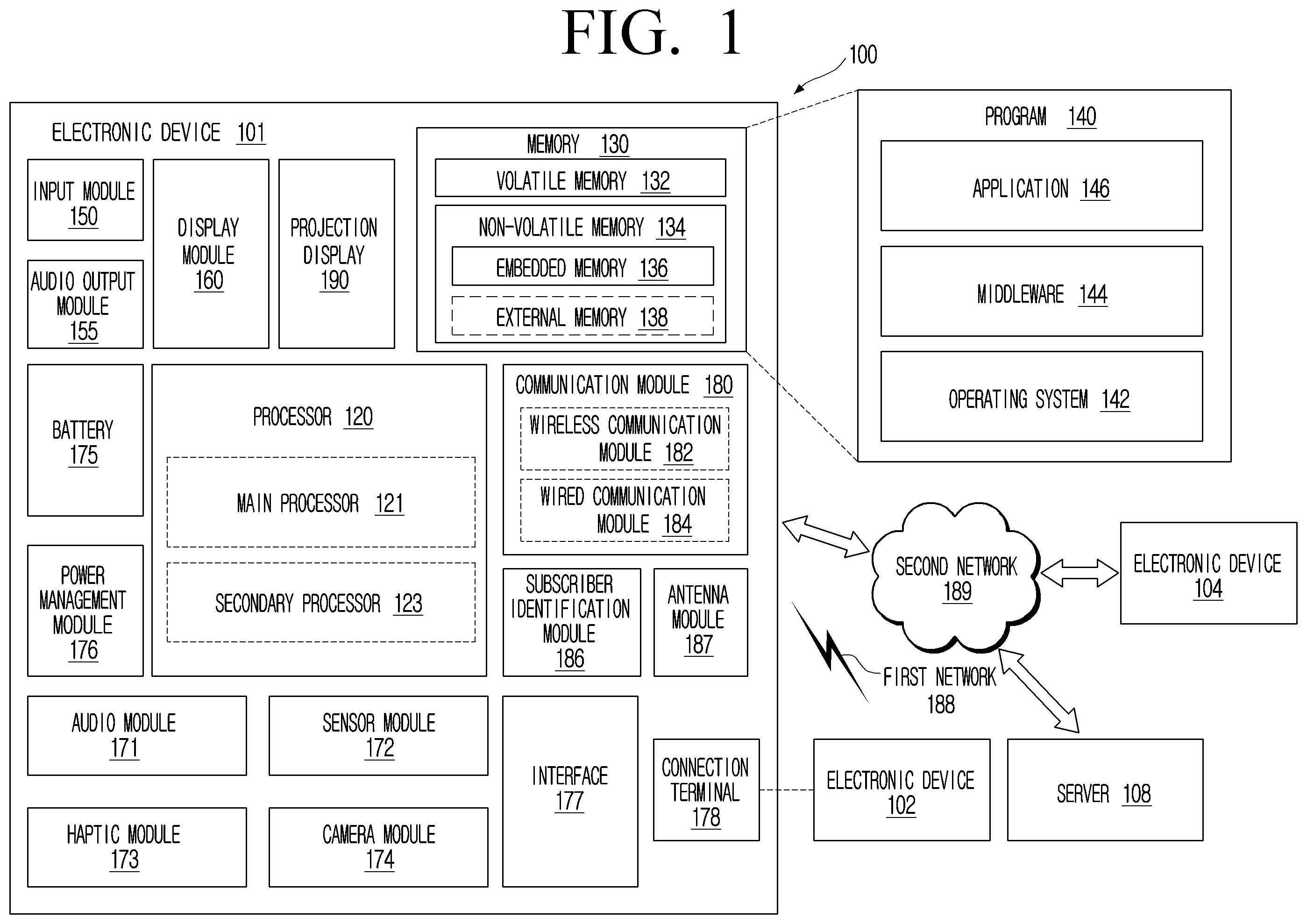
Each component performs a different function, but their value comes from working together.
The sensors constantly monitor how the watch moves.
The processor calculates how those movements affect the projected image.
The optical system adjusts focus and projection path.
The rendering engine compensates for distortion before the image is projected.
From the user’s perspective, all of this happens automatically.
Instead of asking users to hold their wrist perfectly still, the watch quietly adapts to natural movement. That distinction is critical because it changes wearable projection from an engineering demonstration into something that could eventually become usable in everyday life.

A Practical Example: Navigation Without Looking Down
To understand why Samsung designed the system this way, imagine walking through a crowded airport.
Your smartwatch detects that you are approaching your departure gate.
Instead of repeatedly lowering your eyes to read tiny navigation instructions, a directional arrow appears on the back of your hand.
As your arm naturally swings while walking:
- the distance between the watch and your hand changes,
- the projection angle constantly shifts,
- your wrist rotates,
- surrounding lighting conditions vary.
A conventional projector would quickly lose focus or distort the image.
Samsung’s system is designed to compensate for these changes automatically.
As a result, the navigation cue remains readable without requiring the user to consciously adjust the watch.
Whether this exact experience becomes a commercial feature is unknown. The patent does not promise a navigation product. Rather, it demonstrates how adaptive projection could support applications that require information to remain visible while the user continues moving naturally.
That difference between projecting an image and maintaining a usable interface defines much of the invention.
The Real Innovation Is Not the Projector. It Is Adaptive Projection.
Miniature projection technology has existed for many years.
Pocket projectors, laser pico-projectors, and experimental wearable displays have all demonstrated that projecting an image from a small device is technically possible.
The problem has never been projection itself.
The problem has been usability.
A projector attached to a constantly moving wrist quickly becomes frustrating if users must repeatedly reposition their arm just to keep text in focus.
Samsung’s patent addresses precisely this challenge.
Instead of treating projection as a static optical process, it treats it as a continuously adapting system.
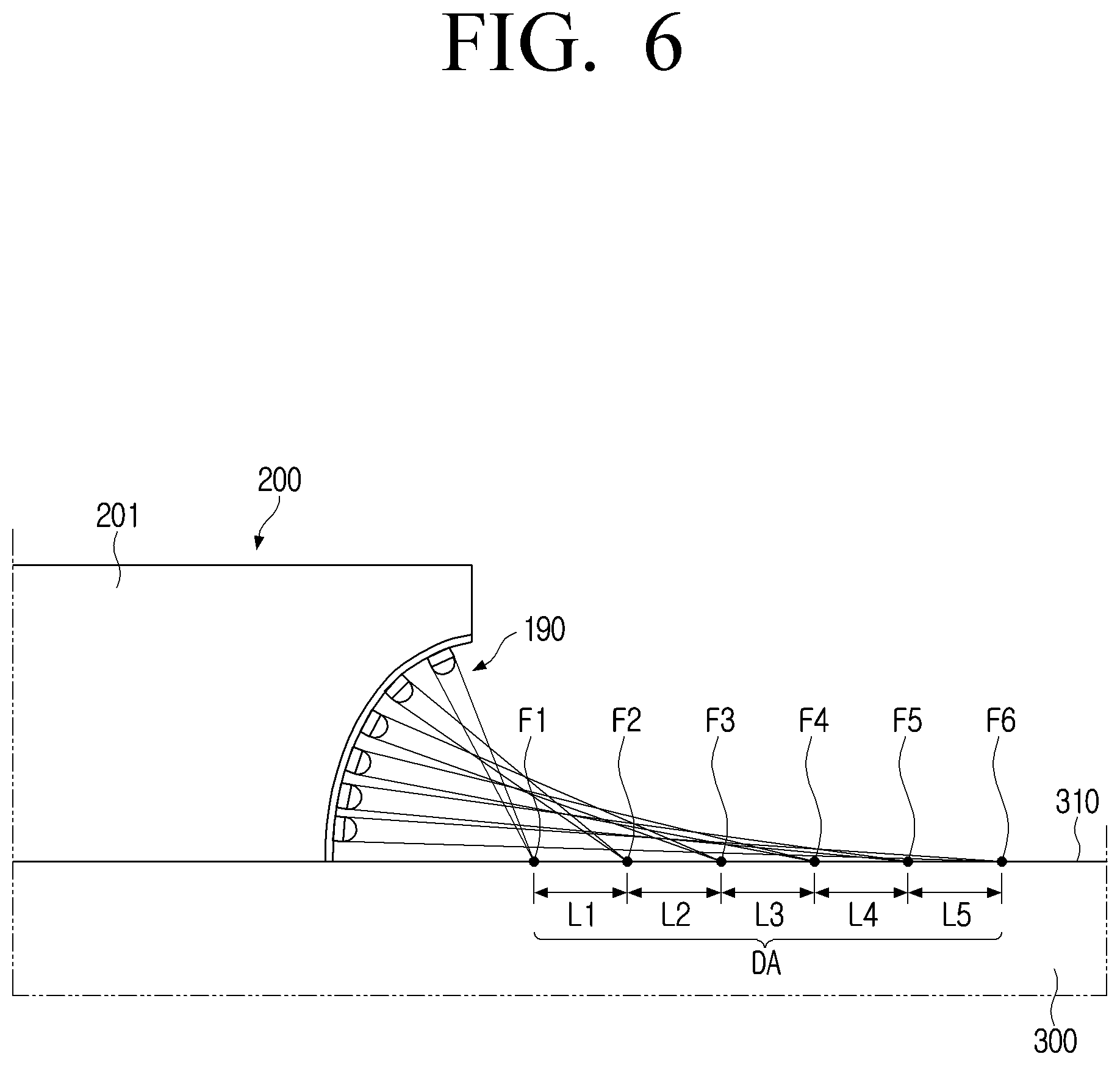
The patent describes multiple projection paths and focal configurations that allow the watch to adjust projection based on changing distances and wrist positions.
As the user’s hand moves closer or farther away, the optical system can select an appropriate focal path while software simultaneously adjusts image geometry and orientation.
The result is not simply a projected picture.
It is a projected interface that attempts to remain readable under real-world conditions.
That distinction represents the patent’s most important technical contribution.
Why Adaptive Optics Matter
Adaptive optics may sound like a small engineering detail.
In reality, they determine whether wearable projection feels practical or unusable.
Imagine reading a projected message while boarding a train.
Every step changes your wrist position.
Every hand movement changes projection distance.
Without continuous optical adjustment, text would constantly blur or drift out of alignment.
Samsung’s adaptive system attempts to prevent exactly that.
The projection becomes responsive rather than fixed. The technology quietly compensates for the user’s movement instead of expecting the user to compensate for the technology.

This design philosophy has historically distinguished successful consumer electronics from experimental concepts.
Products succeed when they adapt to human behavior, not when humans must adapt to the product.
Turning the User’s Hand into a Dynamic Workspace
One of the most distinctive aspects of Samsung’s patent is the choice of projection surface.
Many embodiments focus on projecting directly onto the user’s hand.
At first glance, this seems like a practical decision.
The hand is always nearby.
But the implications are much broader.
By projecting onto the hand, Samsung effectively transforms part of the human body into temporary digital workspace.
Instead of thinking about the smartwatch display as the only interface, the watch can temporarily borrow additional space whenever more information is required.
The smartwatch remains the computing device.
The hand becomes an extension of the interface.
That subtle shift changes how wearable interaction can be designed.
Why the Hand Makes Sense
From an engineering perspective, the hand offers several advantages over walls, tables, or nearby objects.
It naturally remains within projection range.
It moves together with the watch.
Users already look toward their hands during interaction.
No external accessories are required.
Unlike projecting onto an arbitrary surface, projecting onto the hand provides a predictable operating environment.
The patent repeatedly leverages this relationship between the watch and the user’s own body.
Rather than requiring people to find an empty wall or flat surface, Samsung imagines interaction taking place wherever the user happens to be.
More Than a Second Screen
It is tempting to think of the hand simply as a larger display.
The patent suggests something more flexible.
Imagine asking an AI assistant for restaurant recommendations while walking through a city.
Instead of opening multiple applications, the watch projects:
- nearby restaurants,
- walking distance,
- ratings,
- reservation availability,
directly onto your hand.
A few hours later, the same interaction space displays your boarding pass at the airport.
During an evening workout, it becomes a real-time coaching interface showing pace, heart rate, and recovery guidance.
The physical hardware has not changed.
Only the interface has.
The projected workspace expands or disappears according to context. That idea moves beyond larger displays and toward context-aware interaction.
Beyond Notifications: What Could This Technology Enable?
Perhaps the most exciting aspect of Samsung’s patent is not what it explicitly claims, but the interaction possibilities it makes easier to imagine.
The patent does not describe these applications.
Instead, they represent plausible experiences that could emerge if adaptive wearable projection matures.
AI Assistants
Large language models are making wearable devices increasingly capable of generating rich responses.
Today’s smartwatch often reduces those responses to one or two lines of text.
Projection could allow AI assistants to present:
- summarized emails,
- meeting agendas,
- travel recommendations,
- shopping comparisons,
- contextual reminders,
without requiring users to reach for another device.
Fitness Coaching
Imagine a runner receiving projected pacing guidance that updates every few seconds.
A strength-training application could display posture cues or exercise timing while both hands remain free.
Rather than interrupting the workout to interact with a tiny screen, guidance appears only when needed and disappears once the exercise is complete.
Healthcare
Healthcare professionals frequently move between patients while consulting digital records.
A projection system could temporarily display medication schedules, patient identifiers, or procedural checklists while allowing clinicians to keep their hands available for care.
The smartwatch becomes less of a notification device and more of a contextual information assistant.
Industrial Maintenance
Field technicians often divide attention between equipment and handheld documentation.
Imagine servicing an electrical panel while wiring diagrams or maintenance steps appear beside the wrist instead of requiring a separate tablet.
Projection could reduce interruptions without introducing head-mounted displays.
Travel and Translation
Consider standing in a foreign railway station.
Instead of unlocking a phone every few seconds, translated platform information, ticket details, or navigation prompts briefly appear on your hand before disappearing once the task is complete.
The interaction feels temporary, contextual, and almost invisible.
Cooking and Everyday Tasks
Even ordinary household activities illustrate the concept.
Recipe instructions.
Timers.
Ingredient measurements.
Shopping reminders.
Rather than repeatedly touching a phone with wet or occupied hands, the watch provides information exactly when required before returning to its unobtrusive role.
These examples are intentionally forward-looking.
Samsung’s patent should not be interpreted as a roadmap for these specific products.
Instead, they illustrate why adaptive projection matters.
The patent is valuable because it explores a new interaction model that could support many future applications, some of which may not yet exist.
That possibility is what elevates the invention beyond a smartwatch accessory. It positions the watch as a computing hub whose interface can expand dynamically according to the user’s immediate needs.
What Samsung Is Actually Protecting
The phrase “Samsung smartwatch projector patent” naturally draws attention to the miniature projector.
However, that description captures only part of the invention.
A closer reading of the patent reveals that Samsung is not primarily protecting projection hardware. Instead, it is protecting the technologies that make wearable projection practical under real-world conditions.
These include:
- adaptive optical paths,
- dynamic focus adjustment,
- motion-aware image correction,
- sensor-assisted calibration,
- projection-aware interface rendering,
- automatic geometry compensation.
These technologies solve problems that every company attempting wearable projection would eventually encounter.
That distinction is important.
Projector hardware will inevitably improve as components become smaller, brighter, and more power efficient. Those improvements can often be replicated by competitors.
The software, sensing, and optical intelligence required to transform a projector into a reliable wearable interface is much harder to replicate. In emerging technology markets, these enabling technologies frequently become more valuable than the visible product itself.
A Common Patent Strategy in Emerging Technologies
Samsung’s approach reflects a broader strategy often seen in emerging technology markets.
Companies rarely protect only the final product.
Instead, they seek intellectual property around the engineering techniques required to make that product commercially viable.
History provides many examples.
Smartphones were not differentiated simply because they included touchscreens.
Competitive advantage came from gesture recognition, multi-touch interaction, power management, display rendering, and software integration.
Similarly, autonomous vehicles are not protected merely because they drive themselves.
Much of the intellectual property resides in perception systems, sensor fusion, path planning, and decision-making algorithms.
Samsung appears to be applying the same philosophy here.
If wearable projection eventually becomes commercially successful, adaptive projection systems may represent the real competitive advantage rather than projection hardware alone.
For IP professionals, this makes the patent more significant than its title initially suggests.
Rather than asking:
Does Samsung own projector smartwatches?
The more meaningful question becomes:
Which interaction technologies will every future projector smartwatch require? That is where long-term strategic value often resides.
Samsung Is Not the Only Company Rethinking Wearable Interfaces
Samsung’s patent becomes even more interesting when viewed alongside the broader wearable industry.
Nearly every major technology company has recognized the same underlying challenge.
Smartwatches continue becoming more capable.
Their interfaces have not evolved at the same pace.
The companies differ not in the problem they are solving, but in how they believe it should be solved.
| Company | Primary Strategy | Long-Term Vision |
| Samsung | Expand the interface through projection | Flexible interaction without changing the watch form factor |
| Apple | Refine the existing interface | Make small-screen interaction increasingly efficient |
| Reduce interface complexity through AI | Users need to interact less because AI anticipates their needs | |
| Meta | Replace physical displays with AR | Digital information appears directly within the user’s field of view |
| Huawei & Xiaomi | Experiment with new wearable hardware | Explore alternative form factors and interaction models |
Each company is effectively answering the same question:
How should people interact with wearable computers once small displays become the limiting factor?
Samsung’s answer is projection.
Apple focuses on improving the existing experience through interface refinement, ecosystem integration, and interaction design.
Google increasingly relies on artificial intelligence to minimize how much information users need to actively manage.
Meta shifts interaction away from watches altogether by investing in augmented reality glasses.
These approaches are not necessarily competing technologies.
They may ultimately complement one another.
A future wearable ecosystem could combine AI assistants, projection, voice interaction, gesture recognition, and augmented reality depending on context. Seen this way, Samsung’s patent is less about competing with projectors and more about securing one possible role within a much broader interaction ecosystem.
Can Projector Smartwatches Become Commercial Products?
From a technical perspective, Samsung demonstrates that wearable projection is increasingly feasible.
Commercial success, however, depends on much more than technical feasibility.
History is filled with products that worked well in laboratories but failed to become everyday consumer devices.
The question is therefore not:
Can Samsung build this?
The more important question is:
Will people actually want to use it?
Several challenges remain.
Battery Life
Projection consumes considerably more power than conventional OLED displays.
Even as miniature projection engines become more efficient, continuous projection would place significant demands on battery capacity.
That makes it unlikely that future smartwatches would rely on projection as their primary interface.
A more realistic scenario is contextual projection.
The watch projects information only during tasks that genuinely benefit from additional visual space before returning to its conventional display.
Rather than replacing the screen, projection complements it.
Brightness and Outdoor Visibility
Projection quality depends heavily on ambient lighting.
Bright sunlight remains one of the greatest challenges for miniature projection systems.
Indoor environments, offices, hospitals, warehouses, and transportation hubs represent much more favorable operating conditions.
Future advances in laser projection, micro-LED technology, and optical efficiency may reduce this limitation, but brightness will likely remain an important engineering challenge.
Heat and Miniaturization
Smartwatches already integrate processors, batteries, wireless radios, biometric sensors, GPS, and health monitoring hardware.
Adding an active projection system introduces additional thermal and packaging constraints.
Future engineering efforts may therefore focus less on projection itself and more on optimizing overall system efficiency.
User Behavior May Matter More Than Engineering
The largest uncertainty may not be technical.
It may be behavioral.
Consumers have already adapted to interacting with small smartwatch displays.
Projection must therefore provide a meaningful improvement rather than simply introducing a novel interaction method.
Several questions remain unanswered.
Would people feel comfortable projecting notifications in public?
Would projected interfaces feel faster than traditional interactions?
Would users prefer projection over voice assistants?
How much information actually benefits from additional visual space?
These questions cannot be answered by patents.
Only real products can answer them.
Could Enterprise Adopt Projection Before Consumers?
One possibility receives relatively little attention.
Consumer adoption may not happen first.
Many enterprise environments already require workers to access digital information while keeping both hands available.
Field technicians.
Warehouse operators.
Healthcare professionals.
Manufacturing engineers.
Emergency responders.
Aircraft maintenance crews.
These workers often alternate between performing physical tasks and consulting digital instructions.
Projection could reduce those interruptions.
Imagine an aircraft technician inspecting hydraulic lines while wiring diagrams appear beside the wrist.
A nurse reviewing medication schedules without repeatedly turning toward a workstation.
A warehouse employee receiving picking instructions while handling inventory.
These examples are not described in Samsung’s patent.
However, they illustrate where projection could deliver measurable productivity benefits.
Historically, many technologies, including rugged tablets, barcode scanners, and industrial augmented reality, achieved enterprise adoption before becoming consumer products. Wearable projection could follow a similar path.
Looking Beyond This Patent
It is tempting to view Samsung’s invention simply as a projector integrated into a smartwatch.
That interpretation misses the broader trend.
Across the technology industry, companies are increasingly questioning whether digital information needs to remain attached to fixed displays.
Artificial intelligence reduces interface complexity.
Augmented reality moves interfaces into the environment.
Voice assistants reduce dependence on screens altogether.
Samsung explores projection as another way to separate computing from display.
Projection may ultimately succeed.
It may not.
The larger industry transition is likely to continue regardless.
Future wearable systems may distribute information across multiple locations depending on context:
- smartwatch display,
- user’s hand,
- nearby surfaces,
- vehicle dashboards,
- connected home displays,
- augmented reality glasses.
Instead of thinking about “the screen,” users may simply interact with information wherever it is most useful at that moment.
If that future emerges, the smartwatch becomes less of a display and more of a personal computing hub. Samsung’s patent represents one possible step toward that evolution.
Strategic Implications
This patent highlights how technology leaders build early positions around enabling technologies long before markets fully mature. For IP professionals, the real value may lie in monitoring continuation filings, related patent families, and adjacent innovations rather than focusing solely on projector hardware. For R&D organizations, the invention demonstrates that future wearable devices will require the integration of multiple disciplines including optics, sensing, intelligent software, power management, and human-computer interaction to deliver seamless user experiences. For product teams, it raises a fundamental question: should smartwatches continue evolving through incremental display improvements, or should interaction itself become more flexible and adaptive? Samsung’s filing suggests strong interest in exploring the latter. For business leaders, the broader lesson is that patents are not product roadmaps but strategic options. By investing in technologies that could enable new forms of wearable interaction, Samsung is strengthening its position in a potentially important future market, regardless of whether projection-based interfaces ultimately become mainstream.
At first glance, Samsung’s smartwatch projector patent appears to describe a familiar type of innovation: a new hardware feature integrated into an existing product.
A closer examination reveals something much more ambitious.
The patent is not fundamentally about projection.
It is about removing one of the longest-standing constraints in wearable computing: the assumption that every interaction must occur on the watch itself.
Rather than asking how to fit more information onto a tiny display, Samsung asks a more fundamental question:
What if the display no longer defined the boundaries of the interface?
Adaptive optics, intelligent image correction, motion-aware rendering, and dynamic projection are all pieces of a larger vision in which wearable devices become computing hubs capable of presenting information wherever it is most useful.
Whether projection ultimately becomes the dominant interaction model remains uncertain.
Augmented reality, AI-driven ambient interfaces, voice interaction, or entirely different technologies may shape the future instead.
Yet Samsung’s patent provides a valuable strategic signal regardless of which path the market ultimately chooses.
It shows that the next chapter of wearable computing may be defined less by faster processors or brighter displays and more by reimagining where and how people interact with digital information.
That is what makes this patent significant.
It is not simply exploring a new smartwatch. It is exploring the possibility that the smartwatch itself may no longer be the boundary of the user interface.
