
A patent-led view of where GLP-2 innovation is moving – from peptide and biologic protection toward longer-acting therapies, formulations, dosing, manufacturing, oral delivery, and multi-receptor strategies.
GLP-2 Is Entering a Different Kind of Patent Race
GLP-1 may be receiving most of the attention in metabolic medicine, but GLP-2 is developing a very different patent story.
GLP-2 works primarily around the intestine. Teduglutide, the active ingredient in Revestive, is already used for short bowel syndrome. In January 2026, the European Union also authorised Teduglutide Viatris as a generic medicine referencing Revestive. That changes the competitive context around a field that is no longer defined only by first-generation molecule discovery.
The opportunity is increasingly about more than discovering another GLP-2 receptor agonist. Companies are trying to protect how long the therapy lasts, how it is formulated, how it is administered, how it is manufactured, which patients receive it, and what other receptors or therapies it can be combined with.
This makes GLP-2 a natural continuation of our earlier GLP-1 patent landscape. That study showed GLP-1 innovation spreading across therapeutics, delivery, combinations, and adjacent applications. GLP-2 is more concentrated around pharmaceutical R&D, but the patent data shows its technology base becoming increasingly layered.
For this study, we analyzed 1,326 GLP-2 patent families with priority dates from 2006 onward, covering GLP-2 analogues, receptor agonists, teduglutide, glepaglutide, apraglutide, delivery technologies, biologics, formulations, and related approaches.
The central signal: the GLP-2 IP race is moving beyond protecting the molecule itself.
What Does the GLP-2 Patent Portfolio Look Like?
| Families | Alive | Top assignee | Top inventor | Largest priority route |
| 1,326 | 991 | Zealand Pharma 192 families | Lise Giehm 51 families | United States 472 families |
The portfolio already contains a substantial amount of live IP. 991 patent families are classified as alive, compared with 335 that are dead. That puts roughly three-quarters of the identified GLP-2 portfolio in the alive category.
For an IP team, the implication is straightforward: freedom-to-operate work cannot stop at the best-known GLP-2 drugs. Sequence changes, conjugation, dosing, formulation, manufacturing, and delivery can each sit inside separate protection layers.
The 335 dead families are also useful. They should not automatically be treated as open territory, because they may still create prior art, but they can reveal directions that companies explored and later stopped pursuing.

Nearly three-quarters of the identified GLP-2 patent families are classified as alive, indicating that much of the competitive IP landscape remains relevant to ongoing product and R&D decisions.
GLP-2 Patent Filings Accelerated After 2016
GLP-2 patent activity did not grow in a straight line. From 2006 through 2015, annual priority filings generally stayed within a relatively narrow range. Activity then moved into a higher band.
There were 66 families in 2016, followed by 93 in 2017. The portfolio crossed 100 annual families in 2020 with 114 filings, remained high at 109 in 2021, and reached its highest point in the dataset at 133 families in 2022.
The broader change is more important than the individual peak. Average annual filings during 2006-2015 were 47.1 families per year. During 2016-2023, that average rose to 91.4 families per year – almost twice the earlier level.
The apparent decline after 2022 should be read carefully. The dataset shows 86 families in 2023, 69 in 2024, 41 in 2025, and 13 in 2026, but recent priority years are affected by the normal delay between filing and publication. Those later years are therefore incomplete rather than direct evidence that GLP-2 R&D has collapsed.
One family in the 1,326-family dataset does not have a usable priority year, so the year-by-year series totals 1,325 families.
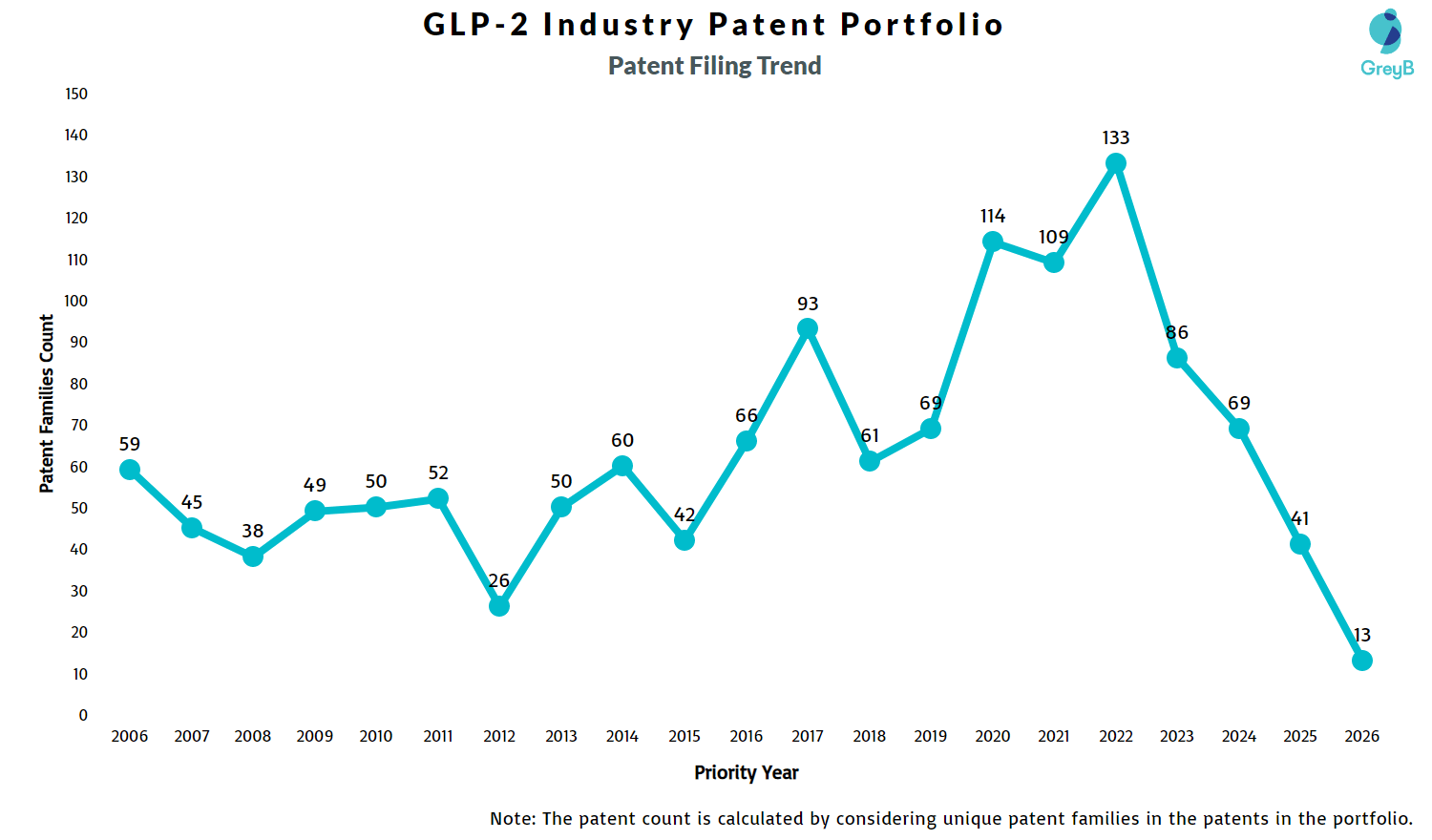
Patent activity moved into a higher filing range after 2016 and peaked in 2022. Recent years remain incomplete because of patent-publication lag.
Zealand Pharma Has Built the Largest GLP-2 Patent Portfolio
Company rankings reveal a pronounced gap at the top. Zealand Pharma has 192 patent families, more than twice Hanmi Pharm’s 85 families.
After those two companies, portfolio sizes fall sharply: Shire-NPS Pharmaceuticals has 25 families, Yuhan Corporation 23, VectivBio 22, Novo Nordisk 20, and Fresenius Kabi 17.
That distribution suggests a field with two particularly large bodies of IP followed by a long tail of companies pursuing narrower technical strategies. But portfolio size alone misses the more useful difference: these companies are protecting different parts of the GLP-2 problem.
| Sr.No | Company | Patent Families | HQ |
| 1 | Zealand Pharma As | 192 | Denmark |
| 2 | Hanmi Pharm | 85 | South Korea |
| 3 | Shire-Nps Pharmaceuticals Inc | 25 | USA |
| 4 | Yuhan Corporation | 23 | South Korea |
| 5 | VectivBio | 22 | Switzerland |
| 6 | Novo Nordisk | 20 | Denmark |
| 7 | Fresenius Kabi | 17 | Germany |
| 8 | Ferring Bv | 14 | Netherlands |
| 9 | Amgen | 13 | USA |
| 10 | Entera Bio | 12 | Israel |
| 11 | Biocompatibles UK Ltd | 12 | United Kingdom |
| 12 | D&D Pharmatech | 11 | South Korea |
| 13 | Biomolecular Holdings | 10 | USA |
| 14 | Defensin Therapeutics ApS | 10 | Denmark |
| 15 | Camurus | 10 | Sweden |
| 16 | Takeda Pharmaceutical Company | 9 | Japan |
| 17 | Sanwa Kagaku Kenkyusho Co Ltd | 9 | Japan |
| 18 | Intrexon ActoBiotics | 8 | Belgium |
| 19 | Heptares Therapeutics | 8 | United Kingdom |
| 20 | Sl Bigen Inc | 8 | South Korea |
The Core GLP-2 Patent Battle Is Still About Peptides – But That Is Only the First Layer
The technology breakdown makes the industry’s technical center of gravity clear. Therapeutic Peptides & Agonists account for 762 families, or about 58% of the landscape. Another 332 families relate to Fusion Proteins & Biologics, roughly 25%. Together, those two areas represent more than 82% of the analyzed families.
That tells us companies are still primarily competing on the therapeutic itself: peptide sequence, receptor activity, stability, half-life, conjugation, and biologic architecture.
But secondary protection layers are becoming difficult to ignore. The dataset also contains 79 nanoparticle-formulation families, 65 related to gene-expression analysis, 47 involving purification and separation, and 27 covering injection pens or reconstitution containers.

Therapeutic peptides and biologics dominate GLP-2 patenting, while formulation, manufacturing, and delivery technologies form smaller but strategically important protection layers.
The Technology Mix Is Changing as GLP-2 Programs Mature
The year-by-year technology view is more informative than the aggregate totals. In 2019, the portfolio contained 27 therapeutic-peptide families and 22 fusion-protein families. By 2020, therapeutic-peptide filings jumped to 80 families. They remained high at 73 in 2021 and rose to 83 in 2022, while fusion proteins reached 28 families in the same year.
The more recent data also shows continued activity around purification, formulations, and administration. This is consistent with a therapeutic area moving from discovery toward product engineering and lifecycle protection.
Early patents often try to protect what the molecule is. Later portfolios increasingly protect how it is produced, stabilized, delivered, dosed, and used. The GLP-2 landscape increasingly contains evidence of all of these layers.

Different Filing Geographies Are Building Different Types of GLP-2 IP
The geography data becomes more useful when technology is layered on top of filing volume. The United States is the largest priority filing route with 472 families, followed by Europe through the EPO with 235, China with 194, and South Korea with 129. Together, those four routes account for roughly 78% of the portfolio.
Their technical profiles are not identical. The United States shows the broadest mix. South Korea stands out for biologics: of its 129 families, 52 are tagged as Fusion Proteins & Biologics and 66 as Therapeutic Peptides & Agonists. China also shows a noticeable process component, with 21 families in Purification & Separation Processes.
For IP teams, that matters because searching only the largest overall jurisdictions can hide where specific technical capabilities are clustering. For R&D and business-development teams, it can help identify where research groups and potential partners are building expertise in particular parts of the GLP-2 value chain.

Four GLP-2 Patents That Show Where the Industry May Be Movin
1. Zealand Pharma is connecting the GLP-1 and GLP-2 worlds
Patent: WO2018104558A1 – Acylated GLP-1/GLP-2 Dual Agonists
The family covers compounds designed to activate both GLP-1 and GLP-2 receptors, including potential use around intestinal dysfunction, body-weight regulation, and metabolic dysfunction.
Why it matters: This family creates a direct bridge between the GLP-1 and GLP-2 landscapes. Instead of treating the two peptide systems as separate therapeutic areas, dual agonism creates additional IP space around receptor balance, sequence design, acylation, dosing, combinations, and indication.
It is also a reminder not to treat patent activity as a product forecast. Zealand currently lists dapiglutide, its GLP-1/GLP-2 dual agonist, as a paused program, while glepaglutide remains in Phase 3 development for short bowel syndrome.
2. Hanmi is trying to make GLP-2 last longer
Patent: US12703730B2 – Long-Acting Conjugates of GLP-2 Derivatives
The family focuses on long-acting GLP-2 derivatives. Hanmi’s broader portfolio also includes site-specific conjugation, liquid formulations, fusion/biologic architectures, combination therapy, and additional intestinal or inflammatory indications.
Why it matters: Peptide therapies face a basic constraint: biological duration can translate directly into dosing burden. Long-acting conjugation changes the competitive question from receptor activity alone to how the molecule remains active and how often treatment is needed. That helps explain why Hanmi’s fusion-protein and biologic activity deserves attention even though its overall family count is below Zealand’s.
3. VectivBio shows why manufacturing and dosing patents matter
Patent: EP4161553A1 – Manufacture, Formulation and Dosing of Apraglutide
The patent family is explicitly directed to manufacturing, formulation, and dosing around apraglutide rather than only the core peptide concept. The dataset also shows later VectivBio families around dosage regimens and graft-versus-host disease.
Why it matters: As an asset advances, protection can move downstream. Manufacturing steps, stable formulations, concentrations, dosage regimens, and treatment schedules can each create additional barriers around a therapeutic. For FTO and market-entry work, these layers can matter as much as the original compound family.
4. Entera Bio is targeting one of peptide therapy’s hardest problems: oral delivery
Patent: EP4482513A4 – Formulations Comprising Acid-Neutralizing Polymer for Oral Administration of GLP-2
The family describes oral GLP-2 formulations that use acid-neutralizing polymer-based approaches. It sits within a broader Entera portfolio focused on oral administration of proteins and active agents.
Why it matters: If GLP-2 therapy can move from repeated injections toward practical oral administration, the formulation itself becomes a major part of the moat. That opens additional patent space around protection from gastric conditions, absorption enhancement, excipient combinations, release profile, and dosage form.
The Leading GLP-2 Portfolios Are Concentrated Around Specific Inventor Teams
The inventor data adds another layer to the company ranking. Lise Giehm leads the dataset with 51 patent families associated with Zealand Pharma, followed by Hanmi’s Choi Jae Hyeok with 40 and Zealand’s Bjarne Due Larsen with 33.
More importantly, 16 of the top 20 inventors are associated with either Zealand Pharma or Hanmi Pharm. That suggests the portfolio advantage is not simply the result of isolated filings. Both companies appear to have repeat inventor teams contributing across multiple generations of GLP-2 technology.
For R&D leaders and business-development teams, inventor-level analysis can reveal information that assignee rankings cannot – including which research groups repeatedly generate new IP and where technical knowledge is concentrated.
| Sr.No | Inventor | Patent Families | Associated Company |
| 1 | Lise Giehm | 51 | Zealand Pharma |
| 2 | Choi Jae Hyeok | 40 | Hanmi Pharm |
| 3 | Bjarne Due Larsen | 33 | Zealand Pharma |
| 4 | Kim Sonne | 27 | Zealand Pharma |
| 5 | Alistair Vincent Gordon Edwards | 26 | Zealand Pharma |
| 6 | Claes Melander | 23 | Zealand Pharma |
| 7 | Sung Youb Jung | 23 | Hanmi Pharm |
| 8 | Min Young Kim | 23 | Hanmi Pharm |
| 9 | Joakim Lundqvist | 22 | Zealand Pharma |
| 10 | Ulrik Moritzen | 22 | Zealand Pharma |
| 11 | Jesper Skodborg Villadsen | 22 | Zealand Pharma |
| 12 | Se Chang Kwon | 20 | Hanmi Pharm |
| 13 | Sung Min Bae | 19 | Hanmi Pharm |
| 14 | Palle Bekker Jeppesen | 19 | Zealand Pharma |
| 15 | Peter Glerup | 19 | Zealand Pharma |
| 16 | Jin Bong Lee | 18 | Hanmi Pharm |
| 17 | Jong Gyun Kim | 17 | ProGen Co Ltd |
| 18 | Kim Junhwan | 17 | Yuhan Corporation |
| 19 | Angela Norton | 15 | Enlila |
| 20 | Sang In Yang | 12 | ProGen Co Ltd |
Academic GLP-2 Research Is Much More Distributed
No university dominates the landscape in the way Zealand or Hanmi dominate the corporate ranking. The University of California and Scripps Research each appear with 12 patent families, followed by the University of Connecticut with 11 and both Tufts University and China Pharmaceutical University with 10.
That distribution has an important implication for technology scouting. Rather than looking for one obvious academic GLP-2 hub, companies may need to search at the level of individual laboratories, inventors, disease indications, and enabling technology platforms.
| University/Institutions | Patent Families |
| University of California | 12 |
| Scripps Research | 12 |
| University of Connecticut | 11 |
| Tufts University | 10 |
| China Pharmaceutical University | 10 |
| The University of Angers | 8 |
| University of Pennsylvania | 7 |
| Stanford University | 6 |
| The French National Research Institute for Sustainable Development | 6 |
| Duke University | 6 |
| The University of Sydney | 6 |
| The University of Texas | 6 |
| University of Michigan | 5 |
| Technical University of Munich | 5 |
| Copenhagen University | 5 |
GLP-2 Patent Disputes May Reveal More Than Filing Counts
Portfolio size tells us where companies are building IP. Disputes can show which rights are important enough to challenge.
The current research set identifies six opposition and litigation matters associated with the GLP-2 landscape. Case-level analysis can answer questions the public filing charts cannot: which patents are being challenged, which companies are involved, which claim types are under pressure, and where future FTO risk may be developing.
Which GLP-2 patents are already being challenged?
Patent filing volume shows where companies are seeking protection. Opposition and litigation can reveal which parts of that protection are becoming commercially important.
Our GLP-2 research identified six opposition and litigation matters connected with this landscape.
Access the detailed GLP-2 IP report to explore the patents involved, parties, legal status, and potential competitive implications.
What Should IP and R&D Teams Take From the GLP-2 Landscape?
The molecule is becoming only one part of the moat. Peptide and agonist patents remain the largest part of the landscape, but companies are surrounding therapeutic assets with claims covering conjugation, formulation, manufacturing, dosage, delivery, and indication.
Delivery could become a larger differentiator. Oral GLP-2 and controlled-release approaches remain much smaller than conventional peptide portfolios. That makes them useful areas for monitoring new entrants and potential white space.
Indication expansion deserves separate tracking. The dataset includes GLP-2 concepts extending beyond traditional short bowel syndrome treatment into areas such as mucositis, graft-versus-host disease, intestinal disease, and metabolic applications. The competitive map can change materially by indication.
Family-level legal analysis matters. A PCT publication or one family member can be dead while national family members remain active. Simple alive/dead filtering is useful for landscape screening, but not sufficient for a real FTO or market-entry decision.
Get the Updated GLP-2 Patent Landscape
This study is based on the GLP-2 patent dataset analyzed for this article, covering 1,326 families with priority dates from 2006 onward.
Patent ownership, legal status, continuation activity, new publications, oppositions, and company pipelines continue to change.
For updated GLP-2 filings, consolidated competitor portfolios, recent innovation signals, opposition/litigation activity, claim-level analysis, and technology white-space opportunities, fill out the form to access the updated analysis.
GLP-2’s Next Patent Cycle May Look Very Different From Its First
The first generation of GLP-2 IP established that intestinal growth and absorption could be therapeutically targeted. The current landscape suggests the next competitive cycle is becoming more layered.
Companies are no longer protecting only a receptor agonist. They are trying to protect the entire therapeutic system around it – molecule, half-life, formulation, manufacturing process, dosing schedule, delivery route, patient population, combination therapy, and indication.
One of the more interesting signals is that GLP-2 may not remain isolated from the much larger GLP-1 ecosystem. Dual GLP-1/GLP-2 patents already show how the pathways can converge. At the same time, paused programs show why patents should be read as strategic options rather than simple predictions of future products.
Three signals worth watching next
| Signal | Why it matters |
| Oral and controlled-release delivery | Smaller portfolios can become strategically important if they materially reduce administration burden or create new product formats. |
| Lifecycle protection around advanced assets | Manufacturing, formulation, dosing, and treatment-regimen claims can become more important as core molecules move closer to market. |
| GLP-1/GLP-2 convergence | Dual-agonist families create overlap between two previously more distinct patent landscapes and may widen the competitive set. |
For IP and R&D teams, the next GLP-2 opportunity may not come from inventing another GLP-2 molecule. It may come from solving one of the problems around that molecule better than everyone else.

