
A battery can look healthy on the dashboard and still be moving toward accelerated degradation.
That is one of the problems emerging battery technologies are trying to solve. As electric vehicles, grid-scale energy storage, and other battery-powered systems operate under faster charging, heavier loads, changing temperatures, and more demanding duty cycles, simply monitoring voltage, current, and temperature is no longer enough. Traditional Battery Management Systems (BMS) largely respond when measured conditions cross predefined limits, rather than anticipating how the battery will behave next.
A recent landscape of more than 900 patents and related developments across the US, Europe, and China shows where the technology is moving. The important shift is not simply the introduction of AI into battery monitoring. It is the move toward using predicted battery health as an input for real-time decisions-from charging and thermal management to power allocation across entire energy-storage systems.
That changes the role of the BMS. Instead of asking, “What is happening to the battery right now?” emerging systems are increasingly asking, “What is likely to happen next, and what should we do about it?”

Why Battery Management Is Moving Beyond Monitoring
Conventional BMS technology has an important limitation: it is primarily designed to react to measured conditions.
Voltage, current, temperature, and charging history provide a picture of the battery’s present state. But battery degradation is influenced by how the battery has been used and how it is being operated under changing conditions. The report highlights the resulting difficulty in accurately predicting degradation, remaining useful life (RUL), and emerging failures. Conservative charging and operating strategies can also limit how much of the battery’s available capability is actually used.
AI/ML-based battery intelligence introduces another layer between sensing and control. Models can process real-time telemetry together with historical operating data to estimate State of Health (SoH), identify degradation trends, predict RUL and faults, and support decisions about how the battery should be operated.
The broader technology direction can be viewed as a four-stage loop:
Sense → Predict → Decide → Act → Learn
The report’s workflow shows real-time voltage, current, temperature, and charge/discharge history feeding AI models. Their predictions then inform charging, thermal management, and power-distribution decisions, with the resulting operating data feeding back into continuous model updates. This is the fundamental transition from a BMS that reacts to conditions toward one that continuously adapts to predicted battery behavior.
Electra AI Is Turning the BMS Into an Intelligence Layer
One of the clearest approaches in the report comes from Electra AI, which positions its technology as an AI software and control layer rather than primarily as a battery-manufacturing platform.
The problem it addresses is straightforward: a conventional BMS can detect that something has gone wrong, but has limited ability to anticipate degradation or emerging faults and then adjust battery operation accordingly. Electra AI’s approach combines battery telemetry with AI/ML and physics-informed models to estimate SoC and SoH, predict degradation and faults, and optimize operation.
What makes this approach important is where the intelligence sits. The AI layer can work with the existing BMS and turn battery-health predictions into adaptive control decisions. In other words, the system is not limited to producing another battery-health dashboard; it is designed to influence how the battery is managed.
For R&D teams, this points toward a separation between the physical battery and the intelligence controlling it. For IP teams, it broadens the monitoring scope beyond battery chemistry and hardware into algorithms, models, telemetry processing, and control architectures.
EMO Energy Connects Battery Prediction With Charging and Thermal Management
EMO Energy takes the intelligence layer closer to the physical operating conditions that drive battery degradation.
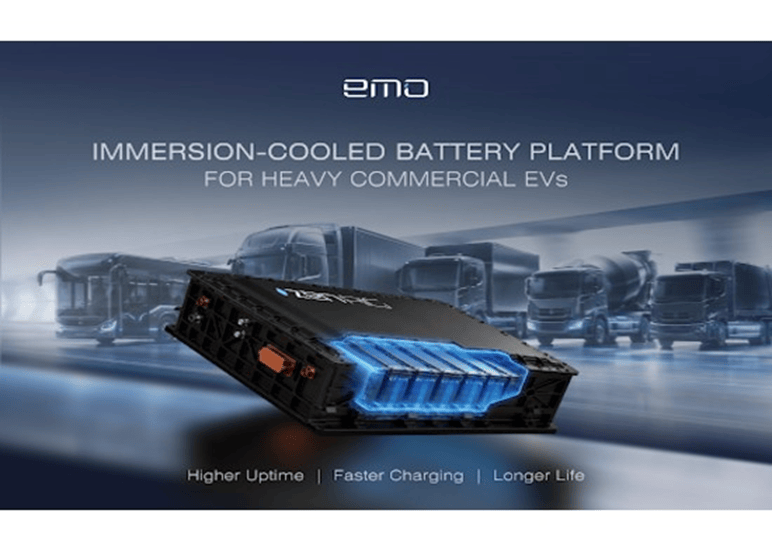
Its SENS/ZEN platforms combine battery intelligence with health prediction, thermal management, and fast-charging technologies. The report identifies frequent fast charging, high utilization, temperature changes, and heavy loads as important degradation challenges for commercial EV batteries.
SENS analyzes cell voltage, current, temperature, charging behavior, and historical operating data using machine learning to predict battery health and degradation. The important distinction is that prediction does not remain isolated from operation: the platform connects battery-health intelligence with charging and thermal-management functions.
This creates a more complete control loop. Instead of first allowing degradation to occur and then detecting it, the system uses its understanding of battery condition to influence how the battery is charged and managed.
For R&D teams, this suggests that battery intelligence is becoming inseparable from charging and thermal architecture. For IP teams, it means relevant innovation may sit at the intersection of AI prediction, charging control, thermal management, and battery operation rather than under a single “AI battery” keyword.
MaxVolt Brings AI-Based Health Estimation Into the Connected BMS
The approach from MaxVolt Energy focuses on another important weakness: estimating battery condition accurately when operating conditions change.
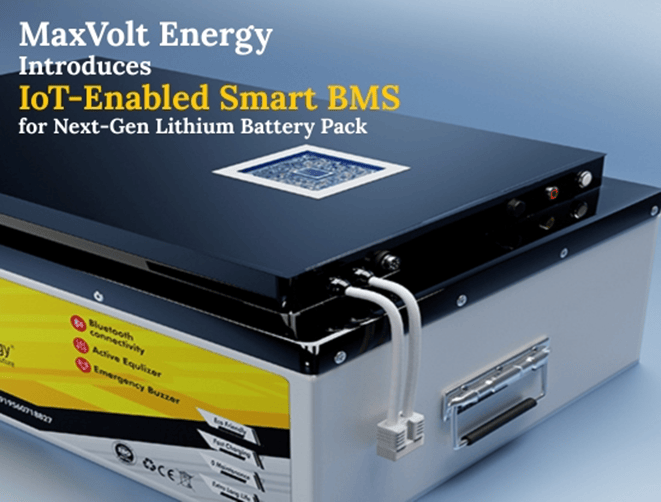
The report describes conventional BMS approaches as having limited accuracy in estimating SoC and SoH under changing conditions. MaxVolt’s AI-enabled Smart BMS uses AI/ML algorithms to estimate these parameters from battery operating data and provides predictive diagnostics, real-time monitoring, and alerts through a connected BMS.
The interesting point is not simply that AI is being used to calculate SoC or SoH. It is the shift from relatively fixed estimation methods toward continuously updated battery-health intelligence. That allows degradation and potential problems to be identified earlier and gives maintenance decisions a more predictive basis.
This is an important layer in the emerging technology stack because accurate health estimation is effectively the foundation for everything that follows. If a system cannot reliably understand battery condition, it cannot confidently use that information to optimize charging, power allocation, or lifetime.
YUNZHI Takes the Next Step: Predict Degradation Before Setting the Charge
The most direct example of prediction becoming control comes from the YUNZHI patent titled “Battery state-of-health prediction type charging method integrating deep learning,” with a priority date of March 6, 2026.
The patent describes a system that collects voltage, current, temperature, environmental temperature, and accumulated charge/discharge information. A deep-learning architecture combining CNN, BiLSTM, and attention mechanisms predicts both the battery’s current SoH and how that health is expected to evolve across future charging cycles.
The important innovation is what happens after the prediction.
The predicted health trajectory is converted into a life-loss target and considered alongside safety and efficiency constraints. The system then dynamically determines charging parameters, implements those parameters through a closed-loop controller, and continues updating the model through incremental learning over the battery’s life.
That creates a distinctly different architecture:
Sense → Predict future SoH → Estimate life loss → Optimize charging → Execute → Learn
The AI is therefore not simply forecasting battery degradation. Its forecast becomes a control variable that changes the charging decision itself.
For R&D teams, this is a significant design direction: charging strategy can become dynamic rather than predetermined. For IP teams, the important patent territory extends beyond “battery health prediction” into the relationship between prediction, degradation targets, charging optimization, closed-loop control, and continuous learning.

Shanghai Zunli Moves Battery Intelligence From One Battery to the Entire Storage System
The final development in the report expands the concept even further.
Shanghai Zunli’s patent, “Power distribution and management system of an energy storage power station based on battery health state,” has a priority date of April 10, 2026. It addresses a problem that becomes particularly important when many batteries operate together: they do not necessarily age at the same rate.
A uniform power-distribution strategy can therefore place inappropriate loads on batteries with very different health conditions. The patent uses online SoH estimation and RUL prediction, combining electrochemical models with AI/data-driven methods. These predictions feed into a two-level power-distribution optimization system.
The basic idea is intuitive. A healthier battery can handle more of the workload, while an aging battery can be operated at a lower level. The system continuously adjusts charging and discharging through the PCS and BMS, using feedback to maintain a closed control loop.
The accompanying workflow makes the distinction especially clear: conventional storage systems apply broadly uniform workloads, while the AI-based approach uses predicted battery health to distribute workloads differently across batteries.
This changes the optimization target from protecting an individual battery to managing degradation across an entire battery system.

The Emerging Patent Landscape at a Glance
| Organization / Technology | Main Problem Being Addressed |
| Electra AI – AI Brain for Batteries | Moving from reactive BMS monitoring to predictive battery intelligence |
| EMO Energy – SENS | Connecting health prediction with charging and thermal management |
| MaxVolt Energy – Smart BMS | Improving SoC/SoH estimation and predictive diagnostics |
| YUNZHI – Deep-learning charging method | Using predicted future degradation to dynamically control charging |
| Shanghai Zunli – Health-aware power management | Allocating storage-system workload according to battery health |
What the Patents Reveal When Viewed Together
Individually, these technologies address different problems. Together, they reveal a much clearer direction.
The first layer is better visibility: AI estimates SoH, RUL, degradation trends, and emerging faults from operating data. The second is prediction-driven operation: those estimates start influencing charging and thermal decisions. The third is system-level optimization: battery-health predictions become inputs for distributing workload across multiple batteries.
The result is a shift in what battery management actually means.
The battery is no longer treated simply as a component whose condition is monitored. Its predicted future condition becomes part of the control strategy.
That is the more important innovation signal across this landscape.
What R&D Teams Should Watch
1. AI models tied directly to control.
Prediction alone is becoming less interesting than prediction that changes charging, thermal, or power decisions. The strongest developments connect model outputs directly to operating actions.
2. Battery-health-aware charging.
Watch technologies that use future degradation or life-loss predictions to dynamically adjust charging parameters rather than relying on fixed charging profiles.
3. Closed-loop battery intelligence.
Systems that continuously sense, predict, act, and learn represent a deeper architectural shift than standalone battery analytics.
4. Fleet and storage-level optimization.
As battery-health predictions become control variables, the opportunity moves from individual battery optimization to managing fleets, packs, modules, and grid-scale storage systems as differentiated populations.
5. Hybrid AI and physics-based models.
The report highlights both machine-learning approaches and combinations of AI/data-driven techniques with electrochemical or physics-informed models. This intersection deserves close attention as battery behavior becomes increasingly model-driven.
What IP Teams Should Watch
The patent landscape suggests that keyword-only monitoring around terms such as “AI battery” or “battery management system” will not be enough.
Relevant inventions can appear under the technical problem being solved: SoH estimation, RUL prediction, degradation forecasting, charging optimization, thermal control, power distribution, fault prediction, incremental learning, or health-aware workload allocation.
The more important IP shift is therefore from monitoring a single technology label to monitoring the connections between technical functions.
For example, a patent focused on charging optimization may incorporate battery-health prediction without positioning itself primarily as an AI invention. Similarly, a power-management patent for an energy-storage system may use predicted RUL as a control input without emphasizing “battery lifetime prediction” in its title.
IP teams should therefore track problem areas and control architectures alongside conventional technology keywords. The report’s 900+ patent landscape reinforces how broad this emerging field has become across the US, EP, and CN markets.
Want to Track Breakthrough Innovations and the Full Patent Landscape?
The patents highlighted in this article represent only a part of the innovation activity shaping AI-driven battery management.
A deeper patent landscape can help you identify the companies developing these technologies, the technical approaches they are protecting, emerging white spaces, and where competitors are building their IP.
Whether you want to understand the full patent landscape, track breakthrough innovations, monitor competitors, or identify emerging technologies before they become widely visible, our team can help you uncover the developments that matter.
Get the complete patent landscape and track the breakthrough innovations shaping your technology area.
Conclusion
The most important change in battery management is not simply the use of AI to analyze more battery data.
It is the emergence of a system in which predicted battery health actively determines what the battery does next.
Electra AI focuses on predictive intelligence, EMO connects that intelligence with charging and thermal management, MaxVolt brings AI-based health estimation into the BMS, YUNZHI uses future degradation to influence charging decisions, and Shanghai Zunli extends the concept to workload distribution across entire energy-storage systems.
Taken together, these developments point to a new model of battery management: sense the battery, predict its future, change its operating conditions, and learn from the result.
For R&D teams, that means the next competitive advantage may come not only from better batteries, but from smarter decisions about how those batteries are used. For IP teams, it means the emerging opportunity is increasingly found at the intersection of AI, battery health, charging, control, and system-level energy management.
The battery may remain the same physical asset-but the intelligence deciding how long it lasts is becoming a technology frontier of its own.

