
Tesla’s WO2026165096A1 suggests that making wireless EV charging autonomous requires solving more than power transfer. The proposed system combines UWB-based positioning, automated vehicle alignment, secure charger authentication, and living-object detection in one charging workflow.
A car with no one to plug it in
Picture an electric vehicle with no driver, finishing its work on a low battery. Nobody is standing by to lift a cable and push it into a port. Wireless charging looks like the answer: park over a pad and let the energy flow.
Tesla’s latest wireless-charging patent suggests the harder problem may not be transferring the power at all. It may be ensuring that the vehicle finds the correct charger, positions itself accurately enough for efficient energy transfer, establishes a trusted connection with the charging equipment, and keeps verifying that no person or animal has stepped into an unsafe area.

One patent, one workflow
Patent publication WO2026165096A1, titled Wireless Charging System for Vehicles with Enhanced Positioning, Living Object Detection, and Authentication, treats these problems as connected parts of a single charging workflow. The application claims priority from January 30, 2025 and was published on August 6, 2026.
The patent describes UWB transceivers on the vehicle and the ground pad that can estimate the pad’s position while the vehicle approaches. Once the vehicle is aligned, the same general UWB infrastructure can operate in a radar-like mode to detect living objects around the charging area. Authentication and wireless communications add a layer for establishing a trusted charging session. The more interesting IP sits around the control, perception, localization, security, and safety stack that wireless charging needs if it is to become increasingly autonomous.
| The patent at a glance | |||
| Publication | WO2026165096A1 | Applicant | Tesla Inc |
| Publication date | August 6, 2026 | Application | PCT/US2026/012865 |
| Status | Pending | Primary technical themes | Wireless charging, UWB positioning, automated alignment, living-object detection, authentication |
The claims focus strongly on obtaining changing distance measurements between transceivers on the vehicle and ground pad, estimating the pad’s relative position, and controlling the vehicle so that its receiver reaches a suitable alignment tolerance for inductive charging.
WHY THIS MATTERS
Wireless power transfer is only one layer of the system. The full sequence runs: discover charger → establish communication → authenticate → locate pad → navigate → align → transfer power → monitor surroundings → intervene if necessary. Tesla’s patent connects several of those functions.
Explore More Tesla Patent Insights
Tesla’s innovations extend beyond vehicle aerodynamics into electric vehicle design, energy technologies, autonomous systems, and robotics. Explore these patent analyses to understand the broader scope of Tesla’s technology development.
Following the vehicle, one step at a time
01. A handshake before the pad
The workflow starts before the vehicle reaches the pad. The patent’s basic setting places a ground charging pad at the parking location, so a vehicle-mounted receiver can obtain energy without a physical connector. Its process flow has four broad steps: identify the ground pad, establish communication, determine distance measurements, and cause real-time alignment while navigating toward the pad. The order tells you something. Tesla is not treating the charger as a passive object the car happens to park over. The charger becomes a participating infrastructure endpoint that talks to the vehicle before charging begins. The vehicle may identify a suitable pad using wireless signals, visual information, or other selection mechanisms, then establish communications before relying on ranging for final alignment.
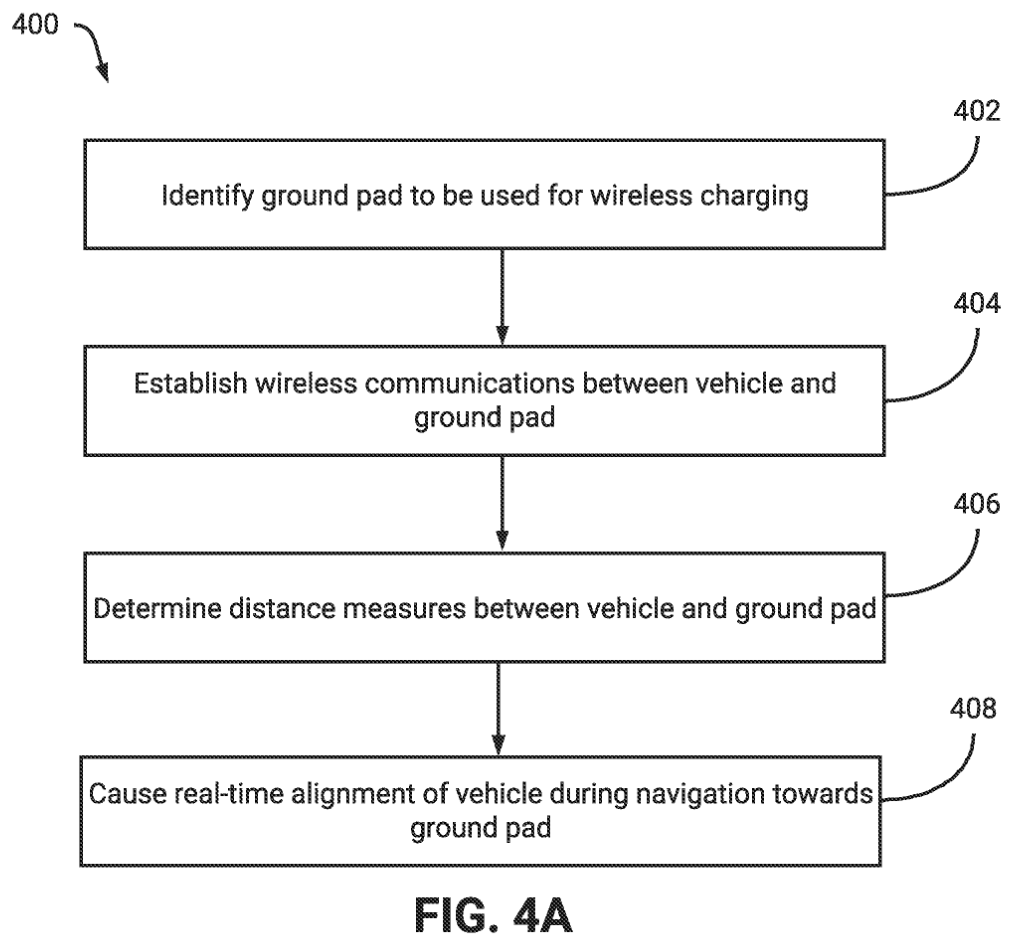
Then comes a problem that grows as charging becomes autonomous. Picture a parking facility with several charging pads and several vehicles. The approaching vehicle needs to know not only that a pad is nearby, but that the communication and ranging information it receives belongs to the pad it intends to use. Tesla therefore describes authentication between the vehicle and the ground pad. In an autonomous setting, digital identity can influence physical behavior: if a vehicle steers itself toward charging infrastructure using ranging data, it needs confidence that the data comes from the intended infrastructure.
02. Parking becomes a localization problem
Inductive power transfer depends on the positional relationship between the transmitting assembly in the ground and the receiving assembly under the vehicle. A plug-in vehicle can be parked imperfectly and still be connected with a cable. A wireless-charging vehicle may not have that flexibility, so the patent treats pad alignment as a localization and vehicle-control problem.
Tesla describes UWB transceivers on the vehicle and the ground pad that obtain distance measurements. Those measurements can be used to calculate the pad’s position relative to the vehicle through techniques including multilateration or trilateration. The specification also discusses combining them with vehicle velocity, steering angle, wheel movement, perception data, machine-learning-derived object positions, and Kalman-filter-based state estimation. Tesla does not appear to rely on a single measurement. The vehicle can keep refining its estimate as it approaches the charging point.
The vehicle also needs several vantage points. It can carry multiple UWB transceivers at different locations, because as it moves over the charger, individual sensors can become blocked, poorly positioned, or less useful for ranging. Tesla therefore describes dynamically selecting between vehicle transceivers during the approach. That matters because wireless charging needs its highest positioning confidence at the end of the maneuver, which is also when the vehicle itself may start to obstruct some sensor-to-pad paths. Multiple transceivers give the control system alternative ranging paths.

03. A pad estimate that never stops updating
The strongest technical part of Tesla’s alignment concept is the real-time ranging architecture. The patent uses multiple distances between vehicle-side UWB endpoints and ground-pad antennas to estimate where the pad is, and that estimate does not stay fixed. As the vehicle moves, Tesla describes updating it with vehicle kinematics and new UWB measurements, with examples involving a Kalman filter and alternatives such as multilateration, trilateration, and least-squares estimation.
Conceptually, the vehicle is not just asking, “Where is the charger?” It is asking, “Given where I previously estimated the charger to be, how I have moved, how I am steering, and the latest ranging measurements, where should I now believe the charger is?” A single noisy result can produce poor final alignment. A continuously updated estimate narrows the uncertainty as the vehicle closes in.
Once the pad’s location is estimated, the vehicle navigates toward it and aligns its receiver with the ground-side transmitter. The patent claims contemplate alignment tolerances of approximately 5 cm, 10 cm, or 15 cm, depending on the embodiment. Those numbers should not be read as parking specifications. They show Tesla linking vehicle-control accuracy to charging efficiency: the closer the receiving and transmitting components sit to their intended positions, the better the system can maintain the coupling that energy transfer needs. Autonomous parking accuracy becomes part of the charging system itself.

04. The same radio becomes a watchman
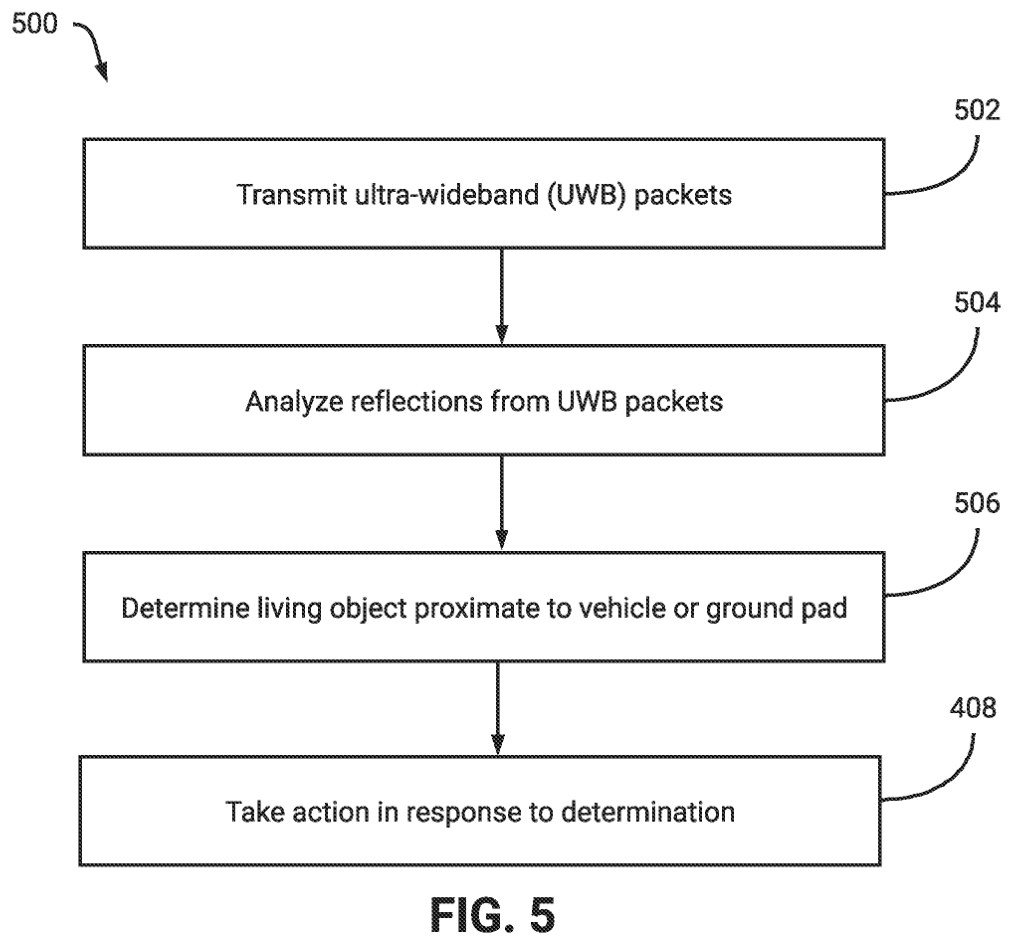
The patent gets more interesting once the vehicle reaches the charger. Tesla proposes that the UWB hardware used for positioning can also run in a radar-like mode to identify objects near the vehicle or ground pad. The vehicle or charging system transmits UWB packets and analyzes the reflections using Channel Impulse Response (CIR) information, along with signal-to-noise ratio and motion data, to decide whether a detected object may be a living object. That extends UWB beyond positioning and alignment to object and presence detection around the charging area.
During approach, UWB answers, “Where is the charging pad?”
During charging, UWB can answer, “What is moving close to the charging pad?”
That is a potentially valuable architectural decision. Rather than build a separate sensor stack just for charging safety, Tesla is exploring whether part of the positioning hardware can take on a second task once alignment is complete.
Detection alone is not enough, though, and Tesla does not want every leaf to stop the charge. An overly sensitive system could halt charging whenever debris, vegetation, or harmless static objects appear near the vehicle. The patent therefore discusses telling object types apart from their reflected-signal characteristics. Examples in the specification include patterns for a walking person, child, hand, foot, pets, or other living objects. Tesla also discusses machine-learning models that classify reflected signals, helping the system separate real safety risks from environmental noise. That has clear commercial value: a charger that interrupts needlessly frustrates users and reduces charger availability. By identifying meaningful safety events more accurately, the approach could make wireless charging safer, more reliable, and more practical than systems based on simple presence detection.
05. Safety in zones, not switches
06. The tension at the center: one sensor, two jobs
From an R&D perspective, this may be the most interesting design signal in the filing. One sensor technology is being asked to solve very different problems at different moments.
| Operating phase | UWB role |
| Charger approach | Distance ranging |
| Vehicle navigation | Pad localization |
| Final positioning | Precision alignment |
| Charging | Radar-like environmental sensing |
| Safety event | Living-object tracking / response input |
Hardware reuse creates potential advantages, but it also adds engineering requirements. A UWB architecture designed mainly for ranging does not automatically work as an effective radar system. A production-ready implementation would need to account for antenna placement, field of view, vehicle-body obstruction, environmental reflections, interference, sensor calibration, motion discrimination, classification accuracy, and transitions between sensing modes. These challenges make this an area where future continuation or follow-on filings would be particularly valuable to monitor.
The bigger signal is not wireless power. It is autonomous docking.
Step back from the individual claims and the pattern comes into focus. A human driver can compensate for imperfect charging infrastructure by repositioning the vehicle, confirming the correct charger, inspecting the surroundings, or connecting a cable when needed. An autonomous vehicle cannot always count on those interventions, which changes what charging automation has to do. An unattended vehicle must be able to identify suitable charging infrastructure, navigate toward it, establish trusted communication, position itself accurately, initiate the charging session, monitor its surroundings, and respond appropriately to abnormal conditions. Tesla’s filing addresses several of these functions within one architecture.
The obvious takeaway from WO2026165096A1 is that Tesla is building intellectual property around wireless vehicle charging. The more useful takeaway is that Tesla is treating charging as an autonomous docking problem: identify the infrastructure, establish a trusted relationship with it, keep estimating where it is, maneuver into a limited positional tolerance, transfer energy, and keep checking that the surroundings remain safe. UWB matters here because Tesla proposes using it on both sides of that transition. Before charging, it helps answer where the vehicle should go. During charging, it can help answer whether it is safe to continue. That is a more consequential signal than the charging pad alone.

None of this proves that Tesla will deploy the exact system described in WO2026165096A1. Patent applications preserve technical options. They are not product-launch announcements. But the filing does indicate that Tesla is thinking about wireless charging as something deeply connected to vehicle navigation, sensing, and autonomy.
07. Where Tesla’s patent appears different
| Player | Representative focus | IP/R&D implication | Strategic positioning |
| Tesla | UWB alignment + vehicle control + authentication + living-object detection | Integrates navigation, charging and safety | Charging as an autonomous vehicle function |
| Hyundai/Kia | UWB charging-pad localization and alignment | Strong prior work around UWB/odometry-based positioning | Precision vehicle-to-pad positioning |
| WiTricity | Wireless power infrastructure, communication, pairing and alignment | Strong IP around the wireless-power ecosystem | Charging-station interoperability and infrastructure |
| SAE ecosystem | Alignment methodologies, safety and interoperability | Push toward common technical frameworks | Cross-manufacturer standardization |
The most defensible differentiation visible in WO2026165096A1 is not the existence of wireless charging or UWB localization on its own. It is the attempt to make several layers work together:
charger identification + trusted communication + continuous positioning + autonomous alignment + safety sensing.
What each team should take from the filing
For R&D teams – The most useful engineering lesson is not “use UWB.” It is to reuse sensing infrastructure across operating states when the sensing physics allow it. Tesla’s architecture changes UWB’s function over time, from ranging on approach to detecting nearby living objects during charging. That reuse may reduce hardware duplication, but it also brings tighter system-level design constraints. The R&D question becomes whether one sensor architecture can deliver enough accuracy, coverage, reliability, and safety performance across very different phases of operation. That question matters more than the existence of any single UWB transceiver.
For business teams – Wireless charging is often pitched as a convenience feature. For a manually driven EV that makes sense, since removing the cable saves the user a physical action. Autonomous vehicles change the commercial logic. A robotaxi, self-driving fleet vehicle, delivery vehicle, or other highly automated platform cannot count on a person always being available to connect a cable. Wireless charging then offers another value proposition: automated energy replenishment. The charger behaves less like an electrical socket and more like a docking station, and the system must provide localization + docking + authorization + safety + energy transfer. Tesla’s patent stands out because it brings several of these layers into one filing.
For IP teams, five things to watch
1. Living-object detection – Tesla could pursue narrower protection around UWB radar signatures, person/pet classification, CIR processing, movement estimation, power-dependent thresholds, or false-positive reduction.
2. Localization – Future filings could focus on antenna placement, transceiver switching, final-centimeter positioning, UWB-camera fusion, calibration, or difficult non-line-of-sight conditions.
3. Authentication – Vehicle-to-charger identity could increasingly overlap with billing, charger reservations, access control, autonomous fleet authorization, and payment.
4. Fleet charging – Once vehicles can independently locate and use charging pads, the next layer becomes deciding which vehicle should use which charger, and when.
5. Autonomy integration – Charging may eventually become another autonomous-navigation destination rather than a separate user action.
As vehicles become more automated, the valuable part of wireless charging may not be moving energy without a cable. It may be owning the technologies that let a vehicle independently complete the last meter between navigation and energy replenishment.
NEXT STEP Wireless charging is becoming a patent-stack problem
WO2026165096A1 sits inside a broader IP landscape involving automakers, wireless-power specialists, semiconductor companies, infrastructure suppliers, and standards participants. As these technology areas converge, understanding a competitor’s position takes more than searching for patents that contain the words “wireless charging.” The analysis has to connect patent families across power transfer, alignment, positioning, sensing, cybersecurity, autonomous parking, charger communication, and safety.

