
More Than an Energy Drink: The Hidden Tech, Patents, and Global Empire of Red Bull
When most people think of Red Bull, they picture a silver-and-blue can, a Formula 1 car tearing around a track, or an extreme athlete jumping out of a helicopter.
What few realize is that behind the famous slogan “Red Bull Gives You Wings” sits a large technology operation. Red Bull is a beverage brand, but it’s also a media company, a motorsport engineering firm, an environmental data pioneer, and a serious owner of intellectual property (IP).
In 2025 alone, Red Bull sold 13.969 billion cans worldwide. Behind that sales figure is a growing portfolio of over 1,400 patents and designs covering hydrogen fuel cells, 350 km/h camera drones, high-tech bottling systems, and even brain performance research.
From Thai Roots to a Global Empire
The story began in 1984 when Austrian entrepreneur Dietrich Mateschitz teamed up with Thai businessman Chaleo Yoovidhya. Yoovidhya had created Krating Daeng (which translates to “Red Gaur,” a large wild bovine native to Southeast Asia), a non-carbonated energy drink popular among Thai truck drivers and workers.
Mateschitz adjusted the flavor for Western tastes, added carbonation, and launched Red Bull Energy Drink in Austria on April 1, 1987. That launch created an entirely new beverage category.
Key Business Metrics Today
- Global footprint: available in over 175 countries.
- Global workforce: 21,924 people employed by the end of 2025 (up from 19,973 at the end of 2024).
- Sales volume: 13.969 billion cans sold in 2025.
Inside the Red Bull Patent Portfolio
Coca-Cola famously keeps its drink recipe as a guarded trade secret. Red Bull takes a different route and protects its mechanical, chemical, media, and digital work through patents.
A full analysis of Red Bull’s global patent portfolio shows 1,482 total patent filings.
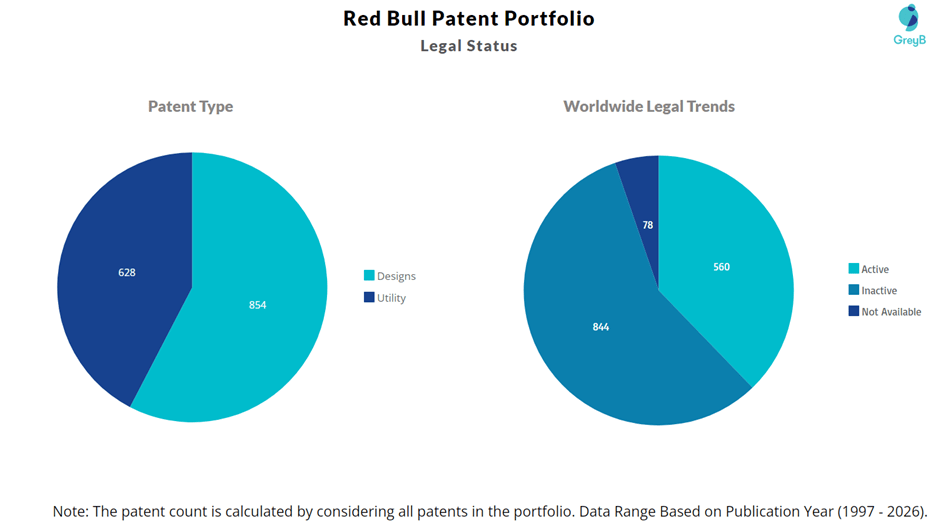
Portfolio breakdown by type and status
| Metric | Detail | Count |
| Patent Type | Design patents (packaging, display units, containers) | 854 |
| Utility patents (inventions, machinery, formulas, software) | 628 | |
| Legal Status | Active patents | 560 |
| Inactive / expired patents | 844 | |
| Pending / status not available | 78 |
Top 10 Target Markets for Patent Protection
Red Bull files patents in the commercial, manufacturing, and distribution hubs that matter most to its business.
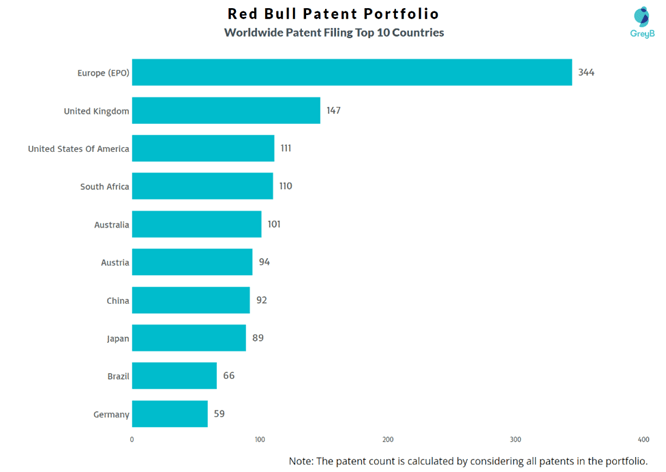
Countries in which Red Bull Filed Patents
| Country | Patents |
| Europe (EPO) | 344 |
| United Kingdom | 147 |
| United States Of America | 111 |
| South Africa | 110 |
| Australia | 101 |
| Austria | 94 |
| China | 92 |
| Japan | 89 |
| Brazil | 66 |
| Germany | 59 |
| Switzerland | 51 |
| Canada | 23 |
| Italy | 21 |
| Hong Kong (S.A.R.) | 18 |
| Spain | 16 |
| Russia | 15 |
| Poland | 13 |
| South Korea | 8 |
| United Arab Emirates | 5 |
| India | 5 |
| New Zealand | 5 |
| Turkey | 5 |
| Mexico | 4 |
| Saudi Arabia | 3 |
| Gulf Cooperation Council | 2 |
| Hungary | 2 |
| Norway | 2 |
| Ukraine | 2 |
| Benelux | 1 |
| Chile | 1 |
| Cyprus | 1 |
| Denmark | 1 |
| Estonia | 1 |
| Egypt | 1 |
| Croatia | 1 |
| Jordan | 1 |
| Monaco | 1 |
| Portugal | 1 |
| Serbia | 1 |
| Singapore | 1 |
| Slovenia | 1 |
| Slovakia | 1 |
| Thailand | 1 |
Which Red Bull Subsidiaries Filing the Patents to Strengthen his Patent Portfolio?
Red Bull works through specialized subsidiaries, each covering a distinct slice of technology.

- Red Bull GmbH (188 utility families): the main corporate entity, handling core beverage formulations, smart refrigeration, automated vending, pasteurization, and packaging design.
- Ubimet GmbH (10 families) and Nowcast GmbH (5 families): weather-forecasting and atmospheric intelligence companies Red Bull acquired to supply real-time environmental data for live events and industrial safety.
- Red Bull Advanced Technologies and Red Bull Racing (7 families): high-performance engineering branches working on lightweight vehicle materials, aerodynamic paints, and zero-emission powertrains.
- Red Bull Media House (4 families): digital broadcast tools, music platform performance analytics, and live streaming video infrastructure.
What Does Red Bull Actually Innovate? The 9 Pillars
Breaking down Red Bull’s utility patents gives 9 core technology categories.
| Technology Area | Patent Families | Real-World Application |
| Cognitive Science & Health Diagnostics | 28 | Diagnostic markers and synthetic compounds aimed at improving working memory, mental focus, and fatigue recovery. |
| Processing & Pasteurization Tech | 16 | High-speed, automated thermal pasteurization systems that keep drinks fresh without added preservatives. |
| Packaging, Can & Container Tech | 15 | Resealable can lids, ergonomic pull-tabs, lightweight aluminum structures, and eco-friendly carton blanks. |
| Meteorology, Weather & Grid Tech | 14 | 3D lightning detection systems and hyper-local precipitation AI to keep outdoor mega-events safe. |
| Beverage Formulations & Sweeteners | 13 | Natural polyphenol extracts (such as sumac and gallic acid), electrolyte mineral blends, and non-caloric sweetener mixes. |
| Drones, Media & Digital Tech | 10 | High-speed tracking drones, live video rendering software, and content streaming systems. |
| Vending, Smart Refrigeration & Display | 9 | Self-opening coolers, transparent display fridges, and automated retail storage facilities. |
| Clean Energy & Motorsport Tech | 6 | Hydrogen fuel cell stacks, aerodynamic paint films, and high-density power systems. |
| Logistics, Supply Chain & Operations | 5 | Cargo securing systems, pallet optimization, and product authenticity tracking. |
Patent Filing Trend of Red Bull

What “New Red Bull” is Doing Nowadays (2018–2026 Trends)
Over the past decade, Red Bull’s patent filings have moved away from simple can openers and display trays toward advanced tech and zero-carbon engineering.
The 350 km/h F1 Filming Drone
Capturing a Formula 1 car at full speed used to be impossible with standard commercial drones. Red Bull solved this by building a custom high-speed drone. According to IP insights on the Red Bull Drone 1 Patent, the design combines custom aerodynamics, extreme battery output, and lightweight frame materials to follow F1 cars live at speeds above 350 km/h without overheating or losing signal.
Hydrogen Fuel Cells with AVL
In April 2024, AVL and Red Bull Advanced Technologies joined forces to develop high-power-density fuel cell technology. That work produced multiple 2024 patent filings covering fuel cell stacks and end-plate structures. The aim is zero-emission, ultra-lightweight clean energy systems for high-performance motorsport and aviation.
Plant-Based Functionality and Zero-Sugar Sweeteners
Red Bull’s recent beverage patents lean heavily on natural, functional ingredients.
- Botanical extracts (2020-2022): extracting gallic acid from sumac plants as a high-potency natural antioxidant.
- Next-gen sweeteners (2024): sweetener combinations built to match the exact taste of natural beet sugar without the calories.
Trademark Battles: The China Court Ruling
Alongside expanding its tech footprint, Red Bull has fought hard legal battles to protect its brand in Asia.
One of the biggest of these reached a conclusion in China. On April 22, 2023, news reports confirmed that the Jilin High Court issued a first-instance verdict against local manufacturers producing unauthorized drinks under the Red Bull name, as reported on Alamy.
The court ordered Red Bull Vitamin Beverage (Hubei) Co., Ltd., Beijing Red Bull Beverage Sales Co., Ltd., and its Jilin branch to:
- Immediately stop producing and selling “Red Bull Vitamin Energy Drinks.”
- Immediately stop using any enterprise name containing the words “Red Bull.”
- Pay 30 million yuan (approx. $4.3 million USD) in damages to the plaintiff, Thailand’s TCI (TC Pharmaceutical / Tensi), the original trademark holder created by Chaleo Yoovidhya’s family.
How Red Bull Drinks Are Made (Ingredients and Nutrition)
Red Bull keeps strict, uniform production standards worldwide.
Where is it Produced?
The main production facilities that supply global markets sit in Austria, Switzerland, and the United States. Cans are filled at these central hubs and shipped worldwide, mostly by rail and sea, to keep the brand’s carbon footprint low.
What Ingredients Go Inside?
- Local water: sourced directly near the production facilities.
- Beet sugar: premium sugar beet provides the carbohydrates for original Red Bull.
- Synthetic caffeine and taurine: produced synthetically to guarantee consistent purity and safety in every can.
- B-complex vitamins: essential vitamins (B3, B5, B6, B12) that help reduce tiredness and fatigue.
Dietary info: Red Bull Energy Drink is gluten-free, lactose-free, dairy-free, and vegan-friendly, with no animal products or animal-derived ingredients.
Caffeine and Sugar Content Breakdown
| Can Size | Caffeine Content | Sugar (Original) |
| 250 ml (Standard) | 80 mg | 27 g |
| 355 ml (Medium) | 114 mg | 37 g |
| 473 ml (Large) | 151 mg | 51 g |
(Note: 80 mg of caffeine in a 250 ml can is roughly equal to a standard cup of home-brewed coffee.) Source
Original vs. Sugarfree vs. Zero
For anyone who wants energy without sugar, Red Bull offers two options.
- Red Bull Sugarfree: replaces beet sugar with Sucralose and Acesulfame K for a light, crisp taste.
- Red Bull Zero: replaces beet sugar with a blend of Sucralose, Sodium Cyclamate, and Sodium Saccharin, matching the signature flavor of original Red Bull with zero calories.
The Verdict: A Brand Driven by Innovation
Red Bull’s global dominance isn’t an accident. By pairing world-class guerrilla marketing with heavy investment in high-speed hardware, zero-carbon engineering, weather data AI, and steady beverage improvement, Red Bull has built a business moat that’s hard to cross.
Whether it’s powering a hydrogen hypercar or capturing live 350 km/h footage trackside, Red Bull shows day in and day out that it does far more than fill aluminum cans. It builds performance tech.
Want to go beyond the numbers? We can conduct a deeper, customized patent analysis around your technology, product, competitor, or market to uncover comparative patent statistics, competitor positioning, active and high-value patent families, filing trends, technology concentration, emerging and lower-density opportunities, potential FTO risks, licensing signals, and R&D whitespace-helping IP, R&D, innovation, and strategy teams understand not just who is patenting what, but where the competitive landscape is moving and what it could mean for their next decision.

