
Tesla’s latest tactile sensor patent describes two manufacturing methods for flexible sensors that fit around robotic fingers. The development could support the touch-sensing needs of humanoid robots such as Optimus, although Tesla has not confirmed its use in production.
A camera can tell a robot where an object is. It cannot measure how firmly the robot is holding that object. For this, a robotic hand needs sensors that detect pressure at the points of contact.
Tesla’s newly published 3D tactile sensor patent application, US20260310299A1, addresses this challenge.
The application describes flexible tactile sensors that can fit around curved robotic surfaces, including fingertips, thumbs, and palms. Tesla also explains two ways to manufacture these sensors.
The first method builds the sensing layers while the material is flat and shapes them afterward. The second shapes the base material first and then adds the sensing layers.
Both methods aim to solve the same problem: making reliable touch sensors that fit the complex shapes of robotic hands.
The difference lies in how the sensors are manufactured. That could affect production costs, sensor accuracy, and the ease of manufacturing them in large numbers.
Tesla’s patent explains the manufacturing methods, but it does not provide comparative test results showing which approach performs better.

Why Are Tactile Sensors Important for Humanoid Robot Hands?
Humanoid robots need more than cameras to handle everyday objects.
A robot might identify a glass or a tool using its vision system. But once it grips the object, it needs information about the contact between its fingers and the object.
That is where tactile sensors become useful.
These sensors can detect contact and changes in pressure, helping a robot understand what happens when it touches or holds something.
The difficulty is fitting them onto robotic fingers.
Robot fingers are small and curved. They bend during movement and experience repeated pressure when gripping objects. A tactile sensor must follow these shapes without losing its ability to detect contact.
Flat electronic materials are relatively easy to print and assemble. Curved surfaces are more difficult because the sensing layers must maintain their position and electrical properties after shaping.
If the manufacturing process changes these properties, two sensors made using the same method could produce different readings.
For humanoid robots that require several sensing areas across each hand, these differences could increase testing and calibration work.
Tesla’s patent focuses on how these flexible sensing layers can be manufactured and assembled.
How Does Tesla’s 3D Tactile Sensor Work?
Tesla’s design uses flexible sheets containing electrically conductive patterns. A thin separating layer sits between the sheets.
When pressure is applied, the sensor produces a change in an electrical reading. Electronic circuits can use that change to detect contact and pressure.
The patent describes two possible sensing methods.
In a capacitive tactile sensor, pressure changes the physical relationship between conductive regions, which affects capacitance.
In a resistive tactile sensor, pressure changes the electrical resistance of a sensitive material.
Both approaches can be used in flexible sensing structures.
Tesla’s proposed design allows these sensing layers to follow curved robotic surfaces, including fingertips and palms.
One important distinction is the meaning of 3D tactile sensor in this patent.
Here, three-dimensional mainly refers to the sensor’s physical shape. The application does not establish that every sensing point can independently measure force in three directions.
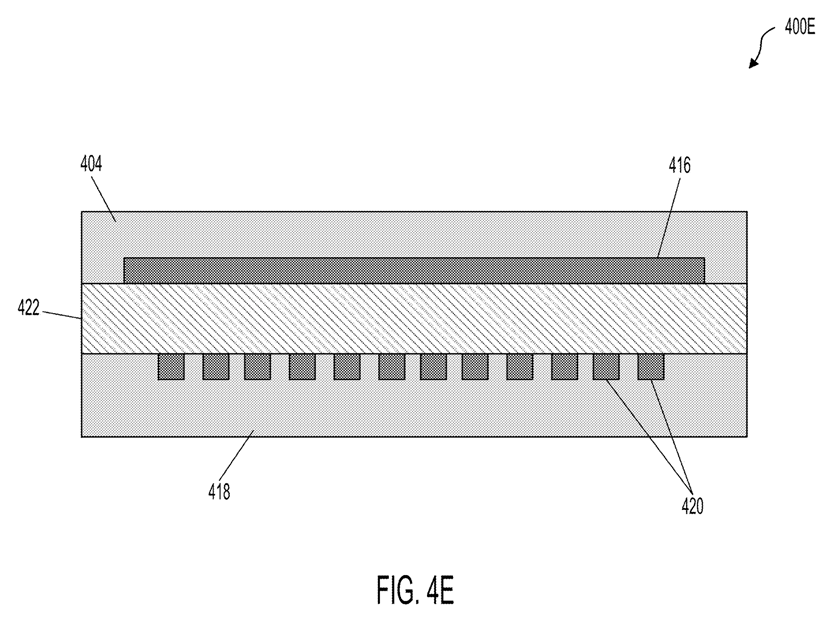
Tesla’s Patent Describes Two Tactile Sensor Manufacturing Methods
Tesla describes two manufacturing approaches for creating flexible tactile sensors on three-dimensional robotic surfaces.
The main difference is the order in which the sensing layers are built and shaped.
Method 1: Build the Tactile Sensor Flat, Then Shape It
In the first method, Tesla creates the conductive patterns on flat sheets of flexible material.
The sheets are joined with a separating layer between them. The complete sensor is then shaped to fit the required robotic surface.
The patent describes screen printing as one way to create the conductive patterns. It also describes thermoforming as an option for shaping the assembled sensor.
Thermoforming uses heat and a mold to give the material its final shape.
Why could this method be useful?
Manufacturers can print and assemble much of the sensor while the material is still flat.
This may allow them to use existing printing and assembly equipment before shaping the finished component.
However, heating and stretching the assembled sensor can affect the conductive patterns or the spacing between layers.
Those changes could influence the sensor’s electrical response.
Tesla does not provide test results showing how much the sensor’s performance changes after thermoforming.
For manufacturers, the question is whether the completed sensor can maintain consistent readings after it has been shaped.

Method 2: Shape the Sensor Base First, Then Add the Sensing Layers
Tesla’s second manufacturing method reverses the process.
The flexible base is first formed into the shape required for the robotic fingertip or another curved surface.
Conductive patterns are then added to this shaped material. The remaining sensing layers are assembled afterward.
The patent describes several possible methods for applying conductive materials, including pad printing and three-dimensional dispensing.
Pad printing uses a flexible printing pad to transfer conductive material onto a curved component.
Why could this method be useful?
The first conductive pattern does not need to undergo the main shaping process after it has been applied.
This may reduce some of the deformation that occurs when an assembled sensor is reshaped.
However, printing and assembling electrical layers on curved surfaces creates another challenge.
Conductive patterns must be applied accurately, and the layers need to align correctly.
Even small differences in these steps could affect the response of the completed sensor.
Tesla has not published production data showing how consistently this method can be repeated.

Which Tactile Sensor Manufacturing Method Could Work Better for Tesla?
Neither method can be considered better based on the information published in the patent.
Each approach has its own manufacturing challenges.
| Manufacturing factor | Flat-first method | Shape-first method |
| Starting material | Flat flexible sheets | Pre-shaped flexible base |
| Conductive patterns | Added before shaping | Added after shaping |
| Main advantage | Printing and assembly can happen on flat material | Conductive patterns follow the curved shape |
| Main challenge | Shaping may affect the assembled sensing layers | Printing and aligning layers on curved material |
| Important test | Electrical consistency after shaping | Accuracy and repeatability of curved-surface printing |
For Tesla, the better method would depend on the materials, shape of the robotic fingers, and equipment used during production.
A meaningful comparison would need to measure completed sensors rather than individual layers.
That includes checking whether sensors give similar readings after assembly, how they perform after repeated contact, and how much calibration they require.
Manufacturing time, production yield, and overall cost would also matter.
The patent describes possible methods but does not provide enough evidence to determine which one would be more suitable for large-scale production.
What Does Tesla’s Tactile Sensor Patent Actually Protect?
Tesla’s published application contains 20 claims, including three independent claims.
These cover two manufacturing processes and one type of sensor structure.
- Claim 1: Describes creating the conductive layers, assembling the sensor, and then forming the completed structure into a three-dimensional shape.
- Claim 10: Describes shaping the first substrate before adding its conductive patterns and assembling the remaining layers.
- Claim 19: Describes a sensor structure in which the assembled layers have been shaped through thermoforming.
The distinction matters for companies developing robotic tactile sensors.
Two sensors may appear similar from the outside but use different manufacturing processes.
For IP teams, understanding the manufacturing steps is therefore important when reviewing potential patent overlap.
It is also important to distinguish a published patent application from a granted patent.
Tesla’s application is not an issued US patent. Its claims may change during examination, and the final scope of protection is not yet established.
How Does Tesla’s Tactile Sensor Compare With Other Robotics Companies?
Tesla is not the only company developing tactile sensing technology for robotic hands.
Several companies already offer sensors that measure different types of contact information.
For example, XELA Robotics develops uSkin tactile sensors that measure normal and sideways forces. Some versions are designed to fit curved robotic fingertips.
GelSight uses an optical sensing approach. Its sensors capture detailed information about an object’s contact area using a deformable material and imaging system.
These technologies are designed around different sensing requirements.
XELA focuses on measuring forces at contact points, while GelSight can capture detailed contact geometry and surface information.
Tesla’s patent describes layered electrical sensors and manufacturing processes that allow them to fit curved surfaces.
This comparison does not establish that Tesla’s sensor performs better or worse than existing products.
The companies are using different sensing methods, and their production processes cannot be compared reliably from the information available in this patent.
For a broader view of the companies and technologies working in this field, explore our humanoid robotics patent landscape.
Could Tesla’s 3D Tactile Sensor Be Used in the Optimus Robot Hand?
Tesla has not confirmed whether this particular tactile sensor design is being used in Optimus.
However, the patent is relevant to the engineering requirements of humanoid robotic hands.
It describes sensor placement on fingers, palms, and other curved robotic parts.
There is also a connection between the manufacturing methods in the application and Tesla’s publicly advertised engineering work.
A Tesla recruitment listing for Optimus hand manufacturing describes work involving advanced tactile sensing hardware.
The role includes manufacturing processes such as thermoforming, dispensing, and lamination. These are closely related to the methods discussed in the patent.
This suggests Tesla is working on both the design and manufacture of tactile sensing hardware for robotic hands.
It does not confirm that the patented sensor has entered production or that the design appears in a particular Optimus model.
A sensor also needs to perform reliably after it has been installed.
For Optimus, that would mean maintaining useful readings while its fingers bend, grip objects, and experience repeated contact.
Production costs would involve more than the sensor materials. Manufacturers would also need to account for installation, testing, wiring, calibration, and replacement.
Tesla’s patent does not provide the data needed to assess those costs.
What Should We Watch Next in Tesla’s Robotic Tactile Sensing Technology?
Tesla has described two ways to manufacture flexible tactile sensors for curved robotic hands.
The next important development would be evidence that either process can produce reliable sensors consistently.
Three questions are worth following.
1. Can Tesla maintain consistent sensor readings across production batches?
Sensors made using the same process should respond consistently after shaping and installation. Large differences could increase calibration requirements.
2. How well do the sensors perform after repeated contact?
Robotic fingers experience repeated bending, compression, and friction. Long-term testing would help show whether the sensing layers remain reliable.
3. Can the manufacturing process support large-scale robot production?
Tesla would need to consider production time, assembly accuracy, testing requirements, and the number of usable sensors produced.
These measurements would help determine whether either manufacturing approach is practical beyond laboratory development.
Until then, Tesla’s 3D tactile sensor patent provides information about its proposed manufacturing methods, not proof of production readiness.
What Tesla’s Tactile Sensor Patent Tells Us About the Future of Robotic Hands
Tesla’s latest tactile sensor patent addresses a manufacturing problem that becomes important when robots need touch sensors across curved fingers and palms.
The company has described two ways to build these sensors.
One creates the complete sensing structure before shaping it. The other forms the base first and then adds the conductive layers.
Both approaches could help manufacturers produce flexible tactile sensors, but they introduce different production challenges.
For robotics companies, the important question is whether these sensors can be manufactured consistently and remain reliable after installation.
For patent and R&D teams, Tesla’s filing offers a useful view of the manufacturing methods being explored for robotic tactile sensing.
The next evidence to watch will be how these designs perform in completed robotic hands and whether the manufacturing processes can be repeated at scale.
Exploring Patents for Robotic Tactile Sensing?
A patent landscape can help identify companies working on tactile sensors, flexible electronics, robotic sensing materials, and manufacturing methods.
Whether you are studying humanoid robot hands, fingertip sensors, or competing tactile sensing technologies, GreyB can help you examine relevant patent activity and identify technical approaches worth investigating.
Fill out the form below to request a patent landscape for the technologies you want to study.
Request a Patent Landscape
