
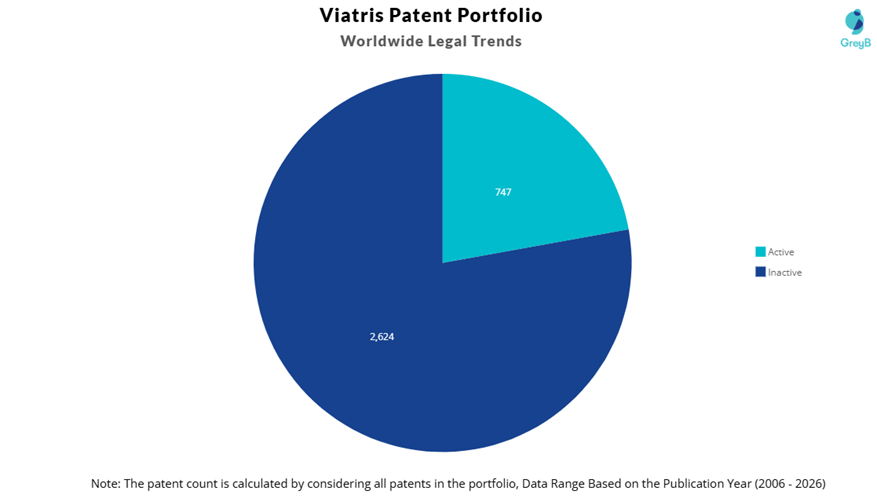
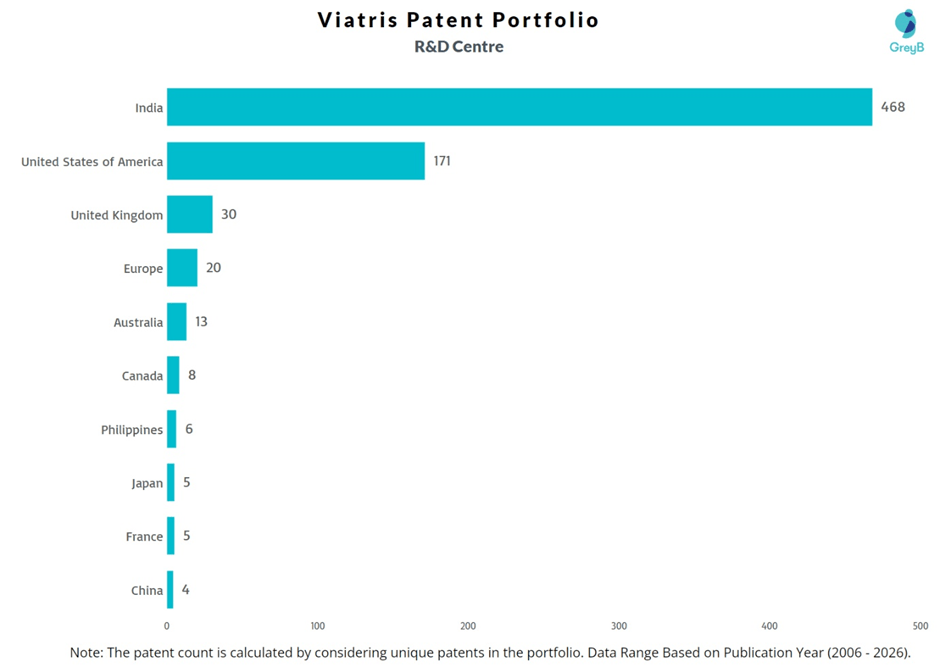
Viatris has a total of 3371 patents globally, out of which 1550 have been granted. Of these 3371 patents, 22.15% patents are active. India is where Viatris has filed the maximum number of patents, followed by United States of America and Europe (EPO). Parallelly, India seems to be the main focused R&D centre and also United States of America is the origin country of Viatris.
Founded in 2020 through the combination of Mylan and Upjohn, Viatris is a global healthcare company focused on developing, manufacturing, and commercializing medicines that improve patient access to healthcare.
The company offers a broad portfolio of branded, generic, and complex medicines across therapeutic areas, including cardiovascular disease, infectious diseases, and central nervous system disorders. Viatris leverages its global commercial and manufacturing capabilities to expand access to high-quality, affordable medicines and improve patient outcomes worldwide.
Do read about some of the most notable patents of Viatris covered in this article. You can also explore Viatris’ patent portfolio, worldwide patent filing activity, patent filing trends over the years, and many other statistics related to its patent portfolio.
How many patents does Viatris have?
Viatris has a total of 3371 patents globally. These patents belong to 753 unique patent families. Out of 3371 patents, 747 patents are active.
How Many Patents did Viatris File Every Year?

Are you wondering why there is a drop in patent filing for the last two years? It is because a patent application can take up to 18 months to get published. Certainly, it doesn’t suggest a decrease in the patent filing.
| Year of Patents Filing or Grant | Viatris Applications Filed | Viatris Patents Granted |
| 2026 | 12 | 24 |
| 2025 | 20 | 35 |
| 2024 | 74 | 52 |
| 2023 | 105 | 60 |
| 2022 | 128 | 30 |
| 2021 | 76 | 51 |
| 2020 | 65 | 109 |
| 2019 | 93 | 65 |
| 2018 | 83 | 92 |
| 2017 | 125 | 128 |
Viatris’ Patent Filing Strategy: A Legacy Portfolio Behind a Modern Healthcare Company
Although Viatris was formed in 2020, its patent footprint extends well before its formation, reflecting the legacy portfolios of Mylan and Upjohn. The company’s historical filing activity provides a broader view of how its intellectual property position has evolved through decades of pharmaceutical development, generic medicines, and complex drug products.
The earlier filing activity largely reflects the innovation and portfolio-building efforts of its predecessor businesses, while more recent filings represent Viatris’ evolving strategy following the 2020 combination. This makes Viatris’ patent portfolio particularly interesting: its filing trends capture both a legacy pharmaceutical portfolio and the company’s transition into a unified global healthcare business.
Analyzing these filings over time can reveal shifts in therapeutic focus, emerging areas of innovation, and how Viatris has continued to build and protect its pharmaceutical portfolio following the Mylan–Upjohn combination.
Viatris Patent Portfolio: From Core Pharmaceutical Chemistry to Broader Technology Platforms
Viatris’ patent portfolio shows a clear evolution from a historically chemistry-led innovation base toward a more diversified set of pharmaceutical and healthcare technologies. Earlier filings were concentrated around API synthesis, purification, solid-state forms and conventional formulation development.
In more recent years, these established capabilities remain active, but they are increasingly complemented by drug-delivery devices, complex therapeutics, gene-delivery technologies, impurity-control solutions and selected digital-health inventions.
| Period | Main technology focus | Family-level evidence | What the shift indicates |
| 2010–2014 | API process chemistry, polymorphs, salts, purification, and formulation engineering | 121 process/solid-state families and 50 formulation families | The portfolio was primarily built around improving how pharmaceutical molecules were manufactured, stabilized, and formulated. |
| 2015–2019 | Continued process chemistry with growing delivery-system and patient-facing technologies | 106 process/solid-state families; increasing presence of inhalation, medication-management, ocular, and device-related families | Innovation started expanding beyond the molecule itself toward how therapies are delivered and used. |
| 2020–2025 | More diversified mix including complex drugs, peptides, AAV gene delivery, respiratory devices, nitrosamine mitigation, and digital health | 44 process/solid-state families and 12 conventional formulation families, alongside newer technology clusters | Traditional pharmaceutical chemistry remains important, but it no longer dominates the recent portfolio to the same extent. |
The strongest quantitative signal is the declining share of conventional process chemistry within the classified portfolio. Process and solid-state technologies accounted for roughly 58% of families in 2010–2014 and around 65% in 2015–2019, but only about 39% in the 2020–2025 period. This does not indicate that Viatris has moved away from pharmaceutical chemistry. Recent filings still cover new synthetic routes, purification methods and solid forms. Instead, the evidence points to a broader innovation model in which these established competencies sit alongside newer technology platforms.
Two recent areas stand out in particular. First, multiple AAV-related patent families filed from around 2020 onward cover recombinant viral vectors encoding therapeutic proteins, including applications connected with ocular treatment. Their recurrence across several families makes gene delivery a meaningful emerging area rather than an isolated filing. Second, several families with 2023 priority dates focus on reducing nitrosamine formation in pharmaceutical products, showing concentrated activity around impurity-control and product-safety challenges.
Representative patents illustrate this progression. Earlier patents such as US8759515B2 focus on improved preparation of tenofovir disoproxil fumarate, reflecting the portfolio’s traditional strength in pharmaceutical process chemistry. Later inventions such as US20200001026A1 move into sensor-enabled inhalation devices, while US20240238375A1 and related families extend into AAV-based therapeutic delivery. More recent filings such as US20240269103A1 address nitrosamine suppression in oral pharmaceutical compositions.
Overall, the portfolio evidence supports a clear conclusion: Viatris’ patenting activity has evolved from a predominantly molecule- and manufacturing-focused estate into a broader technology portfolio spanning complex therapeutics, advanced delivery systems, gene-based technologies and formulation-safety solutions. The recent filings suggest diversification of technical capability rather than replacement of the company’s historical strengths.
Over 1,300 Viatris Patents Have Been Lost Through Non-Maintenance and Other Events
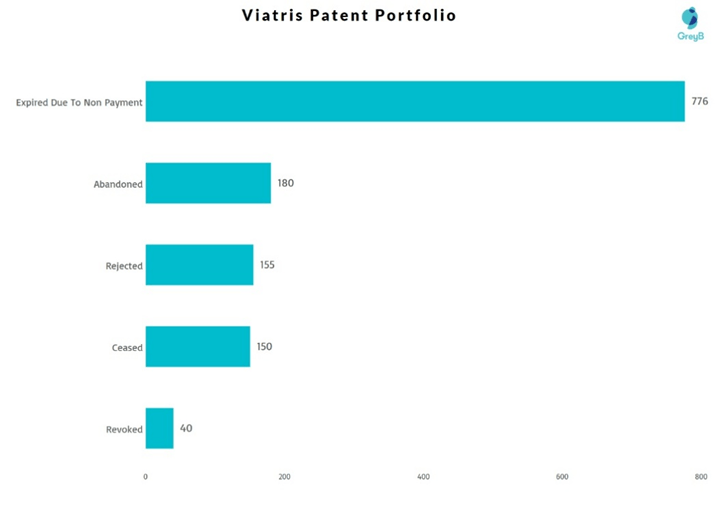
Viatris’ patent portfolio shows significant attrition over the past 20 years. Our analysis identified 1,301 patents that have expired or lost protection due to non-payment, abandonment, cessation, rejection, or revocation.
The largest share-776 patents (approximately 60%)-expired due to non-payment of maintenance fees, making non-maintenance the primary reason for patent loss. In addition, 180 patents were abandoned, 150 ceased, 155 were rejected, and 40 were revoked.
This pattern provides an interesting view of portfolio management, highlighting how a substantial number of patents have left the active portfolio for reasons beyond the normal end of patent term.
How many Viatris patents are Alive/Dead?
How Many Patents did Viatris File in Different Countries?

Top Countries in which Viatris Filed Patents
| Country | Patent |
| India | 482 |
| United States of America | 479 |
| Europe (EPO) | 304 |
| Canada | 202 |
| Australia | 200 |
| China | 146 |
| Japan | 145 |
| Germany | 84 |
| Austria | 79 |
| New Zealand | 76 |
| Hong Kong (S.A.R.) | 68 |
| Spain | 61 |
| Italy | 48 |
| Korea (South) | 44 |
| South Africa | 39 |
| Portugal | 38 |
| Brazil | 36 |
| Mexico | 34 |
| Poland | 34 |
| Israel | 31 |
| Denmark | 28 |
| Taiwan | 26 |
| Hungary | 26 |
| Singapore | 26 |
| Slovenia | 26 |
| United Kingdom | 22 |
| Slovakia | 19 |
| Estonia | 19 |
| Norway | 17 |
| Russia | 17 |
| Philippines | 15 |
| Cyprus | 14 |
| Malaysia | 11 |
| Turkey | 11 |
| Malta | 9 |
| Croatia | 9 |
| Argentina | 8 |
| Macao | 7 |
| France | 7 |
| Indonesia | 5 |
| Chile | 5 |
| Viet Nam | 5 |
| Switzerland | 4 |
| Africa | 4 |
| Eurasia | 3 |
| Finland | 2 |
| Serbia | 2 |
| Saudi Arabia | 2 |
| San Marino | 2 |
| Lithuania | 2 |
| Albania | 2 |
| Ukraine | 1 |
| Uruguay | 1 |
| Paraguay | 1 |
| Algeria | 1 |
| Pakistan | 1 |
| Jordan | 1 |
| Ecuador | 1 |
Track Every Patent Move in Real Time Across 70+ Jurisdictions with Elixir
Where are Research Centres of Viatris Patents Located?
10 Best Viatris Patents
US7449012B2 is the most popular patent in the Viatris portfolio. It has received 229 citations so far from companies like, Kriesel Marshall S and Antares Pharma, Inc.
Below is the list of 10 most cited patents of Viatris:
| Publication Number | Citation Count |
| US7449012B2 | 229 |
| US20120101475A1 | 192 |
| US7794432B2 | 161 |
| US8048035B2 | 129 |
| US20080226698A1 | 129 |
| US20140155827A1 | 107 |
| US20100137808A1 | 90 |
| US7682155B2 | 84 |
| WO2012147053A1 | 74 |
| US9566395B2 | 71 |
What Percentage of Viatris US Patent Applications Were Granted?
Viatris (Excluding its subsidiaries) has filed 171 patent applications at USPTO so far (Excluding Design and PCT applications). Out of these 152 have been granted leading to a grant rate of 92.12%
Below are the key stats of Viatris patent prosecution at the USPTO.

Which Law Firms are managing US Patents for Viatris?
| Law Firm | Total Applications | Success Rate |
| Venable | 27 | 56% |
| Cushman Darby & Cushman | 26 | 100.00% |
| Pillsbury Winthrop Shaw Pittman Llp | 24 | 87.50% |
| Hoxie & Associates Llc | 20 | 100.00% |
| Viatris (In House IP Dept) | 15 | 100.00% |
| Cushman Darby And Cushman | 6 | 90.00% |
| Mcdermott Will & Emery Llp | 6 | 100.00% |
| Crowell & Moring Llp | 5 | 80.00% |
| Sterne Kessler Goldstein & Fox | 5 | 100.00% |
| Anthony Niewyk | 4 | 100.00% |
Orange Book Portfolio Highlights a Near-Term Opportunity Around LYRICA CR
Viatris’ Orange Book-listed portfolio shows a clear difference in the patent protection timelines of its two key drugs. LYRICA CR, with an estimated annual revenue of $2.7 billion, is protected by three Orange Book-listed patents, with the latest patent expiring on November 2, 2026. Given the drug’s significant commercial value and approaching patent expiry, LYRICA CR represents a particularly important product to monitor for potential generic competition.
In contrast, TYRVAYA, with estimated annual revenue of $26.1 million, has a substantially longer protection horizon. Its 12 Orange Book-listed patents extend the latest patent expiry to October 19, 2035, providing a considerably longer period of patent protection.
This contrast highlights a key portfolio insight: LYRICA CR combines high commercial value with near-term patent expiry, while TYRVAYA has a lower revenue base but significantly longer patent protection. Monitoring these patent timelines can help identify potential generic-entry opportunities and competitive risks within Viatris’ portfolio.
| Drug Name | NDA | Est. Yearly Revenue | Orange Book Patents | Latest Patent Expiry |
| TYRVAYA | N213978 | $26.1M | US11224598B2 US10456396B2 US9597284B2 US9532944B2 US9504644B2 US11911380B2 US11903943B2 US11903941B2 US12576080B2 US12653824B2 US9504645B2 US11903942B2 | Oct 19, 2035 |
| LYRICA CR | N209501 | 2.7 billion | US10022447B2 US8945620B2 US9144559B2 | Nov 2, 2026 |
Opposition Activity Shows Where Competitive Pressure Was Highest
The opposition data suggests that competitors were selective about which patents they challenged. After removing duplicate records, we identified 18 distinct opposition proceedings across 11 European patents. More importantly, the activity was highly concentrated: just four patents attracted 11 of the 18 oppositions, or roughly 61% of all challenges.
| Patent | Distinct Oppositions | Signal |
| EP1904522 | 4 | Highest competitive scrutiny |
| EP2010158 | 3 | Multiple challengers targeted the same patent |
The challengers included established pharmaceutical players such as Hospira, Teva, Actavis, Servier and ratiopharm/BioGeneriX, indicating that these were not merely procedural challenges. Competitors appear to have focused their opposition efforts on patents with greater strategic or commercial significance.
This makes the opposition activity useful as another indicator of portfolio importance: the patents attracting repeated challenges were likely the ones competitors considered most important to contest.
From Patent Events to Actionable Signals
Viatris’ portfolio shows that patent value can change well before an expected expiry date. Maintenance-fee lapses, prosecution updates, oppositions, abandonments, and product-level patent changes can all alter the protection landscape.
For IP teams, the real challenge is connecting these events to the drug, patent family, technology, and competitor they affect.
Elixir helps turn scattered patent updates into connected intelligence, making it easier to track important changes, spot emerging risks, and understand where competitive pressure is building.
Track Every Patent Move in Real Time Across 70+ Jurisdictions with Elixir
What are Viatris key innovation segments?
What Technologies are Covered by Viatris?
The chart below distributes patents filed by Viatris