
EP4600159A1 reveals that the difficult problem was not reaching maximum speed, but sustaining stable, controllable, high-resolution filming around an entire race circuit.
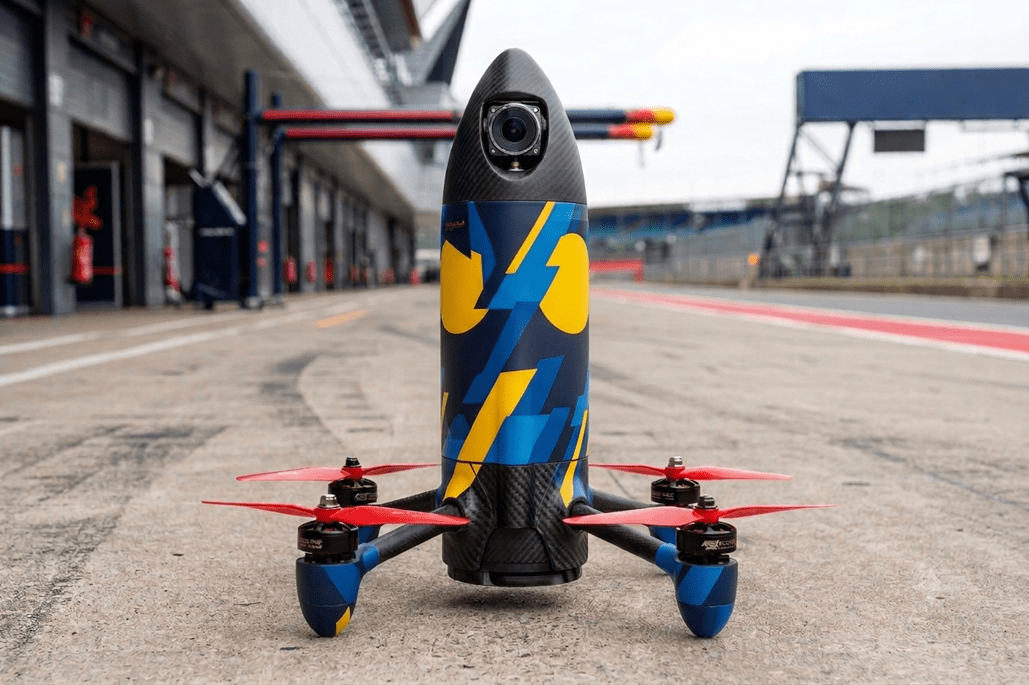
Source :AI Generated Image
Red Bull’s drone filing is not evidence that the company is turning into a conventional UAV manufacturer. It points to a more specific strategy: when existing filming systems could not capture Formula 1 speed in the way Red Bull wanted, the company helped build a new aircraft architecture and protected the configuration that made the shot possible.
The European patent application, EP4600159A1, describes a longitudinal FPV drone with dual cameras, a deliberately positioned center of gravity, forward-tilted rotor axes, thermal-management features, and a relay-drone communication system. Individually, these elements look like engineering details. Together, they form an operating architecture for sustained high-speed filming.
What it reveals: Red Bull did not try to patent speed in isolation. It sought protection for the architecture that makes extreme speed usable for cinematic filming.
Why This Matters: The Fastest Drone Is Not Necessarily the Best Filming Drone
A speed-record drone and a professional FPV filming drone are optimized for different outcomes. A record aircraft may only need to complete a short measured run at the highest possible velocity. A filming drone must accelerate, turn, brake, maintain a stable camera angle, transmit live video, manage heat, and remain controllable throughout the shot.
Red Bull Drone 1 was developed to follow Max Verstappen’s RB20 around Silverstone rather than merely post a straight-line speed figure. Red Bull reported that it reached 300 km/h in four seconds, exceeded 350 km/h, and tracked the car across a complete 5.8 km lap. That operational requirement explains why the patent is more interesting than the headline speed alone.
The strategic implication is straightforward: the differentiator is not the fastest possible quadcopter. It is a filming system capable of converting speed into stable, usable content.
How Red Bull Drone 1 Moved From Prototype to Public Reveal
Red Bull approached Dutch Drone Gods in early 2023. After approximately eight months of development, the team completed a private Silverstone test in September 2023 using the RB19 with Liam Lawson. Further refinement followed, with Red Bull Advanced Technologies contributing structural components such as glass-fiber canopies and carbon arms.
Development and IP timeline
| Date | Milestone |
| Early 2023 | Red Bull begins working with Dutch Drone Gods on a purpose-built high-speed filming drone. |
| September 2023 | A private Silverstone test tracks the RB19, giving the team a full-circuit validation run. |
| 12 February 2024 | Red Bull GmbH files the European patent application. |
| Mid-February 2024 | The final shoot pairs Drone 1 with Verstappen and the RB20 at Silverstone. |
| 27 February 2024 | Red Bull publicly releases the footage and project story. |
| 13 August 2025 | EP4600159A1 is published by the European Patent Office. |
The sequence matters from an IP perspective. Red Bull completed private development work, filed the application, and then publicly released the final footage. The filing was therefore coordinated with the media launch rather than added after the project gained attention.
The Red Bull Drone Patent Family at a Glance
| Published application | EP4600159A1 |
| Applicant | Red Bull GmbH |
| Filing date | 12 February 2024 |
| Publication date | 13 August 2025 |
| Inventors | Ralph Hogenbirk, Bas van ‘t Hul, and Thomas de Koster |
| Current status | Pending |
| Core claim focus | A longitudinal drone architecture with its center of gravity at or above the rotor-support plane and shifted toward the camera-side tip |
| Operational scope | A high-speed FPV filming system that can include the drone, pilot controls, goggles, and a relay drone |
This is a narrow filing signal rather than a broad drone portfolio. Its value comes from how closely the disclosed system aligns with a publicly demonstrated capability and from what the claim structure reveals about the part of the design Red Bull considered most defensible.
What EP4600159A1 Actually Protects
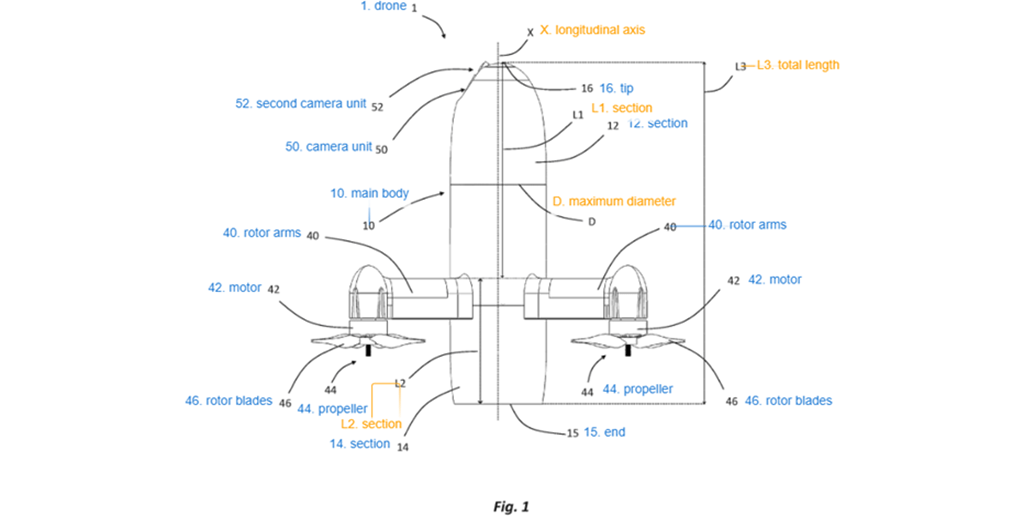
The application covers both the aircraft and a wider operating kit. The drone is built around a longitudinal main body that resembles a rocket or missile more than a conventional flat quadcopter. Two camera units sit close to the forward tip: a high-resolution digital camera for recording and a second analog camera for real-time FPV piloting.
Three or four rotor arms, typically four, connect near the transition between the upper and lower body sections. Each arm carries a motor and a two-blade propeller. The application also describes total length, arm length, weight, battery mass, material choices, cooling arrangements, and component packaging. But these are mostly supporting features.
The independent claim centers on the relationship between the longitudinal body, the rotor-support plane, and the center of gravity. That claim structure is strategically important because it identifies the core invention as a stability architecture rather than a generic claim to a fast drone.
Why the Center-of-Gravity Position Matters
At high forward speed, a multirotor must balance thrust, drag, pitch, and camera orientation. If the aircraft adopts an excessive nose-up posture, its frontal area increases, aerodynamic drag rises, and the recording angle becomes harder to control. That may be tolerable during a short burst, but it undermines sustained tracking around a circuit.
EP4600159A1 specifies that the drone’s center of gravity sits at or above the plane associated with the rotor support structure and is shifted toward the forward, camera-side tip rather than the tail. The application attributes improved high-speed stability to this arrangement.
Battery placement is central to that solution because the battery represents a large share of the aircraft’s mass. The disclosed battery module weighs between 350 and 600 grams within a total aircraft weight of roughly 750 to 1,500 grams. Positioning that mass is therefore not merely a packaging decision; it is part of the flight-control architecture.
So What?
The patent does not treat the battery, cameras, and airframe as separate subsystems. Their physical relationship is part of the claimed high-speed solution.
The Supporting Systems That Make Speed Usable
1. Rotor Geometry Keeps the Body in a More Efficient Flight Posture
In the preferred embodiment, the rotor axes are tilted slightly toward the camera side, at an angle of approximately 3 to 8 degrees. The application presents this as a way to counteract the aircraft’s tendency to pitch into an aerodynamically inefficient posture during high-speed flight.
The aim is not simply to produce more thrust. It is to keep the elongated body closer to the direction of travel, reduce the cross-sectional area exposed to the airflow, and preserve a usable camera angle while the drone accelerates and corners.

2. Camera and Thermal Integration Sustain Recording Performance
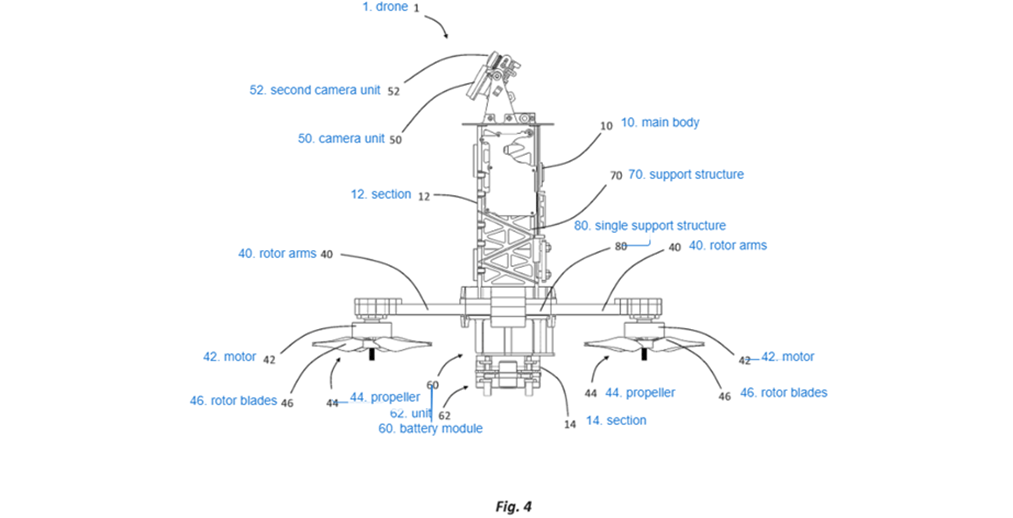
The aircraft separates the recording function from the piloting function. A high-resolution digital camera captures the final footage, while a second analog unit provides the low-latency FPV feed required by the pilot. This division prevents the filming requirement from being reduced to a standard racing-drone camera setup.
The application also gives unusual attention to heat dissipation. The recording-camera electronics sit next to a heat sink and cooling paste, while the electronic speed controller is positioned between additional heat sinks in the lower section. A carbon-fiber reinforcement layer around the controller is described as a way to reduce vibration.
These details show that sustained performance, rather than a brief peak-speed run, shaped the design. High-power electronics can throttle or fail if heat and vibration are not controlled throughout a complete filming sequence.
3. The Relay Drone Expands the Invention Beyond the Aircraft
EP4600159A1 also covers an operating kit that can include the high-speed drone, a pilot control unit, an FPV display, and a relay drone. The relay aircraft retransmits control signals and live video when distance, terrain, buildings, or line-of-sight limitations threaten the direct radio link.
That matters on a circuit such as Silverstone, where the filming drone may travel several kilometers and disappear behind trackside structures. By adding a relay layer, the filing moves beyond airframe design and into end-to-end production infrastructure.
From a competitive standpoint, this is one of the most important aspects of the application. The protected concept is not only a fast aircraft. It is a circuit-scale filming system designed around the practical limits of operating that aircraft.
Red Bull’s IP activity is not limited to drones. Its RB17 hypercar offers another example of how the company approaches protection differently across technologies. While the Drone 1 filing focuses on a specific high-speed filming architecture, the public IP record for the RB17 currently confirms a registered design covering the car’s appearance. Read our analysis of the Red Bull RB17 Hypercar to see what Red Bull has actually protected.
The Product and the Patent: How Closely Do They Align?
The public Red Bull Drone 1 demonstration and the disclosed patent architecture appear closely aligned. Both involve a rocket-shaped FPV aircraft, dual cameras, four rotor arms, high-speed operation, and a full-circuit filming objective. That makes the filing more than an abstract research concept.
Even so, the product and the application should not be treated as interchangeable. A patent family can describe alternative dimensions, materials, component arrangements, and optional embodiments that are not all present in a single prototype. The strongest conclusion is therefore that the public drone demonstrates the commercial relevance of the protected architecture, not that every dependent-claim feature was necessarily used in the final build.
This distinction strengthens the article rather than weakening it. It separates what Red Bull proved publicly from what it sought to reserve legally.
Why One Patent Family Still Matters Strategically
This analysis identified one published Red Bull drone patent family. That is not enough to establish a filing trend, and it does not resemble the portfolio-building behavior of a conventional UAV manufacturer.
But a single family can still carry strategic weight when it protects a system tied to a visible, differentiated capability. Here, the application connects mass distribution, airframe geometry, camera packaging, electronics cooling, operator control, and relay communication. The claims therefore sit around the operating architecture rather than one replaceable component.
This points to a content-company IP strategy applied to hardware. Red Bull appears to be protecting a proprietary production capability that helps create footage others may struggle to reproduce with standard equipment. The objective may be narrower than building a commercial drone business, but it is still strategically relevant.
The Team Combined FPV Piloting With Motorsport Engineering
The application names three Dutch inventors: Ralph Hogenbirk, Bas van ‘t Hul, and Thomas de Koster. Hogenbirk, known in the FPV community as Shaggy FPV, brought experience as both an elite pilot and a software engineer. That combination matters because high-speed filming demands continuous feedback between aircraft design, control behavior, and what the pilot can actually see through the live feed.
Dutch Drone Gods developed the housing, support structure, and thermal-management approach around a mixture of custom-built and supplier-sourced components. Red Bull Advanced Technologies supported the final engineering process and manufactured structural parts. The project therefore combined specialist FPV know-how with motorsport-grade engineering resources.
Who Should Pay Attention to This Filing?
FPV and Cinema-Drone Developers
The application shows that specialized filming requirements can create protectable system architectures beyond conventional gimbals, stabilization software, or camera mounts. Sustained speed changes the design problem across the entire aircraft.
Sports Broadcasters and Media-Production Teams
Red Bull demonstrates that proprietary hardware can become a source of content differentiation. When off-the-shelf systems cannot capture a desired shot, production organizations may become technology developers and patent applicants themselves.
Motorsport and Extreme-Sports Organizations
The drone connects engineering capability directly to audience experience. Similar operational challenges may arise wherever fast-moving subjects, long courses, and limited camera access make conventional filming difficult.
Drone Communication and Relay-System Developers
The relay-drone element broadens the relevance of the filing beyond aerodynamics. It highlights connectivity as an enabling layer for long-range or obstruction-heavy FPV operations.
IP and Competitive-Intelligence Teams
The filing is a reminder that strategically relevant UAV activity may come from media, sports, telecom, agriculture, or industrial companies rather than established drone manufacturers. Monitoring only conventional aerospace applicants would miss these entrants.
Strategic Implications for IP, R&D, and Business Teams
| Audience | Decision signal |
| IP teams | Monitor examination outcomes, claim amendments, family expansion, and follow-on filings rather than judging significance by portfolio size alone. |
| R&D teams | Optimize for sustained operational performance. Peak speed is only useful when stability, thermal endurance, control, and payload performance hold together. |
| Media teams | Treat proprietary hardware as a possible content advantage when standard production equipment cannot deliver a distinctive shot. |
| Drone companies | Expect specialist users to become co-developers or applicants when existing platforms fail to meet application-specific requirements. |
| Business teams | Separate the value of the hardware from the business model. Red Bull may gain strategic value from the system without ever selling the drone as a standalone product. |
Why This Is Worth Writing About Now
We cover the drone patent landscape as part of our broader research into UAV innovation across India, Europe, and the US. Our India drone patent analysis tracked 12,771 patent publications between 2015 and 2026, and one of the clearest findings is that drone innovation is no longer concentrated in aerospace companies. Communication firms like Qualcomm dominate the top inventor counts, agricultural platforms are driving application-specific filings, and defense counter-drone systems are one of the fastest-growing subcategories.
Red Bull fits into a different pattern: a company that sells energy drinks, built a highly specialized UAV for a very specific commercial purpose, protected it with a single focused patent, and then used the resulting footage as a media product.
That’s not a drone manufacturer’s IP strategy. It’s a content company’s IP strategy applied to hardware. Which brings you back to the traditional mindset: energy drink company or drone company? The patent says both are true, at least for now.
As we publish our Europe and US drone patent stats, the Red Bull filing is a useful reference point. It illustrates how patent activity in the drone space now includes players from motor sport, media, and extreme sports, not just UAV manufacturers or telecom giants. It also shows what a single, well-scoped patent looks like in a portfolio that has no prior drone activity.
For IP teams monitoring the competitive landscape, that’s worth tracking. A focused filing can protect an internal production tool while preserving options for licensing, collaboration or future technical expansion. In Red Bull’s case, the answer appears to be the former, at least for now.
Tracking the Next Non-Traditional Entrants in Drone IP
This analysis reflects information reviewed through August 2026. New family members, examination outcomes, and competitor filings can change the picture before products reach the market.
Request an updated European or US drone patent analysis to track emerging applicants, claim activity, and new UAV technologies.
The Real Signal Is Not That Red Bull Built a Fast Drone
Red Bull Drone 1 does not make Red Bull a conventional drone company. It shows that the boundary between media, motorsport, and aerospace engineering is becoming less distinct.
When existing camera systems could not deliver the footage Red Bull wanted, the company worked with specialist pilots and engineers to build a new aircraft architecture. The resulting application focuses not on speed alone, but on the structural and operational system that makes speed usable.
That is the non-obvious IP signal. Red Bull is not necessarily building a drone business. It is using hardware innovation and patent protection to strengthen a media-production capability that supports its broader sports and content ecosystem.

