
Modern drones are no longer defined by how well they fly they’re defined by what they can sense, understand, and accomplish.
For years, drone innovation was largely measured by improvements in flight time, payload capacity, and airframe design. Those capabilities remain important, but India’s patent landscape suggests they are no longer where the industry’s biggest competitive opportunities lie.
An analysis of 12,771 Indian drone-related patent publications, representing 11,627 patent families published between 2015 and 2026, reveals a noticeable shift in innovation priorities. While foundational technologies such as propulsion and structural engineering continue to evolve, a growing share of research is focused on autonomous navigation, artificial intelligence, communication networks, precision agriculture, power management, and defense systems.
This evolution reflects a broader transformation of drones from standalone aerial vehicles into intelligent, connected platforms capable of operating as part of larger digital ecosystems. Whether inspecting infrastructure, monitoring crops, supporting emergency response, or securing sensitive airspace, modern UAVs increasingly depend on software, sensing, wireless connectivity, and real-time decision-making as much as mechanical engineering.
The competitive landscape also tells an interesting story. Global technology companies dominate the largest patent portfolios, while Indian universities have emerged as important contributors to domestic innovation. At the same time, the growing presence of defense and counter-drone technologies indicates that national security requirements are becoming a significant driver of UAV research.
This article examines how India’s drone innovation landscape has evolved over the past decade, the technologies attracting the greatest R&D investment, who is shaping the competitive landscape, and what these trends signal for businesses, innovators, and IP professionals.
India’s Drone Patent Landscape at a Glance
The dataset analyzed comprises 12,771 patent publications corresponding to 11,627 patent families published between 2015 and 2026.
Rather than being concentrated around a handful of aerospace manufacturers, the portfolio reflects contributions from companies working across wireless communication, semiconductors, artificial intelligence, imaging, agriculture, robotics, and defense technologies. This multidisciplinary participation highlights how drones have become enabling platforms that combine advances from multiple technology domains.
The relatively small difference between patent publications and unique families also suggests that much of the innovation is represented by distinct inventions rather than repeated continuation filings. In other words, India’s UAV patent landscape is expanding through a broad pipeline of new ideas rather than incremental extensions of existing portfolios.

When Did India’s Drone Innovation Accelerate?
While drone-related patenting has been steadily increasing for more than a decade, the most significant acceleration occurred after 2021.
Patent publications grew gradually between 2015 and 2020, reflecting an industry that was still exploring commercial opportunities and refining core technologies. However, from 2021 onward, the trajectory changed noticeably, with annual publications rising sharply and reaching their highest level in 2025.
Although 2026 currently shows fewer publications, this should not be interpreted as declining innovation. Patent publications for the current year remain incomplete and will continue to increase as additional applications are published.
Several factors likely contributed to this acceleration. Rapid advances in AI and computer vision have made autonomous flight increasingly practical. Improvements in wireless communication and edge computing have expanded the capabilities of connected UAV systems. At the same time, India’s evolving drone regulations, increasing adoption across agriculture and infrastructure inspection, and growing defense requirements have created stronger commercial incentives for companies to protect drone-related innovations. Rather than representing a temporary surge, the filing trend suggests that UAV technologies have entered a broader commercialization phase where innovation is increasingly driven by practical deployment across multiple industries.
India’s Drone Industry Annual Patent Publications (2015–2026)
| Year of Patents Filing or Grant | India’s Drone Applications Filed | India’s Drone Patents Granted |
| 2026 | 1217 | 37 |
| 2025 | 2959 | 34 |
| 2024 | 2025 | 101 |
| 2023 | 1603 | 63 |
| 2022 | 1468 | 20 |
| 2021 | 950 | 2 |
| 2020 | 830 | 1 |
| 2019 | 750 | – |
| 2018 | 502 | 1 |
| 2017 | 281 | – |
| 2016 | 115 | – |
| 2015 | 71 | – |
Drone Innovation Is Expanding Beyond Flight
Technology distribution shows that drone innovation in India extends far beyond UAV engineering. While Unmanned Aerial Vehicles (2,418 families) remain the largest technology area, substantial patent activity also comes from Core Network & Data Processing (1,734 families), Precision Agriculture & Crop Health Monitoring (1,215 families), Optical Systems & Imaging Devices (758 families), and Network Access & Connectivity (587 families). This indicates that the industry’s focus is shifting from improving aircraft performance alone to building intelligent, connected, and application-specific drone platforms.
The presence of strong patent activity across artificial intelligence, robotics, semiconductors, urban infrastructure, and automotive technologies further highlights the convergence shaping the UAV ecosystem. Rather than evolving as a standalone aerospace industry, drones are increasingly integrating technologies from communication, computing, sensing, and automation, suggesting that future competitive advantage will depend on how effectively these capabilities are combined into real-world solutions rather than on flight hardware alone.

One of the clearest messages emerging from the patent landscape is that drones are no longer being developed primarily as aircraft. Increasingly, they are being designed as intelligent systems capable of perceiving their environment, communicating with other devices, making autonomous decisions, and supporting specialized operational tasks.
This shift becomes evident when examining the distribution of patent activity across technology domains.
The largest technology cluster, Navigation & Autonomous Control, accounts for 491 patent families, making it the most active area of innovation. Rather than improving flight performance alone, these inventions focus on enabling drones to operate with greater independence through autonomous route planning, intelligent flight control, obstacle avoidance, and precision positioning.
The second-largest category, Agriculture & Environmental Applications (351 families), highlights the growing role of drones as operational tools rather than general-purpose aerial platforms. Patent activity in this area spans precision spraying, crop monitoring, environmental assessment, agricultural robotics, and data-driven farm management reflecting the increasing demand for UAVs that improve productivity while reducing resource consumption.
Energy remains another important focus area. Power & Charging Systems, comprising 319 patent families, indicate continued efforts to overcome one of the industry’s most persistent engineering constraints: limited flight endurance. Battery technologies, charging infrastructure, and power optimization continue to receive substantial attention as companies seek to improve operational efficiency.
Core engineering technologies remain highly active as well. Propulsion & Flight Mechanics (255 families) and Airframe & Structural Design (237 families) demonstrate ongoing investment in improving flight stability, aerodynamic efficiency, structural reliability, and mechanical performance. However, unlike earlier generations of drone innovation, these technologies now represent only part of a much broader innovation ecosystem.
The growing importance of enabling technologies becomes even more apparent in areas such as Communication & Connectivity (210 families) and Sensing, Perception & Tracking (139 families). Modern UAVs increasingly function as connected devices that continuously exchange information, process environmental data, and coordinate with other systems in real time.
Although comparatively smaller, Swarm & Multi-UAV Coordination (87 families) also represents an important emerging capability. Coordinated fleets of autonomous drones have applications across logistics, infrastructure inspection, environmental monitoring, disaster response, and defense operations, making swarm intelligence an area likely to attract increasing research attention over the coming years.
Taken together, these technology themes reveal a broader transition within the UAV industry. Competitive differentiation is gradually moving away from mechanical flight performance toward intelligent software, autonomous operation, network connectivity, and domain-specific applications. In many cases, the value of a drone is now determined less by its ability to fly than by its ability to collect information, make decisions, and integrate seamlessly into larger digital workflows.
Leading UAV Technology Areas by Patent Families

Defense Is Emerging as the Next Strategic Frontier for UAV Innovation
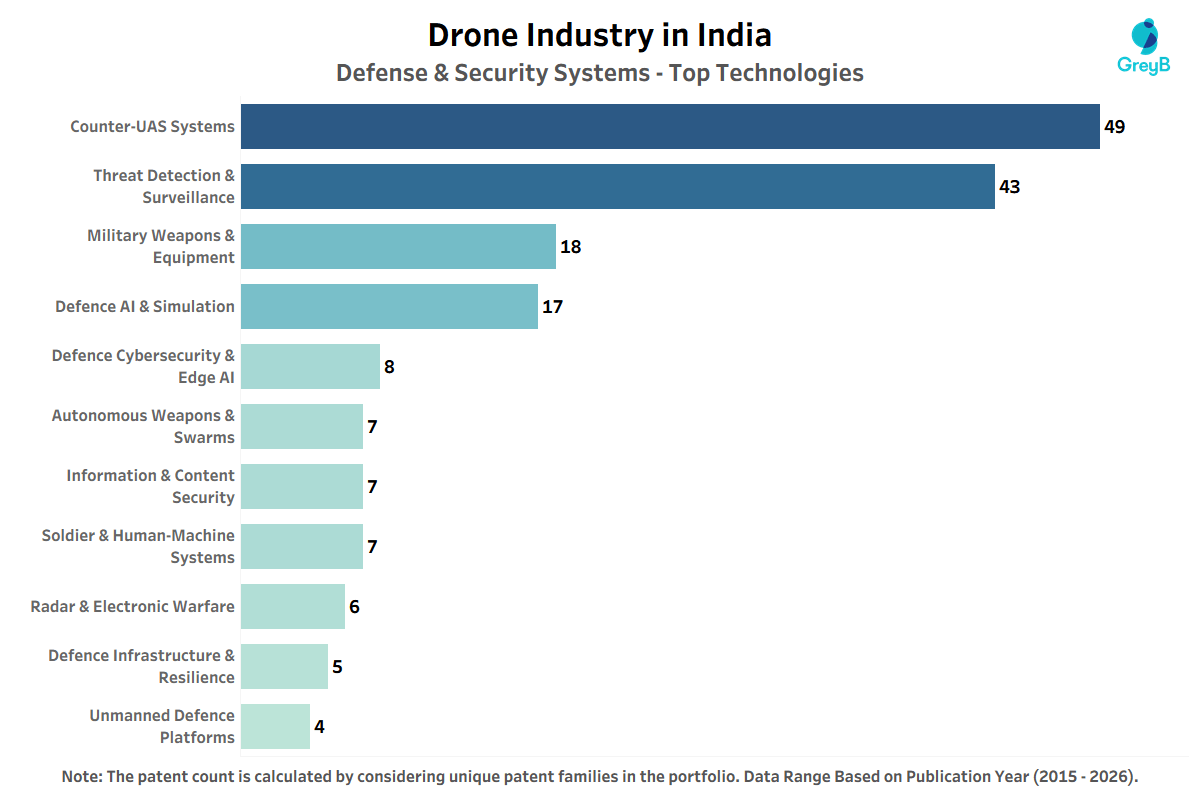
While agriculture remains one of the largest commercial application areas, the patent landscape indicates that defense and airspace security are rapidly becoming an equally important direction for drone innovation.
This shift is reflected not by one dominant technology but by a broad portfolio of innovations spanning counter-drone systems, threat detection, surveillance, military payloads, AI-assisted mission planning, cybersecurity, and electronic warfare. Collectively, these technologies suggest that protecting airspace is becoming as strategically important as deploying drones themselves.
Among the identified defense-related technologies, Counter-UAS Systems account for the largest number of patent families. As drones become more affordable and accessible, governments, defense organizations, and critical infrastructure operators face a growing challenge: detecting, identifying, tracking, and neutralizing unauthorized UAVs without disrupting legitimate aerial operations.
Unlike traditional air defense systems designed for large aircraft, counter-drone solutions require entirely different capabilities. Modern defense patents increasingly focus on radar-based detection, radio-frequency analysis, optical tracking, AI-driven threat classification, GPS-denial resilience, and electronic countermeasures capable of responding to small, agile, and often autonomous UAVs.
The second-largest technology cluster, Threat Detection & Surveillance, reflects another important transition. Rather than simply improving surveillance drones, innovators are developing integrated sensing systems capable of continuously monitoring airspace, recognizing anomalous flight behavior, and generating early warnings for operators. These technologies combine radar, cameras, acoustic sensors, thermal imaging, and artificial intelligence to improve situational awareness across military bases, airports, borders, and critical infrastructure.
Smaller but strategically significant clusters including Military Equipment & Payload Systems, Defense AI & Simulation, Electronic Warfare, and Secure Communication Systems highlight how defense agencies are increasingly viewing UAVs as networked platforms capable of supporting reconnaissance, logistics, tactical coordination, and autonomous mission execution.
Taken together, these trends indicate that India’s defense-related drone innovation is expanding from aircraft development toward complete airspace management ecosystems, where detection, decision-making, secure communication, and coordinated response are as important as the UAV platform itself.
Defense & Security Technology Distribution
Top Patent Companies in India’s Drone Landscape

The leading patent portfolios are dominated by multinational technology companies specializing in wireless communication, semiconductors, consumer electronics, and networking technologies.
The Companies landscape demonstrates that competitive advantage in UAVs is increasingly shifting toward enabling technologies such as communication, AI, sensing, and edge computing. Organizations entering the drone market must therefore consider competition beyond traditional UAV manufacturers.
Top Foreign Companies Vs Top Indian Companies Patent Filing Comparison in Drone Industry Innovation
Another notable pattern emerges when comparing foreign and domestic Companies.
Foreign companies account for a substantial share of patent activity, with portfolios primarily focused on enabling technologies that can be deployed across multiple industries and geographies. Their inventions frequently relate to communication protocols, semiconductor architectures, navigation systems, imaging technologies, and autonomous computing platforms technologies that support not only drones but also broader connected-device ecosystems.
Domestic organizations, by contrast, show stronger activity in application-oriented innovation. Their patent portfolios are more closely aligned with solving local operational challenges across agriculture, infrastructure inspection, environmental monitoring, public safety, and industrial automation. Rather than competing directly with global semiconductor or communication leaders, many Indian innovators appear to be adapting UAV technologies to address market-specific needs.
This distinction is particularly important from an R&D perspective. It suggests that India’s drone ecosystem is developing complementary strengths rather than replicating global technology portfolios. While multinational corporations continue to build foundational technologies, domestic innovators are creating solutions tailored to regional industries and deployment environments.
For startups and emerging companies, this also highlights an important strategic consideration. Competing directly with established global technology providers in areas such as wireless communication or semiconductor design may require significant resources. However, opportunities remain substantial in domain-specific applications where local knowledge, operational expertise, and integration capabilities provide stronger competitive advantages.
Indian Companies Patents in Drone Industry
| Company | Patents |
| TCS | 76 |
| Greinventek Private Ltd | 48 |
| Ideaforge Technology Limited | 29 |
| Sooryauday Aerial Vehicles | 20 |
| Bharat Electronics | 16 |
| Aarav Unmanned Systems Private Ltd | 14 |
| Droame Llp | 12 |
| Bluest Mettle Solutions | 11 |
| Wipro | 11 |
| L&T | 11 |
| Tata Elxsi Ltd | 11 |
| Raphe Mphibr Private Limited | 10 |
| New Horizon Medical Technologies Private Ltd | 9 |
| Garuda Aerospace | 9 |
| Insidefpv Ventures Private Ltd | 8 |
| Lekha Wireless Solutions Private Limited | 8 |
| Steradian Semiconductors Private Limited | 8 |
| Zen Technologies | 8 |
| Hindustan Aeronautics | 7 |
| Jio Platforms | 7 |
| Unmixed Technoworld Private Limited | 7 |
| Vector Technics Private Limited | 6 |
| Mesbro Technologies Private Limited | 6 |
| Quidich Innovation Labs | 4 |
| Sunmint Energy | 3 |
| Roter Precision Instruments | 3 |
| Octobotics Tech | 2 |
| Dronelab Technologies | 2 |
| Flo Mobility | 2 |
Instead, the largest patent portfolios belong to companies such as Qualcomm, Samsung, InterDigital, Nokia, and Huawei.
Foreign Companies Patents in Drone Industry
| Company | Patents |
| Qualcomm Inc | 1460 |
| Samsung | 580 |
| InterDigital | 236 |
| Nokia | 169 |
| Huawei | 126 |
| Largan Precision Co Ltd | 118 |
| LG Electronics | 87 |
| 86 | |
| Ericsson | 80 |
| Xiaomi Inc | 76 |
| Sony Corporation | 62 |
| Stradvision Inc | 60 |
| Walmart Apollo Llc | 46 |
| Wing Aviation Llc | 45 |
| Philips | 44 |
| Amperex Technology Limited | 44 |
| Apple | 35 |
| Panasonic | 35 |
| Microsoft | 29 |
| Idac Holdings Inc | 28 |
| Intel | 28 |
| Nec Corporation | 24 |
| Israel Aerospace Industries Ltd | 23 |
| Lenovo | 22 |
| Guangzhou Xaircraft Technology Co Ltd | 22 |
| Universal City Studios Llc | 22 |
| Honda Motor | 18 |
At first glance, this appears counterintuitive. These organizations are not known primarily for manufacturing drones. However, the patent data reveals a broader reality: modern UAVs increasingly depend on technologies traditionally associated with smartphones, telecommunications, and connected devices.
Today’s drones continuously exchange information with remote operators, edge devices, cloud platforms, and other UAVs. They rely on high-performance processors for onboard AI, advanced wireless communication for real-time data transmission, GNSS technologies for positioning, and computer vision hardware for autonomous navigation. As a result, many of the enabling technologies that define next-generation drones originate outside the conventional aerospace industry.
Qualcomm’s leadership illustrates this trend particularly well. Its portfolio spans wireless communication, edge computing, AI acceleration, navigation, and semiconductor technologies that enable autonomous UAV operation rather than focusing solely on aircraft hardware. Similarly, companies such as Samsung and InterDigital contribute innovations in communication protocols, imaging, networking, and device integration that support increasingly intelligent aerial platforms.
This convergence also explains why communication technologies represent one of the largest technology clusters identified in the patent landscape. As drones become connected nodes within broader digital ecosystems including smart cities, industrial IoT networks, precision agriculture platforms, and defense infrastructure the underlying communication architecture becomes a critical source of competitive advantage.
In other words, the companies shaping the future of drones are not necessarily those building the aircraft they are increasingly those developing the technologies that allow drones to communicate, process information, and operate autonomously.
Key Inventors of India’s Drone Industry Innovation
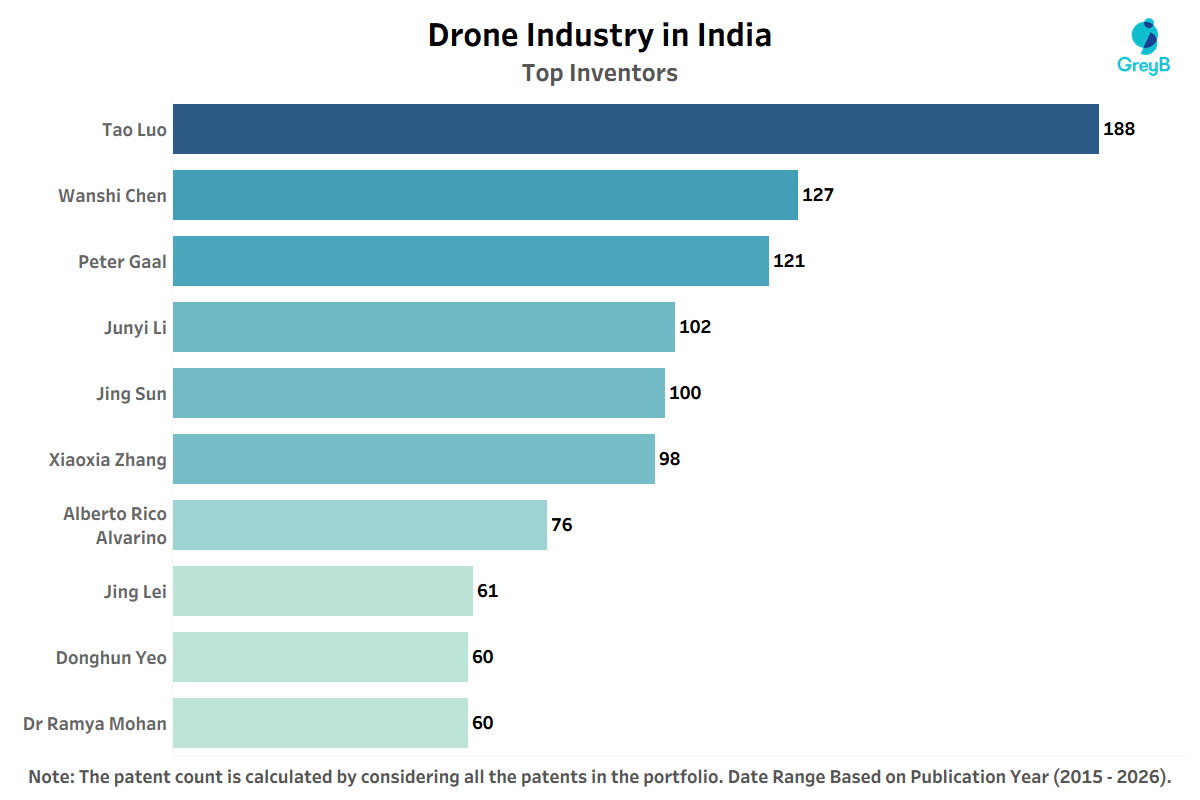
Patent data reveals that drone-related innovation in India’s patent filings is currently dominated by a small group of inventors, with Tao Luo alone accounting for 188 patents significantly ahead of the rest of the field. Interestingly, several of the top contributors are inventors traditionally linked to wireless/telecom patent portfolios, hinting that much of the ‘drone patent’ activity may be driven by underlying connectivity and communication technologies rather than drone-specific hardware or flight systems.”
One caveat worth adding as a footnote in your piece: since the chart counts all patents in an inventor’s portfolio (per the note at the bottom), high numbers may include patents only tangentially related to drones you may want to verify a few of these names before presenting them as “drone specialists” to avoid overstating their focus on the sector.
Leading Inventors and Their Associated Organizations
| Inventor | Patents | Foreign/ Domestic | Currently Associated |
| Tao Luo | 188 | Foreign | Qualcomm |
| Wanshi Chen | 127 | Foreign | Qualcomm |
| Peter Gaal | 121 | Foreign | Qualcomm |
| Junyi Li | 102 | Foreign | Qualcomm |
| Jing Sun | 100 | Foreign | Qualcomm |
| Xiaoxia Zhang | 98 | Foreign | Qualcomm |
| Alberto Rico Alvarino | 76 | Foreign | Qualcomm |
| Jing Lei | 61 | Foreign | Qualcomm |
| Hak-Kyoung Kim | 60 | Foreign | Stradvision |
| Hongmo Je | 60 | Foreign | Stradvision |
| Sukhoon Boo | 60 | Foreign | Stradvision |
| Wooju Ryu | 60 | Foreign | Stradvision |
| Myungchul Sung | 60 | Foreign | Stradvision |
| Yongjoong Kim | 60 | Foreign | Stradvision |
| Donghun Yeo | 60 | Foreign | Stradvision |
| Sony Akkarakaran | 60 | Domestic | Qualcomm |
| Dr Ramya Mohan | 60 | Domestic | SIMATS |
| Taewoong Jang | 60 | Foreign | Stradvision |
| Kye-Hyeon Kim | 60 | Foreign | Stradvision |
| Woonhyun Nam | 60 | Foreign | Stradvision |
| Kyungjoong Jeong | 60 | Foreign | Stradvision |
| Hojin Cho | 60 | Foreign | Stradvision |
| Huilin Xu | 51 | Foreign | Qualcomm |
| Kapil Gulati | 49 | Domestic | Qualcomm |
Leading Indian Academic Institutions in Drone Innovation

Indian universities contribute a significant portion of domestic UAV patent activity, reflecting strong academic involvement across multiple technology areas.
The university ecosystem indicates that India’s long-term competitiveness in UAV technologies will depend not only on commercial investment but also on effective collaboration between academia, startups, and industry.
Representative Patents Reveal Where UAV Innovation Is Headed
Technology distributions provide a high-level view of innovation priorities, but individual patents offer a clearer picture of how those priorities are being translated into practical solutions.
Across the analyzed portfolio, several recurring themes emerge.
One group of patents focuses on autonomous navigation and obstacle avoidance, enabling UAVs to safely operate in dynamic environments with minimal human intervention. These inventions integrate computer vision, sensor fusion, and intelligent flight planning to improve reliability in infrastructure inspection, urban operations, and logistics.
Another major theme centers on precision agriculture, where drones are being designed to monitor crop health, optimize spraying operations, detect plant stress, and improve resource utilization through AI-driven analytics. Rather than functioning simply as aerial imaging platforms, these systems increasingly support real-time agronomic decision-making.
The portfolio also contains numerous innovations related to communication and connectivity, reflecting the growing importance of reliable wireless links for autonomous operations. As UAV deployments expand beyond visual line of sight and collaborative fleet operations become more common, robust communication infrastructure becomes fundamental to safe and efficient drone deployment.
Energy management represents another persistent innovation challenge. Multiple patents address battery optimization, charging systems, and power management techniques aimed at extending flight endurance and reducing operational downtime. These technologies remain critical because battery limitations continue to constrain commercial UAV deployment across long-duration missions.
Meanwhile, defense-related patents increasingly focus on counter-drone detection, secure communication, threat assessment, and electronic protection, indicating that airspace security is becoming an important parallel innovation stream alongside UAV development itself.
Viewed together, these patents illustrate a common direction: innovation is moving away from isolated hardware improvements toward integrated systems capable of sensing, communicating, learning, and making autonomous decisions in complex operating environments.
What the Patent Landscape Means for Businesses
Patent landscapes are valuable not because they show who has filed the most patents, but because they reveal where technology, competition, and market opportunities are heading.
The findings from India’s drone ecosystem suggest several strategic implications.
For IP Teams
The convergence of AI, communication technologies, sensing, and UAV platforms means that competitive intelligence should extend beyond traditional drone manufacturers. Organizations evaluating freedom-to-operate or identifying licensing opportunities must increasingly monitor semiconductor companies, wireless communication providers, imaging specialists, and AI developers alongside aerospace players.
The growing number of application-focused patents also highlights opportunities to identify technology white spaces within agriculture, infrastructure inspection, logistics, and environmental monitoring before these segments become more competitive.
For R&D Leaders
Future differentiation is unlikely to come solely from improving flight performance. Autonomous intelligence, edge AI, communication resilience, sensor integration, and energy optimization are emerging as the technologies that will define next-generation UAV platforms.
Organizations planning future R&D investments should therefore consider complete operational ecosystems rather than individual drone components.
For Startups
The patent landscape suggests that competing directly with global technology leaders in foundational communication or semiconductor technologies may be challenging. However, significant opportunities remain in developing specialized solutions tailored to industry-specific problems.
Agriculture, infrastructure inspection, disaster management, mining, renewable energy, and public safety continue to offer attractive opportunities for application-driven innovation where domain expertise provides a stronger competitive advantage than scale alone.
For Investors
The diversity of patent activity indicates that India’s UAV industry is no longer a niche aviation sector. It increasingly overlaps with artificial intelligence, telecommunications, industrial automation, robotics, and digital infrastructure.
Companies developing enabling technologies rather than standalone drone hardware may therefore represent attractive long-term investment opportunities as drones become integral components of broader digital ecosystems.
Looking Beyond India: Where Is Asia’s Drone Industry Heading?
India’s patent landscape provides valuable insight into the country’s evolving UAV ecosystem, but it represents only one part of a much larger regional transformation. Across Asia, governments and technology companies are investing heavily in autonomous aviation, AI-powered surveillance, precision agriculture, drone logistics, urban air mobility, and next-generation defense systems. As these investments continue, competition is increasingly being shaped at the regional rather than national level.
Comparing India’s innovation trajectory with countries such as China, Japan, South Korea, Singapore, and Taiwan can reveal where technology leadership is emerging, which companies are expanding across multiple markets, and which innovation areas remain underexplored. Understanding these regional trends is becoming increasingly important for organizations planning patent strategies, evaluating partnerships, identifying licensing opportunities, or prioritizing future R&D investments.
India’s drone patent landscape tells a story that extends far beyond aviation.
Analysis of 12,771 patent publications and 11,627 patent families shows that innovation is increasingly concentrated around technologies that make drones more autonomous, connected, intelligent, and application-aware. Navigation systems, AI-enabled decision-making, communication networks, sensing technologies, precision agriculture, and defense applications are becoming central to the industry’s evolution, while traditional aircraft engineering represents only one part of a much broader innovation ecosystem.
The competitive landscape reinforces this transformation. Multinational technology companies dominate foundational enabling technologies, Indian universities are strengthening the domestic research pipeline, and application-focused innovators are adapting UAV capabilities to address local industry needs. Together, these trends indicate that the future of India’s drone ecosystem will be shaped not by a single type of organization, but by collaboration across technology providers, academic institutions, startups, and established enterprises.
Perhaps the most important insight is that the industry’s competitive advantage is no longer determined solely by who builds the best drone. It is increasingly determined by who builds the technologies that allow drones to communicate, perceive, decide, and operate as part of larger intelligent systems. As UAVs become integrated into agriculture, infrastructure, logistics, public safety, and defense, those enabling technologies are likely to define the next generation of innovation in India’s drone industry.
Request the Latest Drone Patent Intelligence
This analysis is based on drone-related patent publications available between 2015 and 2026. Patent activity continues to evolve as new applications are published and emerging technologies reshape the UAV ecosystem.
Looking for the latest competitor activity, technology white spaces, filing trends, or customized drone patent intelligence? Contact our team to access an updated patent landscape tailored to your technology or market of interest.


