
Ford’s filing US20250104469A1 is not primarily about replacing a car key with a face or fingerprint.
It describes a vehicle-centered biometric monitoring system that can capture information from people in or around a vehicle, compare it against biometric data associated with a security event, and change how the result is communicated depending on whether a match is found.
That makes the key idea less about recognition alone and more about what happens after recognition: who receives the result, where it is displayed, and how much information is exposed.
Most consumer discussions around vehicle biometrics focus on convenience. A car recognizes the driver, unlocks the door, loads a seat profile, or replaces a physical key.
Ford’s application points to a different use case.
The filing describes situations in which a person near the vehicle could be compared against a defined security-event cohort, including examples associated with an active warrant or a missing-person report.
The vehicle therefore becomes more than a camera-equipped object. It becomes part of an identity-monitoring system that combines sensing, comparison, privacy-controlled disclosure, and potentially human review.
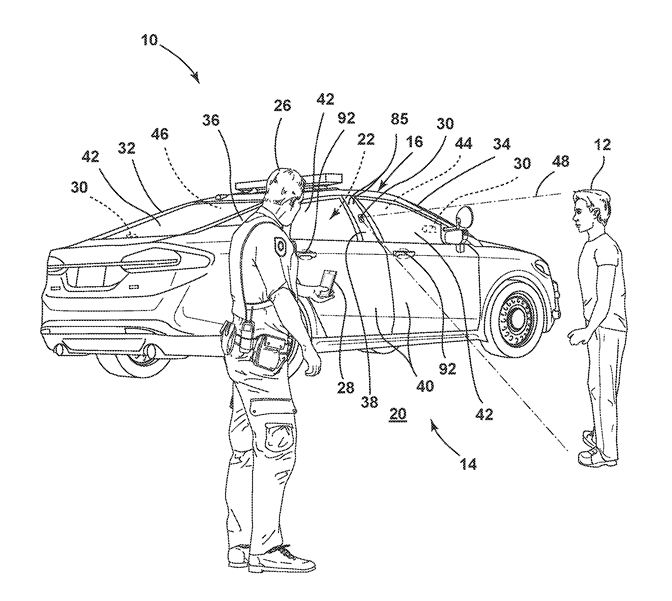
Why Is Vehicle Biometric Identification Different From Face Unlock?
A smartphone normally identifies someone who intentionally presents a face or fingerprint to the device.
A vehicle operates in a less controlled environment.
People can approach from different directions, stand at different distances, move in and out of camera views, touch a door handle, speak, enter the cabin, or simply stand nearby without attempting to authenticate.
Ford’s filing is built around that broader environment.
The system can capture biometric information from a participant in or around the vehicle and compare it with biometric data associated with a security-event cohort.
That changes the technical problem.
The vehicle does not simply need to recognize a face.
The system must determine:
- when biometric scanning should begin;
- which sensor should be used;
- where comparison should occur;
- what to do if a possible match is found;
- who should receive the result;
- how much information should be disclosed.
That last point is central to the filing.
The system is designed not only to identify someone, but also to control how identity-related information is communicated.
How Does Ford’s Biometric Vehicle Monitoring System Work?
At a high level, the patent describes a five-step loop.
1. Capture
A biometric sensor captures information from a person in the vehicle environment.
2. Compare
Control circuitry compares that information against biometric data associated with a security-event cohort.
3. Determine the Result
The system determines whether the captured information produces one or more matches.
4. Select a Privacy Mode
The result is used to choose between two privacy modes.
5. Communicate Selectively
An indication of the result is then presented through the channel associated with the selected privacy mode.
The important control point is step four.
The system does not simply return an identity result. It uses that result to determine how the information itself should be handled.
That result-dependent disclosure logic is what separates the filing from a conventional biometric authentication workflow.
Ford’s Architecture Uses More Than One Biometric Input
The filing does not limit identification to facial recognition.
Its examples include facial features extracted from camera images, fingerprint scanning, iris scanning, and audio that can be processed alongside biometric information.
That flexibility makes sense in a vehicle environment.
A camera may work well under one set of conditions and poorly under another. Lighting, distance, weather, head angle, movement, background noise, and occlusion can all affect capture quality.
The filing also contemplates both exterior and interior sensing locations, allowing the wider system to monitor someone approaching the vehicle, standing near a door, or already inside the cabin.
But the publication does not establish how these different biometric inputs would be fused, weighted, or prioritized.
It provides a flexible architecture and multiple sensing options. It does not provide comparative performance data showing which biometric method works best in real automotive conditions.
That distinction matters because listing several sensors is not the same as demonstrating a reliable multimodal biometric system.

The Core Differentiator Is Not Recognition – It Is Result-Dependent Disclosure
The two privacy modes are the most strategically interesting part of Ford’s filing.
The claimed logic connects the biometric result directly to how information is communicated.
| System outcome | Privacy handling described in the filing |
| Match found | The system can select a first privacy mode and communicate the result through a channel such as an administrator’s mobile device |
| No match | The system can select a second privacy mode and present the result through a different channel, including an in-vehicle display |
This matters because biometric systems create at least two separate risks.
The first is identification risk: the system may identify the wrong person.
The second is disclosure risk: even a correct result may be shown to the wrong audience.
Ford’s filing directly addresses the second problem by making the communication path depend on the result.
That is a more subtle idea than simply adding face recognition to a car.
The system is effectively deciding not just who someone might be, but also who should be allowed to see that information.
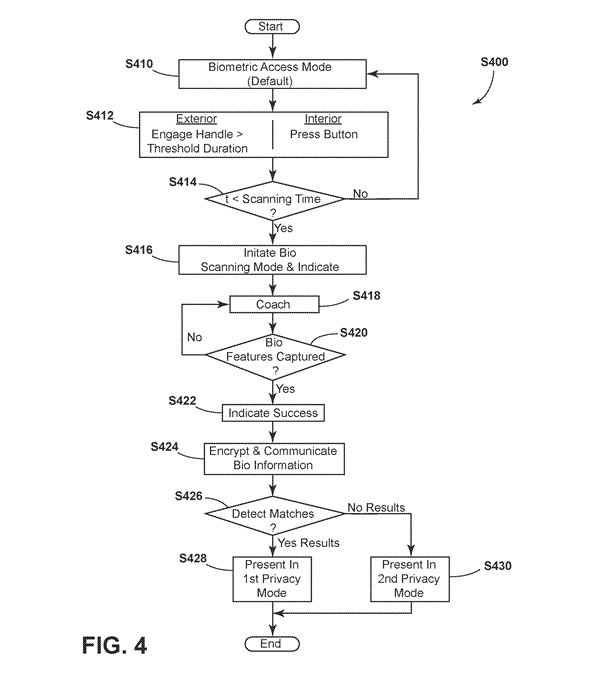
How Can the Biometric Scan Be Triggered?
Ford does not require the vehicle to scan continuously in every embodiment.
One disclosed trigger is interaction with a vehicle door handle.
A sensor associated with the handle can detect engagement and initiate biometric capture.
The description also discusses a threshold duration, such as holding or pressing the handle long enough to activate the biometric mode, although the specific timing is presented only as an example.
Other initiation methods can include interaction with the vehicle’s HMI or a mobile device.
This is important because the trigger determines when a vehicle moves from ordinary sensing into identity-related processing.
Continuous biometric surveillance and event-triggered biometric capture create very different technical, privacy, and regulatory questions.
The filing leaves room for the latter.
What Happens When the System Finds a Possible Match?
The patent’s example interface shows search results containing identity-related information such as a name, date of birth, and records.
The filing also contemplates situations in which more than one candidate match is returned.
Results may therefore need to be ranked or narrowed using additional information, including audio or other identification inputs.
That is significant because real-world biometric comparison is rarely as simple as:
match / no match.
A system may produce several candidates with different confidence levels.
The practical question then becomes what happens when the system is not confident enough to make a definitive decision.
Ford’s disclosure appears to leave room for a workflow in which vehicle-side sensing and remote or administrator-side review work together.
That suggests the system is not necessarily assuming that every identity decision should be fully automated.
For a production system, confidence handling would be critical.
Low-confidence results would need to be treated differently from high-confidence ones, particularly if a result could influence security decisions or downstream actions.

Privacy Mode Does Not Solve Every Privacy Problem
Ford’s privacy-mode logic controls how a result can be disclosed.
But disclosure is only one layer of biometric privacy.
A commercial implementation would also need to answer questions such as:
- What biometric information is retained?
- Is a face image stored, or only an extracted biometric template?
- Does matching occur locally in the vehicle or on a remote server?
- How long is captured data retained?
- Who can access it?
- How is it encrypted during transmission?
- When is it deleted?
The filing includes local vehicle components, network communication, and remote-server architectures.
It does not establish a complete commercial framework for data retention, deletion, or access control.
That difference is important.
Privacy-aware result routing and privacy-preserving biometric processing are related, but they are not the same thing.
A system could carefully control who sees a match while still creating significant privacy concerns around how the underlying biometric data is collected, processed, and stored.
The Vehicle Could Become a Distributed Identity-Sensing Platform
The broader architecture is also worth noting.
Ford does not describe a single camera performing one identification task.
The filing shows a system that can include:
- exterior cameras;
- interior cameras;
- fingerprint scanners;
- iris scanners;
- microphones;
- touch sensors;
- vehicle controls;
- an HMI;
- a mobile device;
- remote server communication.
That moves the concept beyond a dedicated biometric reader.
The vehicle itself becomes the sensing environment.
This is a strategic shift because modern vehicles already contain many of the building blocks required for contextual sensing: cameras, microphones, connectivity, interior displays, exterior sensors, and increasingly powerful compute systems.
The competitive question may therefore become less about adding new sensors and more about deciding how existing sensors are coordinated, what they are permitted to infer, and where the resulting information is allowed to go.
What Does the Patent Actually Establish?
The application protects variations of the same core workflow across different system architectures.
At a simplified level, the common logic is:
capture biometric information → compare it against a security-event cohort → determine whether a match exists → select a privacy mode → communicate the result through the corresponding channel.
Some implementations use remote-server communication for biometric comparison, while others add more specific security-event contexts.
Because this is a published patent application rather than a granted U.S. patent, the current claim language should not be treated as final enforceable scope.
Claims can be amended, narrowed, rejected, allowed in modified form, or divided during prosecution.
For IP teams, the more important question is therefore not only what the filing currently says, but which parts of this architecture Ford continues to protect as prosecution develops.
Could This Become a Production Ford Feature?
The filing alone does not establish that Ford intends to deploy this exact system in a production vehicle.
It does not identify a specific vehicle model, launch date, commercial program, field test, or production performance target.
It also does not provide real-world data for:
- false-match rates;
- false-rejection rates;
- spoof resistance;
- identification latency;
- low-light performance;
- legal compliance;
- user consent.
Those missing pieces matter because biometric performance in a controlled environment can look very different from performance around a vehicle exposed to changing weather, lighting, distance, and movement.
What the filing does establish is that Ford engineers have considered an architecture in which vehicle sensors, control circuitry, remote systems, and privacy-aware result routing are connected into one biometric monitoring workflow.
That makes the patent strategically relevant even if the exact system never reaches production.
What Should IP, R&D, and Security Teams Watch Next?
For IP Teams
The most important signal will be whether the result-dependent privacy logic survives prosecution.
If later claims continue to emphasize the relationship between biometric matches and different disclosure modes, that would reinforce the idea that Ford sees controlled information flow as a meaningful part of the invention.
Related filings could also reveal whether the company is extending protection around remote comparison, sensor integration, or identity-related vehicle security.
For R&D Teams
The key technical signals would include:
- biometric confidence thresholds;
- false-match performance;
- spoof resistance;
- sensor prioritization;
- edge versus remote processing;
- encrypted biometric templates;
- low-light and weather performance.
These measurements would tell us much more about product readiness than another list of supported sensors.
For Security and Product Teams
One of the biggest open questions is what happens after the system identifies a possible match.
Does the vehicle simply display information?
Or could future architectures trigger:
- recording;
- alerts;
- locking behavior;
- remote escalation;
- administrator review;
- other vehicle actions?
That transition from identity detection to automated response would materially change the risk and regulatory profile of the system.
What Ford’s Biometric Vehicle Patent Really Signals
The interesting part of Ford’s filing is not that a car could recognize a face.
Vehicles already contain cameras, microphones, driver-monitoring systems, and increasingly sophisticated sensing hardware.
The more important idea is the control architecture around that sensing.
Ford’s filing describes a system that can decide when biometric capture begins, compare identity information against a security-event cohort, route results differently depending on the outcome, and potentially involve both vehicle-side and administrator-side decision-making.
That makes the vehicle more than a passive sensing platform.
It becomes a node in an identity and security system.
For IP and R&D teams, that is the part worth watching.
The next competitive layer may not be which automaker puts the most cameras in a vehicle.
It may be which automaker develops the control architecture that decides what those cameras are allowed to infer, compare, disclose, and ultimately act upon.
What Other Companies Are Filing Patents in Vehicle Biometrics?
Ford’s filing is one part of a broader innovation space around biometric vehicle access, identity monitoring, in-cabin sensing, privacy-aware security systems, and connected vehicle intelligence.
If you are evaluating biometric vehicle technologies, automotive security systems, or identity-based sensing, request a tailored patent landscape to see which companies are filing in this space, how their approaches differ, and where emerging R&D opportunities may lie.
Fill out the form below to request the analysis.
