

A flying theatre is designed to make passengers feel as though they are soaring through the sky, diving over landscapes, or moving through immersive worlds. But behind that experience lies a different engineering challenge: getting passengers into position, creating convincing motion, and bringing everyone back safely and efficiently when the show ends or when something goes wrong.
Disney’s latest flying theatre application addresses precisely this challenge. It also adds to the broader innovation activity reflected in Disney’s patent portfolio, which offers a wider view of the company’s technology developments.
Published as US20260335777A1, the application describes a passenger platform that begins in a horizontal boarding position and rotates into a substantially vertical show position. Individual seats pivot during this transition to keep passengers upright, while a separate linkage mechanism enables additional platform movements during the experience.
The rotating platform is certainly the attention-grabbing feature. However, the more interesting development lies in how Disney connects four engineering priorities: level boarding, immersive movement, reduced actuator loading, and recovery after a malfunction.
For ride developers and technology intelligence teams, this raises a more commercially relevant question: Can a ride deliver a convincing flying experience without making passenger handling, maintenance, and operational recovery more complicated?
From Boarding Platform to Flying Experience: What Disney Has Designed
A flying theatre coordinates passenger movement with visual content to simulate sensations such as flying, falling, and accelerating. Disney’s application explores a different way of arranging the passenger area to support that experience.
The journey begins with a horizontal platform containing rows of seats. This configuration allows passengers to enter and exit from a level surface. Once boarding is complete, a central hub rotates the platform toward an upright position.
But the seats do not simply rotate with the platform. An articulation mechanism pivots them independently, helping passengers remain upright as the larger structure changes orientation.
Once the platform reaches its show position, a supporting linkage and actuators control additional movements. The system can raise, lower, or tilt the passenger platform relative to the display, with the specification also describing coordination between physical movements and visual effects.
This arrangement gives the passenger platform two distinct roles: a horizontal surface for boarding and a moving seating structure for the entertainment experience.
The engineering opportunity is to combine both functions within one architecture, rather than allowing the requirements of passenger loading to dictate the movements available during the show.

Strategic interpretation: These figures establish the relationship between boarding and show configurations. They do not demonstrate measured improvements in loading speed.
One Application, Multiple Engineering Approaches
The technical significance of Disney’s filing becomes clearer when its different mechanical arrangements are considered together.
Rather than describing only a rotating passenger platform, the application combines a general hub-and-linkage architecture with more specific arrangements involving actuation, braking, seat articulation, and counterbalancing.
| Field | Verified information |
| Publication Number | US20260335777A1 |
| Applicant | Disney Enterprises Inc |
| Title | Flying Theatre Ride |
| Inventors | James Durand and Stephen Brooks Rowe |
This range of disclosed engineering choices makes the application relevant to several aspects of ride development. However, claim count alone does not establish patent strength or commercial value.
It is also important to distinguish the document’s legal status. US20260335777A1 is an A1 application publication, not a granted patent. Its publication does not establish that Disney will build the disclosed system or use it to replace an existing attraction.
Three Engineering Decisions That Could Shape the Ride’s Commercial Value
The application becomes particularly interesting when its technical features are viewed through the operational challenges of running a flying theatre.
Three themes stand out.
1. Making Boarding Easier Without Sacrificing the Show Experience
The first challenge begins before the experience itself.
The specification explicitly connects the horizontal, level platform with easier passenger ingress and egress. It also describes how this arrangement may help users who rely on assistive devices access the system.
The operational reasoning is straightforward: if passengers can enter and leave more easily, the time between experiences may be reduced.
But boarding speed is only one part of the equation.
A ride operator must manage the complete operating cycle, including passenger entry, restraint checks, platform rotation, show duration, return to the loading position, and unloading.
Improving one stage creates limited value if another becomes the bottleneck.
There is also an important accessibility distinction. A level boarding approach may improve access to the seating area, but the application does not establish a wheelchair ride-through arrangement or eliminate the need to evaluate transfers, restraints, and evacuation procedures.
The real opportunity is to make passenger handling more practical without compromising the experience that follows.
2. Turning Small Actuator Movements into Meaningful Ride Motion
Once passengers reach the show position, the engineering challenge changes.
The application describes a linkage arrangement in which lever arms can translate relatively small actuator movements into larger movements of the passenger platform.
By changing the relative actuation, the system can also alter the platform’s pitch.
This is important because the movement experienced by passengers depends on more than the actuator’s physical travel. It also depends on how the linkage transfers that movement to the passenger area.
For R&D teams, this creates several questions worth investigating:
- What range of movement can the mechanism achieve?
- How does the movement affect acceleration and passenger comfort?
- Can the structure maintain adequate clearance throughout its operating range?
- How are structural loads distributed during different movements?
- How precisely can physical movement be synchronised with the visual experience?
The objective is not simply to generate greater movement. It is to create controlled, repeatable motion that supports the intended experience.
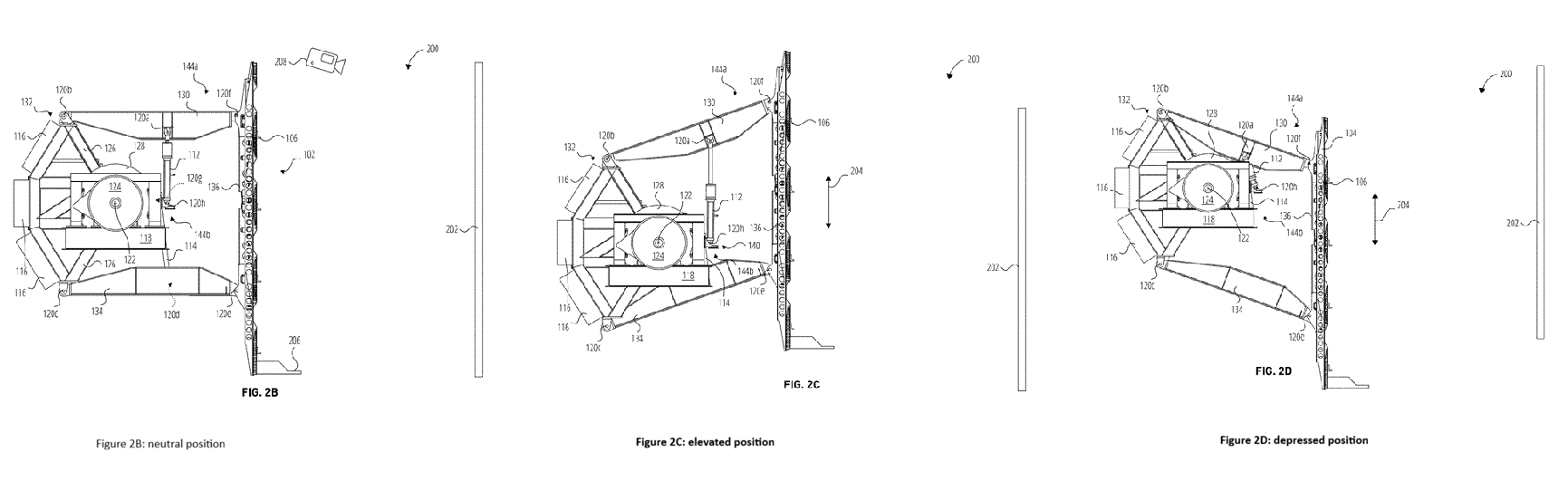
Strategic interpretation: These drawings demonstrate movement during the show, separately from the initial rotation out of the boarding position. The application does not provide validated comparative measurements of motion quality.
3. Reducing Actuator Loads While Planning for Recovery
The third engineering theme addresses something passengers may never notice but operators cannot ignore: what happens when the system stops working?
The application describes a counterweight arrangement that reduces the load supported by the actuators. More importantly, the specification also contemplates using this counterweight to help return the passenger platform to its loading position following a malfunction, including actuator failure or loss of power.
Another embodiment introduces a counterbalance cylinder to reduce actuator loading, potentially allowing smaller actuators to be used.
This connects two important engineering considerations.
First, reducing the load on actuators may influence equipment sizing and mechanical requirements. Second, designing for recovery can help address the challenge of returning passengers to an accessible unloading position when normal operation is interrupted.
For operators, these considerations belong together. A system that delivers impressive movement during a show but creates difficulties when returning to its loading position presents a separate operational challenge.

Strategic interpretation: The figures support the discussion of actuator-load reduction. They do not establish quantified savings or guarantee automatic recovery under every failure condition.
The application does not provide recovery-time tests, energy measurements, or evidence that the proposed arrangement can address every possible fault scenario.
Nevertheless, its inclusion highlights an important R&D consideration: ride performance should be evaluated alongside the ability to maintain and recover the system.
How Does Disney’s Approach Compare With Existing Flying Theatre Systems?
Disney is not the only company exploring ways to combine suspended seating, motion, and immersive screens.
Several ride suppliers already offer flying theatre systems, although their published product descriptions highlight different engineering and operating priorities.
Brogent’s i-Ride uses an electrical motion base with suspended seating oriented toward a dome screen. Its published features include six degrees of freedom and a modular design, placing emphasis on multidirectional movement and system integration.
Mack Rides’ AIRIFIC takes a different approach. Its rotating arrangement allows one side to board and disembark while another group experiences the show. This creates an opportunity to overlap passenger handling with show time.
Dynamic Entertainment’s Flying Theatre emphasises suspended seating with pitch and heave movements, focusing on the physical sensations associated with flight.
Disney’s application brings another combination into the discussion: a horizontal boarding platform that rotates into a show configuration, supported by linkage-driven movements and counterbalancing arrangements.
| Company / System | Evidenced design focus | IP/R&D implication to investigate | Potential differentiation |
| Disney – US20260335777A1 | Horizontal loading, hub rotation, linkage-driven show movement, and counterbalancing | Hub-linkage relationships, seat articulation, actuation, and recovery arrangements | Integrating boarding and show movement within one passenger platform |
| Brogent – i-Ride | Electrical motion base, suspended seating, six degrees of freedom, modular design | Motion-base architecture and module integration in its patent portfolio | Multidirectional movement and modular implementation |
| Mack Rides – AIRIFIC | Rotating arrangement allowing boarding and disembarking while another group experiences the show | Passenger handling, rotation, and load/show interface arrangements | Overlapping passenger handling with show time |
| Dynamic Entertainment – Flying Theater | Suspended seating with pitch and heave movements | Suspension, motion transmission, and loading-floor arrangements | Flight-oriented movement through suspended seating |
Summary: Disney’s application integrates level loading with a rotating passenger platform. Supplier offerings highlight other priorities, including multidirectional motion and overlapping boarding with show time.
Strategic interpretation: This comparison reflects disclosed engineering approaches and published product positioning. It is not a patent-coverage ranking or proof of performance superiority.
The Real Competition May Be in Operating Efficiency
Among these approaches, Mack Rides’ AIRIFIC is particularly relevant to the throughput question.
Disney’s application focuses on making passenger access easier through a platform that transitions between loading and show configurations.
Mack’s arrangement, meanwhile, focuses on overlapping passenger handling with the experience itself.
Both approaches address the time spent between experiences, but they do so through different operating models.
This distinction matters for procurement and R&D teams. Comparing only the number of seats or available movement axes would overlook how each system handles the complete passenger cycle.
There is also a difference in the available evidence. Public product descriptions establish features offered by suppliers, while a patent application establishes what has been disclosed and claimed. Neither source, by itself, provides directly comparable lifetime operating costs or independently validated performance results.
Is This Really “Soarin’ 2.0”?
The comparison is understandable.
Disney’s official Soarin’ experience combines raised seating, a large projection dome, coordinated movement, and sensory effects to create the sensation of flying.
The newly published application belongs to the same broad category of immersive ride experiences. However, its technical focus is more specific: changing how passengers enter, transition into the show configuration, experience movement, and return to the loading position.
The application does not identify a replacement for Soarin’, a particular theme park location, or an opening date.
Calling it a confirmed successor would therefore turn a technical patent interpretation into an unsupported product forecast.
The more useful question is not whether Disney is developing “Soarin’ 2.0”. It is how this architecture could change the engineering and operating requirements of a flying theatre.
Its boarding transition, linkage geometry, and recovery arrangements remain relevant even if the concept eventually appears under a different theme or never becomes a public attraction.

What This Means for IP, R&D, and Business Teams
Beyond the possibility of a new attraction, Disney’s application offers several technology signals worth examining.
For IP teams, the next step is to map the hub, linkage, actuators, seat articulation, and counterbalancing arrangements across relevant patent families. Similar-looking products may provide useful search clues, but technical features and claims must be compared before drawing conclusions about patent overlap or differentiation.
For R&D teams, the priority should be evaluating the complete operating model. This includes cycle time, passenger load cases, actuator duty, maintenance access, motion clearance, and return behaviour.
One particularly practical detail is the specification’s description of replacing actuators by disassembling their end joints. This makes service access another important consideration when evaluating the proposed architecture.
For business and procurement teams, the more useful metric is not simply the number of seats or show duration. It is the usable passenger capacity over an operating day.
That requires considering boarding variability, equipment availability, maintenance requirements, and recovery time alongside the experience itself.
Ultimately, the commercial value of the architecture will depend on whether its proposed benefits remain useful across the entire operating cycle.
Patent monitoring should therefore extend beyond newly published ride concepts and illustrations. Changes in claims, related applications, and independently confirmed deployment activity would provide stronger evidence of Disney’s longer-term technical direction.
Beyond the Flying Experience: The Bigger Engineering Signal
Disney’s US20260335777A1 application highlights an important aspect of immersive ride development: creating the experience is only one part of the engineering challenge.
The other part is making the system practical to operate.
By combining a level boarding platform, independent seat articulation, linkage-driven movement, and counterbalancing arrangements, the application explores how passenger access, show motion, and recovery can be addressed within a connected mechanical architecture.
Whether this concept becomes a future attraction remains unknown. But for companies developing immersive entertainment systems, it offers a useful reference point for evaluating where ride innovation is moving.
The next generation of flying theatres may not be defined only by how convincingly they simulate flight, but also by how efficiently they move passengers through the entire experience.
Access an Updated Flying Theatre Patent Analysis
This analysis examines Disney’s US20260335777A1 application, published on October 29, 2026, alongside selected public product information reviewed through November 6, 2026. It does not represent a complete flying theatre patent landscape.
To explore related patent applications, competitor portfolios, and emerging ride-system innovations, request an updated flying theatre patent analysis.
