
| PATENT US12703258B2 | ASSIGNEE HEVO Inc | GRANT Aug. 11, 2026 | THEME Wireless charging network intelligence |

Wireless EV charging is usually framed as a hardware challenge. A transmitter in the ground creates an electromagnetic field. A receiver under the vehicle collects the energy. The battery charges without a cable.
But US12703258B2, granted to HEVO on August 11, 2026, points toward a different competitive layer. The patent does contain the physical charging architecture. More importantly, its granted claims connect multiple charging stations, location-enabled vehicles, station control modules and a server that uses station availability, operating condition, occupancy and vehicle location to coordinate charging. The claims also extend into reservations, sensors, vehicle positioning and alignment-based power control.
The strategic shift
The question is no longer only whether electricity can cross the air gap efficiently. It is increasingly whether the system can determine which vehicle should charge, where it should charge, whether the station is available, whether the vehicle is positioned correctly, and when power should actually be transferred.
That makes US12703258B2 more interesting as a charging-network patent than as another wireless-power patent.
HEVO Is Treating the Charging Pad as One Node in a Larger Network
HEVO says its work has focused on building manufacturable wireless EV charging systems rather than a standalone charging component. US12703258B2 shows how that hardware can sit inside a broader operating system.
The patent architecture connects the vehicle, wireless charging station and communications infrastructure rather than treating the charging pad as an isolated electrical component.
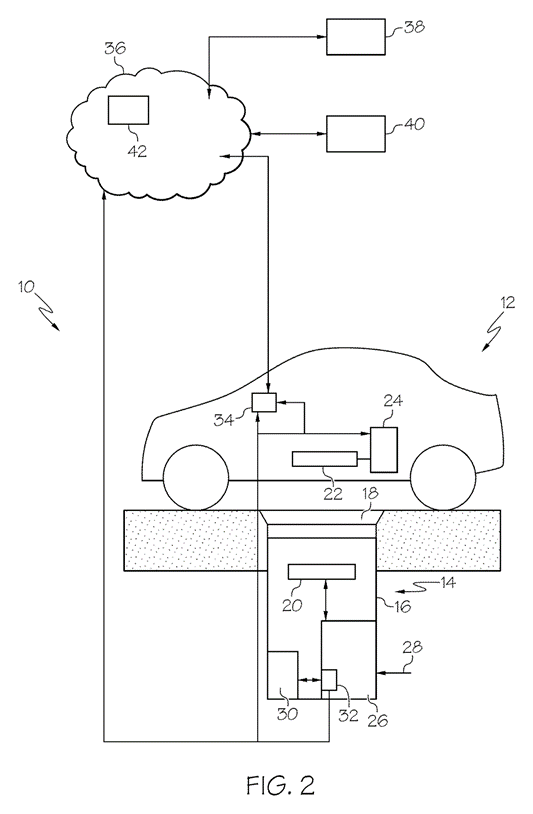
The value of FIG. 2 is that it makes the system architecture immediately visible. The charging pad sits underneath the vehicle, but information flows beyond the pad. That distinction becomes more important as wireless charging moves into fleets, automated parking and autonomous vehicles, where charging may need to happen without a driver manually selecting, connecting and monitoring a charger.
Patent Portfolio Snapshot
| Patent | US12703258B2 | Company | HEVO Inc |
| Title | Systems and Mobile Application for Electric Wireless Charging Stations | Application | US17/367,178 |
| Inventors | Jeremy Ryan McCool; Steven Clark Monks | Filing date | July 2, 2021 |
| Grant date | August 11, 2026 | Core theme | Networked wireless charging management |
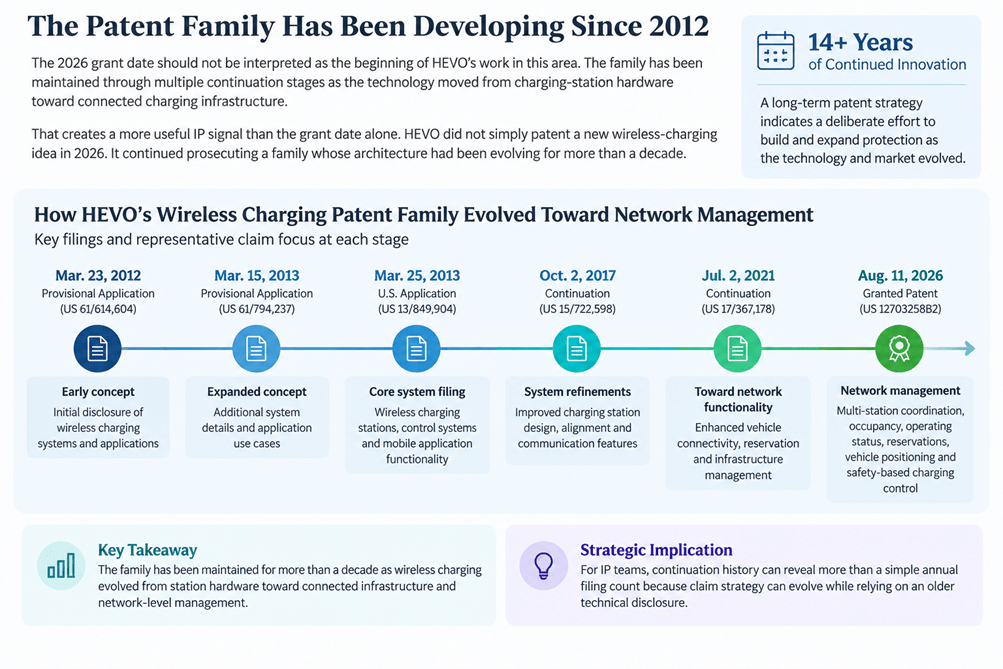
The 2021 application date can be misleading if viewed alone. The continuation chain identified on the patent cover traces back through an October 2, 2017 continuation, a March 25, 2013 application and provisional filings from March 23, 2012 and March 15, 2013.
HEVO has built a patent portfolio around wireless EV charging technologies, covering areas such as charging systems, vehicle alignment, and charging infrastructure. For a broader view of HEVO’s patent activity, including its filing trends, patent families, geographic distribution, and key portfolio statistics, explore our HEVO patents analysis.
The Patent Family Has Been Developing Since 2012
The 2026 grant date should not be interpreted as the beginning of HEVO’s work in this area. The family has been maintained through multiple continuation stages as the technology moved from charging-station hardware toward connected charging infrastructure.
That creates a more useful IP signal than the grant date alone. HEVO did not simply patent a new wireless-charging idea in 2026. It continued prosecuting a family whose architecture had been evolving for more than a decade.
The Physical Wireless Charging System Still Matters
Network intelligence cannot replace the charging hardware. The patent still describes the electrical stack needed to move energy from infrastructure into the vehicle, including ground-side power electronics, a wireless interface, vehicle-side electronics, a battery and a battery-management system.

This image establishes the physical layer beneath the software story. It also shows why looking only at charging coils would give an incomplete view of the patent. Once wireless power-transfer hardware becomes connected to sensing, communications and software, competitive differentiation can move higher in the system stack.
A Charging Station Becomes a Data Source, Not Just an Energy Source
Claim 1 is particularly revealing. The server can determine parameters relating to multiple charging stations based on usage data. Those parameters can include whether a station is occupied, whether it is operational, where it is located relative to a vehicle, and which charging station should be selected for a requesting vehicle.
Dependent claims add historical charging performance, the amount of power transferred, average charging time and charging productivity. That turns the charging station into something more than electrical infrastructure. It becomes a network resource whose operational condition can influence vehicle-routing and charging decisions.
For a private home charger this distinction may have limited value. For a commercial fleet with dozens of vehicles competing for charging capacity, it can become fundamental.
Charger Discovery Starts Before the Vehicle Reaches the Pad
The patent mobile-interface embodiments show users locating charging stations through both a list and a map. FIG. 20 displays multiple charging locations and their distance from the user, while FIG. 21 visually maps charger availability and occupancy.

The strategic point is not the mobile-app interface itself. The important part is that physical charging infrastructure has a digitally represented state. A vehicle or user can know whether infrastructure is available before reaching it. That means station occupancy and operating condition can influence mobility decisions rather than being discovered only after arrival.
HEVO’s Patent Extends Discovery Into Reservation Management
Finding an available charger is only one part of utilization. The patent also describes selecting charging locations, choosing a charging time and confirming reservations. FIG. 30 lays out that sequence for passenger vehicles.
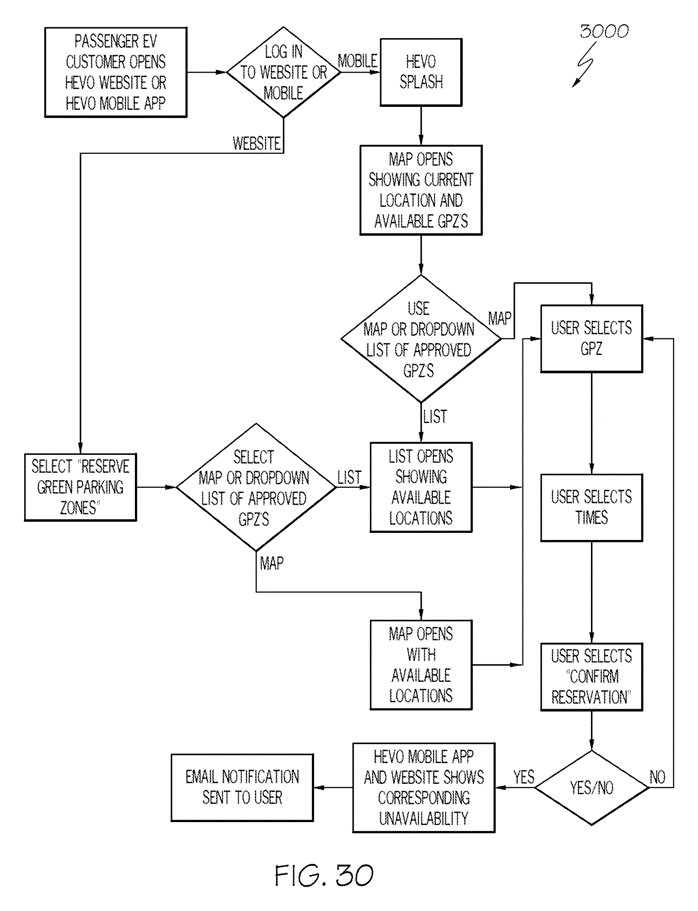
More importantly, reservation logic reaches the granted claims. Claim 9 describes generating a reservation and terminating it when the selected vehicle is not positioned at the charging station according to the relevant station and vehicle information. Independent Claim 14 also incorporates reservation generation and automatic termination when a vehicle is not at the charging station at the reserved time.
That matters commercially because reservations can create virtual occupancy. A charger might appear unavailable even though no vehicle is physically using it. Reconciling reservation data with vehicle-location and station-occupancy data can therefore become part of infrastructure utilization. For fleets, that is much more consequential than a simple booking feature.
Alignment Is Not Merely a Parking Convenience
Wireless charging introduces a constraint that plug-in charging largely avoids. The transmitter and receiver need to be positioned appropriately relative to each other.
US12703258B2 connects that positioning problem directly with power-control logic. Claim 18 describes generating a visual display showing the vehicle receiver relative to the charging unit. Claim 19 introduces directional arrows indicating how the vehicle should move. Claim 20 goes one step further: wireless power transmission can be inhibited when the receiver is misaligned with the charging unit.
Control sequence
Detect position -> communicate alignment -> guide movement -> verify alignment -> permit charging.
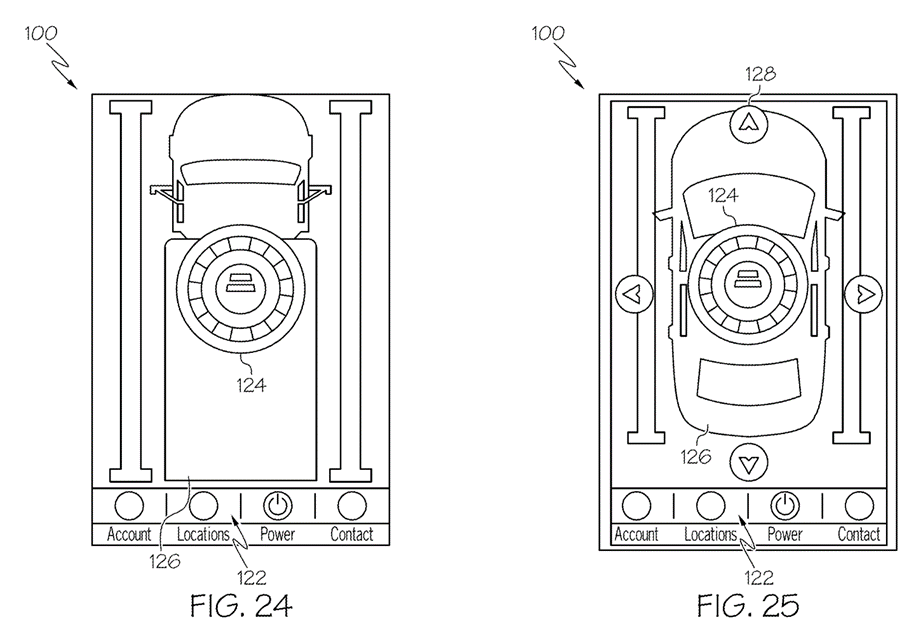
For R&D teams, the distinction is important. Alignment is not simply an app feature layered on top of the charger. It can become part of the logic determining whether power transfer is allowed at all. Design-around analysis therefore needs to examine where alignment is measured, where it is processed, how instructions are generated and how the result affects charger activation.
Safety Is Also Integrated With Network Control
The same system-level pattern appears in safety. Claim 1 covers detecting an object adjacent to the charging station other than the charging vehicle and automatically discontinuing power to the vehicle in response. The patent also links station conditions to sensor information communicated through station control modules.
Safety control loop
Vehicle arrives -> alignment verified -> charging begins -> environment monitored -> condition changes -> power response changes.
For R&D teams, the relevant competitive boundary may therefore include not only the sensing method but also how sensor information participates in charging control.
The Most Interesting Commercial Embodiment Is Hidden Near the End of the Patent
Toward the end of the specification, HEVO moves away from a conventional passenger-car charging scenario and describes Green Loading Zones. The concept is straightforward: commercial vehicles already stop to load and unload goods. If wireless charging infrastructure is embedded in those locations, part of that existing dwell time can potentially become charging time.
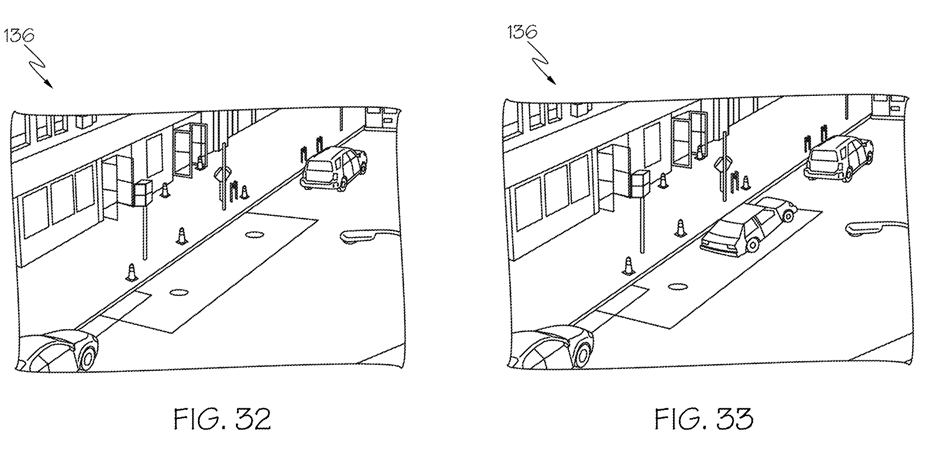
This may be one of the most commercially useful ideas in the document. The advantage is not simply eliminating a charging cable. It is potentially changing when charging occurs.
Operating model
Instead of: drive -> stop operations -> charge -> return to work. The system can move toward: drive -> perform normal activity while charging -> continue operating.
That turns charging from a dedicated event into something closer to an infrastructure service embedded within vehicle operations.
HEVO Extends the Same Logic to Fleet-Level Reservation
The specification does not stop with the physical loading zone. FIG. 34 shows a fleet manager interacting with the system to locate and reserve Green Loading Zones, select time windows and receive information about availability.

This combination of FIGS. 32-34 is stronger than either visual alone. FIGS. 32-33 explain where charging happens. FIG. 34 explains how capacity can be managed. Together they reveal a deeper system architecture: physical infrastructure + vehicle location + charger availability + scheduling + communications.
For a fleet operator, that architecture can translate into operational metrics such as charging-station utilization, average charging-session duration, reservation fulfilment, charger downtime, vehicle dwell time, vehicle-to-pad positioning time, and energy delivered during existing operational stops.
What US12703258B2 Reveals About HEVO’s IP Direction
HEVO’s public patent information shows a family that includes charging-station structures, control modules, communications and alignment functions. The 2026 grant broadens the strategic picture by placing more emphasis on how vehicles, stations and software coordinate.
Portfolio pattern
Charging hardware -> vehicle-to-pad interaction -> alignment and safety -> station connectivity -> reservations and availability -> network-level charging management.
The value of the patent is therefore not one individual feature. It is the way several previously separate charging functions are brought into the same operating architecture.
Wireless Charging Competition Is Moving Across Multiple Layers
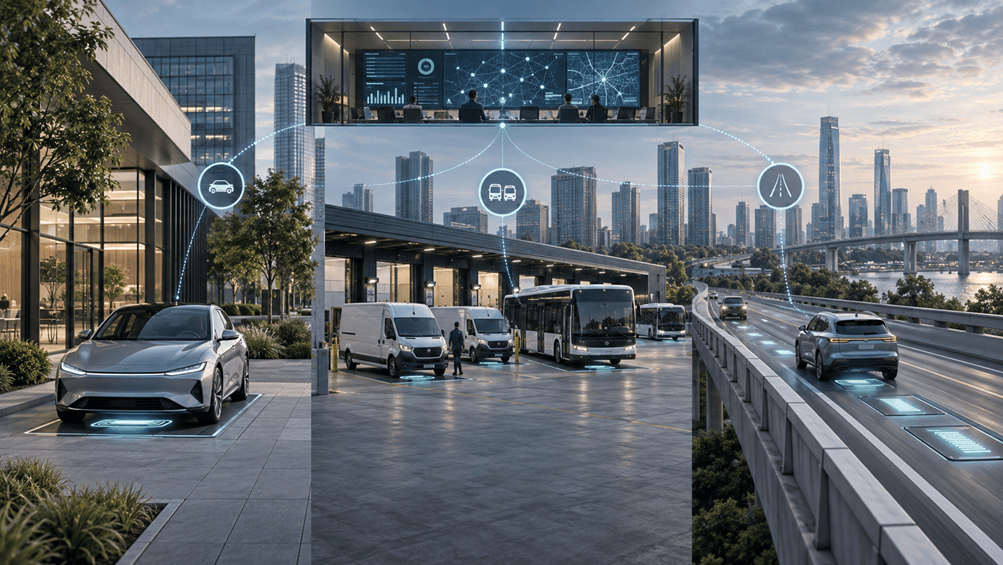
A useful competitor analysis cannot stop at power levels or charging efficiency. Different companies are emphasizing different portions of the wireless-charging stack.
| Company | Publicly visible technology direction | IP/R&D question |
| HEVO | Stationary wireless charging combined with vehicle positioning, software, network management and dynamic-roadway development. | How far can protection extend from physical charging equipment into charger selection, reservations, alignment and session control? |
| WiTricity | Standards-oriented wireless charging systems, interoperability, alignment, safety and cloud-connected fleet/user services. | Where do standards-compliant implementation choices intersect with proprietary alignment, communications and network-control architectures? |
| Electreon / InductEV | Stationary, semi-dynamic and dynamic wireless charging, including high-power fleet applications. | How does the relevant IP landscape change when vehicles charge repeatedly during normal operations or while moving? |
The comparison should not be interpreted as one company being ahead of another. It shows that competitive activity is spreading across several layers: power transfer -> vehicle integration -> alignment -> sensing -> communications -> charging software -> fleet orchestration. For patent teams, those layers increasingly need to be analyzed together.
What IP Teams Should Investigate
US12703258B2 suggests that a meaningful freedom-to-operate or competitor study in wireless charging should not stop at the pad. IP teams should map where each system function occurs.
1. Charging-station selection Which entity chooses the station – the vehicle, a mobile device, the charging network or a centralized server? The architectural location of that decision can matter.
2. Occupancy determination How does the system decide whether a charger is available? Possible implementations can involve physical sensors, charger activity, reservations, vehicle position or combinations of these inputs.
3. Alignment Where is vehicle-to-pad alignment calculated – in the vehicle, charging station, mobile device or a distributed control architecture?
4. Safety response Does detection merely create an alert, or does the detector output directly modify the power-transfer state?
5. Reservation management How does the system reconcile a software reservation with the physical presence – or absence – of the vehicle?
These questions matter because the granted claims span vehicles, charging stations, control modules, sensors and servers rather than placing the entire invention inside one component. The potentially relevant implementation can therefore cross several suppliers and software layers.
What R&D Teams Should Take From the Patent
For engineering teams, the design-around question is broader than “Can we change the coil?” It may instead require decomposing the complete charging workflow.
Consider alignment. A competing architecture could use a different positioning sensor but still need to answer the same system-level questions: when alignment is determined, what device receives the information, how the driver or vehicle is instructed to move, and whether charging remains disabled until alignment is acceptable.
The same logic applies to reservations, occupancy and safety. Changing one component does not automatically change the overall architecture. That is why wireless-charging patent analysis increasingly benefits from functional system maps, not only conventional component-to-claim charts.
What Business and Fleet Teams Should Notice
The non-obvious commercial signal in US12703258B2 is not cable elimination. It is utilization.
If charging can happen during existing downtime – parking, loading, unloading, queuing or fleet staging – the economics of the infrastructure can depend increasingly on how effectively those charging opportunities are identified and allocated.
That changes the metrics worth monitoring. Instead of measuring only charger power and charging efficiency, fleet operators may increasingly care about energy delivered per operational stop, charging opportunities captured, missed reservations, charging-station occupancy, downtime and vehicle availability. The patent claims already include concepts such as occupancy status, charging performance, power delivered, charging time and charging productivity. That is a strong indicator of where wireless charging can become an operations problem rather than merely an electrical-engineering problem.
The Next Analysis Should Go Beyond This Single Patent
US12703258B2 provides a useful view of HEVO’s network-management strategy, but it represents only one part of the wireless-charging IP landscape. A deeper study could map HEVO’s continuation families against WiTricity, Electreon/InductEV and other wireless-charging players across power transfer, charging-station architecture, alignment, object detection, charger selection, reservations, network control, dynamic charging and autonomous fleet operations. This analysis uses US12703258B2 and public company information reviewed through September 2026. For an updated patent landscape, claim-level competitor comparison, continuation-family tracking, white-space analysis or technology-specific FTO study, fill out the form to access the expanded analysis.
Wireless Charging May Ultimately Be Defined by Decisions, Not Pads
The obvious invention in wireless charging is the elimination of the cable. US12703258B2 points toward a less obvious one.
Once vehicles and charging infrastructure can communicate, the system has decisions to make: Which charger is available? Which station should the vehicle use? Is the vehicle actually present? Is it aligned? Is it safe to transmit power? Should a reservation remain active? Should the charger stop? And when several vehicles share limited infrastructure, which charging event should happen next?
Those questions sit above the magnetic coupling between the transmitter and receiver. They sit in the coordination layer.
That is why the most important takeaway from HEVO’s patent may not be that wireless charging is becoming technically better. It is that wireless charging is becoming networked infrastructure. As that transition continues, competitive IP may increasingly accumulate not only under the vehicle, but around the software and communications deciding when, where and how the vehicle receives energy.

