
10,989 Patent Families Show the Race Is Moving Beyond the Aircraft
A patent-led view of where VTOL innovation is concentrating – from propulsion and flight control to transition systems, charging infrastructure, thermal management, fleet operations, and safety-critical power architectures.
| Patent publications | 17,899 | Patent families | 10,989 |
| Alive families | 10,282 | Inactive families | 707 |
| Top company | Textron – 415 families | Top inventor | Dong Ming – 71 families |
| Publication window | 2020-2026 | Scope note | Based on publication year |
The VTOL Patent Race Is Becoming a Systems Race
The most useful signal in the VTOL patent landscape is not simply that filing activity is growing. It is where the protection is accumulating.
Flight Control, Guidance & Navigation and Propulsion & Actuation Systems together account for 6,258 of the 10,989 patent families identified in this study – almost 57% of the entire portfolio.
But the next layers are already visible. Another 1,236 families cover vertiports, charging and ground infrastructure. Multi-Mode & Transition Control accounts for 872 families. Hybrid-Electric Propulsion, aircraft structures, aerodynamic and acoustic optimization, thermal management, sensing and communications add further protection around the aircraft.
That changes the competitive question. The VTOL race is no longer only about who can design an aircraft that takes off vertically. Companies are increasingly protecting the systems needed to control it, transition it between flight modes, supply and distribute power, charge it, manage heat, reduce noise and ultimately operate it as part of a larger transportation network.
The company ranking reinforces that point. Textron leads the landscape with 415 patent families, followed by Beta Air with 220, XPeng with 200 and Volant Aerotech with 129. But the top 30 also includes automakers such as Honda, Hyundai and Porsche; aerospace suppliers such as Honeywell and Safran; State Grid Corporation of China; SK Telecom; and dedicated advanced-air-mobility companies including Archer, Joby, Volocopter, Lilium, Supernal and Wisk.
What Does the VTOL Patent Portfolio Look Like?
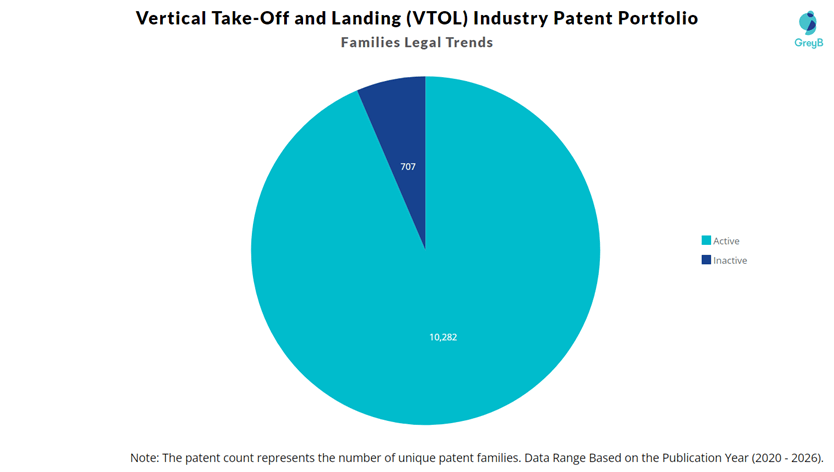
Approximately 93.6% of the identified patent families are classified as alive.
A large historical patent count can sometimes exaggerate competitive pressure because substantial parts of a portfolio may already be abandoned or inactive. That is not what this dataset shows. Most identified VTOL families still contain live rights at the family-screening level.
Patent Filing Trend of VTOL industry
VTOL Patent Activity Accelerated After 2018

The priority-year data shows a clear change in filing intensity. Only 177 families in the dataset trace back to 2017 priorities. That figure rose to 493 in 2018 and 825 in 2019.
The portfolio then moved above 1,000 annual priority families: 1,011 in 2020, 1,205 in 2021, 1,340 in 2022, 1,550 in 2023 and 1,874 in 2024.
Between 2020 and 2024 alone, annual priority activity increased by about 85%. The more important point is not the 2024 peak itself; it is the sustained movement into a much higher filing range.
That pattern suggests VTOL R&D has moved beyond a smaller group of experimental aircraft programs into a broader period of system development involving aircraft OEMs, automotive companies, component suppliers, infrastructure companies and mobility platforms.
The dataset shows 1,743 families for 2025 and 672 for 2026. Those figures should not yet be interpreted as evidence of a collapse in VTOL R&D. Priority-year data is inherently affected by the delay between an initial filing and subsequent publication, making the latest years incomplete.
So what?
The stronger signal is the multi-year rise from 2018 through 2024, not the apparent decline in the latest incomplete years.
Worldwide Patent Filing of VTOL Industry
China and the United States Are the Main VTOL Patent Filing Battlegrounds
China accounts for 6,617 publications in the dataset, followed by the United States with 3,756. Europe (EPO) has 1,339 publications, South Korea 1,127 and Japan 862. Germany follows with 366, Russia with 310 and Australia with 298.
China is particularly notable because its portfolio is not concentrated in one narrow technical area. The underlying dataset shows activity across propulsion, flight control, transition systems and ground infrastructure. The US also has broad coverage, particularly around flight control, propulsion, charging infrastructure and hybrid-electric systems.
| Country | Total Patents |
| China | 6617 |
| United States Of America | 3756 |
| Europe (EPO) | 1339 |
| Korea (South) | 1127 |
| Japan | 862 |
| Germany | 366 |
| Russia | 310 |
| Australia | 298 |
| Canada | 229 |
| France | 208 |
| India | 187 |
| United Kingdom | 160 |
| Brazil | 135 |
| Israel | 134 |
| Spain | 76 |
| Turkey | 62 |
| Romania | 58 |
| Taiwan | 52 |
| Poland | 42 |
| Italy | 42 |
| Mexico | 33 |
| Singapore | 31 |
| New Zealand | 17 |
| South Africa | 16 |
| Hong Kong (S.A.R.) | 15 |
| Ukraine | 14 |
| Indonesia | 13 |
| Sweden | 10 |
| Denmark | 9 |
| Saudi Arabia | 9 |
| Viet Nam | 9 |
| Switzerland | 8 |
| Finland | 7 |
| Malaysia | 6 |
| Eurasia | 6 |
| Netherlands | 6 |
| Slovenia | 6 |
| Luxembourg | 6 |
| Slovakia | 5 |
| Czech Republic | 4 |
| Thailand | 4 |
| Bulgaria | 4 |
| Philippines | 4 |
| Africa | 3 |
| Norway | 3 |
| Lithuania | 3 |
| Croatia | 3 |
| Argentina | 3 |
| Portugal | 3 |
| Morocco | 3 |
| Serbia | 2 |
| Ireland | 2 |
| Austria | 2 |
| Greece | 2 |
| Iran | 2 |
| Belgium | 2 |
| Colombia | 2 |
| Armenia | 2 |
| Chile | 2 |
| Republic of Moldova | 2 |
| Tunisia | 1 |
| Belarus | 1 |
| Mongolia | 1 |
| Ecuador | 1 |
| Gulf Cooperation Council | 1 |
| Latvia | 1 |
Where Patent Innovation is happening in VTOL Industry?
Flight Control and Propulsion Define the Core VTOL Patent Battle
Two technology areas dominate the landscape: Flight Control, Guidance & Navigation with 3,133 families and Propulsion & Actuation Systems with 3,125 families. Together, they account for approximately 56.9% of all families.
The near tie between them is telling. VTOL engineering creates a control problem that conventional fixed-wing aviation does not face in quite the same way. An aircraft may need to manage vertical lift, hover, forward flight, changing thrust vectors, multiple propulsion units and transitions between operating modes.
More propulsion units can create redundancy and control flexibility, but they also increase the number of variables that the aircraft must coordinate. That helps explain why flight-control IP has become as large as propulsion IP itself.
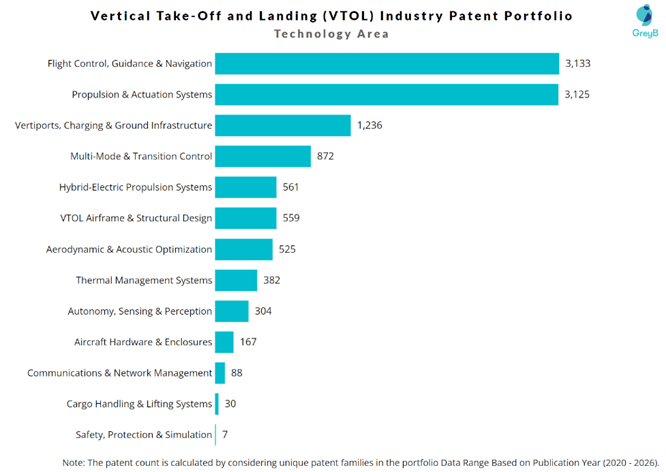
The smaller categories should not automatically be treated as less important. A technology can have relatively few patents yet become strategically critical if it sits at an interface every commercial aircraft must eventually use – charging, grid connection, vertiport operations, thermal safety or communications being obvious examples.
How has VTOL Industry Innovation Research Focus Changed over the Year?

Looking at technology activity year by year reveals something the aggregate totals hide. Propulsion initially led flight-control patenting. In 2020, the dataset shows 345 propulsion families compared with 272 covering flight control.
By 2022, flight control had moved ahead: 434 families versus 375 in propulsion. In 2024, Flight Control, Guidance & Navigation reached 524 families, while Propulsion & Actuation reached 485. The same pattern continued in the available 2025 data, with 525 flight-control families compared with 417 propulsion families.
Other technologies are also expanding. Vertiport, charging and ground-infrastructure families grew from 107 in 2020 to 233 in 2024. Hybrid-electric propulsion increased from 36 to 94 over the same period. Aerodynamic and acoustic optimization rose from 50 to 110, while thermal management moved from 18 families in 2020 to 84 in 2024.
This does not mean propulsion is becoming unimportant. It indicates that the technical bottleneck is broadening. Once a company has selected an aircraft and propulsion architecture, the next difficult questions involve controlling it, distributing energy safely, managing thermal loads, reducing noise, charging the aircraft and integrating it with ground operations.
Which Companies are leading the Innovation Race of VTOL Industry?
Textron leading the VTOL patent innovation race so far –
| Sr.No. | Company | Patent Families | HQ |
| 1 | Textron | 415 | USA |
| 2 | Beta Air Llc | 220 | USA |
| 3 | Xpeng | 200 | China |
| 4 | Volant Aerotech | 129 | China |
| 5 | Honda Motor | 109 | Japan |
| 6 | Boeing | 105 | USA |
| 7 | Hyundai | 102 | South Korea |
| 8 | Porsche | 100 | Germany |
| 9 | Honeywell | 99 | USA |
| 10 | Aerofugia | 85 | China |
| 11 | Geely Holding | 83 | China |
| 12 | Archer Aviation | 79 | USA |
| 13 | Joby Aviation Inc | 69 | USA |
| 14 | State Grid Corporation Of China | 64 | China |
| 15 | Kia Corp | 63 | South Korea |
| 16 | Denso | 56 | Japan |
| 17 | Wing Aviation | 55 | USA |
| 18 | Safran | 54 | France |
| 19 | Hanwha Group | 52 | South Korea |
| 20 | Volocopter | 48 | Germany |
| 21 | Rolls-Royce | 46 | United Kingdom |
| 22 | Lilium Eaircraft Gmbh | 43 | Germany |
| 23 | Aurora Flight Sciences Corp | 40 | USA |
| 24 | Supernal Llc | 39 | USA |
| 25 | Leonardo | 34 | Italy |
| 26 | Sk Telecom Co Ltd | 31 | South Korea |
| 27 | Shanghai Shidi Technology Co Ltd | 30 | China |
| 28 | Wisk Aero Llc | 29 | USA |
| 29 | Mitsubishi Heavy Industries | 27 | Japan |
| 30 | Kitty Hawk Corp | 27 | USA |
Textron leads the dataset with 415 patent families. Beta Air follows with 220, XPeng with 200, Volant Aerotech with 129 and Honda Motor with 109. Boeing, Hyundai, Porsche and Honeywell each have roughly 100 families. Archer has 79 and Joby 69.
The more important feature of this ranking may be its lack of concentration. The top 30 companies collectively hold approximately 2,533 families – only about 23% of the entire landscape. Even Textron, despite being the largest identified holder, represents less than 4% of the 10,989-family dataset.
This tells us VTOL is not yet an IP landscape controlled by one or two dominant patent owners. Instead, the portfolio is fragmented across aerospace manufacturers, startups, automotive companies, avionics suppliers, energy companies, universities and other technology providers.
For R&D teams, that fragmentation creates more potential technology sources, partners and acquisition targets. For IP teams, it makes FTO harder because relevant blocking rights may come from a company that is not viewed as a direct aircraft competitor.
Honeywell is a good example. Its overall family count is below several aircraft manufacturers, but its position can still matter disproportionately in control, avionics and related subsystems. State Grid Corporation of China also appears among the top 15 despite not being a conventional aircraft OEM.
So what?
The competitive set depends on which layer of the aircraft system you are analyzing. Portfolio size alone does not identify every strategically relevant rights holder.
Different VTOL Leaders Are Building Different Types of Moats
Textron: Depth around core aircraft systems
Textron sits at the top of the portfolio ranking with 415 families, giving it the broadest identified position in this dataset. Its scale matters because VTOL competition is increasingly moving across connected layers – propulsion, flight control, aircraft systems and fleet operations – rather than staying within a single component category.
For a competitor, the relevant question is therefore not only how many Textron families exist, but which of them overlap with a specific aircraft architecture, control approach or operational model.
Beta Air: Aircraft plus charging and energy interfaces
Beta Air holds 220 families, placing it second in the landscape. Its position is strategically interesting because electric VTOL commercialization depends on more than the aircraft itself. Charging interfaces, battery management, thermal control and turnaround operations can become part of the same competitive stack.
This creates a broader protection opportunity: a company can build IP around both the vehicle and the infrastructure needed to operate it repeatedly.
XPeng: Multi-mode and transition as a differentiation layer
XPeng ranks third with 200 families. For companies exploring road-air or multi-mode mobility concepts, transition systems become a distinct IP problem. Valuable claims can sit around how the vehicle changes configuration, coordinates propulsion states and safely moves between operating modes.
That is strategically different from a conventional aircraft portfolio because the transition mechanism itself can become a source of differentiation and an FTO constraint.
Archer and Joby: Smaller portfolios can still carry high strategic weight
Archer ranks 12th with 79 families and Joby 13th with 69. Their positions illustrate why family count is only one lens for competitor assessment.
A smaller portfolio can still contain patents that sit close to a critical system architecture. As VTOL platforms move toward certification and commercial operation, the value of those patents may depend more on claim position and implementation overlap than on total portfolio size.
VTOL Patents Are Already Moving From Portfolio Assets Into Litigation
Patent filings reveal where companies are trying to build protection. Litigation reveals which rights may be important enough to enforce.
The litigation dataset supplied for this study identifies six patent records associated with patent disputes. These should not be described as six independent lawsuits because several records belong to the same proceeding.
The dispute data includes matters involving Textron and DJI, Archer and Vertical Aerospace, Arbor Systems and Leonardo, and Archer and Joby.
That is an important maturity signal. VTOL is no longer only an innovation landscape. Patent rights are beginning to move from portfolio building into enforcement, particularly around system-level technologies that can be difficult to redesign once an aircraft architecture is fixed.
Flight-control patents can become competitive boundaries
One litigated record in the supplied dataset relates to US11945597B2, titled “Systems and Methods for Control Allocation for Electric Vertical Take-Off and Landing Aircraft.” The technology area itself is strategically important because control allocation determines how an eVTOL aircraft coordinates commands across propulsion units and aircraft states.
If patent claims sit close to that functional core, they can create more meaningful design-around pressure than patents covering peripheral aircraft features.
Power distribution is becoming its own eVTOL IP battleground
The litigation data also contains patents related to electric-aircraft power distribution and electrical fault isolation, including US11945594B2, US12162614B2 and US12103404B2.
These technologies matter because electric VTOL aircraft depend on distributed electrical architectures that must keep power available, isolate faults and support multiple propulsion loads under safety-critical operating conditions.
The strategic implication is straightforward: the commercial moat around an electric VTOL aircraft may be built not only through airframe and rotor patents, but through how battery power is distributed, isolated and managed when components fail.
The current dataset identifies six litigated patent records across multiple VTOL-related dispute groups. A deeper litigation layer can reveal the patents involved, parties, technology areas, current status and potential FTO implications.
The Key VTOL Inventors by Patent Count
| Sr.No. | Inventor | Patent Families | Associated With |
| 1 | Dong Ming | 71 | Shanghai Volant Aerotech Co Ltd |
| 2 | Xiuxian Chen | 66 | Hefei Lanyi Aviation Technology |
| 3 | Wiegman Herman | 59 | Beta Technology |
| 4 | Giurcă Liviu Grigorian | 56 | INCAS |
| 5 | Xue Song-Bai | 55 | Aerofugia |
| 6 | Tiehong Dang | 53 | Hefei Lanyi Aviation Technology |
| 7 | Jinteng Huang | 44 | Guangdong Heitech Aerospace Technology Co Ltd |
| 8 | Tian Yu | 43 | AutoFlight |
| 9 | Zhang Wei | 41 | Changsha Huayu Xianxiang Aviation Technology Co Ltd |
| 10 | Li Jun | 40 | Tsinghua University |
| 11 | Wanli Yang | 37 | Shanghai Volant Aerotech Co Ltd |
| 12 | Zhao Qijun | 37 | Nanjing University of Aeronautics and Astronautics |
| 13 | Cravener Kyle Thomas | 34 | Bell Textron |
| 14 | Yuan Yao | 33 | Shanghai Volant Aerotech Co Ltd |
| 15 | Fauri Mikel | 32 | McLaren Automotive |
| 16 | Yan Lei | 31 | Guangdong Heitech Aerospace Technology |
| 17 | Li Wei | 30 | AECC Shenyang Engine Research Institute |
| 18 | Wang Tan | 30 | Guangdong Heitech Aerospace Technology Co Ltd |
| 19 | Luan Jian-Chun | 29 | Shanghai Volant Aerotech Co Ltd |
| 20 | Baozhu Zhang | 29 | Shanghai Volant Aerotech Co Ltd |
| 21 | Li Qing | 28 | Sichuan Wofei Changkong Technology Development Co Ltd |
| 22 | Freiheit Collin | 27 | Beta Air Llc |
| 23 | Nicholas Moy | 27 | Beta Air Llc |
| 24 | Muyang Lin | 26 | Nanjing University Of Aeronautics And Astronautics |
| 25 | Yang Chao | 25 | Beihang University |
Dong Ming leads the inventor ranking with 71 families and is associated with Shanghai Volant Aerotech. Xiuxian Chen follows with 66 families associated with Hefei Lanyi Aviation Technology, while Herman Wiegman has 59 families associated with Beta Technology.
The ranking also includes inventors associated with Aerofugia, AutoFlight, Tsinghua University, Nanjing University of Aeronautics and Astronautics, Bell Textron and several Chinese aerospace companies.
The pattern is important because the most active inventors are not concentrated entirely within the largest Western aerospace companies. Several come from younger Chinese VTOL companies and research institutions. Volant Aerotech appears repeatedly through Dong Ming, Wanli Yang, Yuan Yao, Luan Jian-Chun and Baozhu Zhang.
For technology-scouting teams, inventor analysis can reveal emerging R&D clusters before they are obvious from company size alone. It can also show which engineering teams repeatedly generate IP across multiple generations of aircraft development.
What Should IP, R&D and Business Teams Take From the VTOL Landscape?
1. The aircraft itself is only one layer of the moat
Flight control and propulsion still dominate, but the surrounding portfolio already extends into charging, thermal management, transition control, structures, sensing, communications and fleet operations. FTO work should therefore follow the full aircraft operating stack, not just the aircraft configuration.
2. Flight-control IP deserves separate monitoring
Flight Control, Guidance & Navigation has moved alongside – and in recent priority years above – propulsion activity. For an increasingly software-controlled aircraft, the control architecture can become just as strategically important as the hardware producing thrust.
3. Charging infrastructure is becoming part of aircraft IP
More than 1,200 families fall within vertiport, charging and ground infrastructure. That means aircraft-to-charger interfaces, battery diagnostics, grid integration and ground operations should increasingly be monitored as part of the VTOL competitive landscape.
4. Automotive entrants may compete differently from aerospace incumbents
XPeng, Honda, Hyundai and Porsche all appear among the leading portfolio holders. Their presence suggests that some of the most interesting overlap may emerge around electric powertrains, thermal systems, multi-mode vehicles, charging and control rather than conventional aircraft engineering alone.
5. Smaller portfolios can still contain highly consequential patents
Archer and Joby have much smaller portfolios than Textron in this dataset, yet the litigation trigger illustrates why family count alone cannot measure competitive strength. A small set of patents positioned around a critical system architecture can matter more than hundreds of peripheral assets.
6. Litigation should now be monitored alongside filing activity
The presence of disputes involving control allocation, electric-aircraft power distribution and other system-level technologies indicates that FTO risk is beginning to emerge alongside R&D activity. For companies approaching certification, manufacturing or commercial operation, that changes how competitor portfolios should be assessed.
VTOL’s Next Patent Battle May Be About Operating the Aircraft, Not Inventing It
The early technical question in VTOL was relatively simple: can an aircraft take off vertically and still fly efficiently enough to be useful?
The patent landscape suggests the competitive question is becoming much broader.
More companies now need to solve how that aircraft is controlled through different flight modes, how power remains available when part of the electrical system fails, how batteries are charged and monitored, how thermal loads are controlled, how noise is reduced, and eventually how multiple aircraft are coordinated across a transportation network.
That is why the rise of flight control, charging infrastructure, transition control and power-management patents matters. It suggests the next generation of defensible VTOL IP may not come from another aircraft shape.
It may come from making the aircraft reliable, controllable and operational enough to run as a system. The first litigation signals suggest that competition around those layers has already started.
Three signals worth watching next
| Signal | Why it matters |
| Flight-control and transition IP | Control architecture is becoming as heavily patented as propulsion and may be harder to redesign once an aircraft architecture is fixed. |
| Charging, power distribution and thermal management | These technologies determine whether electric VTOL platforms can operate repeatedly, safely and with practical turnaround times. |
| Litigation around system-level patents | The supplied dispute data shows that commercially relevant VTOL IP is beginning to move from portfolio building into enforcement. |
Get the Updated VTOL Patent Landscape
This analysis is based on 17,899 patent publications from 2020 through 2026, consolidated into 10,989 patent families.
The landscape will continue to change as unpublished applications become public, continuation activity expands existing families, patents are reassigned, companies consolidate portfolios and new litigation develops. Fill out the form to access updated VTOL patent activity, competitor movement, recent innovation signals, litigation developments and technology-level white-space analysis


