
BYD’s biggest Flash Charging story may not be the 1,500-kW power rating. It may be the speed at which the company is trying to build a network around it. BYD introduced its second-generation Blade Battery and single-connector Flash Charger on 5 March 2026. By 28 August, it said it had completed 10,000 Flash Charging stations across 332 Chinese cities. The message is clear: BYD is pushing beyond a headline charging demonstration toward a system that must work across thousands of locations.
That shift makes the underlying engineering worth examining. A vehicle cannot use high charging power unless the battery can accept it, the connector stays within safe temperatures, and the station can supply it. Selected BYD patent filings address several of these less visible constraints, including contact cooling, multi-gun connections and station-level power distribution. They offer a useful view of BYD’s technical priorities, even though a patent publication alone cannot confirm what is fitted inside a commercial charger.

How Does BYD Flash Charging Technology Work?
The 2026 launch builds on BYD’s Super e-Platform announcement in March 2025. That earlier platform combined a 1,000-V electrical architecture with up to 1,000 A and 1,000 kW of vehicle-side charging power; BYD separately quoted a charging terminal rated at up to 1,360 kW. The newer Flash Charger is rated at up to 1,500 kW through one connector and is designed to work with Blade Battery 2.0. These figures describe different parts of the system. A charger’s maximum output is not the same as the power a battery accepts throughout a charging session.
The electrical relationship is straightforward: power (kW) is approximately voltage multiplied by current, divided by 1,000. At 1,000 V and 1,000 A, that equals 1,000 kW. Raising current to 1,500 A at the same voltage gives 1,500 kW on paper, but it also increases the burden on cables, contacts and cooling. These examples explain the engineering trade-off; they are not measurements of BYD’s 2026 connector or its sustained charging performance.
| BYD-reported charging benchmark | Reported result | What the number means |
| 10% to 70% state of charge | 5 minutes | Reported with compatible Blade Battery 2.0 vehicle under BYD test conditions |
| 10% to 97% state of charge | 9 minutes | Company benchmark; not a charging time for every BYD vehicle |
| 20% to 97% at -30°C | 12 minutes | Company cold-weather benchmark under stated conditions |
| Single-connector Flash Charger rating | Up to 1,500 kW | Maximum equipment rating, not a sustained battery-input curve |
Blade Battery 2.0 is an important part of this pairing. BYD says it redesigned ion-transport pathways in the cathode, electrolyte and anode, while increasing energy density by about 5%. The company’s short charging times are therefore a battery-and-charger claim, not a charger-only result. They also leave a question that matters to R&D teams: how does repeated high-rate charging affect cell life? A credible answer needs comparable charging curves, temperatures and long-term capacity-retention tests, not a single nine-minute demonstration.
Why Is the EV Industry Investing in Higher-Power Charging?
The push for faster charging is not simply a contest over bigger kW figures. For drivers, the useful improvement is a shorter and more predictable stop. For operators, it is the ability to move more compatible vehicles through a site without creating an expensive bottleneck somewhere else. A 2025 U.S. Department of Energy-supported analysis identifies battery specifications, temperature, state of charge and station design as variables that shape charging time and congestion.
Meanwhile, CharIN’s February 2026 publication on IEC TS 63379 sets hardware requirements for megawatt charging connectors in heavy-duty applications, including contact safety and thermal management. That standard is not a certification of BYD’s passenger-car system, but it shows how seriously high-current hardware is being engineered across the industry.
This is where charging technology becomes a business problem. A high-output charger that spends much of its time waiting for a compatible car, grid power or thermal recovery may not deliver the expected return on equipment investment. The more relevant competitive question is whether manufacturers can combine fast battery acceptance, robust connections and economical site operation. BYD is attempting to coordinate all three. Other players are making different bets on which part of that system deserves the most attention.
BYD vs Tesla, XPeng, Zeekr and NIO: Where Do Their Charging Strategies Differ?
Five vehicle-linked approaches illustrate the race. Their published ratings cannot be arranged into a fair fastest-to-slowest ranking: some describe one connector, others a shared cabinet, and none is a standardized real-world battery charging curve. Read the comparison as a map of technical priorities rather than a league table.
| Company / system | Published equipment rating | Primary technical emphasis | What IP/R&D teams should compare |
| BYD · Flash Charging | Up to 1,500 kW from one connector | Blade Battery 2.0, high-power charging hardware and storage-backed sites | Real vehicle charging curves; connector thermals; site power architecture |
| Zeekr · fully liquid-cooled charger | 1.2-MW single-gun system (company claim) | Liquid cooling and high-current vehicle/charger integration | Coolant layout, connector temperature and peak versus sustained power |
| XPeng · Supercharging | 800-kW charger; up to 800-A capability | High-voltage liquid-cooled hardware and owned network | Vehicle acceptance, high-voltage architecture and station deployment |
| NIO · Power Charger | 640-kW liquid-cooled charger | Cooled charging hardware alongside battery swapping | Charging versus swapping economics; compatibility and user throughput |
| Tesla · V4 Supercharger | Up to 500 kW per passenger-car post; 1,200 kW shared cabinet | Multi-post power sharing and broad vehicle/connector access | Power-sharing control, supported voltages and actual per-car input |
A pattern emerges from this comparison. BYD emphasizes integration across battery, high-output connector and charging site. Zeekr and XPeng put greater public emphasis on liquid-cooled high-voltage hardware; NIO pairs fast charging with battery swapping; Tesla focuses heavily on interoperable posts and cabinet-level power sharing.
Those different system choices suggest different R&D and patent-monitoring priorities. BYD has the highest stated single-connector rating in this selected group, but that alone says little about charging-curve performance, cost per session or defensible IP. Battery suppliers such as CATL add another competitive layer, although their range-added claims are not directly comparable with charger nameplate ratings.
How does BYD compare when peak kW is taken off the table?
A comparative technology and patent study can examine real charging curves, thermal designs, site-power architecture and live patent families across BYD, Tesla, XPeng, Zeekr and NIO. For IP and R&D teams, the goal is to identify where competitors are converging, where their approaches differ—and which differences may matter commercially.
What Actually Limits Ultra-Fast EV Charging?
At megawatt-class power, small component-level losses can become system-level constraints. The evidence is more specific than saying that fast charging creates heat. In a 2025 numerical study supported by experimental validation, modeled connector temperature rose from 60.73°C to 97.33°C as charging current increased from 400 A to 800 A under the studied conditions. This is not a BYD measurement, but it illustrates why connector design deserves the same attention as battery chemistry. Battery taper, differing charger voltages and short peaks in site demand create separate constraints.
| Technical constraint | What creates the bottleneck | Evidence and business/IP implication |
| Heat at connector contacts | Current through contact resistance raises local temperature, particularly around the terminal interface. | 2025 connector study quantified thermal sensitivity; cooling geometry and contact design are distinct IP areas. |
| Battery charging taper | As SOC and cell temperature change, control systems may reduce acceptable current. | DOE-supported study connects SOC and temperature with station dwell; average charging curves matter more than peak kW. |
| Voltage and protocol differences | Vehicle and charger voltage windows, communication and connector ratings must match. | CharIN‘s MCS specification illustrates high-power safety/interoperability requirements for heavy-duty use, not BYD certification. |
| Site power peaks and sharing | Multiple dispensers can request high output at the same time, while grid capacity is limited. | NREL models show the economics depend on utilization and tariffs; DC distribution and storage control merit separate analysis. |
Each constraint opens a different technical problem and a different area for patent analysis. Contact designs and cooling loops are not the same inventions as multi-input switching circuits or storage-backed DC distribution. This distinction matters because a company’s ability to advertise a 1,500-kW charger does not establish that it controls every technology needed to deploy one at scale.
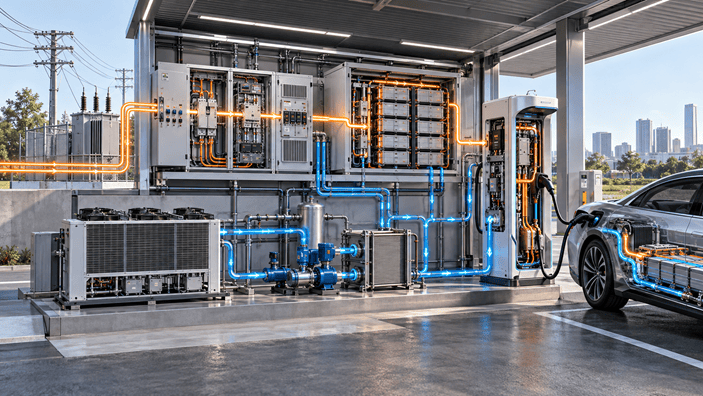
Concept illustration of charging-site cooling and power conversion. It is not a validated schematic of BYD production hardware.
How Do BYD Flash Charging Patents Address These Bottlenecks?
1. Connector Cooling: Getting Heat Away From the Contact
The highest thermal stress need not sit in the cable itself. It can concentrate where the charging terminal meets its counterpart. In CN222645823U, BYD describes a terminal cavity containing a cooling shell with fluid passages. CN222572090U tackles a related weakness by thermally linking cooling tubes in the cable to the charging terminals. The distinction is practical: a cool cable does not guarantee a cool electrical contact. Both filings point to the interface as a critical design area, rather than claiming the general idea of ultra-fast charging.
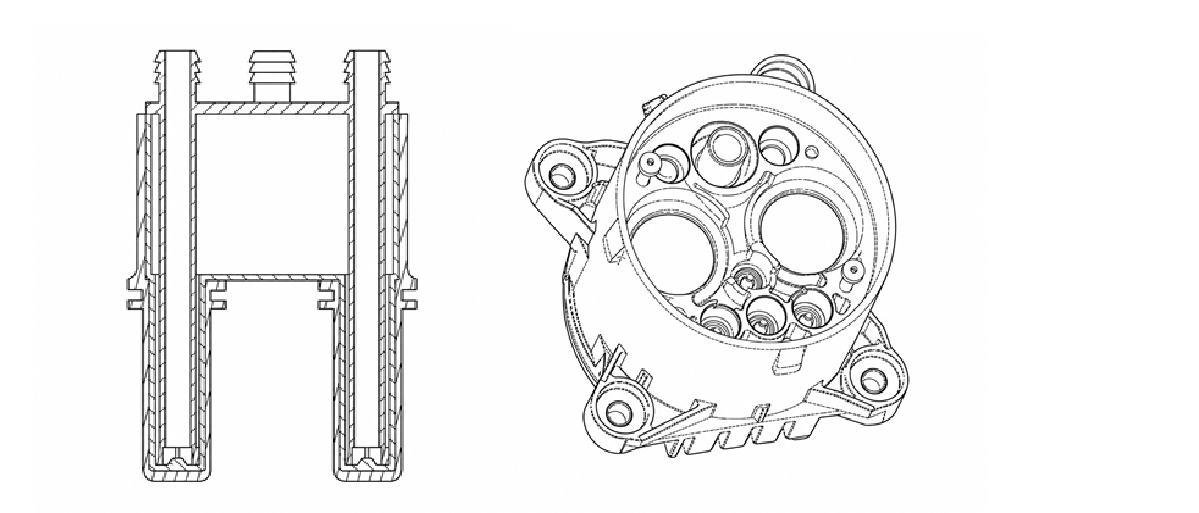
Two further records broaden that picture. WO2026051304A1 describes a liquid-cooled wiring-harness arrangement, while CN223890832U addresses heat dissipation near the rear connection between gun and harness. Taken together, these publications show attention to several potential hotspots. For engineers comparing solutions, the meaningful measures would be contact temperature at specified currents, coolant routing, pressure drop, sealing reliability and performance after repeated connections. The filings do not provide equivalent commercial test results, nor do they establish which structures are used in BYD’s current Flash Charger.

2. Multi-Gun Charging: More Connection Options, Not Automatic Power Addition
CN119527065B describes a multi-gun converter that connects several external charging guns to fewer vehicle-side ports through parallel sub-circuits and controlled switches. The potential benefit is flexibility: certain existing charging assets could be used with vehicles that have fewer charging inlets. It is not a promise that the rated outputs of multiple chargers can simply be added together; current limits, communication and vehicle compatibility still apply.
Another BYD invention, CN108248412B addresses conducted electrical noise in a dual-gun charging system. It solves a different problem from the converter: electromagnetic compatibility rather than connection routing or power aggregation. For IP teams, that distinction is important. A keyword search for ‘dual-gun charging’ may retrieve several invention types with very different claims, competitors and freedom-to-operate implications.
3. Voltage Boosting: A Product Feature Still Needing a Patent Match
BYD’s 2025 Super e-Platform announcement also describes intelligent voltage-boost charging to help vehicles use public chargers with different output limits. That feature matters because the public charging network is not uniform: voltage range, charging protocol and available current all affect compatibility. It belongs in the product story, but the selected patent set analyzed here does not establish a claim-level match for BYD’s specific voltage-boost implementation. A defensible IP assessment would need the relevant published claims before attributing that approach to a particular patent.
4. Storage-Backed Stations: Supplying Peaks Without Assuming Unlimited Grid Power
A charging site can face a different bottleneck from the car: several high-output dispensers may request power at once. WO2026086466A1 discloses a DC bus, an energy-storage device and DC/DC conversion paths for distributing power between connected equipment. CN224037090U covers a related clustered-station arrangement. Importantly, the PCT publication claims priority from the Chinese utility-model filing among its priority records. They should not be counted as two independent inventions simply because they have two publication numbers.
BYD says its commercial Flash Charging stations use fast-discharging storage to support charging where grid connections are constrained. That makes storage and DC distribution a logical area to investigate, but the patents are not a wiring diagram of every BYD site. Storage economics still depend on its energy and power ratings, local tariffs, utilization and conversion losses. From a competitive standpoint, the question is not only whether storage enables a power peak, but whether it can do so economically, repeatedly and across different site loads.
BYD Flash Charging Patent Map: Eight Selected Publications
| Patent Number | Earliest Priority Date | Key technical disclosure | What it establishes, and what it does not |
| CN222645823U | 22 Mar 2024 | Fluid passages inside a cooling shell within the charging terminal; Chinese utility model | A claimed contact-cooling arrangement; production use not confirmed |
| CN222572090U | 25 Jun 2024 | Heat-conducting member joins cooled cable tubes and terminal region; Chinese utility model | Specific combined cooling route; no independent thermal performance result |
| WO2026051304A1 | 9 Sep 2024 | Liquid-cooled harness and connector arrangement; PCT publication | International application publication, not a granted global patent |
| CN223890832U | 20 Jan 2025 | Cooling / heat dissipation around rear charging-gun connection; Chinese utility model | A localized design; no confirmed BYD equipment mapping |
| CN119527065B | 29 Aug 2023 | Multi-gun converter using parallel charging paths and controlled switches; invention grant | Connection and switching structure, not automatic addition of charger ratings |
| CN108248412B | 29 Dec 2016 | Conducted-noise suppression in a dual-gun system; invention grant | EMC-focused approach, not a power-combining patent |
| WO2026086466A1 | 25 Oct 2024 | DC bus with energy storage and DC/DC power-transfer paths; PCT publication | Station circuitry disclosure; related priority to CN224037090U |
| CN224037090U | 25 Oct 2024 | Clustered charging-station power interconnection; Chinese utility model | Related disclosure; must not be double-counted as independent invention |
These are eight publication records, not eight independently validated inventions and not a complete BYD patent portfolio. They span Chinese invention grants, Chinese utility-model grants and published international applications. The overlap between the clustered-station records also shows why patent-family deduplication matters. This curated set cannot support a claim about BYD’s total filing trend, portfolio size or global IP lead. Those questions require a broader search, family-level analysis and review of live claims by jurisdiction.
Download the BYD Product Foresight Report
This article looks at one technology. That technology came out of a bigger study. We reviewed BYD’s patent publications released in September 2026 to find what BYD could build next.
The flash charging technology is one answer.
The report looks at the work it considers most consequential this month. It examines BYD’s developments in ultra-fast charging, battery technology, and charging infrastructure. That points to the future of electric vehicle charging.
The report also flags strategic directions BYD has filed for but hasn’t announced. Flash charging technology is one of the areas examined. And it shows how BYD’s battery and charging developments could move from research toward production, with a clear link to the next generation of electric vehicles.

BYD Flash Charging Network: What Does the Rollout Prove?
BYD’s rollout adds a commercial dimension to the technology story. It reported 4,239 Flash Charging stations at the March launch, 7,018 operating locations by the end of June, and 10,000 completed stations across 332 cities by 28 August 2026. In the August announcement, BYD also reported more than 210 million kWh delivered through the network, over 1.83 million users and nearly one-third of users coming from other car brands. These are company-reported measures, but they suggest that the network is being positioned as shared infrastructure, not just an accessory for BYD vehicles.

BYD Flash Charging station milestones in 2026. March and August show reported completed stations; December is the company’s year-end target, not an achieved count. Source: BYD.
The jump from 4,239 to 10,000 stations represents 5,761 additional locations, roughly 136% growth against the March base. Reaching BYD’s 20,000-station target after 28 August would mean adding about 10,000 more in the final four months of 2026-around 80 per day on average. That is a demanding deployment target, not an achieved result. The reported energy delivered and participation by non-BYD drivers provide more useful evidence of network activity than site count alone; neither measure, however, reveals how frequently vehicles actually receive close to the advertised peak power.
The next meaningful comparison with Tesla, XPeng, NIO or Zeekr should therefore go beyond installations and theoretical kW. It should examine charger uptime, site utilization, average energy delivered per session, charging curves over common state-of-charge windows, vehicle compatibility and the role of on-site storage. Those metrics would begin to show whether BYD’s integrated architecture creates a repeatable customer advantage or mainly a stronger peak-power headline.
Which BYD charging inventions are missing from this snapshot?
These eight publication records are a starting point, not a family-deduplicated landscape. A deeper study can examine live claims, related patent families, prosecution changes and competing applicants to distinguish crowded technical approaches, potential design-around paths and R&D white spaces.
What BYD’s Flash Charging Patents Reveal-and What Remains Open
The most revealing aspect of BYD’s Flash Charging push is how many different bottlenecks it has to address at once. Battery ion transport makes a short charging session possible. Cooling structures help connections tolerate high current. Converters and storage-backed site designs determine how that power reaches the vehicle. The selected patents show engineering activity across several of those layers, not ownership of megawatt charging as a whole.
For IP and R&D teams, the useful next step is to compare specific claims and measured performance within each layer. BYD’s 1,500-kW rating is the attention-grabbing number; the harder-to-copy advantage, if one emerges, will be dependable charging performance across compatible cars, connectors and sites. That remains a question for field data and deeper patent analysis-not a conclusion that can be drawn from a product announcement alone.

