
US20260253591A1 shows Meta exploring a wearable input architecture that can move beyond microphones by combining muscle activity, facial vibrations, motion and acoustic sensing.
| Patent | US20260253591A1 | Company | Meta Platforms Technologies LLC |
| Priority | Feb. 25, 2025 | Published | Aug. 27, 2026 |
The strategic shift: speech input does not have to begin with sound
Voice-first smart glasses have an obvious weakness: speaking aloud is not always socially comfortable, private or reliable. A user may be in a meeting, on a crowded train, in a library or surrounded by competing voices. In those situations, better microphones only solve part of the problem.
Meta’s newly published patent takes a different route. Instead of relying only on airborne audio, the wearable can look for the physical act of speech itself – electrical activity from facial muscles, vibrations travelling through the face, and small movements linked to articulation – and then use those signals to determine what the wearer is trying to say.
This is not a brain-reading patent. The system is directed to articulatory activity: the muscular and mechanical events that occur when a person speaks normally, whispers, mouths words or produces sub-vocal speech. That distinction is important because it moves the interface upstream from the microphone, while still grounding recognition in deliberate physical speech behavior.
The patent is strategically interesting because it does not bet on one sensing modality. Acoustic microphones, contact microphones, inertial sensors and neuromuscular electrodes can be selected or combined depending on the speech mode and surrounding noise. The defensible layer may therefore sit in how the system orchestrates those sensors, not in a single piece of hardware.
| PRODUCT CONTEXT Meta has already commercialized electromyography as an input mechanism at the wrist: Meta Ray-Ban Display ships with the Meta Neural Band, an EMG wristband that converts subtle muscle signals into commands for the glasses. US20260253591A1 explores a different location and task – reading speech-related activity around the head and face. The filing does not confirm a product roadmap, but it shows another way Meta is exploring muscle-based input for wearable computing. |

Meta’s exploration of wearable technology also extends to augmented reality and surface-based interaction. Read our analysis of Meta’s AR glasses patent to understand another approach to hands-free input, explore Meta’s broader patent portfolio to discover its wider technology focus, and learn about the subsidiaries within Meta’s corporate structure.
What Meta is actually patenting: an adaptive speech-sensing stack
The broadest claim is not limited to a specific smart-glasses design. It covers a wearable device whose sensors contact the user’s head or face, detect muscle contractions or vibrations associated with articulatory activity, and determine corresponding speech. Later claims narrow the concept into sub-vocal, mouthed and whispered speech, sensor activation, environmental adaptation, multi-device sensing and machine-learning processing.
That breadth matters. Meta is attempting to protect the sensing-and-decoding architecture rather than only a frame geometry. The same concept could potentially be implemented in glasses, earbuds or other head-worn devices.
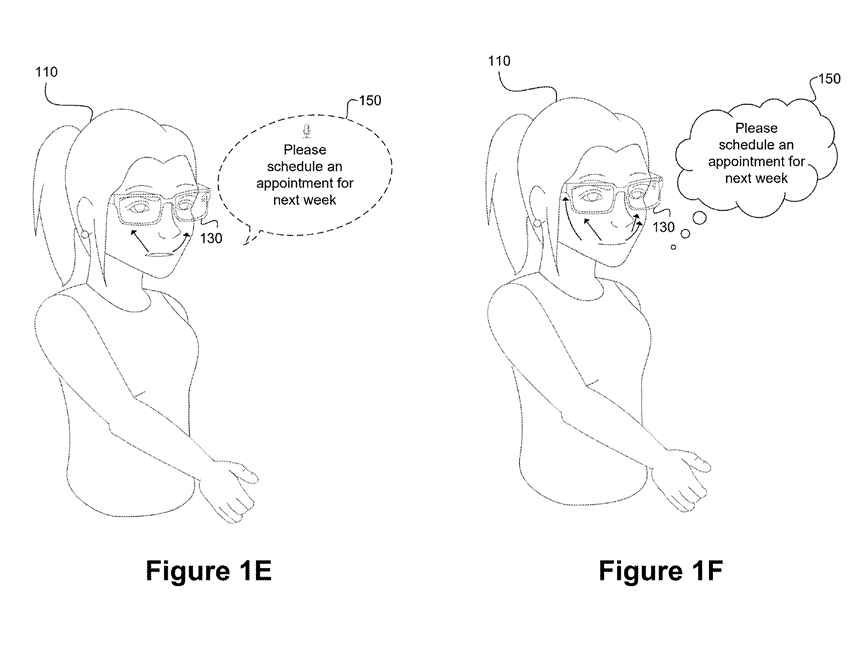
The useful insight is not “EMG replaces the microphone”
The patent treats speech as a spectrum. Normal speech produces strong airborne audio. Whispering can weaken the acoustic channel while still generating facial vibration. Mouthed or sub-vocal speech can leave muscle activity and small mechanical movements even when an ordinary microphone has little to capture.
| Speech / condition | Illustrative sensing priority | Why it matters |
| Normal audible speech | Acoustic microphones | Use the lowest-friction channel when audio is clean. |
| Whispered / quiet speech | Contact microphones + acoustic sensing | Facial vibration can strengthen weak airborne speech. |
| Mouthed speech | Neuromuscular sensors + IMU | Movement and muscle activity remain when audio fades. |
| Sub-vocal speech | Neuromuscular / EMG electrodes | Speech-related muscle activation may remain without audible output. |
The frame itself becomes part of the sensing system
Figure 2 shows why this concept has consequences beyond speech software. Potential sensor locations are distributed around the nose bridge, upper frame, temple arms and behind-ear regions. These locations can access different signals from jaw-related muscles, facial vibrations and head movement.

For a conventional pair of AI glasses, the frame mainly carries cameras, microphones, speakers, antennas, batteries and compute. With sub-vocal input, the mechanical interface between the frame and the wearer’s skin becomes part of the signal chain. Fit, contact pressure, hair, head geometry and nose-pad design can all affect signal quality.
The specification even discusses ways of maintaining electrode contact through hair. That points to a practical R&D reality: this will not be solved by a speech model alone. Industrial design, materials, electrode geometry, calibration and signal processing have to work together. A model may recognize the signal perfectly in the lab and still fail commercially if the frame cannot collect that signal consistently across users.
Silent-speech sensing would therefore be another layer in a smart-glasses platform that is already bringing cameras, audio, controls, connectivity and environmental sensing into the frame. Meta’s other filings show how patents are being used to address different parts of that hardware and interaction stack, from sensor-driven recording controls to AR-oriented eyewear designs. Our earlier analysis of Meta Ray-Ban smart glasses patents provides a broader look at the technologies being developed around the glasses themselves.
Why multimodal sensing can be more defensible than a single sensor
Single-modality approaches create obvious failure modes. Acoustic microphones struggle with ambient noise and privacy. EMG can degrade with poor skin contact. Contact microphones depend on mechanical coupling. IMUs can confuse speech-related movement with chewing, walking or head motion. Meta’s architecture can use one channel to validate another and switch modalities when signal quality changes.
That pushes the inventive focus toward sensor-quality estimation, fusion and real-time selection. For an IP team, those control layers may be as important as the electrode or microphone itself because they can remain relevant even as the underlying hardware evolves.
| R&D DECISION SIGNAL Everyday recognition across face shapes, hair, motion, contact pressure, noise and battery limits is likely to be harder than lab decoding. Those edge cases are where future continuations and engineering differentiation may appear. |
The patent also solves a different voice-AI problem: “Was that sound me?”
In a crowded environment, a microphone can hear the wearer, a nearby conversation and surrounding noise at the same time. The patent proposes cross-checking airborne audio against signals that can only come from the person physically wearing the device. If sound is present but the glasses detect no corresponding wearer-linked muscle activity or vibration, the system can treat that sound as environmental rather than intentional input.

That capability may have nearer-term value even before fully silent speech becomes practical. Body-linked sensing can act as a side-talk rejection or wearer-verification layer: not simply “what words were heard?” but “did the person wearing the glasses produce them?”
Meta is also accounting for battery and device-to-device sensing
Multiple sensors and machine-learning models can drain a wearable quickly, so the patent describes tiered activation. A lower-power signal can act as a gatekeeper; when it detects evidence that articulation is beginning, higher-power sensors or speech-processing functions can wake. When the utterance ends, those components can return to an inactive state.
The architecture is also not limited to one pair of glasses. Claims cover speech-related signals arriving from another wearable, including an earbud. That opens a distributed model in which glasses access the temples and nose bridge while an earbud observes activity closer to the jaw or ear canal. One device can compensate when another has weak contact or ambiguous data.
Machine learning is the decoder, but Meta keeps deployment flexible
The specification discusses recurrent networks, LSTMs, CNNs and transformers, along with personalization and predefined or open-ended vocabularies. Processing can occur on the wearable, on a paired device, remotely or through a hybrid architecture. Strategically, that lets Meta protect the input layer without committing the patent to one compute topology.
The claim structure shows where Meta wants protection to hold
The 20 claims move from a broad physiological speech detector toward narrower fallbacks around sensor switching, power management, environmental adaptation, additional wearables and machine learning. Prosecution will determine how much of that scope survives, but the current structure reveals the layers Meta considers worth protecting.
| Claim layer | Claims | What it covers | Strategic read |
| Core detection | 1 | Head/face sensors detect muscle contraction or vibration and determine speech. | Broad architectural base. |
| Speech modes | 2-4 | Sub-vocal, mouthed and whispered speech; modality selection. | Protects adaptive sensing. |
| Power + commands | 5-7 | Wake sensors on articulation cues; execute resulting command. | Moves concept toward deployable wearable use. |
| Multi-device | 8-9 | Additional wearable signals, including earbuds. | Extends scope beyond one glasses frame. |
| Environment + ML | 10-16 | Noise/SNR-based selection, trained models, token/feature processing. | Protects the intelligence around the sensors. |
| Device/system scope | 17-20 | Head-worn device, processor, system and software forms. | Creates multiple implementation paths. |
Why it matters: the commercial significance may depend less on one illustrated glasses design and more on whether broad sensing-and-decoding claims remain intact after examination.
A targeted filing path suggests Meta has been moving upstream from audio
This patent is more informative when read beside Meta’s earlier wearable-audio filings. A 2021-priority family (US20230050954A1, later granted as US12041427B2) combined contact and acoustic microphones to improve voice wake and suppress environmental interference. A later family (US20240214725A1; 2022 priority) placed a vibration/contact sensor in the nose pad to capture speech through facial-bone vibrations.
US20260253591A1 takes the next step: rather than only improving audio capture, it combines EMG, contact sensing, motion and conventional audio to recognize speech across audible, whispered, mouthed and sub-vocal modes. The R&D question has therefore shifted from “How can glasses hear the wearer better?” toward “Can glasses determine what the wearer is saying when sound itself is no longer reliable?”
| Priority | Representative filing | Technical focus | Strategic step |
| 2021 | US20230050954A1 | Contact + acoustic microphones | Improve voice capture under noise. |
| 2022 | US20240214725A1 | Nose-pad vibration/contact sensor | Capture body-conducted speech. |
| 2025 | US20260253591A1 | EMG + vibration + IMU + acoustic sensing | Recognize speech even when sound is weak or absent. |
Targeted view only; this is not a complete Meta patent landscape.
This progression captures only one technical thread within Meta’s much broader patent strategy. Beyond wearable speech interfaces, Meta’s portfolio spans AI, AR/VR, hardware, connectivity and other computing technologies, with patent activity extending across multiple markets and R&D areas. For a wider view of how these technologies fit together, our analysis of Meta’s patent portfolio examines its filing trends, patent geography, technology focus and broader innovation activity.
Meta is not alone – the competitive split is in how silent speech is sensed
Silent-speech IP is already competitive, so the strategic question is not whether Meta was first. It was not. The more useful comparison is which sensing route each player is trying to own and where those approaches could converge around future wearable products.
| Company / filing | Primary sensing route | Strategic focus | Competitive implication |
| Meta – US20260253591A1 | EMG + contact microphones + IMU + acoustic microphones | Adaptive multimodal recognition across speech modes. | Competes at sensor orchestration and wearable-ecosystem layer. |
| Wispr AI – US20240221741A1 | Wearable facial/head/neck signals with ML | Dedicated silent-speech wearable control. | Directly relevant around facial EMG, calibration and silent decoding. |
| Apple – US20200370879A1 | Self-mixing interferometry / vibration sensing | Silent gestures or commands plus wearer-linked vibration. | Shows an optical route that can avoid electrode dependence. |
| Q (Cue) – EP4381475B1 | Coherent-light sensing of facial micromovements | Generate speech output from reflected-light changes. | Electrode-free optical sensing can compete for the same input problem. |
What IP, R&D and business teams should watch next
IP teams: Track prosecution of claim 1, narrowing amendments, cited prior art, foreign family members and any continuation activity around adaptive sensor selection, multi-device sensing or facial EMG placement. A continuation can reveal which layer Meta considers commercially worth preserving.
R&D teams: Treat fit and sensing reliability as part of the core technical problem. Signal quality across head shapes, hair, movement, chewing and changing contact pressure may become as important as model accuracy.
Business teams: The commercial value is not simply “silent typing.” It is reducing moments when users avoid AI glasses because speaking aloud is awkward, private conversation is impossible, ambient noise is high or hands are occupied. Better input availability can expand when the device is actually usable.
This analysis is based on US20260253591A1 and a targeted set of public related filings reviewed through September 4, 2026. It is not a complete Meta portfolio or FTO study. For updated prosecution, continuations, foreign family members, claim changes and a broader silent-speech / wearable-input landscape, fill out the form to access the updated analysis.
The non-obvious takeaway
The important signal is not that Meta has patented silent speech. The field already includes competing EMG, vibration and optical approaches. What is more distinctive in this filing is Meta’s attempt to make the wearable choose intelligently among sound, vibration, movement and muscle activity depending on the user and environment.
If that architecture becomes technically viable, the competitive question for AI glasses could shift from who has the best voice assistant to who controls the interface that can understand deliberate speech activity before those words ever become useful microphone audio.
