
Motorola Mobility adaptive display concept attracted attention because it can bend, stand on its own, and wrap around the wrist. But the more interesting story is not simply the flexible screen it is the technology required to make those different shapes actually useful.
Motorola Mobility patent records show work across mechanical structures, shape retention, battery and thermal management, deformation sensing, multi-mode device configurations, and software that responds to the devices physical state.
Together, these patents suggest that Motorola Mobility Llc is exploring something broader than a bendable phone. Physical shape itself could become part of how the device functions, responds, and interacts with the user.
This article examines the patents behind that idea, the engineering problems Motorola Mobility Llc is trying to solve, and what those filings may reveal about the competitive opportunities around adaptive devices.
| Primary mechanical patent | US12578763B2, Deformable Electronic Devices and Methods for Constructing the Same |
| Related functional records | US20250133158A1 (deformation-state detection); US20240314233A1 (multicell thermal management); US20250208817A1 (multi-section configurations); US12443289B1 (orientation-responsive wrist function) |
| Design patents | USD1101046S1, USD1100872S1, USD1107700S1, USD1108386S1, USD1108387S1, USD1108421S1, USD1108422S1, USD1108425S1 |
| Company | Motorola Mobility Llc a Lenovo Company |
| Product context | Motorola Mobility Adaptive Display Concept |
| Analysis scope | Selected-patent strategic analysis; not a complete Motorola Mobility portfolio, legal opinion, or freedom-to-operate study |
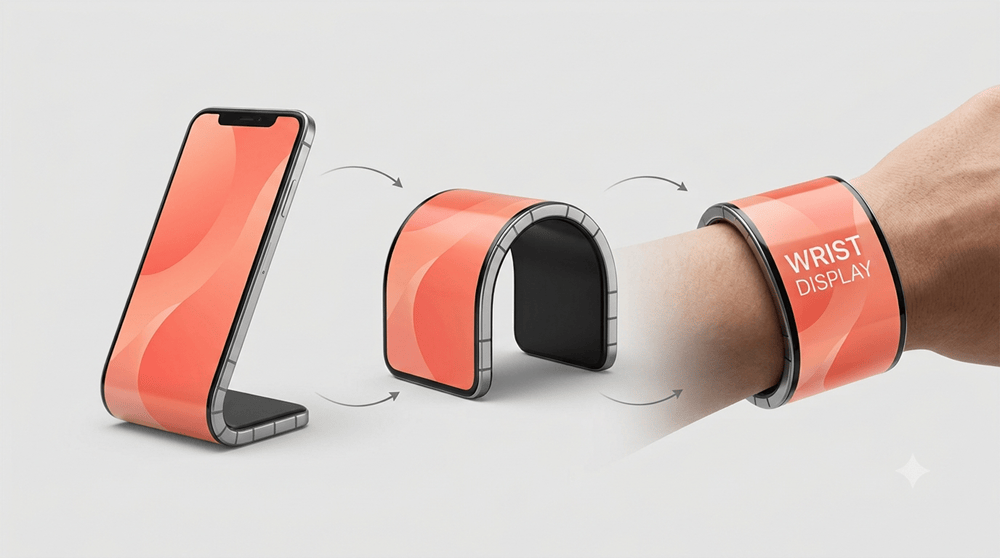
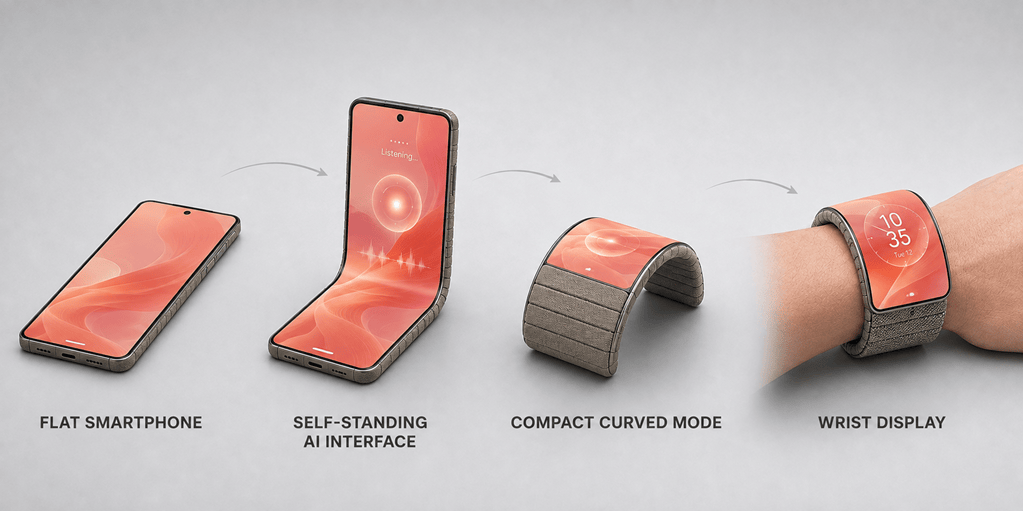
Conceptual illustration of an adaptive smartphone whose physical configuration changes how the device is carried, viewed, and used. Illustrative only; this is not a Motorola Mobility patent drawing or an announced commercial product.
The Hard Part Is Not the Flexible Screen
The demonstration shows what a user sees. The core patent shows how Motorola Mobility Llc is trying to make those shapes mechanically workable.
A flexible OLED can bend. A usable adaptive phone must also control where the body bends, keep rigid components away from high-strain regions, prevent unwanted reverse bending, hold the selected position, and preserve electrical continuity as sections move.
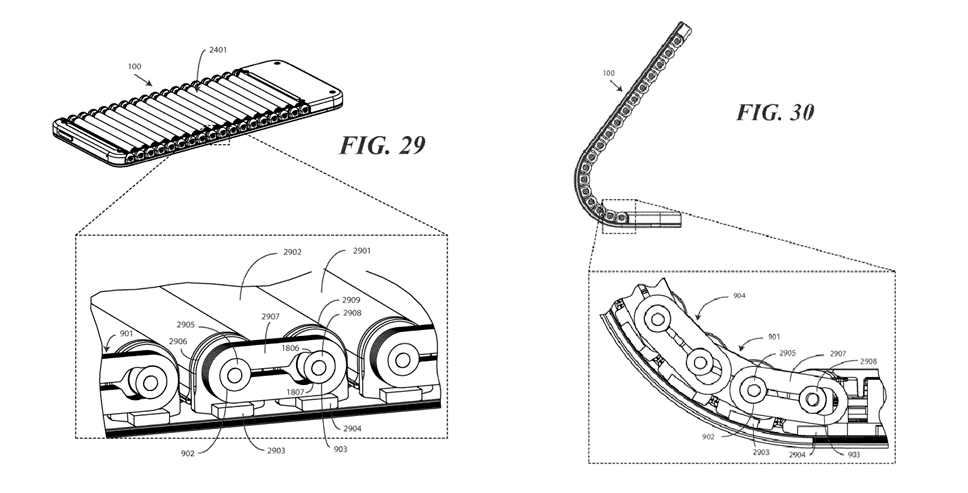
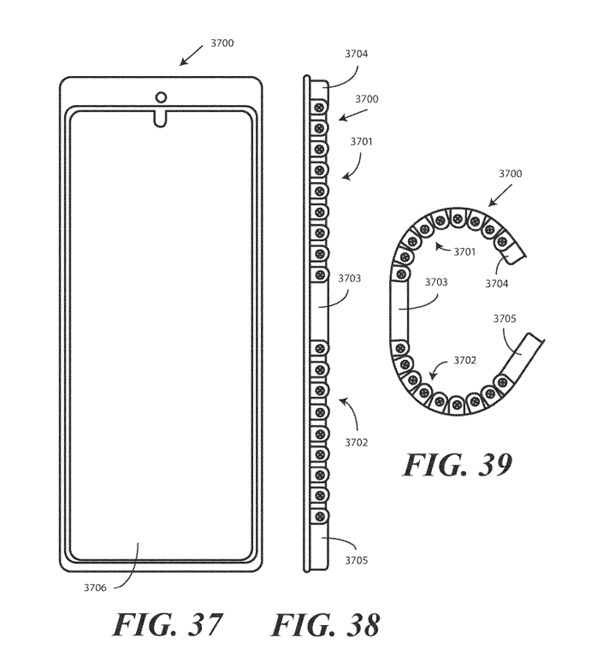
US12578763B2 uses a series of pivot shafts and links beneath the flexible substrate. One shaft can rotate inside a pivoting aperture, while another can rotate and translate inside a sliding aperture. That extra movement gives the structure room to change curvature rather than forcing all strain through a small number of hinge points.
Spreading small movements across many linked sections can reduce localized stress and create more controllable intermediate shapes. For R&D teams, the useful benchmark is therefore not the maximum bend. It is whether the complete device bends predictably, holds its shape, and continues to work after repeated use.
For competitors, a similar flexible panel is not enough. Support geometry, device thickness, bend limits, holding force, and fatigue life can all become meaningful differentiators.
Motorola Mobility Protected the Core Architecture Before the Public Reveal
The patent record shows that the core utility application was in place before Motorola Mobility publicly demonstrated the adaptive-display concept. The selected design applications were filed immediately before the reveal, and the corresponding rights issued later.
This sequence matters because it shows that the demonstration was supported by an earlier IP program rather than being only a visual concept. It does not, however, prove that the device was ready for mass production.
A patent can preserve a future product option while manufacturing cost, durability, repairability, production yield, and market demand remain unresolved.
The more important update is that Motorola Mobility public patent activity now reaches beyond the core mechanism. Selected related records address how the device could identify its shape, distribute battery load and heat, manage multiple display sections, and adapt a wrist-worn function to device orientation.
Taken together, these records create a broader analytical view of the adaptive-device stack. They are not all part of the same patent family and should not be read as one combined claim set. Their value is that they show several engineering layers Motorola Mobility is exploring around the same product idea.
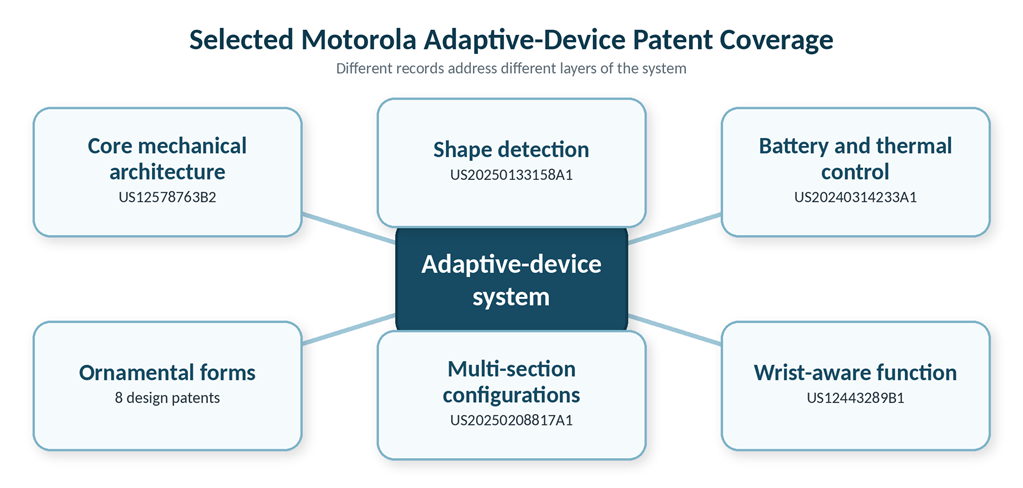
| Strategic takeaway: The commercialization question is no longer whether Motorola Mobility will explore shape sensing, battery control, or geometry-aware software. Public patent records already address those areas. The next signal is whether these layers are integrated into a durable and manufacturable product system. |
Shape Retention Matters More Than Extreme Flexibility
A phone that bends but cannot reliably stay where the user puts it would have limited practical value.
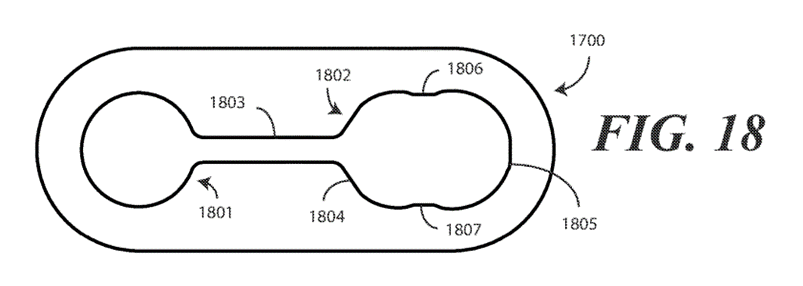
Motorola Mobility addresses this through friction built into the link mechanism. Patent FIG. 18 shows a pivoting aperture, a sliding aperture, and a compression slot. The slot allows the link to flex while interference between the shaft and aperture creates resistance.
Independent claim 1 specifically includes the compression slot and the friction-producing relationship. In practical terms, the mechanism is intended to help the phone hold a selected shape until the user bends it again.
That makes useful stopping positions more important than simply achieving the tightest possible bend. A device that can reliably hold angles for video calls, photography, desk use, or content viewing may be more useful than one that only demonstrates extreme flexibility.
For R&D teams, a key test is whether holding force remains consistent after thousands of bend cycles. A device may remain mechanically intact yet become too loose to support itself or too stiff to reshape comfortably.
Competitors could deliver the same user benefit with a different articulated structure, magnetic retention, elastic resistance, or another mechanism. For IP teams, the relevant question is whether the competing structure uses the relationships covered by Motorola Mobility claims, not simply whether it produces a bendable phone.
Battery Packaging Is One of the Hardest Commercialization Constraints
Flexible displays receive most of the attention, but batteries create a harder packaging constraint. In a normal smartphone, large rigid cells can occupy continuous internal space. In a device that bends across much of its body, rigid components have to be arranged around moving regions.
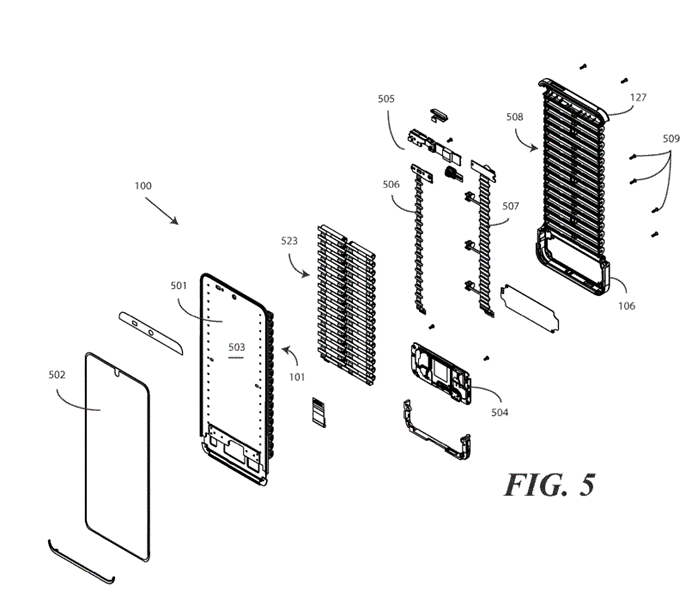
US12578763B2 addresses this by distributing rechargeable cells between structural supports. Independent claim 18 makes the integration especially relevant: it recites paired stanchions, interleaved link groups, rechargeable cells, electronic circuitry, and a flexible display as parts of the same device architecture.
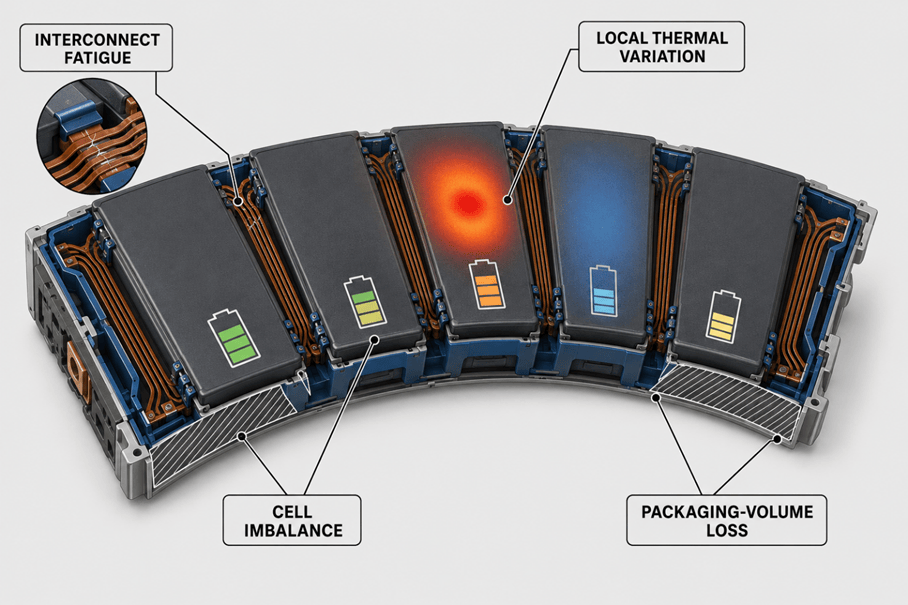
The specification also routes flexible conductors beneath battery regions to connect cells and electronics across the deformable structure. This arrangement can help keep relatively rigid cells away from primary bending regions, but it also increases system complexity. More modules mean more electrical connections, packaging gaps, thermal zones, and less continuous volume for energy storage.
A related Motorola Mobility application, US20240314233A1, extends the problem from physical packaging into operating control. It describes multiple energy-storage devices and a thermal-mitigation circuit that can select which cells supply power according to how the device is held or supported and its geometric configuration.

In practical terms, the system can draw more power from cells farther from a user’s hand or distribute heat differently when the device is resting on a surface. The strategic point is that a segmented battery architecture may require active thermal and power management, not only careful placement of cells.
The patent records do not provide long-term battery-aging, bend-cycle, or real-world thermal test data. Those remain commercialization questions rather than demonstrated Motorola Mobility weaknesses.
A company may gain an advantage through thinner cell modules, more durable flexible interconnects, better thermal isolation, faster fault detection, or smarter multicell balancing even without a better flexible display.
Utility and Design Patents Create Two Different Design-Around Questions
The utility patent focuses on functional structure, while the selected design patents protect ornamental appearance.
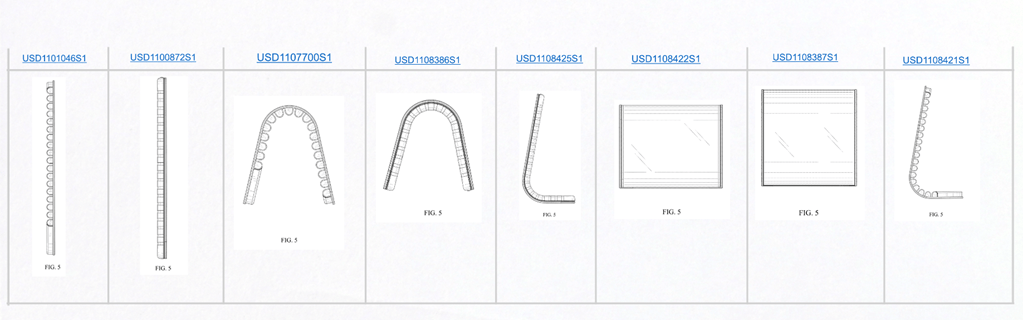
Each of the eight selected U.S. design patents is titled Display and claims the ornamental design shown in its drawings. The number of design patents matters less than how their claimed views differ. A side-by-side comparison can reveal differences in curvature, side profile, terminal shape, and other visible features.
1. Functional question: Can a similar product mode be built without using the structural relationships covered by Motorola Mobility utility claims?
2. Visual question: Can the product use a sufficiently different ornamental appearance from the issued design patents?
Solving one question does not automatically solve the other. A different mechanism may still raise a design-patent issue, while a different exterior may still use a utility-patented structure.
The eight design patents are therefore more useful as a visual comparison set than as a simple patent count.
The Software Has to Know the Phone’s Shape
Hardware alone is not enough. The software has to recognize the device’s current shape and adapt the interface or function to it.
Motorola Mobility demonstrated this at a basic level: the flat concept uses the full 6.9-inch display, while the upright self-standing mode presents a more compact Android experience on a smaller visible portion of the screen.
The specification of US12578763B2 discusses flex sensing, geometry detection, display partitioning, and changing content presentation as the device bends. A screen wrapped around a wrist or partly hidden from view cannot use the same interface as a fully flat display.
US20250133158A1 addresses this layer more directly. It describes magnet–magnetometer pairs positioned in neighboring linkage members so that processors can identify predefined deformation states, including wrap, L-shaped, and tent-shaped configurations. The detected state can then be used by applications to adjust where and what content is presented.

This turns physical geometry into another software input. Phones already respond to orientation, motion, ambient light, and proximity; an adaptive device can also respond to its own shape.
US12443289B1 provides a narrower but concrete example of that idea. In a wrapped, wrist-worn configuration, sensors detect changes in orientation and processors move a flashlight output along the flexible display. The record does not establish broad ownership of every geometry-aware interface, but it shows how shape and orientation can control a particular device function.

The IP distinction matters. The core utility patent’s issued claims focus mainly on physical architecture. The deformation-state application and wrist-function patent address different features with their own claim language. Analysts should therefore compare claim scope record by record rather than treating every software discussion as one broad right.
Motorola Mobility Is Exploring More Than One Adaptive-Device Architecture
The core mechanical patent describes a flexible display supported by a linked structure. A separate Motorola Mobility application, US20250208817A1, describes a different multi-section approach.
In that record, a first section and a third section can carry displays while an intermediate section is display-free. The displays can sit on different sides, face opposite directions, or form tent, stand, and wrist-wearable configurations. The processors can also divide content between displays or stop content on one display depending on the geometry.
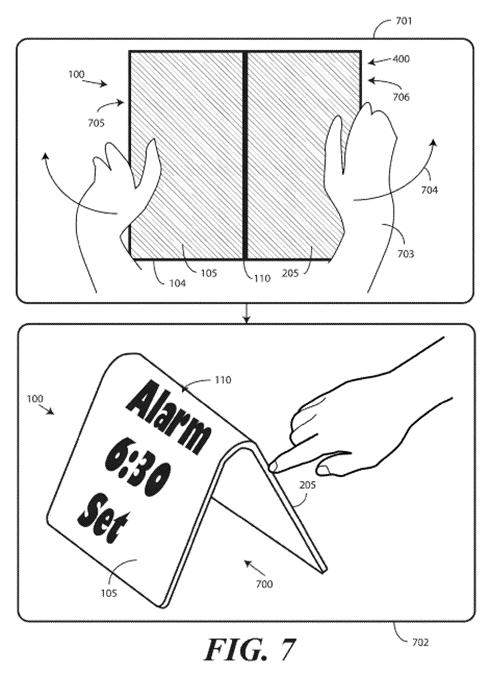
Strategically, this suggests that Motorola Mobility is not limiting its exploration to one physical stack. A future adaptive device could use one continuous flexible display, multiple display-bearing sections, or another architecture that delivers similar modes. The application broadens the design-around analysis, but it does not prove that the demonstrated concept uses that architecture or that Motorola Mobility intends to commercialize it.
Standing Mode Could Be More Useful Than Wrist Mode
The wrist-worn mode is the most visually striking part of the concept, but the self-standing modes may have broader everyday use.
Wrist use introduces additional constraints around fit, weight, heat, impact, comfort, accidental touch, and screen visibility. Self-standing use requires less change in user behavior and could support video calls, camera framing, content viewing, fitness instruction, desk-based interaction, translation, and hands-free assistant use.
These are ordinary use cases, but that is the point. Repeated everyday utility may matter more than novelty. A new form factor does not have to replace another device category; it only has to create enough useful moments to justify its added mechanical complexity.
Standing, tent, and wrap configurations appear across the selected mechanical, shape-detection, and multi-section records. That does not prove commercial intent, but it makes these modes important for product testing and claim mapping.
A more useful product question is therefore not whether people will wear a phone on the wrist, but whether enough recurring tasks become easier when the phone can position itself without a separate stand or accessory.
If the answer is yes, standing and partial-bend modes may justify much of the added complexity even if wrist wear remains occasional.
What These Patents Do Not Mean
The selected patent set should not be read as proof that Motorola Mobility is preparing to launch this exact device.
It does not establish production volume, final industrial design, battery performance, durability, manufacturing yield, repairability, commercial timing, or market demand.
It also does not mean Motorola Mobility owns the broad concept of a bendable or wrist-worn phone.
The records cite earlier work associated with Samsung, LG, Flexterra, Lenovo, TCL, ZTE, Oppo, and others across flexible devices, wearable displays, foldable phones, shape-retaining structures, and flexible-screen support systems.
That prior art changes the strategic interpretation. Motorola Mobility opportunity is not to control flexibility as a category. Its stronger position is more likely to exist where specific mechanical architecture, shape retention, battery packaging, deformation sensing, industrial design, and adaptive functions intersect.
The selected records should not be treated as a complete freedom-to-operate assessment. A competitor would also need to examine display-layer patents, alternative support mechanisms, batteries, antennas, sensors, thermal systems, interface software, foreign rights, prosecution history, and third-party claims.
Published patent applications may also change during examination. Their current text is useful for understanding technical direction, but it should not be treated as fixed issued claim scope.
The patent set is best treated as an IP signal about where Motorola Mobility has invested engineering effort, not as a complete map of who controls the category.
Where Competitors Can Still Differentiate
As flexible displays become more available, differentiation can shift to the systems around the panel.
Motorola Mobility selected records highlight several layers: movement control, shape retention, battery and electronics packaging, deformation sensing, thermal control, multi-section configurations, exterior design, and geometry-aware functions. Competitors can approach every layer differently.
A competing product does not need to copy Motorola Mobility complete architecture to create a similar user experience. It could use a different spine, a different retention mechanism, a different battery layout, fewer engineered states, or stronger software around a simpler physical structure.
The strongest commercial position may therefore come from integrating enough of these layers reliably and economically rather than leading on the flexible display alone.
For competitive intelligence, raw patent counts will not answer the most important question. The useful comparison is which companies are solving the same product problem, which technical route they are taking, and where claim scope may constrain or preserve design-around options.
What Still Needs to Mature Before Commercialization
The broader patent set changes one conclusion from the earlier analysis: shape detection, battery control, thermal management, multi-mode configuration, and geometry-aware software are no longer merely hypothetical filing areas. Motorola Mobility already has public records in those directions.
The stronger commercialization signals should therefore be more concrete. Watch for bend-cycle and holding-force data; stable interconnect resistance; battery aging and cell balancing; thermal behavior in different shapes; sealing and drop performance; repair methods; sensor calibration; false mode-detection rates; manufacturing tooling; supplier activity; certification work; and developer support.
A practical product may also use a limited number of engineered states flat, standing, tented, partly curved, and wearable rather than allowing unrestricted free-form bending. Defined states are easier to detect, test, support in software, and explain to users.
Patents show solution concepts and strategic options. They do not show that the complete system can be manufactured at acceptable cost and remain reliable through years of everyday use.
What IP, R&D, and Business Teams Should Track Next
The next step is not simply to count Motorola Mobility patents. Track whether claim scope, engineering evidence, and public commercialization signals begin to connect the separate layers of the adaptive-device system.
| Stakeholder | Signal to Track | Strategic Relevance |
| IP teams | Continuations, claim amendments, alternative mechanisms, design filings, deformation-sensing claims, segmented-battery claims, multi-display claims | Shows where protection is expanding and where design-around space may remain |
| R&D teams | Holding-force consistency, bend-cycle durability, interconnect resistance, temperature distribution, cell balance, sealing, drop performance, sensor calibration | Tests whether the complete device remains mechanically, electrically, thermally, and digitally stable |
| Innovation teams | Which physical states solve repeated user problems and whether transitions between states feel natural | A memorable form factor matters only if people use its modes often |
| Competitive-intelligence teams | Competitor approaches to spines, retention, batteries, shape sensing, multi-display layouts, and adaptive software | Similar experiences may emerge from very different architectures and claim positions |
| Business teams | Suppliers, tooling, certifications, repair plans, durability evidence, software identifiers, and developer support | These are stronger launch signals than patent publications alone |
A Product-Mode Claim Map Is More Useful Than a Patent Count
Map the flat, standing, tented, partially curved, and wrist-worn modes against the utility claims, design drawings, and related functional records.
Claim 1 of US12578763B2 focuses on distributed pivoting, sliding, and friction created through the compression-slot relationship. Claim 18 combines paired stanchions, interleaved inner and outer link groups, rechargeable cells, circuitry, and the flexible display. Claim 21 separately covers the core sliding-link architecture with pivot shafts supported by stanchions, without the compression-slot limitation stated in claim 1.
The related records add different questions. US20250133158A1 is relevant to how a mode is detected. US20240314233A1 is relevant to how power and heat may be managed in different support conditions and geometries. US20250208817A1 is relevant to multi-section and multi-display configurations. US12443289B1 is relevant to a specific orientation-responsive function in wrist mode.
The practical question is not simply how many patents Motorola Mobility has. It is which user-visible modes are difficult to reproduce without using a claimed structure or function, and which can be delivered through a different technical route.
The Bigger Bet Is Shape as Part of the Interface
The flexible display is the easiest part of Motorola Mobility concept to notice, but the selected patent records show that the harder challenge is system integration.
The device has to bend without concentrating stress, retain useful shapes, package rigid components around moving regions, keep electrical connections reliable, manage heat and battery load, identify its current geometry, and adapt content or functions to the visible part of the display.
Each problem creates a separate opportunity for engineering differentiation and patent protection. Motorola Mobility does not need to own the broad idea of a bendable phone to build a meaningful position. It needs to protect and integrate enough of the technologies that make changing shape useful, reliable, and manufacturable.
For IP teams, the priority is claim scope and design-around space. For R&D teams, it is whether the complete system remains mechanically, electrically, thermally, and digitally stable after repeated deformation.
For product and business teams, the question is which physical modes solve recurring problems and whether the concept can be manufactured, supported, and repaired at scale.
If adaptive devices become meaningful, the advantage may not be how far a phone bends, but what it becomes after bending.
Shape Is Becoming a System-Level Differentiator
Motorola Mobility selected patent records suggest that adaptive-display innovation extends well beyond a flexible screen. The more important competitive layer is how mechanical design, shape retention, battery and thermal management, deformation sensing, multi-mode configurations, and software work together as one usable system.
For IP, R&D, and business teams, the key question is not simply who has the most flexible-device patents, but which companies are solving the hardest integration challenges and where those solutions create meaningful patent protection, design-around opportunities, or commercialization signals.
Discover What Competitors May Be Building Next
Patents can reveal where companies are investing before new products reach the market. Tracking filings can help identify emerging technologies, competitor priorities, and potential innovation opportunities.
A broader patent analysis can show how Motorola Mobility adaptive-device strategy compares with other players across flexible displays, battery systems, sensing, mechanical architectures, and adaptive software.
Want to know who else is working on similar technologies and where the strongest opportunities or design-around spaces may exist? Explore our deeper patent intelligence analysis.
