
A patent intelligence analysis of how NASA’s VTOL research evolved from aircraft architecture to noise, navigation, autonomy, infrastructure, and scalable operations.
Air taxis are beginning to move out of presentation decks and into real-world aviation trials. In March 2026, the Federal Aviation Administration selected eight proposals for its eVTOL Integration Pilot Program, intended to test next-generation aircraft in real operating environments. A few months later, BETA Technologies and United Therapeutics participated in an FAA-backed medical-transport demonstration using electric aircraft.
Source: FAA eVTOL Integration Pilot Program announcement
But getting a vertical-takeoff aircraft into the air is only one part of the problem.
It also has to transition efficiently from hover to cruise. It needs to remain stable when gusts hit. It must avoid becoming an unacceptable source of community noise. It has to know where it can safely land. Its navigation system must remain dependable when tall buildings obstruct satellite signals. And as automation increases, the aircraft needs to know which decisions should remain with the human operator and which can safely move to the machine.
Those are exactly the kinds of problems that appear across NASA’s VTOL patent activity.
NASA’s Advanced Air Mobility mission remains active and says its work is intended to provide industry and the FAA with data needed to develop and integrate electric air taxis, drones, and other advanced aircraft. Its research extends beyond vehicle design into automation, noise, vertiports, and airspace integration.
Source: NASA Advanced Air Mobility mission
Our analysis of 19 curated NASA VTOL patent-family records shows a similar evolution. The earliest patents are dominated by the aircraft itself – rotors, thrust vectoring, transition from hover to forward flight, and alternative wing architectures. The newer patents increasingly move outward from the aircraft.
They address noise, aerodynamic modeling, turbulence, vertiport planning, vision-based landing, GNSS reliability, and human-autonomy interaction.
| Strategic takeaway NASA’s portfolio appears to be moving from “How do we make VTOL fly?” toward “How do we make VTOL practical enough to operate at scale?” |
NASA’s VTOL Patent Portfolio Has Expanded Beyond Aircraft Design
Of the 19 curated patent records analyzed, aircraft architecture remains the largest technical area. But the more important signal sits in the other half of the portfolio: more than half of the analyzed records address technologies beyond simply creating vertical lift.
| Technology area | Curated patent records | Approx. share |
| Aircraft architecture, propulsion & VTOL configuration | 8 | 42% |
| Autonomy, navigation & flight control | 7 | 37% |
| Aerodynamic modeling | 2 | 11% |
| Noise mitigation | 1 | 5% |
| Vertiport infrastructure | 1 | 5% |
That matters because commercial AAM will not succeed solely because someone builds the best eVTOL airframe. It will depend on whether the whole operating system around that airframe works.
NASA’s First Problem Was the Fundamental VTOL Trade-Off: Hover vs. Cruise
One of the earliest inventions in the dataset is US10071801B2, whose priority chain reaches back to August 2013.
The problem behind the patent remains central to modern eVTOL design. Aircraft that hover efficiently and aircraft that cruise efficiently typically want very different aerodynamic architectures. Rotary-wing aircraft can hover but sacrifice some of the efficiency associated with wing-borne forward flight. Fixed-wing aircraft are efficient in cruise but ordinarily require runway infrastructure.
NASA’s patent tries to combine the two. The disclosed tri-rotor aircraft can operate as a rotorcraft during vertical flight and as a fixed-wing aircraft during forward flight. A front rotor changes orientation during the transition, while the tail-mounted rotors contribute to vertical flight and can be deactivated or reconfigured during cruise.
The important point is not that NASA patented a three-rotor aircraft. It is the engineering trade-off underneath it: how much VTOL hardware can an aircraft carry without compromising the flight phase in which that hardware is no longer required?
That same question continues to influence modern eVTOL architectures. Tilt rotors, tilt wings, lift-plus-cruise systems, stopped rotors, and distributed propulsion are essentially different answers to the same problem.

NASA Then Started Making Thrust Do More Than Produce Lift
By 2017, NASA was investigating a more flexible interpretation of VTOL control. US11613349B2 describes a VTOL aircraft capable of continuously varying its pitch attitude while hovering.
Rather than forcing the airframe to remain in one conventional hover orientation, articulating thrusters can change their direction and allow the aircraft to hover horizontally, vertically, or at intermediate orientations. The patent also describes maintaining stability using vectored thrust and rotor-speed control.
That changes the role of propulsion. A propeller no longer exists only to provide lift or forward thrust. It becomes part of the aircraft control architecture.
This is increasingly significant for electrically propelled VTOL aircraft because multiple independently controlled motors create opportunities to manipulate aircraft motion through differential thrust. NASA’s patent even considers adapting aircraft attitude to sloped or moving landing surfaces.
| Technology evolution Early VTOL question: How should the rotors move between hover and cruise? Next question: How much of the aircraft’s attitude can be controlled by the thrust system itself? |

NASA Is Also Asking Whether Airflow Can Replace Mechanical Complexity
Another highlighted family, represented by GB2623011B / WO2023278690A1, takes a different route. Instead of solving VTOL transition entirely by rotating propellers or rotating the wing, the invention combines a deflected propeller slipstream with coflow-jet flow control.
The patent identifies several drawbacks in conventional VTOL approaches: rotating wings or propulsors require actuators that add weight and complexity, while separate hover and cruise propulsion systems leave parts of the aircraft unused during portions of the flight.
The disclosed system uses propeller airflow over highly deflected flaps. Within the flap, suction and injection openings connected through a compressor manipulate the airflow to help maintain attached flow and generate lift at high flap deflections.
This represents another way of attacking the same commercial problem. Rather than asking how to build a better mechanism for moving the propulsor, NASA and Coflow Jet are effectively asking whether airflow can be manipulated strongly enough that less mechanical transformation is required.
For R&D teams, that distinction matters. A significant portion of eVTOL differentiation may ultimately come not from the number or placement of propellers, but from how intelligently their airflow is used.

Then the Problem Changed: Can a City Tolerate Hundreds of These Aircraft?
An aircraft can be safe, efficient and technically impressive and still face resistance if every flight becomes audible across the neighborhoods below it.
NASA has been treating community noise as a design and operational problem. US11312478B2, with a 2017 priority, describes an adaptive phase-control architecture for aircraft using distributed propulsion.
Multiple propellers produce tonal noise that can interact depending on the relative angular positions of their blades. NASA’s system estimates acoustic conditions for observers on the ground and determines combinations of relative propeller phases intended to reduce noise in designated areas.
The unusual insight here is that noise is not treated solely as something fixed when the propeller is manufactured. It becomes something that can potentially be actively managed during flight.
NASA’s wider AAM research also reflects this concern. The agency has developed tools and conducted testing intended to help manufacturers predict and reduce eVTOL noise and to support low-noise route planning.
Source: NASA AAM noise research
| Commercial implication Aircraft performance determines whether an eVTOL can fly a route. Noise may determine how often it is allowed to fly that route. That makes acoustics a scalability problem, not merely a comfort issue. |

In 2020, NASA’s Patent Portfolio Left the Aircraft and Moved Onto the Ground
Perhaps the clearest evidence that NASA is looking at the wider AAM ecosystem is US20220067863A1 Vertiport Assessment and Mobility Operations Systems.
The invention is not a new aircraft. It is a system for deciding where the aircraft should land.
The patent evaluates possible vertiport locations using factors such as noise, zoning, proximity to public transportation, fire stations, hospitals, power infrastructure, and other geographic considerations. The system divides a geographic area into subregions, assigns values and weights to relevant factors, and identifies areas whose combined suitability exceeds a defined threshold.
That might sound more like urban planning software than aerospace IP. That is precisely why the patent is strategically interesting. Commercial VTOL deployment depends not only on whether an aircraft can land vertically, but whether there are enough legally, socially, and operationally viable places for it to land.
NASA’s High Density Vertiplex research has similarly investigated vertiport automation, interactions between aircraft, air-traffic systems and vertiport infrastructure, and the management of higher-density operations.
Source: NASA Advanced Air Mobility vertiport research
An eVTOL with a 100-mile range is much less valuable if useful landing sites are too far apart. So vertiport availability can effectively become part of the aircraft’s usable performance envelope.

NASA Is Patenting How to Understand an Aircraft Before It Is Flown
One of the less visible but strategically important patents is US11983467B2 Rapid Aero Modeling for Computational Experiments (RAM-C).
The invention applies rapid aerodynamic modeling techniques to computational experiments such as CFD to generate aerodynamic models suitable for flight-dynamics studies and simulation. The patent specifically contemplates applications including Lift+Cruise vehicles and rotorcraft.
Why does that matter? Conventional aircraft already require substantial aerodynamic modeling. VTOL architectures make the problem harder because their airflow can change dramatically between hover, transition, cruise, descent, and landing. Multiple rotors also interact with wings, fuselages and each other.
A new eVTOL architecture therefore does not only need a novel configuration. It needs a trustworthy digital understanding of how that configuration behaves across the flight envelope.
For R&D organizations, modeling IP can be as strategically useful as vehicle hardware IP. Better models can mean fewer physical test iterations, faster design evaluation, better controller development, earlier identification of unstable configurations, and improved simulation of off-nominal conditions.
NASA Is Using Propellers as a Turbulence-Control System
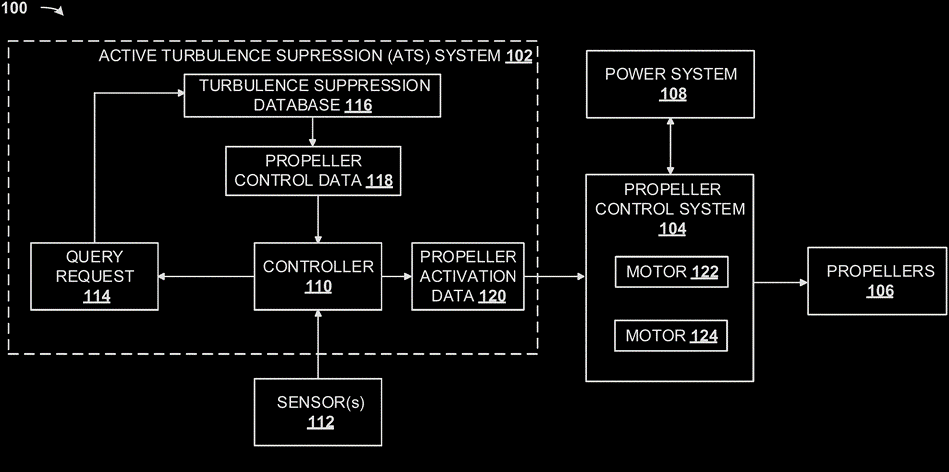
That connection between modeling and control becomes particularly visible in US20230264827A1, NASA’s active turbulence-suppression invention.
NASA points out that eVTOL aircraft can be relatively lightweight and operate at lower altitudes, making them susceptible to gust-induced motion such as Dutch-roll oscillation.
Source: NASA Active Turbulence Suppression technology
Its solution avoids adding another dedicated stabilization mechanism. Instead, the aircraft uses propellers it already has. When the system detects that the aircraft is moving toward an undesirable roll condition, it can retrieve pre-computed turbulence-suppression data and alter the speed of selected lift propellers. Those propellers then generate forces that counter the gust-induced roll moment.
This is one of the most interesting architectural patterns in NASA’s portfolio. The same hardware can serve multiple roles: takeoff system – landing system – stabilization actuator.
That kind of functional consolidation can be especially valuable in electric aircraft, where every additional actuator, structure and kilogram affects range.
What Happens When GPS Becomes Unreliable Exactly Where the Air Taxi Needs to Land?
A future air taxi approaching a vertiport between tall buildings has a different navigation problem from a commercial aircraft approaching an open airport. Buildings can obstruct or reflect satellite signals, and the consequences become more serious as aircraft operations become more automated.
NASA’s Vision-Based Approach and Landing System (VALS) addresses that problem. The system uses an onboard camera to detect known visual landmarks around the landing site. Those landmarks are matched against stored information to estimate the aircraft’s position and orientation. The estimate is then combined with inertial information through an extended Kalman filter to refine the aircraft state allowing the system to provide alternative position, navigation and timing information when GPS is unavailable or unreliable.
Source: NASA Vision-Based Approach and Landing System
The strategic point is not that NASA has created another camera-navigation system. It is that future AAM systems may require layered navigation architectures. GPS may be the primary input, but safe automated operation increasingly requires the aircraft to know what to do when the primary input stops being dependable.
Another NASA Patent Tries to Predict GPS Weakness Before the Aircraft Gets There
A related patent goes one step further. US12625278B2, co-assigned to NASA and MITRE, uses terrain information and satellite-orbit data to predict satellite visibility and GNSS performance across a geographic area.
The system can calculate where combinations of visible satellites are likely to provide better or worse positioning quality and use that information to support aircraft operation or route planning.
| Layered navigation strategy Before the flight: predict where satellite navigation will weaken. During approach: use alternative vision and inertial navigation when GPS becomes insufficient. |
That is a more sophisticated safety architecture than treating GPS loss purely as an emergency. It is about anticipating navigation degradation before it occurs.
NASA’s Latest Autonomy Patents Suggest Removing the Pilot Is Not the Immediate Question
The autonomy section of the dataset is one of its strongest signals. But NASA’s work does not simply ask how to replace the pilot. It asks something more practical: which tasks should the human perform, and when should automation take over?
NASA’s US12172660B2 describes dynamic function allocation between a human operator and an automated or autonomous system. The system can consider the operator’s cognitive or physical state and redistribute tasks when the human becomes distracted, incapacitated, overloaded or otherwise unable to perform them optimally.
A continuation, US12703379B2, expands the work to include monitoring an operator’s visual attention to areas of an operating panel. The continuation was granted in August 2026 and traces back through the earlier application and its 2021 provisional priority.
That is an important distinction for AAM. The path may not be pilot – no pilot. It may instead be pilot-controlled – automation-assisted – dynamically shared control – supervised autonomy – higher autonomy.
NASA itself continues to research increased automation throughout AAM, including automated vehicle functions and airspace management.
Source: NASA Advanced Air Mobility automation research
For IP and R&D teams, human-autonomy collaboration may therefore represent a major transitional technology category even if fully autonomous passenger air taxis eventually become technically feasible.
NASA’s Patent Timeline Shows the Problem Moving Outward
The strongest way to read this portfolio is chronologically. The inventions show the technical problem expanding from aircraft geometry into the surrounding operating ecosystem.
Technology evolution over the time –
| Period | Representative invention | Engineering problem | Strategic shift |
| 2013 | US10071801B2 | Hover-to-cruise transition | Make VTOL and efficient forward flight coexist |
| 2015 | US10370100B2 | Aerodynamic thrust vectoring | Improve propulsion/control flexibility |
| 2017 | US11613349B2 | Variable aircraft attitude in hover | Turn thrust into flight control |
| 2017 | US11312478B2 | Distributed-propulsion noise | Make VTOL more acceptable to communities |
| 2020 | US11983467B2 | Rapid aerodynamic modeling | Understand complex configurations faster |
| 2020 | US12006030B2 | Distributed propulsion + fixed wing angle | Reduce transition hardware and mass |
| 2020 | US20220067863A1 | Vertiport assessment | Extend the problem into ground infrastructure |
| 2021 | GB2623011B family | Deflected slipstream + coflow jet | Replace some mechanical complexity with airflow control |
| 2022 | US20230264827A1 | Turbulence suppression | Use existing propulsion for stability |
| 2022 | VALS family | GPS-denied approach and landing | Build navigation redundancy |
| 2022/23 | US12625278B2 | GNSS-performance prediction | Anticipate navigation degradation |
| 2021 onward | US12172660B2 / US12703379B2 | Human-autonomy collaboration | Prepare for higher levels of automation |
Portfolio progression
Make VTOL fly → Make VTOL practical → Make VTOL resilient → Make VTOL scalable
NASA Is Not Another Joby or Archer – and That Makes Its Patents More Interesting
Commercial eVTOL manufacturers ultimately need to sell aircraft or operate transportation services. NASA plays a different role. Its active AAM programme says it provides research and data intended to help industry develop these technologies and help the FAA integrate them into U.S. airspace.
Some NASA technologies are also openly presented as licensing opportunities. Both the Vision-Based Approach and Landing System and Active Turbulence Suppression System are presented through NASA’s Technology Transfer portal with licensing pathways.
That makes NASA’s patent portfolio relevant to commercial eVTOL companies in three different ways.
- NASA patents can form technically important prior art. An OEM entering a seemingly new area may discover NASA investigated the underlying architecture years earlier.
- NASA may represent a technology source rather than simply an IP obstacle. Some patented systems can potentially be licensed instead of independently recreated.
- NASA’s filings identify engineering bottlenecks. If NASA has spent years patenting solutions around turbulence, noise, navigation, and human-autonomy interaction, commercial R&D teams should at least ask whether those same problems exist in their own roadmaps.
The better competitive question
Which companies are solving the same technical problems – and are they solving them in fundamentally different ways?
NASA’s VTOL Patents Are Only One Side of the Competitive Story
NASA’s portfolio shows how researchers have approached some of the hardest technical problems in advanced air mobility: VTOL transition, distributed propulsion, community noise, airflow management, turbulence suppression, navigation redundancy, vertiports, and human-autonomy collaboration.
But it does not answer the bigger competitive question: how does NASA’s position overlap with Joby, Archer, Wisk, BETA Technologies, Eve, and other companies trying to commercialize advanced air mobility?
A deeper patent landscape can compare how these organizations are protecting solutions across:
- VTOL architecture
- tilt/lift-plus-cruise propulsion
- distributed electric propulsion
- transition control
- acoustic management
- gust and turbulence response
- autonomous approach and landing
- GPS-denied navigation
- flight-control systems
- vertiport technologies
- human-autonomy collaboration
For IP teams, that can reveal earlier foundational patents, potentially overlapping claim territory, licensing options, design-around opportunities, and white spaces. For R&D teams, it can show which engineering problems competitors are solving differently and which architectures are attracting concentrated patent activity.
Want to know where NASA’s VTOL IP overlaps with the companies commercializing air taxis? Request the deeper NASA vs. eVTOL competitor patent landscape.
NASA’s Patents Suggest the Hardest Part of the Air Taxi May Not Be the Air Taxi
When NASA’s VTOL patents are viewed individually, they look like a diverse collection of aerospace inventions: a tri-rotor aircraft, a thrust-vectoring system, a noise-control method, a vertiport-planning platform, an aerodynamic-modeling system, a turbulence controller, a vision-based landing system, a GNSS-performance predictor, and a human-autonomy framework.
Seen chronologically, however, they tell a much more coherent story.
NASA began with the aircraft. How should it take off vertically? How should it transition? How can propulsion and airflow reduce the compromises between hovering and cruising?
Then the portfolio moves outward. Can the community tolerate the noise? Can we accurately model unconventional flight behavior? Can passengers tolerate turbulence? Where will the aircraft land? What happens when GPS is blocked? How should increasingly autonomous aircraft share responsibility with humans?
The technical challenge therefore expands from a vehicle into an ecosystem.
| Final takeaway The aircraft may be the product. But the defensible technology stack extends far beyond the aircraft itself. |
That is where NASA’s VTOL patent activity becomes particularly valuable – not as a prediction of which air-taxi design will win, but as a record of the engineering problems the industry still has to solve.

