
| Patent | EP4147535B1 | Assignee | JUUL Labs Inc |
| Title | Vaporizer device with variable booster circuit | Patent Filed | 07 May 2021 |
| Granted | 10 Dec 2025 | Estimated Expiry | 07 May 2041 |
| Opponent | JT International Sa | Opponent Firm | EIP |
| Opposition Filed | 10 Sep 2026 | Opposition Status | Pending |
Patent oppositions don’t make headlines often. But when one of the industry’s most-watched IP players files a 23-document challenge against a freshly granted vaporizer patent, it’s worth paying close attention – especially if your own products or R&D pipeline touch the same technical space.
In September 2026, JT International filed an opposition at the EPO against JUUL’s European patent on vaporizer power management. If you’re tracking competitor IP, assessing your freedom to operate in Europe, or building a product that involves heating element control, this case is directly relevant to you.
This article breaks down what the patent actually covers, what JTI’s evidence is arguing, and what the outcome could mean for IP, R&D, and business decisions across the industry.
JUUL Labs received the European grant for EP4147535 in December 2025. JTI filed its opposition at the EPO near the end of the available nine-month window.
JTI used almost the full opposition window. The significance is less about timing itself and more about the breadth of the evidence submitted. The EPO gives opponents exactly nine months from the grant date to file. Companies that use the full window are usually the ones that spent those months building a strong case rather than rushing one. JTI submitted 23 documents – a large stack for an EPO opposition – which tells you this is a serious, well-resourced challenge.
What’s at stake here isn’t a minor patent. EP4147535 covers how a vaporizer adapts power delivery to maintain consistent heating performance as battery voltage changes and heating-element characteristics shift during use. If it holds, it blocks a specific class of power management designs in European e-vaporizers until 2041. If JTI wins, that space opens up.
What This Patent Actually Protects
EP4147535 covers one specific thing: how a vaporizer manages power to its heating element when the battery starts running low.
Here’s the problem it solves in plain terms. As a battery drains, it delivers less voltage. If your vaporizer just passes whatever the battery gives to the heating coil, the experience gets worse over time – less vapour, lower temperature. JUUL’s patent fixes this with a smarter power circuit.
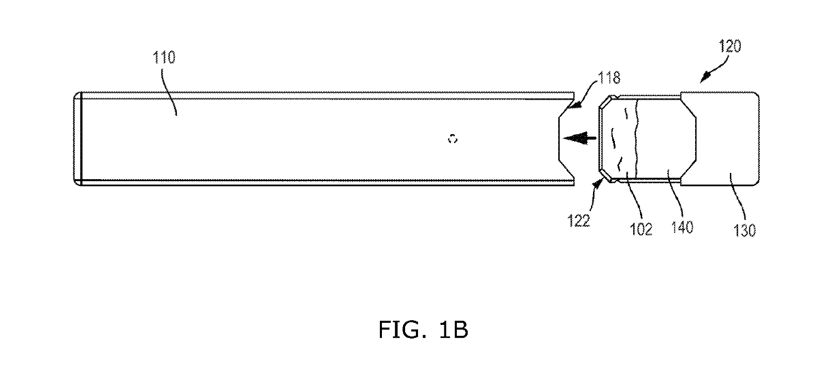
The circuit works in two modes. When the battery still has enough juice, it runs in bypass mode – power flows through at battery voltage, but the controller chops it on and off rapidly to control how much heat is delivered. When the battery drops too low, it switches to non-bypass mode – it actively boosts the voltage above what the battery can provide to keep the heating element performing.
What makes this patentable isn’t the boost circuit alone, or the chopping alone. It’s the combination: a controller that reads the heating element’s condition in real time, decides which mode to use, and switches between two fundamentally different ways of controlling power – all automatically.
The patent covers this as both a device (Claim 1) and a method (Claim 15). For JTI’s opposition to fully clear the space, it needs to knock out both. Killing one doesn’t kill the other.

What JTI Is Actually Arguing
JTI submitted 23 documents. That’s a lot. Most EPO oppositions don’t go anywhere near that number. It tells you two things: this is a well-funded challenge, and JTI isn’t betting everything on one piece of prior art.
The documents split into two groups, each making a different argument.
“This already existed in vaporizer patents”
The first group pulls from the e-cigarette patent world itself – documents filed between 2013 and 2021. The oldest ones, E6 (2015) and E11 (2013), predate JUUL’s filing by six to eight years.
JTI’s argument here: the idea of controlling power delivery to a vaporizer heating element wasn’t new when JUUL filed in 2021.
But there’s a catch. Showing that vaporizer power control existed isn’t enough. JTI needs to show that a prior document specifically describes a two-mode switching system – triggered automatically by sensor readings from the heating element. A vaporizer that just varies power output continuously is a different design. That’s the gap the EPO will scrutinise.
One document worth flagging: E2 was published in November 2021, around the same time as JUUL’s filing. JTI isn’t using it to say the invention wasn’t new – it’s using it to say it was obvious. The field was already heading there, so JUUL’s solution wasn’t a leap.
The Chinese patents – E14 and E15, both filed with translations – also signal something. Getting foreign-language documents translated and formally submitted as EPO evidence takes real effort. JTI didn’t do that for throwaway references.
“Any engineer would have done this anyway”
This is the sharper argument, and it comes from outside the vaporizer world entirely.
JTI pulled patents and technical documents from general power electronics – including papers from Texas Instruments, a university PWM glossary, and a converter datasheet. Some go back to 2006 and 2007, well before e-cigarettes were a commercial category.
| Evidence | Published | What it’s targeting |
| E13 – US2007164759 (A1) | Jul 2007 | Heating control based on resistance measurement – 14 years before JUUL filed |
| E17 – US2006047368 (A1) | Mar 2006 | Variable output power regulation – 15 years prior |
| E8 – US2013104916 (A1) | Mar 2015 | Current/voltage control for electric heating |
| E19–E23 – Texas Instruments, ST, University of Plymouth | 2006–2017 | PWM control and duty cycle adjustment as standard, textbook engineering |
The argument: adjusting power delivery using this kind of switching – including in a bypass circuit – is basic electrical engineering. Any competent engineer working on a vaporizer in 2021 would have known to do this. JUUL didn’t invent it; they just applied it.
Here’s the problem for JTI though. Its strongest documents each target a different part of the patent. The 2006–2007 patents go after the circuit architecture. The Texas Instruments papers go after the power-chopping element. No single document covers everything together. So JTI’s case relies heavily on combining multiple references and arguing the combination was obvious – which is a legitimate ground at the EPO, but harder to win than a straight “this exact thing already existed.”
That gap is exactly where JUUL will push back.
What it reveals for R&D and IP professionals
The patent is still active. An opposition doesn’t pause it – JUUL can still enforce it while the EPO works through the challenge. Realistically, don’t expect a final decision before late 2027 or early 2028.
A few things will shape how this plays out:
Will JUUL change its claims? Patent holders can narrow their claims during an opposition. If JUUL tightens the language – say, by being more specific about exactly what sensor readings trigger the mode switch – the patent might survive but cover a smaller area. That’s not necessarily bad for JUUL; a narrower but stronger patent can be harder to design around than a broad one that gets revoked.
Does JUUL have the same patent elsewhere? This is a European patent. If JUUL filed the same invention in the US, UK, or Japan, those are separate fights. What happens at the EPO doesn’t automatically change them – but a loss in Europe tends to shape how licensing negotiations go globally.
If you work in IP: Watch JUUL’s response filing – it’ll show which parts of the patent JUUL considers most defensible. Also look out for any divisional applications JUUL files in parallel. These can preserve wider claim scope outside the opposition proceedings.
If you’re in R&D: The patent is more specific than its abstract suggests. A vaporizer design that just varies voltage continuously – without a hard switch between two defined modes – likely falls outside Claim 1 as it currently stands. Same goes for a design where the power-chopping happens during boosting, not bypass. Worth checking against the actual claim language rather than the abstract.
If you’re on the business side: This won’t resolve quickly, and it could go either way. Don’t build your European roadmap around an assumed outcome – factor in the uncertainty.
The Bigger Picture
The interesting thing about this opposition isn’t that JTI filed – it’s how they filed it.
A 23-document submission that reaches back to 2006 power electronics patents and four Texas Instruments application notes isn’t a scattergun approach. It’s a deliberate argument that the core technique – dynamically adjusting power to a heating element based on sensor readings – was well-known engineering long before e-cigarettes made it commercially important. JTI is saying JUUL applied existing power management to a vaporizer. Not that it invented power management.
Whether the EPO buys that argument will come down to one question: is Element D – duty cycle adjustment specifically in bypass mode – an inventive combination, or just an obvious next step?
If the EPO accepts JTI’s inventive-step arguments, the patent scope could be significantly affected. If JUUL can show that the mode-dependent switching between two fundamentally different control methods was a genuine insight – not just plug-and-play engineering – the patent has a real chance of surviving, possibly in a narrowed form.
Either way, this is one to watch. Anyone developing vaporizer products for Europe with bypass-mode duty cycle control in their architecture has a direct interest in how this plays out.
Facing a patent opposition – or worried one could be coming? Whether it’s a challenge against your own patent or a competitor’s grant that’s blocking your path, GreyB’s team has worked across similar cases. We can help you assess the strength of an opposition, identify prior art, map your FTO position, or monitor proceedings as they develop. Talk to our experts.

