
Every new court system invites the same habit: count the cases, note the increase, and move on. But that misses what the UPC docket is beginning to reveal in 2026. Activity is already concentrating around particular industries, venues, and repeat participants.
To understand those patterns, we analysed 283 UPC patent proceedings recorded between January 1 and June 30, 2026. The dataset covers technology sectors, procedural stages, proceeding types, courts, plaintiffs, defendants, and law-firm representation.
With most proceedings still unresolved, this is not a scorecard of who is winning. It is an early map of where enforcement pressure is building, which organisations are appearing repeatedly, and how parties are using different procedural routes within the UPC system.
Appeals are counted separately from first-instance proceedings, and related actions may appear as separate records.
Which Technology Sectors Face the Most UPC Patent Litigation in 2026?
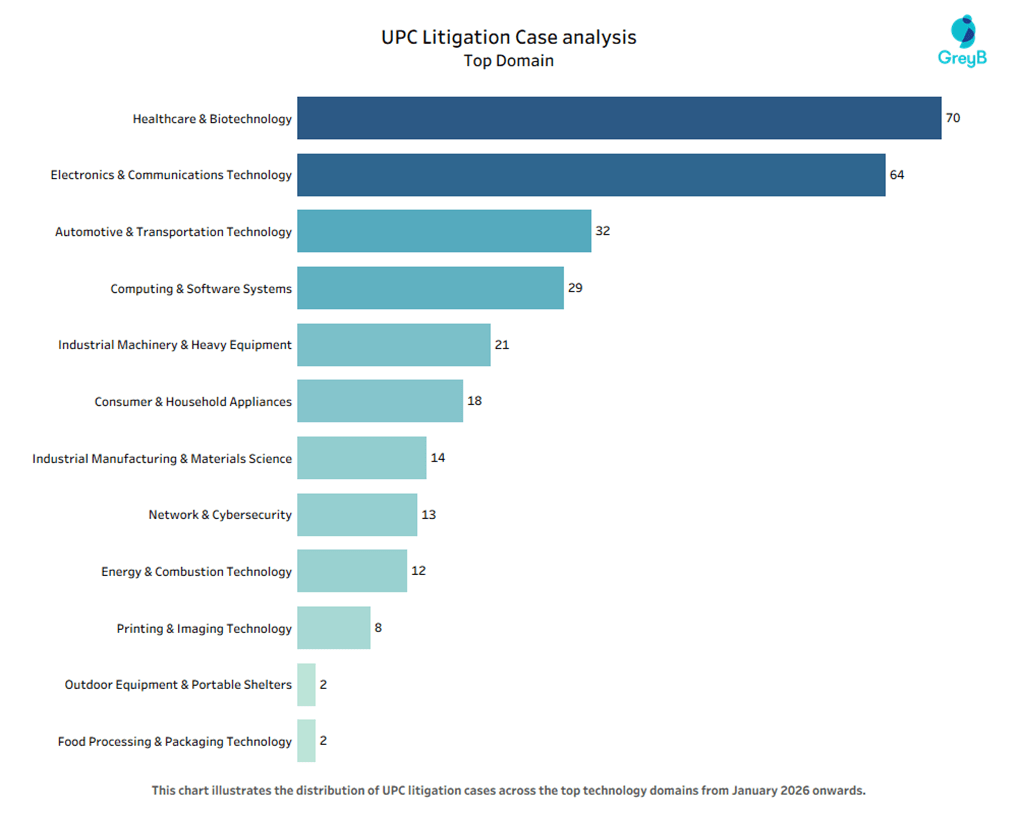
Breaking the 15 sectors into three broad groups makes the pattern easier to see. Healthcare and electronics sit well ahead of the rest, with 70 and 64 proceedings.
Automotive, software, and energy form a middle group, with between 12 and 32 proceedings each. Printing, food packaging, and outdoor equipment appear at much lower levels.
For a general counsel or head of IP, these numbers are a starting point, not a risk score. A sector with fewer proceedings can still create serious exposure if one dispute affects a core product, an important supplier, or your freedom to operate.
What matters is not only how many proceedings appear in a sector, but how closely those proceedings relate to your own products and technologies.
Want to Explore Patent Litigation in Your Company’s Technology Area?
Fill out the form to see litigation in your tech area. The docket changes every week, so these counts can shift. Access our updated tracker for the latest details.
What Case Phase Are Most UPC Patent Cases in During 2026?

More than 92 percent of the docket is still in the Written Phase. About 6 percent of proceedings have closed, while fewer than 2 percent have reached the Oral Phase. At first glance, that might make the system seem too early to draw useful conclusions.
In reality, this is what makes the dataset valuable. Most proceedings have not reached a final outcome, so the data says more about how companies are choosing to litigate than who is winning. It highlights where enforcement is building, which procedural routes parties are using, and where litigation activity is becoming more concentrated.
For IP, legal, and R&D teams, that makes the current docket an early indicator rather than a results table. Waiting for final judgments means waiting until many strategic decisions such as portfolio reviews, licensing discussions, product launches, or freedom-to-operate assessments have already been made.
The next question is how parties are using the UPC itself. The proceeding types provide the clearest picture.
Proceeding Type Breakdown in 2026 UPC Patent Litigation

Infringement actions lead the dataset with 76 proceedings, while appeals follow closely with 71. These figures sit side by side in the chart, but they represent different parts of the litigation process. Infringement actions reflect first-instance enforcement, while appeals involve the review of earlier UPC decisions.
The dataset also includes 36 counterclaims for revocation, 18 proceedings involving provisional measures, and 8 standalone revocation actions. Taken together, these figures show that parties are not using the UPC through one route alone. Patent owners are bringing infringement claims and seeking interim relief, while defendants are also challenging the validity of the patents being asserted.
The high number of appeals is notable because it means appellate decisions are already becoming an important source of guidance across the system. The figure alone does not show whether parties are appealing more aggressively, but it does show that the Court of Appeal is already playing a significant role in how UPC practice develops.
Proceeding types show how parties are using the system. The next question is where that activity is taking place and which divisions are seeing the most first-instance and appellate work.
Which UPC Courts Are Handling the Most Patent Litigation in 2026?
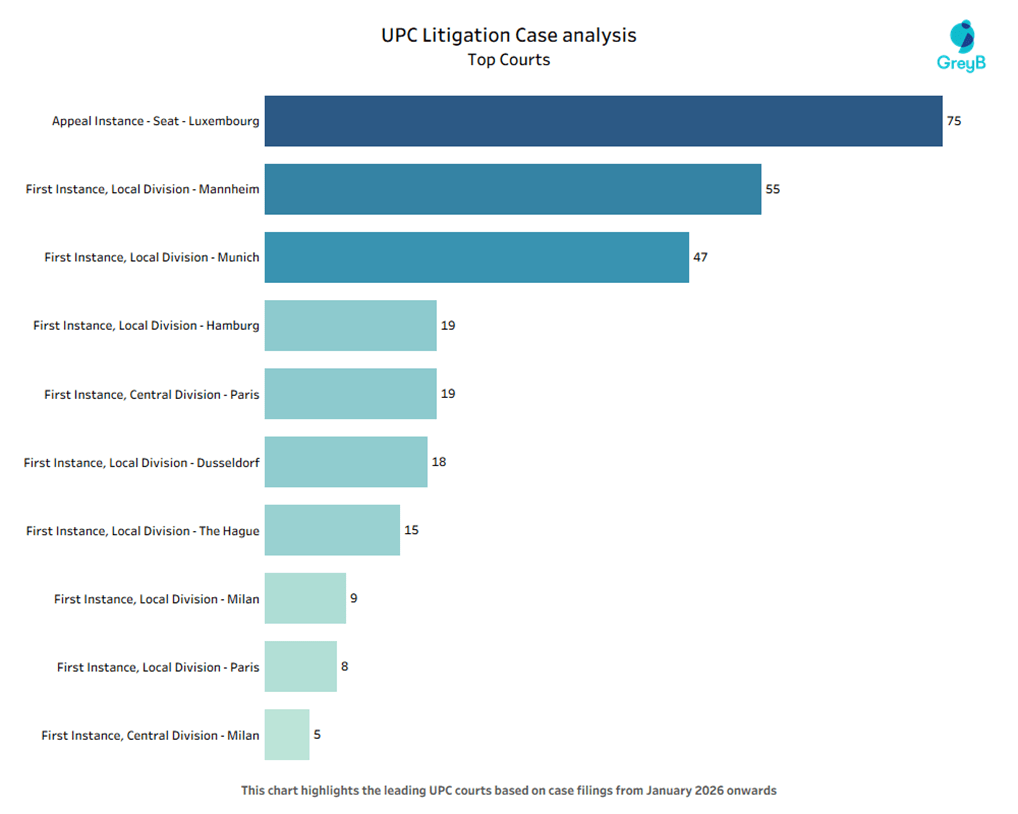
The court data tells two different stories. Luxembourg leads the overall chart with 75 proceedings because it represents the Court of Appeal. Mannheim and Munich, by contrast, lead first-instance activity, with 55 and 47 proceedings respectively.
Paris, Hamburg, Düsseldorf, and The Hague form the next group, with between 15 and 19 proceedings each. The remaining divisions appear at much lower volumes.
These figures need to be read separately. Mannheim and Munich show where a large share of first-instance activity is taking place. Luxembourg shows how much work has already moved into appellate review.
For companies planning an enforcement or defence strategy, first-instance volume can help identify which divisions are seeing recurring procedural and technical issues. Appellate activity matters for a different reason: Court of Appeal decisions can influence how similar questions are handled across the UPC system.
Case volume does not prove that one division is more favourable to patentees or defendants. It does, however, show where UPC experience is currently building fastest.
The venue data shows where disputes are being heard. The next question is who is bringing them.
Who Are the Most Active Plaintiffs in UPC Patent Litigation in 2026?

Four plaintiffs lead the dataset with nine proceedings each: Sanofi, Network System Technologies LLC, Ericsson, and Huawei.
The mix is important. It includes companies from pharmaceuticals, telecommunications, and patent licensing, showing that current UPC activity is not being driven by one industry or one type of claimant.
These plaintiffs may be using the court for different commercial reasons, including product competition, licensing, and patent enforcement. However, the case count alone does not explain their motives or show which claimant is more successful.
For companies monitoring UPC exposure, the more useful question is whether these repeat plaintiffs hold patents connected to their products, suppliers, technical standards, or licensing relationships.
The plaintiff data shows who is bringing cases. The defendant data shows where that activity is landing.
Which Companies Faced the Most UPC Patent Lawsuits in 2026?

Samsung and Qualcomm lead the defendant ranking with nine proceedings each, followed by Hurom with eight and Xiaomi with seven.
The wider list is more varied than the top four names suggest. It includes device makers, semiconductor companies, telecommunications businesses, automotive-related companies, financial institutions, and pharmaceutical firms.
That spread shows that current UPC activity is not limited to one product category. Proceedings are appearing across devices, components, connectivity, digital services, industrial products, and regulated markets.
The chart does not show how individual disputes move through a supply chain. It does, however, identify the companies and commercial areas where enforcement activity is recurring. For IP and R&D teams, that can help focus monitoring on technologies, components, suppliers, and licensing relationships that overlap with their own products.
The defendant data shows where litigation pressure is landing. The next section looks at the law firms gaining the most repeated exposure to that work.
Which Law Firms Are Handling the Most UPC Patent Cases in 2026?

Bardehle Pagenberg appears most frequently in the dataset, representing plaintiffs in 31 proceedings and defendants in 29. Hoyng Rokh Monegier follows with 34 proceedings in total. Other firms show a stronger concentration on either claimant-side or defendant-side work.
That distribution is useful because it shows where repeated UPC experience is accumulating. Some firms appear regularly on both sides of disputes, while others are more closely associated with one type of representation.
The chart should not be read as a ranking of law firms or legal outcomes. It reflects activity, not success. Experience in a particular technology, division, proceeding type, and client position remains equally important when evaluating legal counsel.
Taken together, the law-firm data completes the broader picture built throughout this article. The same patterns of concentration seen across sectors, courts, plaintiffs, and defendants are also visible in legal representation, showing that a relatively small group of firms is handling a significant share of current UPC activity.
What the 2026 Data Does Not Yet Show
The figures measure activity, not success. A high number of proceedings does not establish a stronger record for a plaintiff, defendant, law firm, sector, or court. With most cases still in the Written Phase, it is also too early to draw firm conclusions about injunctions, damages, patent survival, settlements, or long-term venue preferences.
The Takeaway for 2026
Put the full dataset together and one pattern stands out: UPC activity is concentrating across several connected areas at the same time.
Healthcare and electronics lead the sector rankings. Mannheim and Munich account for a large share of first-instance activity, while Luxembourg carries the appellate workload. Several plaintiffs, defendants, and law firms also appear repeatedly across the docket.
No single ranking tells that story on its own. It becomes visible only when sectors, proceedings, venues, companies, and legal representation are read together.
For IP and legal teams, the practical question is whether these patterns overlap with their own portfolios, products, suppliers, standards, or licensing relationships. For R&D and business teams, the value lies in identifying those points of exposure early enough to review technical dependencies, design-around options, launch plans, and supplier arrangements before a dispute becomes urgent.
Case data shows where the risk is. It doesn’t show who’s actually arguing it.
Which individual attorneys are building UPC track records, in which divisions, in which technology domains? Fill out the form to access attorney level UPC litigation intelligence.
