
Deepinder Goyal’s announcement of the Temple activity tracker created significant industry buzz roughly a year ago, but early attempts to track its underlying intellectual property in public patent databases yielded no records. This initial absence was not a sign of an unprotected product launch, but rather a reflection of standard patent publication lags that keep newly filed applications confidential for several months.
In July 2026, Temple Private Limited’s first wave of intellectual property documents surfaced publicly, offering a clear view into how the company is structuring its protection strategy across key international jurisdictions. These Temple patent records provide the first public glimpse into the company’s IP activity.
The public disclosures consist of two design patent families registered through legal counsel Bird & Bird LLP, covering electronic monitoring hardware and specialized mounting peripherals. More recently, Temple has also expanded its clinical and scientific footprint through the acquisition of London-based longevity medicine practice Longevous, bringing its founders and team into the company as it moves closer to the commercial launch of its wearable platform.
Interesting Read – Apple’s Biosensing AirPods Patent, Red Bull Drone 1 Patents.
The device itself and the way it attaches to the user.
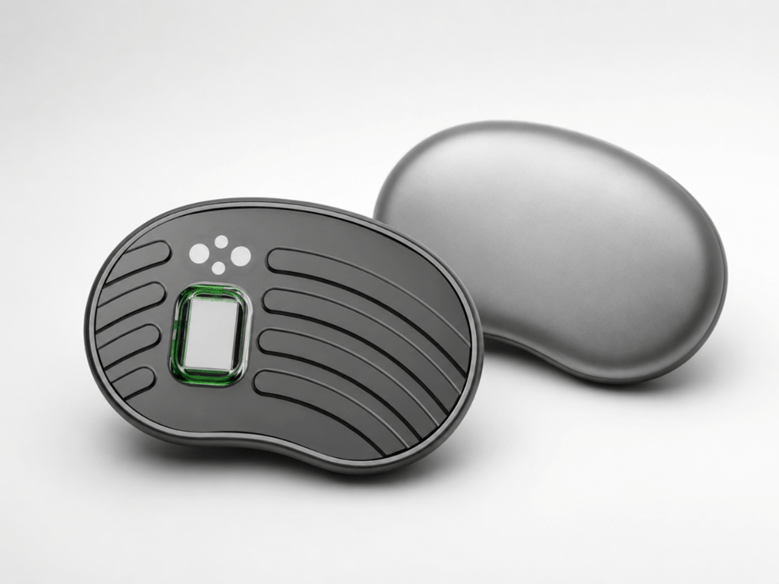
Temple is designed to sit around the temple area and monitor physiological signals closer to the brain.
What Makes Temple Different From Existing Wearables?
Most popular fitness wearables build their insights from signals collected away from the brain.
WHOOP, for example, uses measures such as heart-rate variability, resting heart rate, sleep, skin temperature, and blood oxygen to calculate recovery. Oura combines heart rate, HRV, temperature, sleep, and activity to estimate how ready a person is for the day.
Temple is taking a different route.
Instead of adding another measurement to the wrist or finger, the device is being placed close to the brain and is being positioned around monitoring changes in cerebral blood flow and oxygenation.
That could make Temple interesting for athletes and performance-focused users because it may add another layer of information alongside heart rate, recovery, sleep, and training data.
The important word here is may.
Temple has not yet publicly explained enough about its sensing method and validation for us to judge how useful these measurements will be in everyday use. Public reporting has also noted that details such as the exact sensing method remain undisclosed.
So, at this stage, the interesting question is not whether Temple can replace a smartwatch or fitness band.
It is whether measurements taken close to the brain can provide information that existing wearables cannot.
And Temple’s first patent filings give us an early look at how the company is building around that idea.
Temple Has Filed Two Designs Around the Product
Only two Temple design filings are visible in the data reviewed for this analysis. That is too small a portfolio to draw filing trends or create meaningful charts.
A simple patent table tells the story better.
| Temple IP | Application No. | Filing Date | Publication / Registration | Class | Other Identified Registrations | What It Protects |
| Wearable unit | IN485448001D | Dec. 29, 2025 | IN485448001S | Locarno 10-04 | EU0151455950001S, GB6533778S | External shape and appearance of the Temple wearable |
| Adhesive / mounting component | IN504184001D | June 1, 2026 | IN504184001S | Locarno 08-08 | – | External design of the component used to attach the wearable |
Both Indian designs were published on July 24, 2026. The first filing also has corresponding registrations identified in the supplied data for the European Union and the United Kingdom.
There is an important distinction here.
These are design protections. They protect what the products look like rather than the underlying method Temple uses to measure cerebral blood flow.
And that makes each filing worth looking at separately.
Patent (IN485448001S): Protecting the Temple Wearable Itself

The first image shows a compact, rounded device with a smooth surface and an asymmetric lower edge.
At first glance, that may appear to be little more than the shape of the product. But for a device that needs to be worn visibly on the side of the head, physical design can become an important part of whether people are willing to use it.
Temple has already been reducing the size of the wearable. Goyal recently said that the latest version is less than half the size of the earlier model.
That makes the design filing more meaningful.
Temple is not only working on what the device measures. It is also working on making the hardware small enough and distinctive enough to become something people may actually wear.
The design right gives Temple protection against products that copy the same visual form.
What it does not tell us is what sensors are inside the device, how the signals are collected, or how the data is turned into useful information.
That part of Temple’s IP story is still largely hidden.
Patent (IN504184001S): Temple Is Also Protecting the Attachment
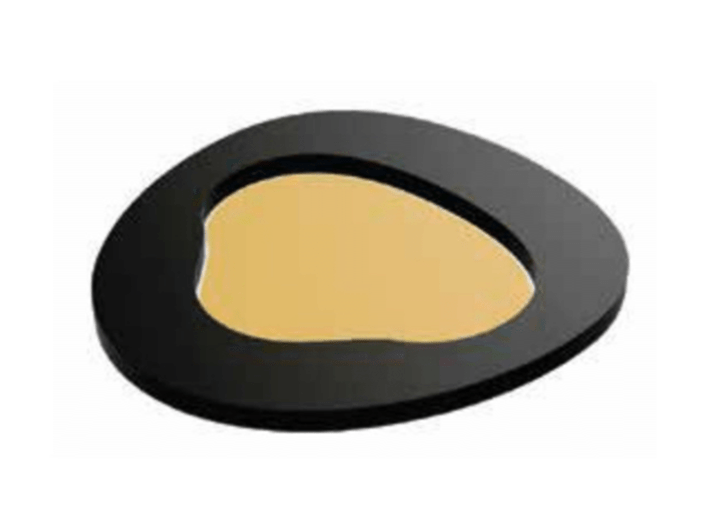
The second filing is easier to overlook because it does not cover the electronic device.
It covers the mounting or adhesive component.
But for a wearable that sits against the side of the head, this component could be just as important to the overall product experience.
A sensor needs to stay in the right position while someone is moving, training, or sweating. The filing itself does not tell us how well Temple solves those problems, and because it is a design registration, it does not protect the adhesive material or its chemistry.
What it does show is that Temple does not appear to view the attachment as a generic accessory.
The company has protected it as a separate part of the product.
That tells us something useful about the way Temple is thinking about the device: not simply as a sensor, but as a wearable system in which the electronics and the way they sit on the body are both important.
The Bigger Question: Where Are the Patents for the Brain-Monitoring Technology?
This is where Temple becomes particularly interesting from an IP perspective.
The two filings currently identified protect the product’s appearance. They do not explain the technology that measures cerebral blood flow.
The supplied dataset does not identify a published technical patent covering areas such as the sensing mechanism, calibration, signal processing, or the way Temple converts raw readings into performance insights. This leaves an important gap in the current Temple patent landscape.
That does not necessarily mean such patents have not been filed.
Patent applications can remain unpublished for a period after filing. Temple could also still be developing parts of the technology before deciding what should be patented and what should remain confidential.
For anyone monitoring the company, therefore, the next Temple patent may be much more revealing than the first two.
A future filing around how cerebral blood flow is detected, how movement is handled, or how the resulting signal is interpreted could tell us far more about where Temple believes its real technical advantage lies.
Wearable Innovation Is Moving Beyond the Wrist
Temple is not developing in isolation.
Across the wearable industry, companies are experimenting with different parts of the body because different locations can provide access to different signals.
Apple is a good example. AirPods Pro 3 now include in-ear heart-rate sensing during workouts. The earphones use light-based sensing together with motion data to measure heart rate turning a product originally built for audio into another source of health information.
Muse is even closer to Temple’s direction.
Its Athena headband combines EEG, which measures electrical brain activity, with fNIRS, a light-based method used to track changes in blood oxygenation around the brain. Muse positions this information around focus, mental effort, and endurance.
Meanwhile, products such as Oura and WHOOP have already shown that users are willing to wear dedicated devices continuously when the information helps them make decisions about sleep, recovery, or performance.
Taken together, these developments point to a broader change.
The wearable race is no longer only about putting more sensors into a smartwatch.
It is increasingly about finding the right place on the body for a particular measurement.
The finger works well for some signals. The ear is becoming useful for others. The forehead and temple area are now being explored for brain-related measurements.
For companies developing the next generation of wearables, that opens a much larger technology landscape than the wrist alone.
Want to know who else is working on similar brain-monitoring and next-generation wearable technologies?
A focused patent landscape can reveal companies developing similar sensing methods, emerging startups, recent inventions, and technology areas that may not yet have reached the market.
Request a deeper patent analysis to identify the players and technologies developing around Temple.
Why Should IP and R&D Teams Pay Attention?
Temple is interesting not only because of the product itself.
It also shows how quickly a new wearable category can begin forming around a different measurement point.
For IP teams, this means competitor monitoring should extend beyond companies selling similar products today. Relevant patents may come from sensor companies, medical-device developers, university research groups, sports-technology startups, or businesses working on completely different applications of the same sensing technology.
A company looking only at other fitness trackers could easily miss them.
For R&D teams, the bigger opportunity is to understand what new signals are becoming practical outside hospitals and research labs.
Could brain oxygenation become useful for athlete recovery? Could similar sensing help measure mental fatigue, attention, workplace safety, sleep, or cognitive performance?
Those questions can reveal product opportunities beyond the application a patent owner originally had in mind.
And for business and innovation teams, the useful signal is often the combination of several developments: more patent activity, smaller sensors, new body locations, and multiple companies trying to solve related problems.
When those signals begin appearing together, a research topic can start turning into a commercial category.
That is why looking at Temple alone gives only part of the picture.
The more valuable analysis is understanding what is forming around it.
Temple’s First Patents May Be Only the Starting Point
Temple’s first public IP does not yet explain how its brain-monitoring technology works.
Instead, it shows the first layer of the product being protected.
One design covers the wearable itself. The other covers the component that keeps it attached to the user.
That may sound simple, but it gives us an early clue about Temple’s approach: the company is treating both the sensing device and its physical connection with the body as parts of the product that deserve protection.
The deeper technical story is still to come.
And that is what makes Temple worth watching.
As the wearable industry moves from the wrist toward the finger, ear, forehead, and other sensing locations, the next major opportunity may not come from adding another feature to an existing smartwatch.
It may come from finding a new signal and the right place on the body to measure it.
Temple is one example of that change.
Exploring a similar wearable, biosensing, or neurotechnology space?
GreyB can help identify relevant patents, emerging companies, technology gaps, and possible business opportunities around a specific technology.
Request a custom patent study to explore the landscape beyond Temple.

